Key Takeaways (or TL;DR)
- Today, the taxi booking business has become a lucrative opportunity. It offers convenience to commuters, reliable income for drivers, and data-driven revenue for owners.
- To make a successful taxi business, you must follow all the essential steps: conducting an effective market study, preparing a detailed business plan, choosing the appropriate business structure, making an online presence, and expanding its operations worldwide.
- Taxi business operators generate income from a range of sources, including commissions, corporate trips, surge pricing, and cancellation fees.
- The cost to start an online taxi business ranges from $5,000 for a basic setup to over $100,000 for a feature-rich, large-scale platform.
- The emerging trends in the taxi industry include micro-mobility services, green hydrogen, autonomous vehicles, and more.
- Running a taxi business comes with several key challenges, including the high operational costs, market competition, and regulatory & compliance issues.
- By starting a taxi business online, you will enjoy a range of benefits, including advanced scalability, high-tech support, and flexible pricing.
- At Elluminati, we empower businesses with a highly customizable taxi booking solution that automates complex operations needed to lead the taxi market with confidence.
Taking the driver’s seat in your own taxi business can be a roller coaster experience, especially when navigating the complexities of how to start an online taxi booking business. It’s a journey that requires more than just a fleet; it involves a clear understanding of market dynamics, regulatory frameworks, technology choices, scalability, and long-term differentiation in a highly competitive mobility ecosystem.
With the right strategy, stakeholders, platform, and execution plan, you can do wonders. We have created this end-to-end roadmap to help you move from concept to launch with all the details you would need. No matter where you are standing right now in your online taxi booking business plan, this guide is for you.
How to Start an Online Taxi Business—A Step-by-Step Guide
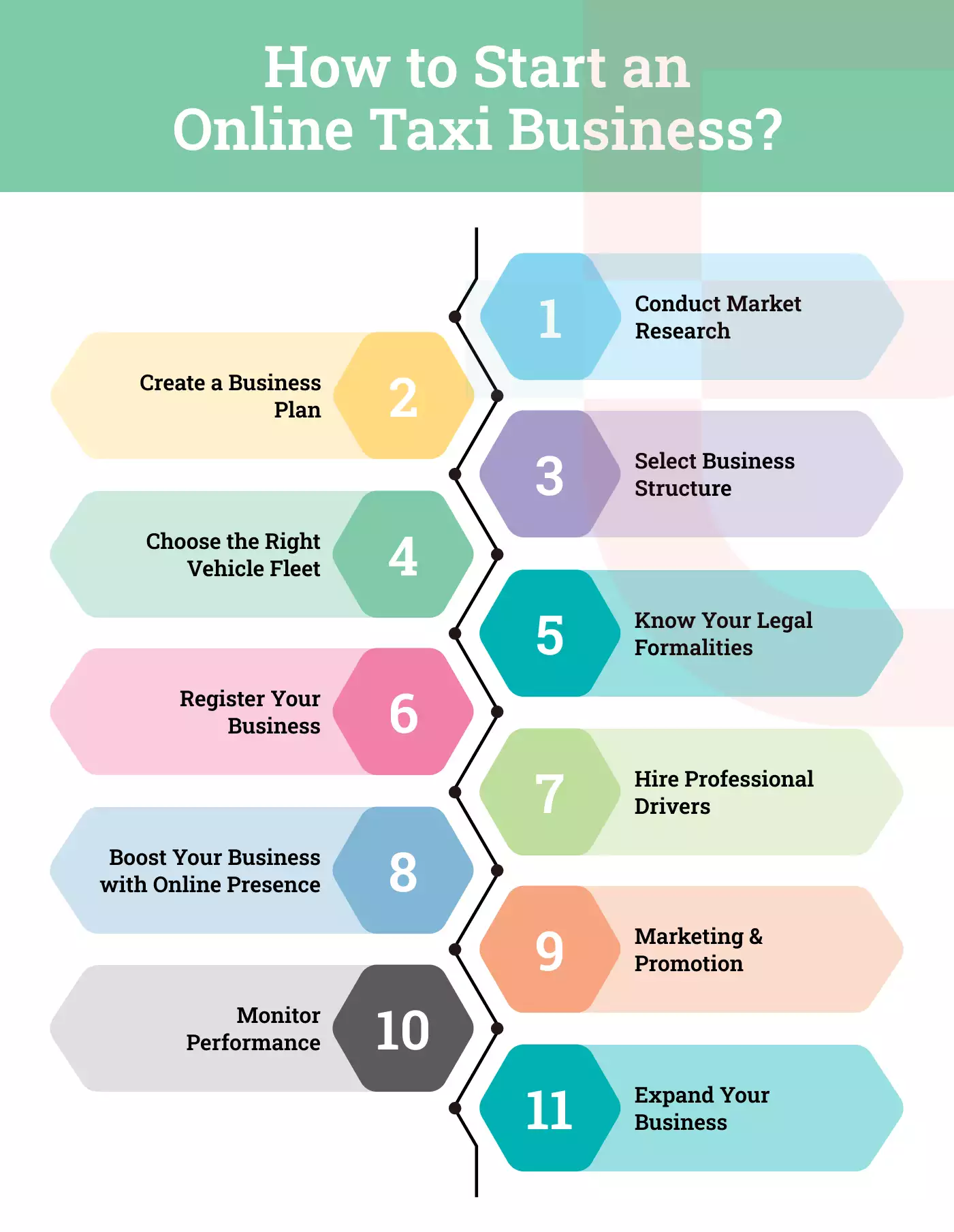
Building an on-demand taxi booking app is not just one decision. It comes up with so many questions that pop up in every business owner’s mind as they step into the taxi industry, including how to establish a taxi company. What type of business structure will suit my business plan? And more.
Therefore, here, we will help you with a step-by-step guide on starting a taxi business
Conduct Market Research
The first and foremost step in establishing a profitable taxi business is to conduct a thorough analysis of your target audience, recent market trends, and your competitors’ offerings, among other key factors. This research report will help you determine your exact target audience requirements and easily identify the key gaps you have compared to your competitors.
This research not only identifies internal factors but also considers external factors that impact your business, including seasonal fluctuations, economic trends, regional regulations, and other relevant factors.
Questions to ask yourself while researching the market
- What are the common mistakes to avoid when starting a taxi business?
- What is the size & growth of the taxi industry in your targeted region?
- What strategies did competitors adopt to grow their business?
- What will be the competitors’ market position?
- What are the pain points of competitors?
Create a Business Plan
After recognizing the market trend and competitors’ strategies, the next vital step is to give your dream business a tangible shape by outlining its objectives and setting specific goals. To do so, you are first required to identify the actual needs of your target audience; that is,
- Which type of vehicle does your target audience select for travelling?
- What services would you like to offer with your business, such as ride-sharing, taxi booking, and car rental?
- Addresses the issues that your target audience is focusing on solving.
By analyzing the similar questions highlighted above, you can obtain a defined business goal and successfully implement it.
Select Business Structure
Before effectively applying your business plans to real life, you must select the right business structure. This involves determining how you want to establish your taxi business, such as through a sole proprietorship, an LLC, or a partnership.
Every business structure comes with its pros and cons; for instance, in a sole proprietorship, you have all the power to control your business; however, with an LLC, you may receive other legal and tax advantages, depending on your business requirements.
Choose the Right Vehicle Fleet
The choice of vehicles plays a crucial role in determining a taxi business’s long-term profitability and operational efficiency. Moreover, you need to decide whether to own or lease all the vehicles, depending on your budget and business strategy.
Additionally, your target audience’s preferences have a significant impact here. For instance, there is a customer base that prefers sedans for travel due to their affordability, SUVs for larger groups, and EVs for eco-friendliness. So, it’s always best to research your target audience’s preferences before selecting the vehicle type for your business.
Vehicle Equipment:
Equipping your vehicles with the latest technology is crucial for providing your customers with a safe and convenient travel experience. It may include installing GPS systems, taxi meters, and other accessibility features such as Wi-Fi, wheelchair access, baby seats, and more.
Know Your Legal Formalities
Once you have finally decided on how to run a taxi business, the next move you should take is to fulfill the legal formalities to bring your business into legal compliance.
As we all know, every country has its registration standards; therefore, it’s essential to review the specific legal rules and formalities of the country where you intend to start a taxi business.
Taxi Business License
To operate your business in any region, a taxi business license is mandatory, which further demands the following criteria:
- You must register your taxi business as a preferred structure, such as an LLC, a corporation, or a sole proprietorship.
- Also, you are required to obtain a specific certificate recognized as an operating authority from a particular city or state.
- Also, you will get a tax ID, a number issued by the government, like an EIN in the US or GST in India, to report your earnings and pay commercial taxes.
Vehicle Permits
All the vehicles you use in your business require official government permits to ensure customer safety and compliance.
- First and foremost, the vehicle title or registration must reflect whether it’s for public services or only offers a private service.
- A regular inspection of vehicles to ensure they work smoothly.
- In many countries, it’s also mandatory to integrate fare meters, GPS trackers, and other signage, such as roof lights, etc.
Driver’s Licenses
To lawfully run a taxi business, you need to ensure your driver’s license, which may vary in the following circumstances:
- Usually, drivers need a Group 2 or chauffeur license. This is one of the key requirements for a driver over 21, along with a clear driving record, which is essential to ensure customers’ safety.
- Also, before contracting or hiring a driver, it is essential to check their fitness to ensure passenger safety.
Background Checks
Most countries are conducting rigorous background checks to ensure drivers have no criminal history or poor driving record.
Insurance Policy
Being a business owner, it’s your responsibility to take your drivers’ and passengers’ safety concerns at the top. Therefore, it is necessary to have adequate insurance coverage for your taxi business, including liability coverage for both vehicles and drivers.
After all, staying compliant with all the applicable regulations is essential to avoid legal issues and maintain a positive reputation for your taxi business.
Register Your Business
After considering all the legal requirements, you are required to register your business officially, following particular norms stated by the government, including:
- Submit your company name and business type
- Attach other transportation-related documents which are locally bound by specific region
- Licenses and permits, and more, when filing your business for registration.
Once your business receives official approval, you are eligible to conduct business.
Hire Professional Drivers
Drivers are considered the backbone of your taxi business. Thus, for entrepreneurs, when hiring a professional driver, it’s essential to verify a valid driving license, their driving record, and communication skills, and to ensure they are familiar with all local routes and traffic regulations.
However, some businesses also arrange special training programs for their drivers to educate them on defensive tactics and to develop customer relationship skills that enhance their customers’ experience.
Build Your Taxi App or Launch with a Ready-made Solution
Your app will be the foundation of your online taxi business, directly impacting customer experience, operational efficiency, and scalability. At this stage, you need to decide whether to build a custom taxi app from scratch or launch faster with a ready-made white-label solution.
Building an app from scratch provides complete flexibility and control over features, but often requires thousands of dollars of investment and a 12-18 months development timeline. On the other hand, a ready-made Uber clone taxi app enables businesses to launch quickly within 1-3 weeks.
It comes with pre-built functionalities such as real-time ride tracking, driver management, automated dispatch, multiple payment integrations, and admin controls.
Before making a decision, consider these factors:
- Budget and development cost requirements
- Time-to-market and launch goals
- Required customization and branding flexibility
- Scalability for future business expansion
- Essential features such as GPS tracking, payment systems, and analytics
Marketing & Promotion
Even the well-known taxi business needs a strong visibility to attract and retain customers. Below are some of the key ways that help you promote your business effectively:
Branding:
Build a strong identity for your company, like Uber’s. This will help you in developing trust and credibility among your customers worldwide.
Marketing Channels & Other Promotional Ways:
Aside from branding, you can even take the help of multiple marketing approaches to promote your services, which include:
- Overall, digital marketing platforms make it easy to reach potential customers.
- Referral programs to encourage existing users to invite friends and family members in exchange for exciting rewards.
- Real-time app store optimizations to list your app differently in app or Play stores, using the relevant keywords, an appealing interface, and a clear description showcasing key benefits and features.
- Collaborate with hotels, airports, and other corporate firms to expand your services and secure a steady stream of rides.
- Ensure your customers receive satisfying taxi service by encouraging them to share their real-time reviews and feedback.
Monitor Performance and Optimize Business Operations
To facilitate smooth growth, you are required to optimize your business operations, including monitoring driver performance and maintaining fleets, as well as providing customers with convenient taxi services.
Indeed, a daily business analysis will help you easily identify areas for improvement in your business and enable you to make data-driven decisions related to further business expansion and the service journey.
Expand Your Business
Once you have streamlined your business management, you are eligible to expand your taxi business into new areas or cities without impacting your overall business performance.
In a franchising model, you can achieve accelerated growth by leveraging the local market expertise & investment of independent partners.
Why Start an Online Taxi Booking Business
Before we go through the core strategy, let’s understand why to start an online taxi booking business. Tapping into the taxi business is about capitalizing on a rapidly evolving digital mobility market. It offers scalability, recurring revenue opportunities, and innovation potential. It is intriguing for you for many reasons:
Growing Demand
The market for on-demand ride-hailing services continues to grow globally. It is driven by urbanization, increased smartphone and internet penetration, and changing commuter preferences. Convenience, safety, and a cashless taxi experience are the priorities for riders, and they are also the targets of both small and large taxi companies.
It sums up to a huge market. The global online taxi service marke is expected to grow from USD 177.64 billion in 2026 to approximately USD 788.44 billion by 2035.

Source : Precedence Research
You can cater to the market with technology and foster innovation. This will help enter the market with lower barriers to entry.
Flexibility in Cost
One of the significant benefits of online taxi business strategies is that it allows you to start with minimal investment- from a single vehicle, fleets or by partnering with existing drivers, fleet owners. This lowers initial investments, financial risk, and upfront costs while enabling you to scale as demand grows.
Technology Enables Competitive Advantage
A powerful technology system plays a key role in establishing your taxi business. You can offer your customers advanced features and a more efficient ride-booking experience. Real-time ride booking, GPS tracking, cashless payments, and seamless user experiences are features today’s customers expect by default.
Modern technologies like machine learning, computer vision, and AI features for taxi apps give a competitive edge from the start.
Advanced Scalability
An online taxi platform is inherently scalable. You can begin with a single city and expand to multiple cities, regions, or even countries by replicating your model and leveraging technology to efficiently manage operations, payments, and customer engagement.
High Customer Value & Loyalty
Online taxi services crack riders’ core pain points: quick booking, transparent pricing, safety, and digital convenience. Delivering value in these areas boosts customer satisfaction and retention—laying the foundation for long-term loyalty and recurring usage.
Types of Taxi Booking App Business Models
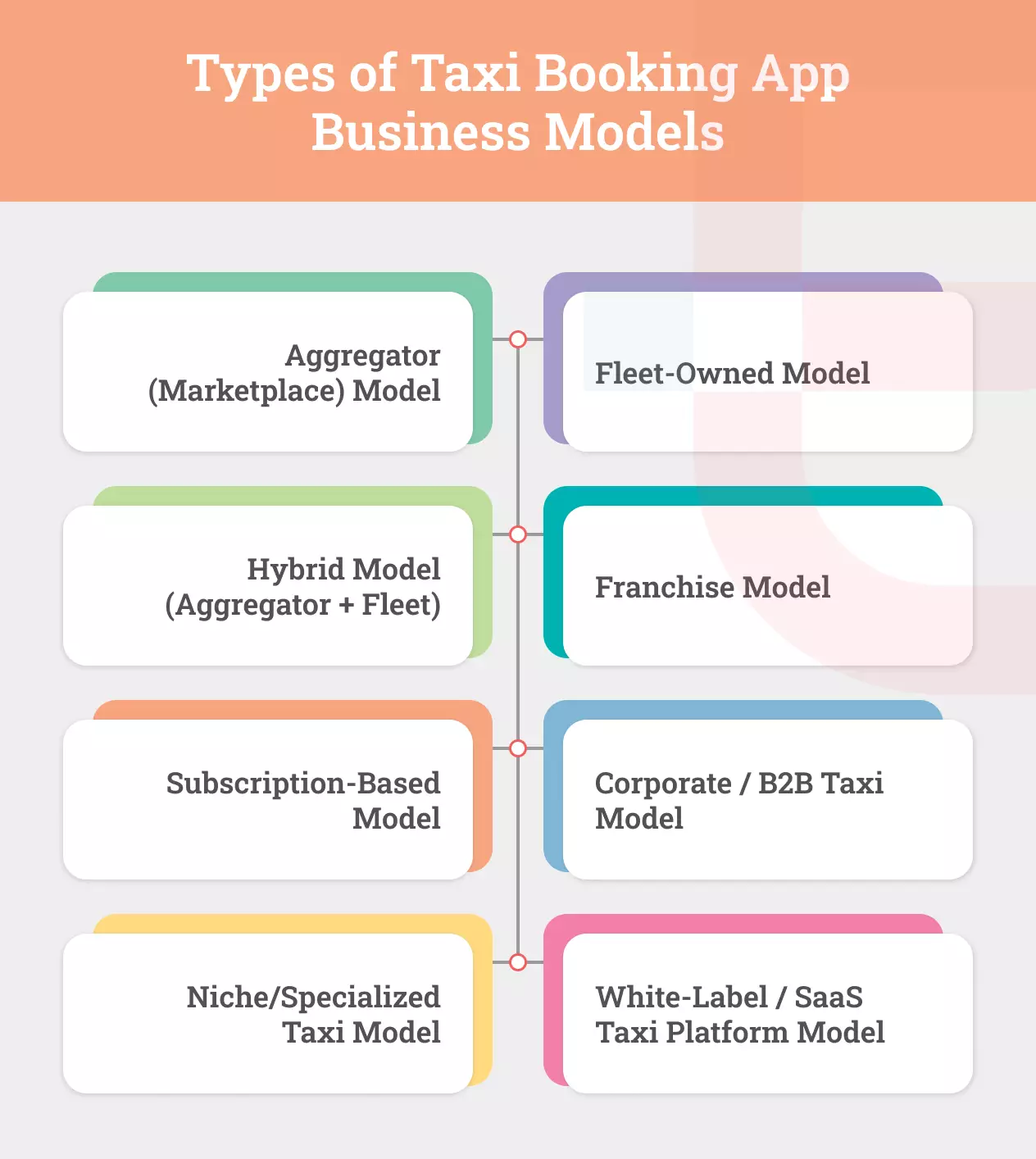
The basic taxi business operation is offering rides. But when you go backstage, the operations, processes, and revenues differ. These models are used globally and can be adapted to different markets, regulations, and growth goals.
1. Aggregator (Marketplace) Model
It is widely known and the most basic taxi business model. In this model, you do not own a fleet. Instead, you connect independent drivers with riders based on the requirements through a digital platform and earn a commission on every ride. It is one of the most scalable models, as it connects an unlimited number of drivers and riders.
The most common real-life examples are Uber, Bolt, and Careem.
How It Works
- You own the platform (app + backend)
- Independent drivers register and offer rides
- You take a commission per completed trip
Revenue Sources
- Commission per ride (10-30%)
- Surge pricing margin
- Driver subscriptions or onboarding fees
- In-app advertising
| Pros | Cons |
|---|---|
| Low asset ownership | Driver churn risk |
| Fast scalability across regions | Strong competition |
| High profit potential | Heavy marketing needed |
2. Fleet-Owned Model
In this model, you own all the vehicles and manage the drivers on a digital platform. This is a digitally enabled version of a traditional taxi business.
How It Works
- You own or lease all vehicles
- Drivers are employees or contract staff
- Full operational control
Revenue Sources
- Ride fares
- Corporate contracts
- Rentals & hourly bookings
| Pros | Cons |
|---|---|
| Complete service control | High upfront investment |
| Better branding consistency | Vehicle maintenance costs |
| Easier regulatory compliance in some regions | Slower expansion |
3. Hybrid Model (Aggregator + Fleet)
In this model, both owned vehicles and third-party drivers work. This model offers flexibility. It offers you the flexibility to manage both within a single platform. Balanced model used by many regional leaders
How It Works
- A combination of owned vehicles and third-party drivers
- An owned fleet ensures availability during peak demand
Revenue Sources
- Ride commissions
- Direct ride revenue from owned vehicles
- Subscriptions & premium services
| Pros | Cons |
|---|---|
| Supply stability | Moderate operational complexity |
| Reduced cancellation rates | Higher costs than pure aggregator |
| Better service quality |
4. Franchise Model
You can partner with regional taxi service providers and manage their operations on your platform. It allows you to expand locally with minimal operational burden.
How It Works
- Regional partners operate under your brand
- Franchise owners manage drivers and operations
- You provide technology and branding
Revenue Sources
- Franchise fees
- Revenue-sharing
- Technology licensing fees
| Pros | Cons |
|---|---|
| Rapid multi-city or international expansion | Quality control challenges |
| Lower capital investment | Brand consistency risks |
| Local market expertise |
5. Subscription-Based Model
In this model, your drivers pay a fixed monthly or annual charge instead of a per-ride commission. Its advantage is that you can get predictable revenue and driver/rider loyalty.
How It Works
- Drivers or riders pay a monthly/annual fee
- Reduced or zero per-ride commission
Revenue Sources
- Subscription plans
- Premium features access
| Pros | Cons |
|---|---|
| Stable recurring revenue | Requires a large user base |
| Higher driver retention | Slower early monetization |
| Lower ride pricing |
6. Corporate / B2B Taxi Model
This model focuses on business clients rather than individual riders, providing transportation for employees or clients. You can even use this model alongside a hybrid model to add a revenue channel to your business.
How It Works
- Businesses book rides for employees or clients
- Centralized billing and reporting
Revenue Sources
- Corporate contracts
- Monthly invoicing
- Service-level agreements (SLAs)
| Pros | Cons |
|---|---|
| High-value clients | Longer sales cycles |
| Predictable revenue | Custom integrations required |
| Lower churn |
7. Niche/Specialized Taxi Model
This model targets specific customer segments or use cases rather than the mass market. You can keep your targeted services with premium positioning.
Common Niches
- Women-only taxis
- Electric vehicle (EV) taxis
- Luxury or executive taxis
- Airport-only transfers
- Medical or elderly transport
Revenue Sources
- Premium fares
- Memberships
- Partnerships
| Pros | Cons |
|---|---|
| Less competition | Limited market size |
| Strong brand identity | Requires niche marketing |
| Higher margins |
8. White-Label / SaaS Taxi Platform Model
Instead of running a taxi business yourself, you sell or license taxi booking software to other operators. Or register your taxi business with any SaaS taxi software provider.
How It Works
- You sell or license your taxi software to operators
- Clients run their own taxi business using your platform
Revenue Sources
- Setup fees
- Monthly SaaS subscriptions
- Customization & support fees
| Pros | Cons |
|---|---|
| High scalability | Sales-driven growth |
| Recurring revenue | Requires a strong tech & support team |
| No driver management |
Based on these business models and your understanding, you can select your priority and define your taxi business model accordingly.
| Business Goal | Best-Fit Model |
|---|---|
| Fast expansion | Aggregator/Franchise |
| Full control | Fleet-Owned |
| Balanced risk | Hybrid |
| Recurring revenue | Subscription/SaaS |
| Enterprise focus | Corporate B2B |
| Differentiation | Niche model |
Do You Want to Consult on the Business Model that Best Suits Your Taxi Services? Reach Out to Us for Our Industry Expertise
How Do Taxi Businesses Generate Revenue?
For businesses, it’s very important to understand the revenue sources that help them achieve sufficient profit. Therefore, below are some common channels that can help you determine efficient ways to make your business more profitable.
Commission Charges
One of the most common ways to generate extra income for you through your taxi business is by charging a commission on every ride booked through your taxi app. The commission percentage varies between 15 and 20%, depending on the market, competition, location, and services offered.
Surge Pricing
Every company, including Uber and Ola, implements a dynamic pricing strategy, also known as surge pricing, in their business. You can increase trip prices during peak hours, ensuring that both you and the driver earn enough income by providing services during high-demand hours.
Cancellation Charges
Every company has a varied cancellation policy; some may charge a fixed cancellation fee, while others charge a fee based on the stage of cancellation.
For instance, if your customers cancel the booking within several minutes of the reservation, they won’t be charged any cancellation fees. Still, if they cancel the trip after it’s been accepted or after several hours, they are supposed to pay the charges set by the business owner.
Subscription Model
One of the steady ways to generate revenue is through a subscription model, designed for both customers and drivers. For the customer subscription model, you may ask customers to purchase a plan tailored to their requirements in exchange for discounted rides and priority booking during peak hours.
However, in the driver subscription model, they were asked to select a plan in exchange for receiving zero commission deduction or access to features like priority ride requests.
Corporate Trips
Many companies provide separate transport facilities for their employees. By partnering with such a firm and offering them a corporate ride package, you can increase your business’s profitability.
Incentive-Based Earning Model:
As a driver is one of the factors that leads your business towards a successful path, offering this incentive-based earning model helps increase driver engagement by rewarding them for performance, such as the number of trips, maintaining high ratings, or working during peak hours.
This will not only keep your drivers motivated but also ensure vehicle availability during peak hours, directly boosting your revenue.
How Much Does It Cost to Start an Online Taxi Booking Business?
Considering only the steps related to starting a taxi business is not enough, especially if it’s your first time stepping into the taxi industry; your budget plays a significant role.
Therefore, we have outlined some of the basic costs to consider when planning to start an online cab business.
| Cost Category | Description | Estimated Cost (USD) |
|---|---|---|
| Business Registration & Legal | Company registration, licenses, transport permits, and legal consultation | $1,000 - $5,000 |
| Taxi App Development | Passenger app, driver app, admin panel (custom or white-label) | $8,000 - $60,000 |
| UI/UX Design | App & admin panel design, user experience optimization | $1,500 - $5,000 |
| Backend & API Development | Server-side logic, databases, integrations | $3,000 - $15,000 |
| Cloud Hosting & Servers | AWS / Azure / GCP infrastructure (annual) | $1,200 - $6,000 |
| Maps & GPS APIs | Google Maps / Mapbox / local map services | $500 - $3,000 |
| Payment Gateway Integration | Stripe, PayPal, Razorpay, regional gateways | $500 - $2,000 |
| Security & Compliance | Data security, encryption, GDPR & regional compliance | $1,000 - $4,000 |
| Driver & Vehicle Onboarding | KYC verification, document processing | $500 - $2,000 |
| Maintenance & Updates (Annual) | App updates, bug fixes, feature enhancements | $2,000 - $8,000 |
Discover the Future Trends & Opportunities in the Online Taxi Businesses
Advancements in technology have significantly impacted how taxi businesses operate today. Now, let’s conduct a thorough analysis of key trends and opportunities expected to emerge in the online taxi industry.
Electric & Autonomous Vehicles
As concerns about environmental sustainability grow, many taxi companies are transitioning to electric vehicles, as they not only reduce carbon emissions but also offer cost savings in fuel and maintenance.
Not only have we witnessed the rise in EVs, but demand for driverless vehicles is also growing among customers, as they have the potential to increase efficiency, reduce operating costs, and enhance customer safety.
Micro-Mobility Solutions
Nowadays, the trend toward micro-mobility solutions is growing, as people opt for alternatives such as electric scooters and bicycles to cover short distances rather than rely on taxis.
Many cities, particularly those with high traffic volumes, are now gradually shifting their approach towards adopting micro-mobility services.
Augmented Reality
Most taxi businesses are now incorporating augmented reality into their solutions to provide customers with a more enjoyable experience. Designed with advanced technology, it provides drivers with a 3D navigation view that shows exact routes and addresses, helping them determine the distance to the customer.
On the other hand, it also shows customers the current locations of taxi drivers from a 3D perspective, enhancing their experience.
Beyond this, future trends in the taxi business appear very promising, driven by the growing integration of blockchain, AI, and machine learning.
Green Hydrogen
The Hydrogen taxi market is projected to grow from 353k units by 2035, at a CAGR of 28.3%.
In today’s world, where people are shifting towards more eco-friendly services, the hydrogen taxis shine as a beacon of sustainable innovation. The mechanics of the hydrogen-powered taxi are intriguing; it operates on a fuel cell, converting hydrogen into electricity and leaving only water vapor in its wake.
Potential Challenges to Start an Online Taxi Booking Business
Starting and managing an online taxi business comes with its fair share of challenges, and it is a must for you to address these to make your business future-ready.
Compliance & Regulatory
Maintaining regulatory compliance is a constant challenge for taxi businesses. It can be complex to comply with local laws, obtain licenses, and adapt to rule changes. Also, disputes and legal issues arising from the regulations can disrupt services and harm your business’s reputation.
Data Security & Protection
Safeguarding customers’ information and managing digital transactions safely is essential. Any lapse in security, such as cybersecurity threats or data breaches, can cause financial loss and damage customer trust.
High Operational Costs
Another significant challenge for a business owner is managing high operational costs, day-to-day activities, fleet management, and other resources.
Changing Customer Preferences
The significant change in ride-hailing standards affects demand for taxi services. If you are unable to adapt to market needs, your customers will go to competitors who offer better options, such as eco-friendly vehicles or easier booking through a taxi app solution.
Technological Disruptions
We all know that technology improves operational efficiency, but it also brings risks such as cyber threats, system failures, and reliance on third parties. Several problems, such as bugs or outdated interfaces in your taxi booking software, may lead to a disappointing user experience and harm your business reputation.
Communication Gap
It is vital to maintain clear communication with customers to ensure smooth operations and deliver satisfying results. Misunderstandings or delays in replies can lead to frustration, and customers may leave your services with a negative impact.
How Can Elluminati Help You Build a Taxi App?
In today’s world, where the demand for taxi businesses is rapidly increasing, it is an ideal time for businesses or investors to consider investment opportunities. Those planning to enter the taxi market can review the steps outlined above to understand how to start an online taxi booking business and why start an online taxi booking business is profitable.
Moreover, to stay ahead in this fast-paced market, you can also take the help of Elluminati, a leading taxi app development company. With over 14 years of experience, we specialize in delivering industry-specific solutions catering to your business demands and markets
Our feature-rich applications for riders and drivers offer secure payment methods and real-time tracking, simplified payments, and many more such features. While our scalable solution allows you to meet your expanding business needs and achieve them effectively through a single platform.
FAQs
Starting an online taxi booking business costs vary widely, from $10,000 for a small operation to $100,000+ for larger fleets with custom apps. Also, there are several other factors affecting its expenses, including vehicle leasing, mandatory permits & licenses, and more.
The estimated timeline for launching an online taxi booking app is largely determined by how you plan to build it. If you opt for a ready-made taxi app, then it will take 1-4 weeks. However, if you want to build an app from scratch, it may take over 2-4 months.
Taxi companies generate revenue primarily through
- Commission
- Corporate rides
- Cancellation Fees
- Subscription programs
- In-app advertising
Starting a taxi business online comes with its own set of challenges, which include:
- Regulatory compliance.
- Higher operational costs.
- Driver recruitment & retention.
- Technological integration.