Key Takeaways (or TL;DR)
- Starting a taxi business in South Africa is a rewarding opportunity for entrepreneurs, due to increasing market demand and growing urbanization.
- Before launching, new entrants should comply with legal requirements like business registration with CIPC, obtain a PrDP license, and comply with SANTACO if they are designated on a specific route.
- Passenger and driver insurance are inevitable; for drivers, COID registration is mandatory.
- For app-based taxi services, businesses must comply with POPIA rules and regulations for data protection and the security of users.
- To start a taxi business in South Africa, you need to research the target audience, choose a business model, and then register the business.
- After registering a business, you need to structure a business plan and obtain permits and licenses.
- Securing vehicle finance is the most important part; an advisor like SA Taxi Finance will help you through direct dealerships with Toyota & VW cars.
South Africa’s growing population and increasing urbanization have significantly transformed the ride-hailing market, which represents rewarding opportunities for new entrants. If you’re an entrepreneur and want to take advantage of this booming segment and make an impact, but don’t know how to start a taxi business in South Africa, then we’ve got you covered.
This guide is a curated step-by-step process that explains every necessary detail. Along with that, you’ll have a deeper insight into the South Africa taxi business market size, reasons for starting a taxi business, and important aspects like cost breakdown & mistakes you can avoid to successfully start an online taxi business.
Why Start a Taxi Business in South Africa?
It will be beneficial for you to understand why starting a taxi business in South Africa could be advantageous.
Massive Market Size
- The South African ride-hailing market is growing rapidly, with an expected revenue growth of USD 2.64 billion in 2026 and an increasing CAGR of 4.25% between 2026 and 2031.
- The demand for on-demand ride-hailing is increasing due to high usage of mobile & internet.
- Public transportation, like metro trains and buses, is unreliable. The people want reliable, hassle-free, and safe rides.
- The demand for airport transfers is rising due to tourist transport and long-distance trips.
Scalable Business from One Vehicle to a Full Fleet
The taxi business is naturally scalable, which makes it highly practical for entrepreneurs to start with a single vehicle. They can validate the demand and gradually expand the business by reinvesting profits to add a small fleet. This creates a steady and well-funded business growth cycle as the fleet expands. Eventually, enhance business operations like driver-onboarding, performance tracking, and route planning.
With the app-based taxi business model, scaling becomes efficient and predictable. Features & modules like data-driven insight dashboard, automated dispatching, and real-time analytics help to manage operations at scale without any hurdles.
Growing Urban Demand for App-Based Taxi Services
Giant taxi players like Bolt and InDrive proved that people in South Africa are now booking rides through an application. Both ride-hailing platforms are now part of the daily lives of urban commuters and tourists across major cities. However, this growing demand comes at a cost for operators who typically pay 20-25% of commission on these platforms.
If you create your own ride-hailing platform, every fare price stays within the business, and you retain full ownership of the supply for customers. Plus, since Uber has reduced its operations due to challenges to grow and a decline in service quality in some parts of South Africa, the competition has decreased. So it’s actually a great opportunity to fill the gaps between demand and supply.
Technology is Transforming the Taxi Industry
For years, South Africa’s taxi industry has navigated a system that is shaped by the South African National Taxi Council (SANTACO). New entrants often struggle to gain access as a local taxi operator because established operators have control over high-demand routes, as these operators comply with SANTACO.
For app-based and metered models, change this dynamic entirely. Instead of relying on fixed routes, you compete directly for passengers who book rides through an app, eliminating the need for SANTACO approvals or territorial conflicts. This approach also brings operational advantages, such as reduced cash handling through digital payments, which lowers theft risks.
Additionally, customers in South Africa are now preferring EVs for sustainable transportation, which cuts the fuel costs with at least 200 kms range and fast charging. The government is also supporting taxi businesses financially, helping them start ride-hailing businesses by adopting EVs.
Expert’s Tip:
- Starting a taxi business between rural and township routes could be beneficial for startups, as people need to commute daily, and there are very limited options available for reliable transport.
- Using electric vehicles will save you from unwanted fuel costs, and customers are also demanding sustainable taxi services.
- Targeting the airport transfer niche may work for high profit, but in reality, demand depends on the season. That’s why partnering with hotels and travel agents is recommended.
Grab the Competitive African Market at the Earliest with Our Readymade Taxi App
Legal Requirements to Start a Taxi Business in South Africa
Regulatory compliance is a crucial part of starting a taxi business in South Africa. Any missing permit doesn’t just delay your launch, but it can also lead to fines and a permanent shutdown. Here’s a brief detail of the legal requirements that you can follow.
Must Have Documents & Permits
CIPC business registration
The Companies and Intellectual Property Commission (CIPC) is the legal entity that provides the process of registering a ride-hailing company in South Africa. You can easily apply for your business from the official website. The online registration costs approximately R175.
Tax Clearance Certificate (PIN)
A Tax Compliance Status (TCS) PIN is a secure, digital code issued by the South African Revenue Services (SARS) that allows taxi companies to verify tax compliance status online.
Professional Driving Permit (PrDP)
PrDP is a mandatory document required to drive specific commercial or public transport vehicles on public roads. This certificate ensures safety and legal compliance for operators transporting passengers.
Public Transport Operating License
This license is issued by your Local or Provincial Regulatory Entity (PRE). This is the most time-consuming document, which means you have to apply early before the launch because timelines for this license range from 3 to 6 months.
SANTACO Association Membership & Route Letter
It is required if you are operating on a designated mini bus route.
COID Registration
It is a mandatory process to register your business with the Compensation Fund under the Compensation for Occupational Injuries and Diseases Act (COIDA), which covers workplace injuries for drivers.
Roadworthiness Certificate
Every vehicle of yours must pass an authorized roadworthy test before carrying any passengers.
Passenger Liability Insurance
This insurance is legally required and the most important document, which covers injury or death of passengers.
Comply With Additional Rules For App-Based Taxi Services
POPIA Compliance
Any app that collects user data, for instance, name, phone number, trip history, or payment details, must comply with the Protection of Personal Information Act (POPIA) to ensure that customers’ digital data is safe and protected on your business platform.
Data Processing Agreements
If a third-party provider hosts or processes your users’ data, a formal data processing agreement between you and that provider is legally required under POPIA.
Copyright Registration
Protecting your app’s branding, UI design, and name from imitation is worth doing early, particularly if you’re investing in brand identity and marketing from launch.
How to Start a Taxi Business In South Africa? – Step-Wise Guide
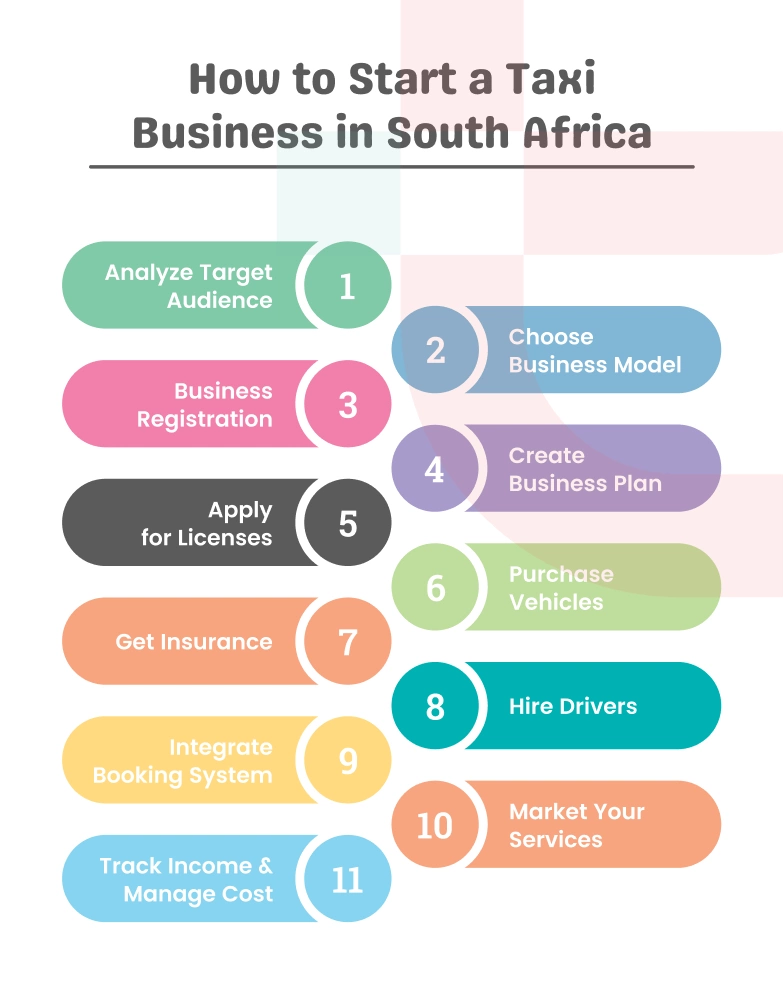
Starting a taxi business in South Africa requires thorough research on the audience, understanding market demand, and complying with regulations. Here is an in-depth explanation of the steps.
Step 1: Research Target Audience & Competitors
Before any capital investment, spend a week analyzing your target audience and identifying potential competitors. Understand which routes are overcrowded, which regions are underserved, and where competition is low so you can easily offer your service.
Observe peak hours queues for mini-bus routes. And for app-based models, test giant competitors’ apps such as Bolt and InDrive in your targeted area or region to analyze what services those apps offer, wait times, fare price structure, and surge prices.
Step 2: Choose a Business Model
It is necessary to choose a specific business model that aligns with your core objective and the taxi app’s revenue model to generate income from multiple streams. Here are three business model types that you can choose from,
| Business Model |
What it is |
When to use it |
|---|---|---|
| Platform Model |
You own your own on-demand ride-hailing platform that connects passengers with independent drivers in real-time. This model generates revenue from chargeable commission on drivers and service fees from customers. |
When you want to scale faster in various regions, this model is suitable for it. |
|
Owned Fleet Model |
Unlike the platform model, you own the fleet or hire drivers based on contract and offer seamless taxi service. Usually, revenue stays within your business. |
Best when you want full control over pricing, routes, driver standards, and customer experience. Ideal for operators starting with one or two vehicles. |
|
Hybrid Model |
This model is a combination of both the platform model & owned fleet model, where you own vehicles and also allow independent drivers to join. |
This model is well-suited for operators who want stable revenue from owning a fleet while also wanting to scale strategically. |
Step 3: Register Your Business
To start a taxi business in South Africa, you need to follow some mandatory legal compliance steps. Without it, you will risk your entire business, funding, and investments, but all of these steps are manageable if you plan ahead of your launch.
Register your business at CIPC – the process is entirely online and will cost you approximately R175 for a private company. Register your business name properly without any errors because it will appear on your operating license and every other official document.
After CIPC registration, open a dedicated business bank account because mixing personal and business finances could lead to accounting problems. And lastly, obtain your Tax Clearance PIN from SARS for your operating license application and any other corporate or governmental paperwork.
Step 4: Create Your Business Plan
A strong business plan starts with an executive overview of your business concept, including what problems your business solves and your target market. From there, it describes the business structure and what sets you apart from other businesses. Include customer segment analysis, market size, growth projections, and a SWOT assessment in your market analysis.
Outline your operational plan by documenting day-to-day workflow, how you’ll recruit drivers, how you’ll acquire vehicles, and what technology you’ll deploy for platform booking and payments. Pair that with your decided fare and surge pricing strategy.
Step 5: Apply For Your Permits & Operating License
This step is initially the longest one, and that’s where most new entrants lose momentum. Because the Public Transport Operating License alone takes approximately 3 months to obtain, applying earlier for this license before launch is important.
While your operating license is in progress, ensure your PrDP and passenger liability insurance are in place through the local traffic department to maintain safety and legal compliance for customers. This includes your own driving license, medical certificate, and a police clearance.
If you’re operating on a designated minibus route, then you’ll also need a verified certificate under the SANTACO association without any failure. Additionally, metered and app-based platforms can skip this documentation because it is not necessary for them.
Step 6: Secure Vehicle Finance & Own a Fleet
For most new operators, financing the vehicle is the biggest hurdle. For vehicles, SA Taxi Finance offers a Toyota and VW dealership. They’ll need your business plan, CIPC documents, and association letter before approving anything. WesBank’s commercial vehicle division is worth comparing, particularly for newer vehicles.
If you have cash available, buying a reliable used vehicle is the best option. Once purchased, take it straight to an authorized testing station for a roadworthy certificate.
Step 7: Get the Right Insurance
Passenger liability cover is required by law, and one serious claim can exceed the full value of your vehicle. Your vehicle insurance should comply with passenger transport because standard personal car insurance does not apply to a commercially operated taxi, regardless of what the policy name suggests.
If you employ drivers, COID registration with the Department of Labor is mandatory, which covers driver injury on duty. For single-vehicle operators, income protection insurance is also worth considering.
Step 8: Hire & Onboard Your Drivers
Who you hire matters more than almost any other early decision. One unreliable driver means vehicle damage, longer wait times for passengers, decreased revenue, and potential legal issues. Every driver must hold a valid license for minibus or sedans, alongside a current PrDP, police clearance, and medical certificate.
Before committing to anyone, run a test drive on the actual route with the driver. Watch how they handle the vehicle, how they treat passengers, and whether they show up on time. Once you’re satisfied, put everything in a written contract with a daily revenue target, fuel responsibility, minor repair liability, and mobile phone policy.
Step 9: Set Up Booking & Payment System
How passengers book and pay directly determines how far your business can grow. A fully-functional platform determines if your service is findable, bookable, and trackable, which opens up a different level of growth entirely. There are three practical levels to choose from.
A basic option – WhatsApp group with EFT or cash works for small metered operators with a loyal regular client base.
The intermediate option – In this option, a third-party dispatch app pairs with a card machine, giving a wider reach without heavy tech investment.
The advanced option – Leveraging a white-label app like Uber that you own, including the booking experience, customer data, driver tracking, and payment flow. For operators planning to grow beyond five vehicles, this is the only option that scales with you.
Step 10: Market Your Taxi Service
For minibus route operators, your brand is built through consistency, such as the same vehicle colors, professional driver conduct, and reliable departure times every day. Passengers notice, and in a market where trust is earned through repetition, that consistency becomes a real competitive advantage.
For app-based operators, branding is more active. Start with a Google Business Profile so your service appears in local searches. Build a WhatsApp community for repeat passengers. A recognizable brand in this space compounds quietly.
Step 11: Track Revenue, Manage Cost, And Plan Your Next Vehicle
The taxi businesses that fail aren’t usually due to low demand, but because the operator has no clarity of cost structure. The daily cash coming in creates the vagueness of profitability. But without tracking fuel, maintenance, insurance, and finance costs against that income, you can’t actually confirm if the profit you are earning is long-term.
This is why tracking daily income, fuel spent, and repair costs is essential. Set a weekly target for all fixed costs covered before anything counts as profit. For tracking daily income, integrate the dashboard in your platform that tracks daily rides and revenue. Track all your maintenance costs through a spreadsheet and evaluate the cost structure within a month of launch.
Get Elluminati’s Ready-to-Launch Taxi App with Africa-Ready Features
Explore Types Of Taxi Businesses Operating in South Africa
Before committing to a model, first understand the landscape and, according to it, discover various taxi types that operate in South Africa.
Minibus Taxis
Minibus taxis are 15-seater vans used for daily traveling, which is common in cities and townships. This taxi is ideal for higher passenger volume and daily income.
Metered Taxis
Metered taxis are regular sedan or hatchback taxis that charge a distance-based fare, which are common for airport transfers and hotels.
App-Based Ride-Hailing Taxis
App-based ride-hailing taxis like Bolt are common in urban areas and suburbs. Generally, these taxis are ideal if you’re targeting younger commuters and corporate passengers as your audience.
Startup Cost Breakdown For Starting a Taxi Business in South Africa
The cost breakdown below is just a working estimate; actual costs may vary by province and the vehicle type you choose.
| Expense | Estimated Cost (ZAR) |
|---|---|
|
Vehicle (used sedan) |
R120,000 – R250,000 |
|
Vehicle (mini bus) |
R350,000 – R600,000 |
|
Operating License |
R5,000 – R20,000 |
|
PrDP |
R500 – R1,500 |
|
Insurance (monthly) |
R2,000 – R6,000 |
|
Fuel (monthly) |
R8,000 – R15,000 |
|
Maintenance reserve |
R2,000 – R5,000 |
|
App Development (optional) |
R80,000 – R300,000 |
|
White-label app |
R47,000 – R190,000 |
| Total – sedan (basic setup) | R140,000 – R300,000 |
| Total – mini bus taxi | R370,000 – R650,000 |
| Total – App-based taxi business | R205,000 – R570,000+ |
Common Mistakes to Avoid When Starting a Taxi Business in South Africa
Real-world experience in this industry produces a consistent pattern of mistakes. The following are specific issues that cost you money, time, and your entire investment.
1. Buying a Fleet Before Securing an Operating License
This is the most expensive mistake a new entrant can make, because operating licenses in South Africa are vehicle-specific. If you purchase a vehicle before the license is confirmed, and the vehicle doesn’t meet the rules, you either operate illegally or restart the entire application process with a different vehicle, which is a time-consuming process that delays your launch.
2. Ignoring SANTACO & Local Association Dynamics
Operating on a dedicated minibus taxi route without SANTACO membership or route approval is not just a compliance issue, but it invites organized resistance from established operators. Routes in South Africa are regulated and controlled by the local taxi association & authorities. New entrants who ignore this structure face real consequences later at the time of launch.
For App-based and metered operators working outside designated minibus corridors, there is significantly less exposure to this dynamic of regulatory compliance, which is one of the advantages of the platform-owned ride-hailing model for new entrants.
3. Ignoring Insurance for Vehicle and Passengers
Standard personal car insurance does not cover a commercially operated taxi. Many new operators discover this only after an accident, and at that point, the claim is eventually rejected, and the operator is personally liable.
Without the correct commercial vehicle and passenger liability cover, any minor accident can exceed the vehicle’s total value and financially end a new business overnight. Verify your policy details with your insurance officer before the vehicle carries a single passenger.
4. Hiring Drivers Without a Written Contract
Driver agreements should be a written contract that includes rules and regulations. When disputes arise over vehicle damage, missed shifts, or daily takings shortfalls, an operator with no written contract has no legal standing.
A basic driver contract should cover at least a daily or weekly revenue target, fuel responsibility, liability for minor damage, shift hours, notice period, and the mobile phone policy while driving. It protects both parties and removes uncertainty.
5. No Daily Revenue or Cost Tracking
This is the significant reason why online taxi businesses fail. Because without tracking fuel costs, maintenance, insurance, finance installments, an operator cannot know if the business is actually generating revenue or slowly decreasing capital.
That is why integrating a dedicated dashboard on your platform is essential because it tracks daily and monthly generated revenue. For cost tracking, a basic spreadsheet also works for any repair costs, fuel costs, and maintenance charges.
6. Scaling Too Fast Before The Vehicle Becomes Profitable
Taking on a second vehicle before the first is generating consistent revenue means two vehicles with thin margins and no financial recovery. One unexpected repair or a week of low passenger volume can create an insufficient cash flow across both vehicles simultaneously.
First, improve the operational efficiency with one vehicle, then buy the second one. A consistently profitable vehicle is a stronger foundation for a second vehicle than two vehicles both operating at the uncertainty of scalability.
How Elluminati Can Help You Build a Taxi App in South Africa?
Considering the current market scenario, starting a ride-hailing business is a genuine opportunity. The structural demand, profitable revenue model, and entry paths are clear for new entrants. Now that you have all the information about how to start a taxi business in South Africa, it’s time to kickstart your business without any delay.
Elluminati, a taxi app development company, is helping entrepreneurs like you to build a scalable platform that is backed by 14+ years of tech experience and knowledge across the global industry. Our app offers modern features that enhance your operational efficiency and increase ROI to support your business growth.
FAQs
Yes, it is profitable to start a taxi business in South Africa due to rising market demand, daily commuters, and tourists.
To start a taxi business in South Africa, you can follow the steps below:
- Research target audience & competitors
- Choose a business model
- Register your business
- Build a business plan structure
- Apply for permits and an operating license
- Secure finance and purchase a vehicle
- Get the right insurance
- Hire and onboard drivers
- Integrate booking & payment system
- Market your taxi services
- Track income, manage cost, and scale
A basic sedan-based metered taxi setup ranges from R140,000 to R300,000. A minibus taxi operation runs R370,000 to R650,000. An app-based ride-hailing business with its own platform sits between R205,000 and R570,000+, depending on the technology solution chosen. These figures include vehicle, permits, insurance, fuel reserve, and tracking.
A custom-built taxi booking app for South Africa typically costs between R80,000 and R300,000, depending on the feature set, the development team, and whether you’re building from scratch or using a white-label solution. White-label platforms are pre-built, which costs less and launches faster than fully custom builds.
If you intend to operate on a minibus taxi route, then SANTACO association membership and a route letter from your local association are strictly required because, without them, you risk conflict with established operators and cannot obtain a public transport operating license for that route. However, this certificate is an exception for app-based taxi businesses.
The Public Transport Operating License is issued by your Local or Provincial Regulatory Entity and typically takes between 3 and 6 months, depending on the province and the completeness of your application.
Passenger liability insurance is legally required, which covers passenger injury or death, and comprehensive commercial vehicle insurance. If you employ drivers, then COID registration with the Department of Labor is also mandatory.