Key Takeaways (or TL;DR)
- In today’s competitive ride-hailing market, integrating AI features in an Uber clone platform is no longer optional but essential for building a scalable and high-performing taxi business.
- Advanced AI features in Uber clone app help you automate dispatching, improve driver utilization, reduce idle time, and deliver a faster, more reliable ride experience to customers.
- By implementing AI capabilities such as WhatsApp AI assistants, demand forecasting, driver scorecards, post-trip AI feedback, and more, you can significantly enhance operational efficiency and customer satisfaction.
- As AI continues to evolve, businesses that embed the right Uber clone AI features from the start are better positioned to build a future-ready, data-driven ride-hailing operation.
AI features are redefining how ride-hailing platforms operate, from automating dispatch to simplifying operations. AI helps taxi apps become smarter, faster, and safer for both riders and drivers.
Platforms without AI capabilities often struggle with demand fluctuations, pricing challenges, and operational inefficiencies, which directly affect revenue and customer retention.
Therefore, we will walk you through this article that explains how AI features in an Uber clone app address these exact challenges, giving you a clear advantage when building or scaling your platform.
What are the Key Benefits of Implementing AI Features in the Uber Like App
AI features in the Uber like app enable you to improve operational efficiency, increase revenue, and deliver an exceptional customer experience.
Faster Ride Matching and Reduced Wait Times
The smart dispatching system analyzes drivers’ availability, traffic conditions, and historical patterns in real-time to assign trips more efficiently. This significantly reduces customer wait times while increasing trip completion rates across your platform.
Faster matching also strengthens your ability to scale operations across regions, where speed matters most and availability directly influences user retention.
Optimized Pricing for Higher Revenue
Instead of relying on a static pricing model, this AI-driven dynamic pricing helps you adjust fares in real-time based on demand, weather conditions, location, and peak hours. This ensures your platform remains competitive while maximizing revenue during high-demand periods.
Moreover, to sustain in the market, you also need to frame a revenue model for taxi apps that balances drivers’ incentives, customers’ affordability, and platform margins, relying solely on surge pricing.
Improved Driver Utilization and Productivity
One of the biggest operational inefficiencies in any ride-hailing business is drivers’ idle time. But thanks to AI’s capabilities, which minimize this by predicting demand in advance and pre-allocating drivers in peak-demand zones before the surge period even begins.
To further reduce trip time, AI-powered route optimization calculates the fastest path based on live data. At the same time, integrated geolocation for tracking enables dispatchers and customers to see every ride in real time.
Smarter Decision-Making with Data Insights
From identifying peak-demand zones to analyzing driver performance and customer behavior, advanced AI-driven insights can help you easily transform raw information into data-driven actionable insights for sound decision-making.
This eliminates unnecessary guesswork in operations and enables you to manage your entire business proactively, improving overall operational control as your platform scales.
Increased Safety and Fraud Prevention
Safety and trust are crucial to any ride-hailing platform. AI smartly manages both. By continuously monitoring driver behavior, detecting anomalies, and flagging suspicious fraudulent transactions in real-time.
In addition, you can enhance safety by implementing advanced passenger safety features on your platform, thereby reducing fraud risks and improving platform credibility.
Top AI Features in an Uber Clone and Its Use Cases
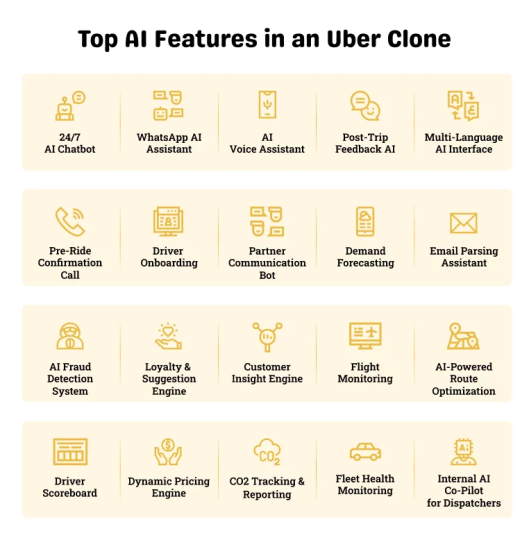
1. 24/7 AI Chatbot for Instant Customer Support
As your business grows, it becomes difficult to manually provide around-the-clock customer support for booking issues, cancellations, and refunds. This is where the AI chatbot is one of the most valuable features in an Uber clone app.
It understands natural language, accurately identifies user intent, and performs actions such as processing refunds and providing trip updates without human involvement. This solves complex issues smoothly while allowing you and your team to focus on tasks that drive more value to your business.
Did you know, Uber has also built an AI support system that automatically resolves issues, minimizing documentation time for agents by 80% and response time by 6% per interaction.
Outcome:
Faster resolution of customer queries, lower operational costs, and helps you scale your customer support infrastructure
2. WhatsApp AI Assistant for High-Converting Bookings
Not every customer will download your app, but most already use WhatsApp daily. Integrating an AI assistant into WhatsApp lets customers book rides quickly, track drivers, and receive trip updates directly through messages. It also allows you to respond promptly to customer queries, making the booking feel more natural and effortless.
This approach is particularly effective if you plan to enter markets where messaging platforms dominate digital interactions, such as South Asia, Southeast Asia, and Latin America. It allows you to expand your business reach without increasing operational overhead.
Outcome:
You can easily convert users outside the app by allowing them to reserve a taxi via a WhatsApp AI assistant, boosting booking conversions and expanding your market reach.
3. AI Voice Assistant for Phone-Based Ride Booking
While mobile apps dominate digital interactions, there is a user base, including elderly passengers and individuals from low-connectivity areas, who still rely on phone calls for booking rides.
But over time, the AI voice assistant seamlessly replaces the call-based booking process with automation. It captures trip details, confirms bookings, and sends timely follow-up notifications, enabling you to serve a broader customer base quickly and accurately while minimizing delays and manual operational work.
Outcome:
Expanding a market reach, preventing missed bookings, and allowing you to scale effectively by automatically accepting call-based bookings.
4. Demand Forecasting for Smarter Supply Management
The ride-hailing ecosystem is rapidly growing, expected to reach USD 392.27 bn by 2031, and capturing that growth depends on how well your platform manages supply amid rising demand.
AI-powered demand forecasting is one of the most strategically important AI features in the Uber like app. It analyzes historical ride data, weather conditions, and occasional events to allocate the right number of drivers before peak hours, reducing cancellations and maximizing ride fulfillment.
This foresight enables you to strategically position your drivers in those areas before demand spikes, improving your trip availability and reducing customer wait times.
Outcome:
Helps you plan strategically to allocate resources efficiently, even during peak hours, resulting in higher trip completion rates and reduced driver idle time.
5. Driver Scorecards for Performance Monitoring
Drivers are the backbone of your taxi business, and staying on top of their performance across a growing fleet manually can be a difficult task. This is where AI capabilities work appropriately.
The AI-driven driver scorecards provide continuous visibility into your drivers’ performance, including their punctuality, trip frequency, acceptance rate, and, most importantly, customer feedback.
These insights help you identify top performers, maintain consistent service standards, reduce complaints, and ultimately deliver a safe trip experience to customers.
Outcome:
Provides you with real-time insights into the driver’s overall performance, helping you find valued drivers and alerting to inappropriate driving patterns in advance, maintaining standards as it scales.
6. Email Parsing Assistant
When you are managing multiple services, including corporate bookings, fleet partners, and driver onboarding and tracking activities, unchecked inboxes can become a major bottleneck for your business.
However, AI-based email parsing eliminates this inefficiency by automatically reading emails, identifying intent, and categorizing them into their aligned flows, helping you remove sorting steps entirely, minimize lag, and deliver on-time resolutions to queries, attracting a larger customer base to the platform.
Outcome:
Accelerate query response times, reduce manual workload, and streamline coordination among all users.
7. AI-Powered Pre-Ride Confirmation Call
Clear and timely communication plays a vital role at every stage of a ride. Lack of coordination can create confusion between customers and drivers, which in turn can increase customer queries and a negative user perspective toward your platform.
Streamline this process using AI-powered calls that provide real-time updates based on trip stages, from pickup confirmation to delay notifications, driver check-ins, and post-trip updates.
Each call is personalized based on the actual trip conditions, with the right name, accurate ETAs, and the right moment, ensuring communications stay consistent through the process, whether you are running 500 trips a day or 50,000.
Outcome:
Enhances overall transparency, reduces manual intervention, and delivers a smoother ride for all your customers.
8. Partner Communication Bot
Timely and consistent communication among drivers is very important. With the growing driver network, managing interactions between drivers has become time-consuming and has led to inconsistencies.
However, to handle this intelligently, a partner communication bot perfectly works. It handles routine queries, sends automated updates, and manages communication across multiple channels like WhatsApp and SMS, ensuring the driver receives accurate trip information without human intervention.
Outcome:
Speed up coordination across large driver networks and reduce manual workloads, enabling them to focus on other crucial tasks.
9. Driver Onboarding & Daily Checklist
Getting a new driver from sign-up to their first trip now no longer requires your team to chase paperwork. You can handle it perfectly with an AI-driven onboarding flow. It tracks each driver’s documents and vehicle details, provides training and activation via the app or WhatsApp, flags incomplete steps, and sends reminders.
Moreover, it follows a daily checklist, keeping the active drivers on track with pre-shift checks, expiry reminders, and compliance prompts before each shift.
Outcome:
Faster onboarding process for drivers, improved compliance standards, and sustained a steady supply of active drivers that meet demand over time.
10. Post-Trip Feedback AI
Real-time customer feedback after every trip helps businesses stay up to date on service quality, and post-trip feedback is essential for this. It identifies patterns like drivers receiving repeated complaints about the same issue, geographic zones with consistently lower scores, vehicle categories underperforming, and more.
Also, it automates follow-up communication for low-rated trips, reaching out to the affected customers, acknowledging the issues, and triggering a platform credit or investigations workflow as appropriate.
Outcome:
Enables you to continuously improve your services by solving your customers’ concerns early, thereby increasing customer retention.
Over 50% of Ride-hailing Platforms Leverage AI to Automate Operations. Elluminati’s Uber like App is Advanced for Integrating AI Features
11. Multi-language AI Interface
A customer who cannot understand your app will not use it, and will not come back. This is where a multi-lingual AI interface plays an essential role: it helps you operate across different regions by adapting content and interactions to user language preferences.
It dynamically adjusts app interfaces, notifications, and support responses, ensuring a localized experience without requiring separate app versions. This is essential for scaling into diverse markets where language accessibility directly impacts user adoption.
Outcome:
Supports you reach a wider user base, without rebuilding the solution, seamlessly operating across multiple regions with multi-lingual support.
12. AI Fraud Detection System for Secure Transactions
With the increasing adoption of AI on platforms, it also comes with risks, such as fake accounts, payment anomalies, etc. Detecting these manually can slow down the process and may result in a huge loss on your platform.
This is where the AI fraud detection system aligns perfectly with your operations. It monitors all transactions and user behavior in real time, identifying suspicious patterns before payouts are processed, helping you improve processing accuracy over time while building a trustworthy relationship with your end users.
Outcome:
Safeguarding crucial business data from fraudulent activities, improving transaction security, and strengthening platform credibility.
13. Loyalty & Suggestion Engine for Higher Retention
Whether it’s about identifying high-frequency customers, analyzing customer patterns, or generating personalized offers, such as subscription plans, ride bundles, and more, a loyalty & suggestion engine with AI can help you increase retention rates.
Also, these surface-proactive ride suggestions are based on established time-of-day patterns, prompting a booking before customers even open the app.
Outcome:
Convert your one-time platform visitors into regular customers by offering additional benefits and delivering a personalized experience over time.
14. Flight Monitoring for Efficient Airport Transfers
Customers often get frustrated when their flight is delayed, as it disrupts their scheduled services and forces them to wait longer for another taxi.
However, you can eliminate customer frustration with this AI-powered flight monitoring feature. It connects you with every scheduled airport pickup to live flight data, updating customers and drivers on flight delays and automatically dispatching another shift, thereby minimizing driver idle time and giving customers a better experience.
Outcome:
Delivers customers with a seamless airport transfer experience and keeps them updated on flight delays through real-time alerts, resulting in improved overall customer trust.
15. Customer Insight Engine for Personalized Ride Experience
In the modern era, customers prefer platforms that offer personalization, and taxi apps are no exception. Thus, leveraging AI-powered capabilities to deliver a tailored experience is the best choice for businesses.
It is among the Uber clone AI features that analyze customers’ behavior, booking habits, and preferences based on their past trip history. Also, it recommends preferred vehicle types, routes, and more, thereby improving convenience and building user loyalty towards your platform.
Outcome:
Supports faster bookings, improves the overall user experience, and increases the number of recurring trips by offering users a personalized experience.
16. AI-powered Route Optimization Engine for Faster and Smarter Trips
Unlike static maps or GPS routing, this AI-powered feature analyzes real-time traffic data, weather conditions, and road closures to recommend the most efficient route for each trip. This ensures drivers can reach their destinations faster by avoiding delays caused by unpredictable conditions.
Moreover, with this fuel-efficient route optimization, you can save money on operational expenses while maintaining fleets more efficiently.
Uber runs its trip serving zone calculations on AWS Graviton4 chips, resolving routes and making matching decisions in milliseconds.
🚀 AI-thon is in full swing @Uber! 🤖✨
Tech teams across Uber are bringing imaginative ideas to life in our internal hackathon and expanding what’s possible with AI. Teams around the globe are heads down building, with submissions coming in just a few hours!
And of course,… pic.twitter.com/yQgGfwJ1ua
— Uber Engineering (@UberEng) December 17, 2025
Outcome:
Shows accurate ETAs, reduces fuel consumption, and offers a faster trip experience to customers.
17. Dynamic Pricing Engine for Real-Time Fare Optimization
Before the advent of AI, you had to update prices manually whenever market demand surged. However, by adopting artificial intelligence, fares are adjusted based on demand, driver availability, and other factors, eliminating the need for manual price updates.
This ensures transparent and fair pricing for riders while motivating drivers to stay active during peak hours to earn extra revenue. Additionally, it enables you to balance customer affordability with profitability.
Outcome:
Optimized revenues in real-time, balancing the supply-demand and handling the ride-hailing operations with efficiency.
18. CO2 Tracking & Reporting AI
Calculating emissions per trip is now easy with this CO2-tracking and reporting functionality. It enables your customers to check their trip’s carbon footprint in the app, and you can generate a sustainability report for regulators. Also, it flags the high-emission routes and highlights where switching to EVs makes a huge difference.
Nowadays, we know that sustainability reporting is increasingly a compliance requirement, particularly in the European market and other major centers where a zero-emission mandate is in place.
Outcome:
Offer customers zero-emission trips, comply with all regulatory requirements, and deliver a better experience for environmentally conscious users.
19. Fleet Health Monitoring
For every taxi business, taking effective care of its fleet is crucial, and AI-powered capabilities help achieve this through predictive fleet health management. It analyzes overall vehicle data, such as usage and last maintenance gaps, detects early warning signs, and schedules maintenance before breakdowns occur.
This significantly reduces last-minute maintenance costs, extends vehicle lifespan, and improves overall operational efficiency without disrupting customers’ trips, providing a smooth ride experience.
Outcome:
Minimal downtime, lower the maintenance costs, while improving the overall fleet’s reliability.
20. Internal AI Co-Pilot for Dispatchers
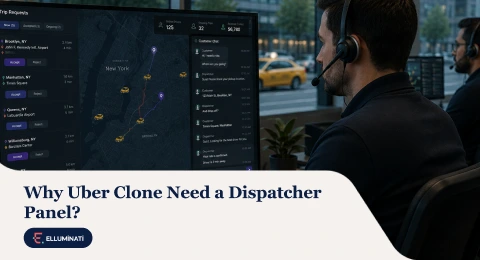
This in-built dispatcher co-pilot is an AI assistant embedded in your operations dashboard, providing real-time recommendations on supply positioning, demand anomalies, and track exceptions, and indicates platform health signals. This helps you make an informed decision faster than manually interpreting raw dashboards.
As the platform scales, this becomes essential for managing compliance, as the number of requirements increases without adding any extra operational overhead.
Outcome:
Helps you make faster decisions, improve efficiency, and scale operational management.
How Elluminati Can Help You Build an AI-powered Uber Clone
Building a ride-hailing platform in 2026 is not limited to scalability! Nowadays, businesses entering the market are actively looking to embed AI capabilities into their app like Uber, to stay ahead of the competition and meet rising customer expectations. This article covers the essential AI features in an Uber clone app that not only boost your business revenue but also enhance scalability and increase customer retention.
Whether you are planning to launch or upgrade your platform, opting for our Uber clone solution is the ultimate choice. It already integrates these advanced capabilities, which can significantly reduce development time and operational complexity.
Not only that, but it gives you a measurable advantage in enhancing your overall performance, expanding your customer base, and helping you stand confidently in this rapidly growing mobility market.
FAQs
Below are some of the crucial AI features in an Uber clone app;
- WhatsApp AI Assistant
- Demand Forecasting
- 24/7 Chatbot Support
- Driver Scorecard
- Post-Trip Feedback
- AI-Powered Route Optimization, among others
The cost of adding AI features in Uber clone script varies depending on your business requirements. If you want to integrate a basic feature like a chatbot, then it may cost between $15,000 to $50,000. However, if you want enterprise-grade features such as route optimization and demand forecasting, it may cost you over $60,000.
The AI-powered features help you enhance your customer experience by delivering a faster, more personalized ride-matching experience, personalization suggestions, and instant support to solve their queries, making their entire travel journey smoother and more reliable.
An integrated AI chatbot automates your operational, repetitive tasks like tracking rides and resolving customer queries, handles cancellations without human intervention, reduces manual workload, and provides 24/7 instant query resolution that builds trust in your customers towards your platform.
Demand forecasting enables you to predict high-demand areas in advance, which, in turn, helps you strategically allocate resources to get more rides while minimizing drivers’ idle time.
The development timeline for an AI-powered Uber clone app highly depends on your business needs. If you want an Uber like app with basic AI features integrated, then it may take 2 to 3 weeks. However, if you have any special needs, such as demand forecasting, route optimization, and more, it may take 3 to 4 months.