Key Takeaways (or TL;DR)
- Stripe, PayPal, and Adyen are globally accessible payment gateways that support multiple currencies, while M-Pesa, PayStack, and Mercado Pago are regionally operated payment options.
- A payment gateway must meet PCI-DSS compliance requirements and security standards, implement tokenization and encryption, and comply with regional data privacy regulations such as GDPR and PDPA.
- When choosing the right payment gateway for your taxi business, don’t just rely on transaction fees.
- The right gateway should offer local and international payment support, secure and reliable transaction processing, seamless integration with your taxi platform, efficient refund management, and the scalability needed to support long-term business expansion.
A high-functioning, efficient, and reliable payment gateway is the backbone of each transaction. Your payment gateway is the last thing your riders touch before they become revenue.
In your taxi business, a payment gateway affects transaction success rates, driver satisfaction, customer retention, and your ability to expand the business into new markets.
Choosing the right payment gateways is not as simple as selecting the most popular one. In this article, you will find the best 30 payment gateways for taxi apps from around the world, along with how they work, key features, the regions they operate in, pricing, and security compliance details.
What are Payment Gateways for Taxi Apps?
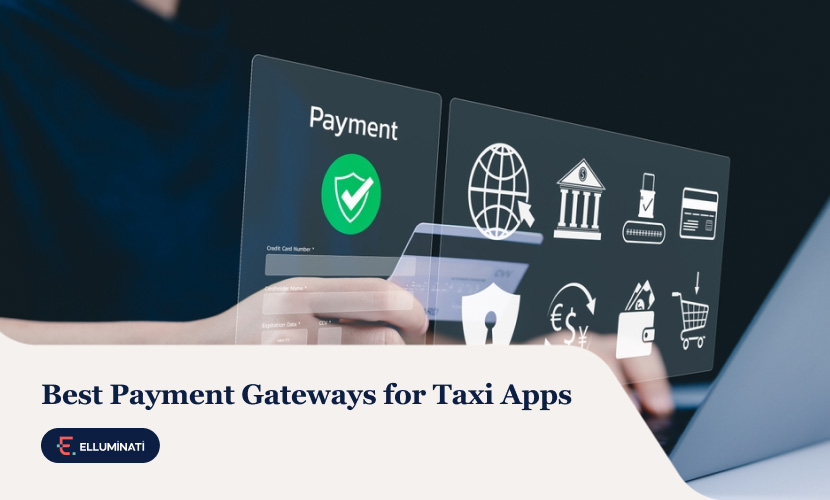
Payment Gateway helps to validate the details of the user and ensures that the funds are transferred securely. It serves as a bridge between the platform and the financial platform that processes payments.
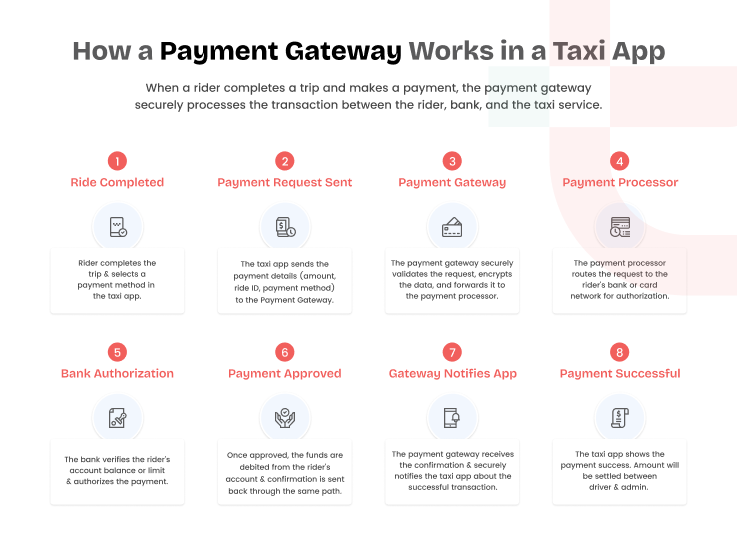
When a rider pays via the payment gateway, it captures the transaction, encrypts the data, communicates with the bank for the payment network, and confirms whether the payment is successful.
It supports multiple currency conversions, automated payouts for drivers and partners, and ensures that every transaction meets the security and compliance standards required in each region where it operates.
Here is how the payment gateway works in a taxi booking app:
Why is Integrating Multiple Payment Gateways for Ride-Hailing Apps Important?
Enhanced Payment Flexibility
Riders expect to pay using their preferred payment method, whether it’s credit/debit cards, digital wallets, bank transfers, UPI, or local payment solutions, compatible with them in thier region. Integrating multiple payment gateways supports diverse payment preferences across different regions, resulting in a smoother checkout experience and higher ride completion rates.
Improved Trust & Convenience
A familiar and reliable payment option builds confidence during transactions. Multiple payment gateways in your taxi app allow riders to choose a reliable option, reducing payment hesitation and failed transactions while improving the overall customer experience and encouraging repeat bookings.
Supports Faster Driver and Partner Payouts
Payment gateways are not limited to collecting customer payments. They also simplify payouts to drivers, fleet owners, and business partners. It helps you automate payout settlements, process payments more efficiently, and reduce payout delays, resulting in higher driver satisfaction and smoother platform operations.
Faster Scalability Across the Globe
When you integrate only your region-specific payment gateways, it may become a barrier to growing your business. Configuring globally accessible payment gateways into your platform helps you expand into new regions and handle operations across multiple currencies, making it easier to serve new customers hassle-free.
Minimizes Dependency on a Single Provider
Multiple gateway integrations allow your taxi app to automatically route payments through alternative providers during downtime, technical issues, or service disruptions. It ensures higher payment success rates and uninterrupted business operations.
30 Best Online Payment Gateways For Taxi Apps
Here is the list of the 30 best online payment gateways for taxi booking apps, and compare each one by its features, supported countries, and currencies
| Payment Gateways | Supported Regions | Key Features |
|---|---|---|
| Stripe | 195+ countries, including the US, Canada, the UK, Europe, and parts of Asia, support 135+ currencies. | PCI compliant,
Regulatory licenses globally, Flexible payout options, and payout processing |
| PayPal | 200+ countries and 130+ currencies for business accounts. | PayPal Payouts for driver settlements and Buy Now Pay Later (BNPL) supported features. |
| Adyen | 70+ countries across 6 continents and 150+ local payment methods. | Split payouts, automated payment settlements, and an AI-powered fraud engine. |
| Razorpay | Operates in India and Malaysia (as Curlec), supports 180+ countries and 135+ currencies accepted | Automated payouts, instant refunds |
| Square | Available in 8+ countries, including the US, Canada, the UK, Australia, Japan, France, Ireland, and Spain. | PCI-compliant security, free account setup |
| Paystack | Nigeria, Ghana, South Africa, Kenya, and Côte d’Ivoire. | Dedicated Virtual Account, PCI-DSS-certified systems,
Automated fraud monitoring |
| Mercado Pago | Argentina, Brazil, Chile, Colombia, Mexico, Peru, and Uruguay, support the local currency of each country | Mercado Pago Wallet, instant driver payouts, and installment payments. |
| PayU | 50+ countries (India, LatAm, Europe, Africa, and Southeast Asia. | Dynamic routing for higher approval rates, cross-border settlements, and automated reconciliation. |
| PayTabs | UAE, Saudi Arabia, Egypt, Jordan, Kuwait, Oman, Iraq | Mada (KSA) support, Arabic UI, AI smart routing, GCC payment method integration. |
| PayFort | UAE, Saudi Arabia, and the MENA region | AWS integration, Amazon ML fraud detection, Central Bank of the UAE (CBUAE) and Saudi Central Bank (SAMA) compliant, and real-time payouts. |
| Flutterwave | Available in 30+ African countries and supports 150+ currencies globally. | USSD payments (no data required), automated driver payouts. |
| Xendit | Indonesia, Philippines, Thailand, Vietnam, Malaysia, and Hong Kong. | Virtual accounts for driver reconciliation, e-wallet support (GoPay, OVO), and multi-currency SEA. |
| Telr | UAE, Saudi Arabia, and the wider MENA region | Fast merchant onboarding, recurring billing for corporate accounts, AED/SAR/EGP support. |
| MoMo MTN Money Mobile | 20+ African countries (MTN network). | USSD payment capability (no data needed), instant settlements, multi-country single integration. |
| Espago | Poland, the Czech Republic, Hungary, and the broader CEE region. | SEPA bank transfers support multiple currencies. |
| PayGate | South Africa, Botswana, Namibia. | Direct integration with major SA banks, 3D Secure. |
| Orange Money | 10+ African and Middle Eastern Countries. | USSD payments, driver wallet support, and instant settlement. |
| Paymentez | Ecuador, Peru, Colombia, and select Latam countries | Simplified onboarding, multi-currency support, and recurring billing. |
| Fawry | Egypt (primary), wider MENA | Direct offline cash payment at Fawry’s offices, Fawry wallet, multi-channel payments (SMS, app, web). |
| PowerTranz | Caribbean, Central America, 30+ country bank connections | Multi-currency support, recurring payments, P2PE certified, QR/in-person transactions. |
| M-Pesa | Kenya, Tanzania, Uganda, DRC | 50M+ active users, USSD payments, instant settlement, driver wallet support. |
| Omise | Thailand (primary), Malaysia, Japan | Thai-specific methods (Promptpay), LINE Pay, and TrueMoney e-wallet support, and recurring billing. |
| PayMongo | Philippines | PCI-DSS compliant, BSP-compliant, API integration, simplified onboarding. |
| WiPay | Caribbean region (Trinidad, Jamaica, Barbados, and more) | Caribbean-specific bank payouts, QR code and SMS payment links, transparent pricing, and developer-friendly API. |
| Ozow | South Africa | Instant EFT bank transfers, real-time settlements, SARB and FIC compliant, bypass card processing fees. |
| Ompay | Oman, South Asia, parts of MENA, and Africa | Apple Pay and Samsung Wallet support, fixed-fee multi-country transfers, CBO-compliant, merchant dashboard. |
| Iyzico | Turkey, select MENA and European markets | 3D Secure authentication, installment payments, tokenization, PCI-DSS Level 1, no setup or monthly fees. |
| Khalti | Nepal | Multiple payment options (e-banking, mobile banking, Khalti wallet, Connect IPS), NRB-regulated, instant settlement, ride-hailing integration. |
| GCash (Webpay) | Philippines | Dominant Philippine mobile wallet, 2% card exchange rate, recurring billing, instant driver payouts, BSP-regulated. |
| PayMob | Egypt, Jordan, Pakistan, Kenya, and the broader MENA | Marketplace split payouts, PayMob Send for mass driver settlements, POS solutions, payment links via WhatsApp, and CBE-regulated. |
1. Stripe
Stripe is a cloud-based financial infrastructure platform that serves as both a payment gateway, which captures and encrypts transaction data, and a payment processor, transferring funds between the customer, bank, and merchant.
Business Model and Pricing
It operates on a pay-as-you-go pricing model, meaning businesses are charged a flat percentage and/or a fixed fee per successful transaction.
- The standard card processing fee is up to 2.9%, along with an additional $0.30 per successful transaction.
- 0.5% additional fee on the standard card processing fee for manually entered cards.
- 1.5% additional fee on the standard card processing fee for international cards.
- Charges a 1%-2% additional fee on the standard card processing fee for currency conversion (there is no single global Stripe currency conversion charge; it varies by region and transaction type)
- Stripe Connect manages money flow among riders, drivers, your platform, your business partners or fleet operators, and supports verification, payout schedules, fees, and compliance workflows.
2. PayPal
PayPal is one of the most recognized digital payment brands worldwide. This is particularly valuable in Western markets, where riders are already familiar with the PayPal ecosystem.
For taxi businesses targeting regions such as North America, the UK, and Western Europe, it can be an effective payment gateway that enhances customer confidence and supports smoother transactions.
Business Model and Pricing
PayPal operates on a transaction-fee-based model, where a payment provider earns revenue by charging fees each time a transaction is processed.
- PayPal charges a 2.9% + 0.30 USD per domestic transaction in the United States.
- Rates for commercial transactions (including QR codes) in India generally align with merchant fees, with some localized effective rates as low as 1.9% depending on terms.
- For international transactions (outside India), 4.4% of the payment received, plus a fixed fee based on the destination or currency, is charged.
- It also charges around 3-4% for currency conversions.
- Charges 2% of the total transaction amount for domestic automated payouts
- Also, if you want to set up an automated payout for drivers, then the platform will charge you approximately $0.25 per payout.
3. Adyen
Adyen entered the market when providers processed with a patchwork system, that is, they depended on outdated payment infrastructure and third-party services, which made the payment process more complex and less efficient.
Now, it has become one of the leading companies worldwide that functions as a payment gateway and payment processor. It gives taxi businesses like yours complete control over the entire payment flow, whether it is accepted online, through mobile, or directly in-person.
Business Model and Pricing
Adyen follows a process-fee-plus-interchange pricing model, combining card network fees with its own processing fee for each transaction.
- It charges $0.13 per transaction with a variable payment method fee based on the region
- It charges a minimum monthly invoice of $145, making Adyen not an ideal choice for a small taxi business.
- Adyen does not charge a single, flat markup for currency conversion. Instead, their charges are based on the prevailing wholesale interbank exchange rate plus a variable percentage markup (usually around 1% to 3%), or a fixed-rate foreign exchange (FX) fee depending on your negotiated contract.
4. Razorpay
Razorpay is a widely used payment gateway in India. It supports UPI, net banking, digital wallets, and wallet transfers.
Business Model and Pricing
Razorpay operates on a straightforward transaction-fee model:
- Razorpay charges approximately 2% per transaction via domestic cards, net banking, wallets, and UPI.
- It takes a 3% charge on each transaction made with international cards.
- For EMI transactions, the charges range from 1.5% to 2.5%, depending on the bank.
- For drivers, RazorpayX offers an automated payout system.
5. Square
Square is a reliable financial services and mobile payment platform based in San Francisco, California. It operates as an end-to-end payment processor and point-of-sale (POS) system, handling both in-person and online transactions without requiring additional payment gateways.
Business Model and Pricing
Square operates on a percentage-based transaction model, charging businesses a fixed percentage of each payment processed through its platform.
- It charges 2.9% plus a $0.30 per transaction fee for online card payments.
- 1% plus $0.25 per ACH (Automated Clearing House Transfer) bank transfer for driver payouts.
- Implies 3.9% on international card payments.
- Enterprise-level pricing is also available for high-volume taxi businesses.
- It also integrates digital software that allows drivers to seamlessly process fares through a single ecosystem, eliminating the need to equip taxi meters.
About Square Cash:
Drivers can maintain a Square Cash account and receive instant payouts without waiting for bank transfers.
6. PayStack
PayStack is a Nigerian fintech company headquartered in Lagos, Nigeria, and was acquired by Stripe in 2020. It has become the dominant payment gateway across the West African market, particularly Nigeria, Ghana, Kenya, and other growing mobility regions.
Business Model and Pricing
PayStack operates on a transaction fee-based model.
- For Nigeria card payments, Paystack lists 1.5% + NGN 100 for local cards, capped at NGN 2,000; the NGN 100 fee is waived for transactions under NGN 2,500. For Nigeria international cards, the fee is 3.9% + NGN 100.
- Other countries have different charges for domestic and international card payments. Paystack lists Ghana: 1.95%, Kenya local cards: 2.9%, Kenya international cards: 3.8%, and South Africa local cards: 2.9% + ZAR 1 with international cards: 3.1% + ZAR 1.
- Currency handling is not just a “conversion charge” in a single fixed fee; it depends on the payment flow, country, and settlement currency.
- For driver-automated payouts, a custom pricing model is available.
- Paystack works well if your operation is based in one of its supported countries and you mainly need local card payments, bank transfer collection, and some international card acceptance.
Dedicated Virtual Accounts (DVA) are unique bank account numbers created for individual customers so businesses can receive payments by bank transfer into a reserved account linked to that customer.
7. Mercado Pago
Mercado Pago is Latin America’s largest payment ecosystem, processing transactions for millions of users across Brazil, Mexico, Argentina, and Colombia. It enables taxi businesses to secure online and offline transactions, offering a seamless way to handle payments, transfers, and daily finances across the region.
Business Model and Pricing
Mercado Pago operates on a transaction fee-based model with regional variations:
- It charges a 3.49% fee plus a regional fixed fee on transactions made with credit or debit cards.
- Mercado Pago wallet payments take a 1.99% charge and an additional regional fixed fee per transaction.
- For international card payments, there is a 4.99% charge per transaction.
- For driver settlements, Mercado Pago Payouts are flexible. With 2% per payout or a flat fee, depending on the method.
8. PayU
PayU is a leading global payment gateway and a fintech company operating in over 50 emerging markets, specializing in online transaction processing, customer credit, and payment security.
Business Model and Pricing
PayU operates on a transaction-fee model with regional variations.
- It charges approximately 2% to 3% on domestic card payments, depending on the region.
- A 3% to 4% charge is applied to international card payments.
- A 0.5% to 2% fee is applied to bank transfers or local payment methods.
- It charges 1% to 2% for driver payouts, depending on the payment method.
- It also charges additional fees depending on the region.
9. PayTabs
PayTabs is one of the fastest-growing payment gateways in the MENA (Middle East and North Africa) region and is headquartered in the UAE, with a specific expertise in GCC (Gulf Cooperation Council) markets. It offers Arabic-language infrastructure, supports direct payment methods, and integrates with Mada cards.
Business Model and Pricing
PayTabs operates on a transaction fee-based model.
- Charges between 1.99% and 2.49% plus AED 0.50 per domestic card payment on each transaction.
- For international card payments, fees range from 2.99% to 3.49% per transaction.
- 1% bank transfer charges.
- 1.99% charges for direct wallet payments like Apple Pay or Google Pay.
- A custom pricing model is available for automated driver payouts.
- PayTabs also features AI-driven routing, also known as the Payment Orchestration Platform, which automatically routes each payment to the best available bank or payment gateway, making transactions smoother and more reliable.
What is a Mada Card?
Mada is Saudi Arabia’s national debit card network. It is widely used to pay at POS terminals and online stores that route through the GCCNet interbank network or when co-badged with Visa or Mastercard.
10. PayFort (Rebranded as Amazon Payment Services)
PayFort, acquired by Amazon and rebranded as Amazon Payment Services, is one of the leading payment service and gateway providers across 9 countries in the MENA region. It helps ride-hailing businesses to process cashless transactions and in-app payments securely.
Business Model and Pricing
It operates as an Omnichannel payment gateway, enabling businesses to process global and local transactions via a single platform.
- PayFort charges 2% to 2.5% on each domestic card payment.
- 3% to 3.5% of fees for international card payments.
- It charges 2% per digital wallet payment.
11. Flutterwave
Flutterwave is one of the largest payment networks in Africa, achieving unicorn status with a $3.2 billion valuation, and is backed by a blockchain payment company, Ripple. It has broad geographical coverage, including West and East Africa under a single integration.
For entrepreneurs who want to build a Pan-African ride-hailing platform, Flutterwave is one of the most efficient choices.
Business Model and Pricing
Flutterwave operates on a transaction fee-based model.
- It charges approximately 1.5% to 2% for domestic card payments, based on the region.
- Each payment made with international cards will incur a fee of 3.5% to 4%.
- Also, Flutterwave doesn’t charge a fee for bank transfers directly, but it may take 1.5% in fees depending on the country and payment method.
- For driver payment settlements, it charges a fee between 0.75% and 1.5%, depending on the payout method.
12. Xendit
Xendit is Southeast Asia’s leading payment gateway company, founded in Indonesia. It processes billions of dollars in transactions annually for businesses ranging from e-commerce to ride-hailing across Indonesia, the Philippines, Thailand, Vietnam, and Malaysia.
Business Model and Pricing
Xendit operates on a transaction fee-based model with regional variations.
- It charges 2.5% to 3% on all domestic card payments, depending on the region.
- In addition to the fixed international card payment charges, it will also take a 3.5% to 4% fee.
- E-wallet payment fees are 2% to 2.5% plus a fixed fee.
- For bank transfers, there is a charge of approximately 0.5% to 1.5%.
- Xendit Payouts enables hassle-free automation of driver settlements. It charges 1% to 2% per transaction, depending on the payment method.
- Xendit offers virtual accounts for drivers. Earnings deposited by drivers or payments made by riders are automatically matched to the right driver, minimizing manual work and making reconciliation quick, accurate, and hassle-free.
13. Telr
Telr is a UAE-based payment gateway available across the MENA region. For ride-hailing businesses, it offers a faster integration process, lowers the barrier to entry, and is a great option for taxi app payment gateway integration for SMEs.
Business Model and Pricing
Telr operates on a transaction-fee-based model.
- For card payments, there will be a charge of 2.5% to 3% and an additional fixed fee per transaction.
- Bank transfer charges will be 1% plus a fixed variable fee.
- A 2.5% charge will apply to digital wallet payments.
- For international card payments, the charges will be 3.5% to 4%.
- A custom pricing model for driver payouts is available and varies by payment method.
14. MTN Mobile Money (MoMo)
MTN Mobile Money, also known as MoMo, is a mobile financial services platform operated by MTN Group based in Africa. It enables users to add, send, and receive money directly from their mobile phones without requiring a bank account. In sub-Saharan Africa, where half of the population remains unbanked, MoMo would be the best payment method to leverage for both riders and drivers.
Business Model and Pricing
MTN Mobile Money operates on a transaction fee-based model that varies significantly by country.
- It charges the rider 1% of the fee for each booking.
- For the driver payout, the platform charges 0.5% to 1.5%, depending on the country and withdrawal method.
- A 2% to 3% charge will be applied to each international transaction.
- Custom rates are available for high-volume ride-hailing enterprise platforms.
15. Espago
Espago is a Polish fintech company and API-linked payment gateway, helping businesses across Poland, the Czech Republic, and Hungary, providing direct SEPA integration and local Central and Eastern European payment method support.
Business Model and Pricing
Espago operates on a transaction fee-based model.
- For domestic card payments, Espago charges 2.5% to 3.5% and an additional fee of 0.30 Euros, depending on the card type.
- For bank transfers, it will charge 0.5% to 1% on each transaction.
- Espago Payout enables automated payments for drivers with a custom pricing model.
SEPA
– Single Euro Payments Area (SEPA) is a standardized, cashless payment system used to make fast & cost-effective bank transfers and direct debits in Euros across participating European countries.
16. PayGate
PayGate is an established online payment gateway company based in Cape Town, South Africa, now working under the Network International Group, acquired by DPO Group. It allows businesses to accept credit cards, digital wallets, and local bank transfers. It operates across the African continent, particularly in Southern Africa, including South Africa, Botswana, and Namibia.
Business Model and Pricing
PayGate operates on a transaction fee-based model.
- For card payments, it charges 2.5% to 3.5% depending on the card type, plus a fixed fee of ZAR 5-10 (0.30% to 0.61%).
- The bank transfer charges range from 0.5% to 1.5%, plus an additional fee.
- PayGate Payout is an optimal option for automated driver settlements.
Want a Taxi App Solution That Supports Multiple Payment Gateways Seamlessly? Choose Elluminati’s Taxi App Solution
17. Orange Money
Orange Money is a mobile-based digital wallet and money transfer service operated by one of the world’s largest telecommunications companies, Orange S.A. It enables users to add money, send transfers, and make payments directly from their mobile phones without requiring a bank account.
With over 50 million active users across Francophone Africa, Orange Money is the dominant payment method in Senegal, Mali, Cameroon, and the Ivory Coast. For entrepreneurs starting their business in this region, it is mandatory to integrate this payment gateway into their ride-hailing platforms.
Business Model and Pricing
Orange Money operates on a transaction fee-based model that varies significantly by country.
- The platform charges a payment fee of 1.5% from the rider, depending on the country and transaction amount.
- It takes payout fees of 0.5% to 2% from the driver, depending on the country and withdrawal method.
- For international transfers, the charges range from 2% to 3.5%, depending on the country.
- Custom rates are available for high-volume platforms.
18. Paymentez
Paymentez was acquired by Nuvei, a global payment technology provider, in September 2021. The company is headquartered in Miami, but it operates regional offices throughout Latin America, including Argentina, Brazil, Colombia, and Mexico.
Business Model and Pricing
Paymentez operates on a transaction fee-based model.
- It charges 2.9% to 3.9% for domestic card payments, depending on card type, and an additional fee.
- For bank transfers, the fees will be between 0.5% and 1.5%.
- A custom pricing-based model is available for the Paymentez driver payout.
19. Fawry
Fawry is Egypt’s leading electronic payment network, which has built an extensive offline payment network alongside its growing digital presence. With more than 225,000 physical locations, allowing users to process digital transactions, pay bills, and manage cash physically at retail stores, Fawry POS machines, or through the myFawry App.
Business Model and Pricing
Fawry operates on a transaction fee-based model.
- For online card payments, it charges 1.5% to 2.5% on each transaction.
- The direct wallet payment charge is 1%.
- Fawry Payouts is the optimal option for automated driver payouts, with charges that vary by payout method.
20. PowerTranz
PowerTranz, formerly known as First Atlantic Commerce, is headquartered in Bermuda. It is a multi-currency payment gateway for credit and debit card processing, secure online customer authentication, and fraud management.
For entrepreneurs launching a taxi operation in Trinidad, Jamaica, Barbados, or Central American cities, PowerTranz is the only gateway option with a direct regional banking connection.
Business Model and Pricing
- PowerTranz charges payment fees ranging from 2% to 3.5% on each transaction made through the platform.
- Additionally, it charges $0.30, which is a specific regional industry standard.
- The company charges variable rates for payments made through regional card types and for setting up multi-currency accounts.
- Percentage-based fees for in-person hardware routing and QR transactions.
- A $25 per month subscription fee is also applied.
21. M-Pesa Mobile Money
M-Pesa is not only the most popular payment method in Kenya but also the financial infrastructure of East Africa. Operated by Safaricom and serving 50+ million active users, M-Pesa is the non-negotiable payment layer for all ride-hailing platforms operating in Kenya, Tanzania, and Uganda.
Business Model and Pricing
M-Pesa operates on a transaction fee-based model that varies by country.
- The platform charges riders a 1% fee, which varies by country.
- It applies a 0.5% to 1.5% fee to drivers, which varies by country and withdrawal method.
- For international transfers, the fees range from 2% to 3%.
- Custom rates for enterprises are available for high-volume platforms.
22. Omise
Omise is a Bangkok, Thailand-based fintech company that integrates with its local payment infrastructure, including PromptPay and Thai e-wallets, to provide payment gateway and processing solutions for businesses. Valued at $1 billion, it operates globally across Thailand, Singapore, Malaysia, Japan, and the USA.
Business Model and Pricing
Omise operates on a transaction fee-based model.
- The platform charges 2.5% to 3.5% on domestic card payments, plus fixed THB fees.
- A 0.5% to 1.5% fee on bank transfers.
- 2.5% charge on payments made via e-wallet.
- Omise offers a custom pricing model for automated driver payouts.
What is PromptPay
PromptPay is a real-time payment and funds transfer service developed in Thailand. It allows users to transfer funds directly between bank accounts using simple identifiers like a phone number or National ID number.
23. PayMongo
PayMongo is the Philippines’ emerging payment gateway based in Manila. It offers direct integration with GCash and PayMaya, the two mobile wallets that dominate customer payments in the Philippines. For businesses planning to start a ride-hailing business in the Philippines, PayMongo’s local market expertise is one of the best gateway options for your business.
Business Model and Pricing
PayMongo operates on a transaction fee-based model.
- For card payments, the platform charges approximately 2.2% to 2.9% per transaction, plus an additional fixed fee of PHP 12-15 (0.22% to 0.27%).
- 1% on each transaction made via bank transfers.
- Takes 2.2% fees for E-wallet plus a fixed fee.
- A custom pricing model is available for automated driver payouts.
24. WiPay
WiPay is a Caribbean-based payment technology company that specializes in providing electronic payment solutions for businesses. With its direct banking connections and Caribbean-specific expertise, WiPay addresses the fundamental challenges of moving money efficiently within the Caribbean banking system.
Business Model and Pricing
WiPay operates on a transaction fee-based model.
- Competitive percentage-based fees on each transaction via card payments.
- Custom rates are available for high-volume platforms.
25. Ozow
Ozow is a prominent South African fintech company that offers a unified, end-to-end digital payments platform for merchants and customers. Originally, it was launched as an instant Electronic Funds Transfer (EFT) and pay-by-bank provider under the name i-Pay. It simplifies transactions by enabling card-free, real-time transfers directly from bank accounts.
Business Model and Pricing
Ozow operates on a transaction fee-based model.
- For card payments, Ozow charges 2.75% per transaction and a fixed fee of ZAR 5 to 10 (0.27% to 0.54%).
- For Instant bank transfers, it charges 2.5% per transaction and a fixed fee of ZAR 5 (0.27%).
- A custom pricing model is available for automated driver payouts.
26. Ompay
Ompay is a comprehensive financial platform backed by Omantel and regulated by the Central Bank of Oman. It functions as both a customer finance app and a business payment gateway, with a focus on cross-border remittances and handles the payments between Oman and the MENA and South Asia region.
Business Model and Pricing
Ompay operates on a transaction fee-based model.
- Charges OMR 2.00 (5.20%) per transaction for India, Bangladesh, Philippines, Sri Lanka, Egypt, Nepal, Kenya, Indonesia, and Uganda.
- Charges OMR 1.00 (2.60%) per transaction for Turkey, Tunisia, Algeria, Morocco, Nigeria, Jordan, Lebanon, Iraq, Yemen, Palestine, UAE, Saudi Arabia, Kuwait, Qatar, Bahrain, Tanzania, Ghana, Rwanda, Sierra Leone, Myanmar, Thailand, Vietnam, and Georgia.
27. Iyzico
Iyzico is a leading financial technology company based in Istanbul, Turkey. It started by offering virtual POS services and AI-based payment technologies to companies of all sizes in the e-commerce world.
The platform simplifies complex checkout processes for over 120,000 e-commerce websites, including giants like Amazon, Nike, and Zara. Later in 2019, it was acquired by PayU for $165 million, making it one of the largest markets in the EMEA region (Europe, the Middle East, and Africa).
Business Model and Pricing
Iyzico operates on a transaction fee-based model.
- Transaction fees apply as a percentage-based charge.
- Enterprise pricing is available for high-volume merchants.
28. Khalti
Khalti is one of Nepal’s premier and most inclusive digital wallets and payment gateways, regulated by Nepal Rastra Bank. Operating as a primary payment partner for major ride-hailing apps in Nepal, such as Pathao, Tootle, and more. It displays drivers with a unique Khalti QR code on their dashboard, which a rider can simply scan to pay the exact fare instantly.
Business Model and Pricing
Khalti operates on a transaction fee-based model with flexible and custom pricing.
- One-time API integration charges, then a service charge applies to each transaction.
- A custom enterprise pricing model is available for high-volume platforms.
Khalti offers flexible pricing and personalized schemes for every unique business model.
29. GCash (Webpay)
GCash is the Philippines’ leading mobile wallet and digital payment platform, operated by G-Xchange Inc. and regulated by the Bangko Sentral ng Pilipinas (BSP). For entrepreneurs looking to operate in the Philippines, GCash is an essential payment gateway.
Business Model and Pricing
GCash offers lower fees compared to other local services, with a standard 2% charge for card exchanges.
- Standard 2% charge for card exchanges with transparent pricing.
- Reduced fees on bank transactions to improve affordability.
- Real-time processing and clear rates to help companies budget effectively and boost cash flow.
- Enterprise custom pricing available for high-volume platforms.
30. PayMob
PayMob is an Egyptian fintech company and one of the most highly optimized payment gateways in the MENA region. It is one of the most taxi-app-oriented gateways available, with proven integration by major ride-hailing platforms like Uber and Swvl.
Business Model and Pricing
PayMob operates on a transaction fee-based model.
- Standard transaction fees vary by payment method and region.
- No publicly listed setup fees or monthly charges.
- Custom enterprise pricing available based on volume.
- Pricing negotiated directly with PayMob’s sales team.
- PayMob features a WhatsApp Payment link, allowing businesses to generate secure, transaction-specific payment URLs to send it directly with customers via WhatsApp.
Must-Have Payment Security and Compliance in Every Taxi App
A secure payment system not only protects data but also lets entrepreneurs eliminate the risk of fraud and legal issues and minimize revenue loss. The following are key payment security standards and compliance considerations for taxi app payment gateway integration.
PCI-DSS Compliance
The Payment Card Industry Data Security Standard (PCI-DSS) is the globally mandated technical and operational framework that protects the cardholder data and CVV codes from unauthorized access. For any taxi app that accepts card payments, directly or through payment gateways, PCI-DSS is mandatory.
It is essential to meet PCI-DSS requirements across app architectures, data storage practices, and network configurations. Proper data safeguards can help build their trust and retain them, especially when they add card details for repetitive rides and in subscription-based taxi services.
Data Encryption and Tokenization
Data encryption converts readable credit data into unreadable ciphertext using a cryptographic key. When a rider enters their card details into your taxi app, the system immediately encrypts the data using Transport Layer Security (TLS) before transmitting it.
However, tokenization goes further. It replaces the actual card data with a randomly generated, unique identifier token. Taxi app stores only this random token in its database. Now, when a rider uses a saved card for future rides, the app will send the token details, not the card number, to the payment gateways, creating a safety wall; even if the database is compromised, attackers get only the tokens, not the card data.
Fraud Detection Systems
Ride-hailing platforms with high-volume transactions often become targets of payment fraud, account takeovers, stolen card use, and promotional abuse. However, there are multiple payment gateways that leverage ML models to train on the billions of transactions that identify suspicious payments in real-time.
For instance, Stripe’s Radar, Adyen’s Revenue Protect, and Razorpay’s in-built system provide a high-frequency transaction environment.
Secure Payment Authentication (OTP, 2FA)
Secure payment authentication adds an extra layer of verification before completing a transaction. Features like OTP (One-Time Password) verification and Two-Factor Authentication (2FA) system confirm that the payment is being made by the actual account holder.
For taxi apps, this becomes important during high-value rides, wallet top-ups, or international transactions, and when any riders update their saved payment details. 3D Secure 2.0 (3DS2) is also supported by major card networks and most enterprise gateways, providing a frictionless authentication experience that applies strong authentication only when the risk signals indicate it is needed, keeping the checkout smooth for daily rides.
Compliance with Regional Data Privacy Regulations
Every market has its own data privacy frameworks that govern how entrepreneurs can collect, process, and transfer rider and driver data, including payment information. For instance, GDPR in Europe requires explicit consent for data processing and restricts the data transfer to other countries without adequate privacy frameworks.
Whereas in Thailand the PDPA is mandatory, in India the Digital Personal Data Protection Act has been initiated, and the UAE has a PDPL.
For entrepreneurs operating a taxi business in any state or country, it is a must to understand and integrate the regional data privacy regulations, as they protect the complete payment details and personal data of the overall business.
How to Choose the Right Payment Gateway for Your Taxi App
Choosing the right payment gateway is one of the most important decisions for any taxi business. A payment gateway directly affects riders’ experience, conversion rates, operational efficiency, and business scalability.
Understand Your Targeted Market
Before choosing a payment gateway, taxi businesses should first understand their target audience and operating regions. The operation of payment gateways varies from region to region. For instance, UPI is dominant in India, while M-Pesa is essential in Kenya and Mercado Pago in Latin America.
Selecting a payment gateway that supports local payment methods, currencies, and regional banking systems helps improve payment success rates and riders’ convenience. It also becomes easier for taxi businesses to expand into new markets when the gateway supports multiple currencies and international transactions.
Evaluate Riders’ Payment Preferences
Besides conducting thorough market research, it is also important to analyze the riders’ payment preferences in the region you are planning to operate your taxi business.
The younger urban riders may prefer digital wallets, whereas corporate accounts do indeed require invoicing, and the rural market mostly needs a USSD or cash option. It often happens that the payment gateway that works for one region may not be an adequate option for another.
Compare Costs and Fees
Each payment gateway charges transaction fees, setup costs, driver payout charges, and cross-border transaction fees. While lower transaction fees may seem attractive initially, one should also evaluate the gateway’s overall value and service quality.
For instance, in a taxi business that processes hundreds of transactions daily, even a 0.5% difference in fees can affect long-term profitability. Therefore, comparing pricing structures helps businesses select a cost-effective gateway without compromising performance, security, and riders’ experience.
Check Integration Compatibility
A payment gateway should integrate smoothly with the taxi booking app, driver app, admin panel, and existing business ecosystem. Complicated integrations can increase development time, operational issues, and maintenance costs.
It is essential to assess the quality of the gateways through their API documentation, SDKs, and compatibility with your taxi app technology stack. It will ensure easy integration, faster deployment, smoother payment processing, and a better user experience across the platform.
Ensure Secure Payment Processing
Security is one of the most critical factors when choosing a payment gateway for taxi apps. Since riders are saving their payment details and making frequent digital transactions, the gateway must provide advanced security features, including PCI-DSS compliance, tokenization, fraud detection, and secure authentication.
Security is a completely non-negotiable factor; it helps taxi businesses build riders’ trust, prevent fraudulent transactions, and protect sensitive financial data, while it also reduces risks related to chargebacks and payment disputes.
Check for Scalability
As taxi businesses grow, transaction volumes also increase significantly. A payment gateway should be capable of handling higher transaction volumes during peak hours, festivals, and periods of business expansion without affecting payment performance.
Integrating a scalable payment gateway supports multi-city operations, international expansion, and increasing customer demand.
Refund and Cancellation Handling
Ride cancellations and payment disputes are common in the taxi business. A better payment gateway choice can speed up the refund process, offer dispute resolution support, and directly manage the chargeback capabilities that affect customer satisfaction and the overall operational workload.
Policy for Failed Transactions
Failed transactions can negatively impact customer trust and ride completion rates. Automatic refund processing for failed payments, clear dispute resolution support, and proper management of failed transactions help reduce customer complaints and ensure a smoother payment experience.
Accelerate Your Go-to-Market with Elluminati’s Ready-to-Deploy Solution with Pre-integrated Multiple Payment Gateways
Common Mistakes to Avoid When Choosing Payment Gateways for Taxi Booking Apps
Choosing Only One Payment Method
Businesses often make mistakes when integrating only a single payment gateway. In markets where a specific wallet or mobile money platform is dominant, the absence of the payment requirement option becomes the biggest barrier for riders when completing the booking process.
Ignoring Local Payment Preferences
Every region has its own dominant payment gateways. A gateway process that works smoothly in North America will result in poor authentication rates and rider experience in Southeast Asia and Africa. Therefore, market-specific payment behavior requires a region-specific gateway selection.
Overlooking Multi-Currency Support
Multi-currency support is an essential feature when expanding your taxi services internationally or serving tourists and business travelers. Without it, riders may face payment difficulties or incur additional transaction charges. Therefore, choosing a payment gateway with international payment and currency support helps taxi businesses scale globally and provide a smoother payment experience.
Ignoring Security Compliance
Security should never be compromised while selecting a payment gateway. Some businesses opt for payment gateways that charge lower transaction fees. This may increase the other financial costs, such as data breaches, regulatory fines, or prolonged processing outages, that exceed the savings from lower transaction charges.
Poor Integration Planning
A difficult-to-integrate payment gateway can lead to technical issues, delayed launches, and poor payment performance within the taxi app. Therefore, before opting for a payment gateway, verify whether it supports automatic commission splits and whether its drivers’ payouts are smooth before making a final decision on integration.
Elluminati Helps You With Scalable Taxi Booking App Compatible with Any Payment Gateways
Choosing the right payment gateway for taxi apps is a strategic decision. The wrong choice limits your market reach, increases integration costs, and reduces rider trust. While an informed decision about the payment option can make every transaction frictionless for your business.
If you have finalized multiple payment gateways to integrate into your app, you need to find the right taxi booking platform that is compatible and compliant. Elluminati offers tailor-made taxi booking app development. We build apps as per your target market and riders’ demands, and help you integrate any payment gateways that provide your riders with a seamless booking process and your drivers with automated payouts.
FAQs
The best payment gateways for taxi booking apps include Stripe, Razorpay, Adyen, PayStack, Mercado Pago, and PayTabs, depending on the region you operate your taxi business in.
Payment gateway integration in taxi apps involves using the gateway’s REST API or mobile SDK to tokenize card data, set up automated split payouts for drivers, configure webhooks for real-time payment events, and enable fraud detection tools. Most leading gateways provide step-by-step documentation for developers.
The initial cost for payment gateway integration ranges from $1500 to $8000. However, the actual costing will depend on the level of complexity and additional features, including multi-currency support and automated driver payout, among others.
The basic payment gateway integration takes anywhere between 1 to 2 weeks. However, the complex integration with the split payouts, AI-powered fraud detection systems, and multi-currency support may take 3 to 6 weeks.
The role of PCI-DSS compliance in a taxi app payment is to safeguard the cardholder data. It protects riders from fraud, limits the company’s financial risk in the event of data breaches, and maintains the business’s authorization to accept card networks such as Visa and Mastercard.
The best payment gateways for a taxi booking app globally include Stripe and Adyen. Stripe is best for startups and growing platforms, while Adyen is the enterprise-level payment option. Both support multiple currencies and offer automatic payout features for drivers.
Yes, in regions like Southeast Asia, Africa, and the Middle East, cash still remains the dominant payment method for ride-hailing businesses, alongside digital payments.