Key Takeaways (or TL;DR)
- Legal requirements for a taxi business in the USA include business registration, TNC licensing, driver verification, vehicle inspection, and operational compliance.
- It is essential for every taxi business to acquire a TNC (Transportation Network Company) license, which varies by state.
- Driver background checks, screening standards, and vehicle inspections are mandatory in all states.
- Data privacy features like user consent and data encryption should be included in your platform.
- Under the ADA Act, you need to provide ride-hailing services to people with disabilities without any discrimination.
The ride-hailing market in the United States is growing exponentially, which creates strong opportunities for businesses.
However, entering the market does not simply mean launching an app and onboarding drivers. It is essential for you to understand the legal requirements for a taxi business in the USA, as missing even a single one can lead to penalties and compliance risks.
From business registration and TNC licensing to data privacy compliance and insurance coverage, each requirement plays a critical role in ensuring smooth operations for your business. This article will break down the complete legal framework to help you launch in a compliant way.
Why Legal Compliance is Essential to Start a Taxi Business in the USA
Although the USA offers strong business opportunities, it also requires businesses to operate under well-defined regulations. These rules will affect the daily operations of the platform. From driver onboarding and payment to data handling, each aspect must comply with state and city laws. Without fulfilling these requirements, you might have to face consequences like:
- Face heavy fines
- Get suspended or banned from operating
- Lose trust among riders and drivers due to safety and data privacy concerns
- Face lawsuits and financial risks due to compliance violations
That’s why legal compliance becomes an essential part of launching and scaling a taxi business in the USA.
Why Does the USA Have a Layered Legal Framework for Taxi Businesses?
Unlike many countries, the legal framework for taxi businesses in the USA is not governed by any single national authority. It distributes regulations across federal, state, and municipal levels. At the federal level, there are broader rules for rider protection, data security, and transportation safety.
However, each state also has its own set of rules. This means what applies in California will significantly differ from New York and Texas. On top of that, many major cities like Chicago and Seattle add a third layer of local regulations.
Key Regulatory Bodies of the USA You Must Know
Before starting the compliance process, it is essential for you to know the different types of authorities that govern your operations in the country.
- Federal Level: Agencies like the FTC, FCC, and DOT define rules for user data, communication, and transportation safety that impact the platform’s performance.
- State Level: State Public Utility Commissions (e.g., CPUC in California), State DMVs, and State Insurance Departments manage TNC licensing, driver eligibility, vehicle standards, and insurance compliance in each state.
- Local/City Level: City transportation departments and taxi and limousine commissions (NYC’s TLC) handle city-specific permits, pricing regulations, and reporting requirements for taxi businesses.
Expert Tips:
Before planning for app development, start building a compliance checklist per state and city you want to operate in. Because regulatory requirements vary by region.
What are the Legal Requirements for Taxi Business in the USA?
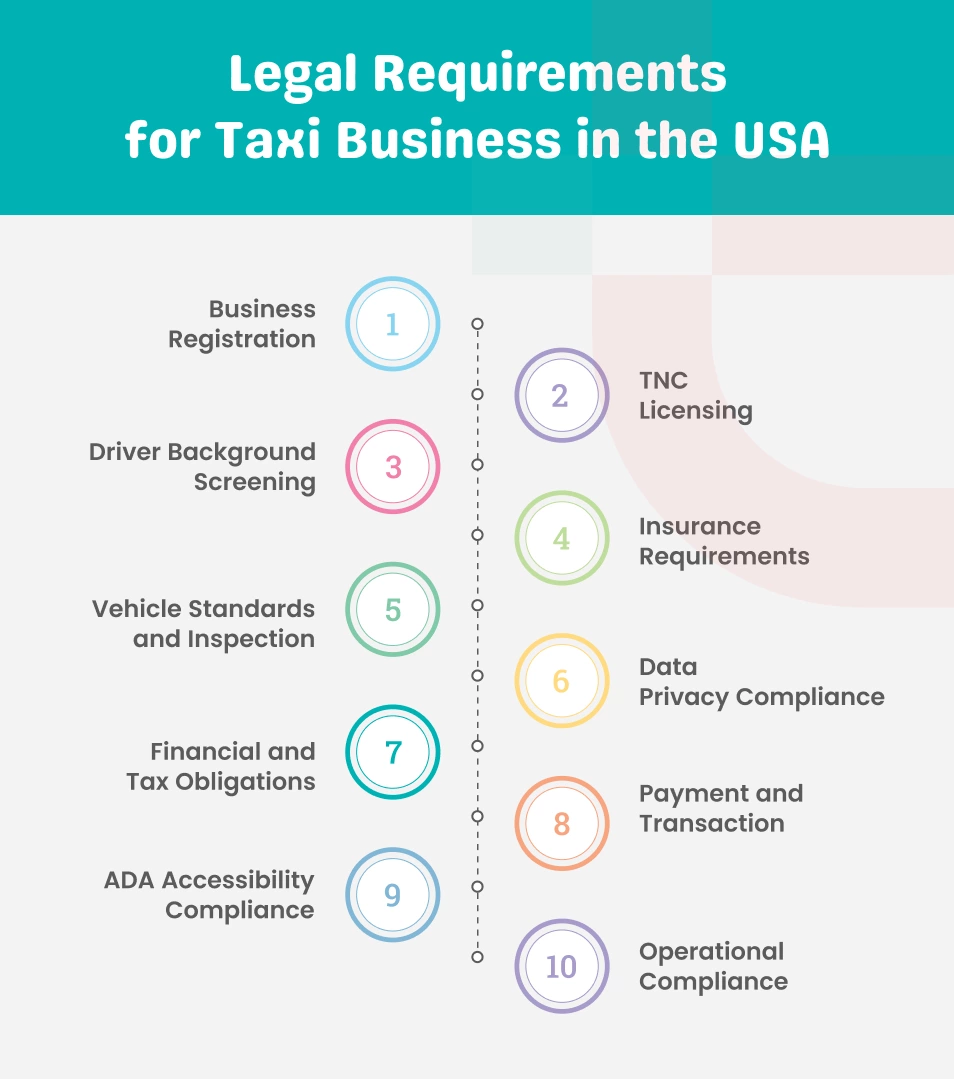
Regulatory compliance involves much more than just registering the business entity. Below is the complete step-by-step process, so you don’t miss out on any essential requirements.
1. Business Registration
Before applying for any license or permit, you should first register your business with the relevant state authority, usually the Secretary of State where you want to operate. This creates a legal identity for your company with the state and federal governments.
Choose the Right Business Structure
Business structure refers to choosing an appropriate legal entity to manage liability, taxation, and licensing. Taxi businesses must choose between LLC and corporation structures.
LLC
LLC protects your personal assets from being pursued for repayment of the company’s debts or liabilities. It is easier to set up and costs less to maintain. Due to this, it becomes suitable for early-stage startups.
Corporation
Corporation, on the other hand, is useful to raise investor funding and scale operations across multiple states. So, it is suitable for large-scale enterprises that want to expand.
After selecting the structure, you will have to:
- Register your business at the state level with the Secretary of State, where you want to operate
- Then obtain a Federal Employer Identification Number (EIN) from the IRS (Internal Revenue Service) for tax filing, payroll, and creating a business bank account.
- Open a dedicated business bank account to keep business financial handling separate from a personal one.
Apply for Local Business Licenses
Operating regulations not only vary by state, but also at the city level. Many cities have their own license requirements in addition to state-level regulations. For instance, Chicago and Boston require additional local permits along with state TNC (Transportation Network Company) licenses.
Also, if you plan to operate in specific locations like airports, you may need to meet additional requirements. Many local airports issue their own operating license separately. Ignoring such rules can delay the launch even if you have completed state registration. That’s why it is essential to map out every city-level requirement before starting the application process.
2. Secure a Transportation Network Company (TNC) License
TNC is a type of license mandated by the state and many federal governments for companies connecting riders with drivers through a digital platform. This is one of the most critical legal requirements for the taxi business in the USA. Without it, you cannot operate legally in any state or city.
Unlike traditional taxis or limousines, on-demand cab booking businesses operate through an app-based dispatch system and not a physical one. That’s why it is essential to fulfill. This permit ensures that your business is compliant with local transportation rules, insurance obligations, and safety standards.
How TNC Licensing Works in Different States?
There is no single federal TNC license. These permits vary by state and sometimes by cities. Here are some examples of major states having varying regulations.
| State | Governing Authority | License Fee | Key Requirement |
|---|---|---|---|
| California | CPUC (California Public Utilities Commission) | Around $1,000 | Requires a TNC permit valid for three years, with separately defined insurance coverage periods. |
| Texas | TDLR (Texas Department of Licensing and Regulation) | Varies | Statewide TNC permit needed. Also, airports may impose additional regulations; record-keeping is required for 5 years |
| New York State | NY DMV (Department of Motor Vehicles) | Varies | The TNC Act applies across the state, but New York City has separate TLC requirements. |
| Massachusetts | TNC Division (Department of Public Utilities) | Varies | Needs a formal permit application with complete business and driver documentation |
| Washington (Seattle) | Dept. of Finance & Admin. Services | Per-ride fee | Requires annual license approval along with dispatch application approval; charges 18-cent per-trip fees for rides within Seattle |
Note: TNC licensing rules, fees, and requirements change frequently and vary by location. So, always check with the relevant state or city authority before applying to ensure you meet the latest regulations.
Get a TNC License for Every State You Want to Expand
A TNC license will be only valid in the state where it is issued. You will have to apply for a separate permit in each location if you want to expand operations in multiple states.
Besides state-level permits, some cities like San Francisco and New York City also require local licensing. So, always keep legal requirements at the top whenever you plan to scale across different states.
TNC License Application Requirements Common Across Most States
You would need to provide the following documents along while applying for TNC licensing:
- Proof of business entity registration
- Proof of insurance coverage meeting state minimums
- Background check policy
- Driver screening and onboarding protocols
- Digital dispatch application details
- Accessibility compliance plan
Expert Tips:
TNC licensing can take significant time. So, it’s better to start applications 3 to 6 months before your intended launch date.
3. Meet Driver Background Screening Standards
Drivers are an integral part of your taxi business, not just for fulfilling demand but also for building your brand credibility and rider trust. In case of not following proper standards, it can create legal liability that shuts down your operations. So, driver screening is a legal obligation and not an optional process.
What Driver Background Checks to Perform?
Before onboarding any driver on the platform, perform detailed background checks based on state and city regulations. Usually, most screening procedures include:
- Full criminal background checks at both the national and county levels
- Sex offender registry checks, which are mandatory in most states
- Examine driving records by looking for reckless driving, serious traffic violations, and DUIs.
Most states specify how far back this process must go, usually 7 years or even more, based on local regulations. Many states also require ongoing monitoring, meaning you need to track drivers’ performance and behavior regularly after onboarding them.
Complete Driver Eligibility Criteria
Background checks are just one part of driver eligibility standards. There are several other criteria that every driver should meet before starting to operate for your business. This will include:
- Drivers must be at least 21 years of age. (The age criteria will vary by state, but it is a compulsory criterion. So confirm it for every market you want to operate in.)
- There should not be felony convictions in the past 7 years. Such drivers should not be allowed to operate.
- Every driver should have valid documentation of vehicle registration and ownership.
- They should have incorporated valid licenses for a minimum period as specified by the state government.
Besides these requirements, in many cities like Seattle, drivers have to complete a defensive driving course and a professional conduct training program before operating. Compliance with these standards helps you ensure rider safety.
Understand Driver Classification Rules
In the case of on-demand taxi businesses, drivers are classified as independent contractors and employees. Proper classification is a must to prevent serious legal consequences. Misclassification can result in back taxes, lawsuits, and costly penalties.
Expert Tips:
Many businesses speed up the driver onboarding process to launch faster, which poses a significant risk to rider safety. It would be better to include automated background screening workflows directly in the platform. This will enable faster time-to-market while ensuring regulatory compliance.
4. Fulfill Insurance Requirements for Your Business
Insurance is the most complex requirement for legal compliance for the taxi business in the USA. However, it is essential, as personal auto insurance typically does not cover accidents that occur while working for on-demand transportation platforms.
Types of Insurance You Will Need
There are two types of insurance:
- Commercial Auto Insurance: It covers vehicle-related damage caused during operations.
- Liability Insurance: It protects your business from any liability caused by injury or damage to riders, third parties, or property during the trip.
Both these insurances are mandatory to protect your business from legal risk.
The Three Insurance Periods You Should Know
Insurance is divided into three operational periods, and each of them has its own unique coverage requirements.
- Period 1 (App on, no ride request yet):b> It starts the moment the rider logs into the app. In this phase, minimum primary liability per person will be $50,000, $100,000 per incident, and $25,000 for property damage caused during accidents. Also, many states, like California, require additional excess coverage of $200,000.
- Period 2 (Ride accepted, passenger not yet in vehicle):b> It applies when the driver accepts the ride, but the rider is not yet picked up. In this stage, $1,000,000 is needed in primary commercial liability insurance.
- Period 3 (Passenger in vehicle):b> This covers the time when the rider enters the vehicle. It will require $1,000,000 in primary commercial insurance along with $1,000,000 in uninsured or underinsured motorist coverage.
Decide Responsibility for Insurance Coverage
This is where many taxi businesses get confused. You should clearly define who will be responsible for insurance coverage. Responsibility is structured in three ways.
- The platform acquires its own TNC insurance policy covering all drivers operating in it.
- Each driver has their own TNC-specific insurance policy
- A combination of both, where the driver’s policy covers Period 1, while the company’s policy applies in Period 2 during high risk.
You can choose the appropriate structure based on factors like:
- Size of your driver network: Businesses with a large driver network usually opt for a platform-level policy.
- Cost considerations:b> Acquiring a platform-level policy includes more upfront costs, but it provides full business control. On the contrary, a driver maintained structure is less expensive but requires constant compliance monitoring from your end.
- Risk Involved: The platform is still exposed to liability if the driver’s policy lapses without your knowledge. Due to this, many businesses handle policies by themselves.
- State you operate in: In some states, it is compulsory for businesses to hold the primary policy. In such scenarios, you are not left with any choice but to go for a platform-maintained structure.
- Business Stage:b> Startups often choose a combination structure due to its affordability. While established enterprises usually opt for a platform-maintained structure to ensure cleaner compliance.
No matter which structure you choose, your platform must check regularly that every driver operating on the platform has active insurance at all times. Also, some states have stricter regulations. For instance, New York state requires $1,250,000 in liability coverage when the rider is in the vehicle.
5. Comply with Vehicle Standards and Safety Inspection Needs
Not every vehicle will qualify to operate on the platform. You should permit those who comply with local regulations. These rules are meant to ensure rider safety, reduce accident risks, and maintain the quality standards of your business.
Check Vehicle Age and Condition
Each vehicle should meet the following baseline requirements before going live on the platform.
- They should not be older than 10 to 16 years. The exact age criteria will vary by state and city.
- Should incorporate four doors and a seating capacity of at least four riders.
- All of them must have clean titles and no salvage history. Any visible damage, like structural issues or component defects, impacts safety and so is not allowed to operate.
- None of them should have major modifications from their original factory design, as it can affect safety compliance.
Inspect Vehicles Periodically
In addition to basic compliance needs, many states need annual or periodic safety inspections for vehicles to ensure safety compliance.
For example, the California Public Utilities Commission (CPUC) mandates a 19-point vehicle inspection before approval and even during continued operations. It primarily covers checking important components like brakes, lights, seat belts, and tires.
Also, many states even limit the maximum seating capacity. According to the California Standard, there should be a maximum of seven passengers on a trip, including the driver. Inspection records should be maintained and reported in many jurisdictions.
You are required to have a system that can track inspection dates, store documentation, and flag vehicles that are due for renewal. This will help you ensure consistent service quality.
6. Ensure Data Privacy and User Protection Compliance
Since the platform will handle sensitive information of riders and drivers, like location and bank account details, it is required to meet data privacy standards. Noncompliance can result in significant fines and loss of user trust. These requirements usually differ at both the federal and state levels.
Understand Federal and State Privacy Regulations
Data privacy rules usually differ at both the federal and state levels. And it is compulsory for you to comply with each regulation.
- California Consumer Privacy Act (CCPA)b> applies to every business that handles data of California residents, regardless of the company’s location. You are required to meet this requirement even when any one of your users is a California resident.
- States like Virginia, Illinois, and Coloradob> have their own privacy laws, and you need to comply with each state’s legislation if you want to operate in multiple states.
Privacy regulations usually apply to the following types of user data:
- Payment information
- Identity data of both riders and drivers
- User location data
- Trip history
How to Implement Privacy Regulations?
Having a dedicated privacy page on the website is not enough to ensure security compliance. You need to implement those practices practically on the platform. For this,
- Create informed consent where users should explicitly permit you to collect their information before you gather anything.
- Apply data encryption measures to all sensitive information during storage and transmission.
- Give users the right to access, delete, or opt out of data gathering when needed.
- In case of breach activity, you must notify the affected users and relevant authorities immediately within a specific timeframe.
Applying strong measures helps you stay secure and build long-term trust among users.
Expert Tips:
Privacy compliance should be baked into the platform from the beginning instead of bolting it on afterward. So, while choosing a technology provider, make sure to ask whether the solution involves CCPA-ready data handling, data encryption, and consent management built in.
7. Know Financial and Tax Obligations Clearly
Taxation is a core requirement for taxi booking business legal compliance in the United States. These apply to your company, drivers, and payment infrastructure, followed by your platform. Not adhering to these rules can result in financial liabilities and penalties.
Types of Business Tax Requirements
Your business must fulfill both federal and state tax requirements.
Federal Taxes
You need to file corporate income tax returns with the Internal Revenue Service (IRS). The tax rates will vary depending on the type of business structure (LLC or corporation) you have.
State Taxes
Regulations for tax filing differ in every state. Some may charge a corporate tax, others have no state income tax at all, while many would charge a franchise tax.
In order to ensure proper compliance, you should register with the tax authority in every state you operate in. Working with a tax professional who has a complete understanding of state-level operations can help you.
Understand the Driver’s Responsibilities for Taxation
It is essential for drivers who operate as independent contractors to pay self-employment taxes. In such cases, the platform does not withhold payment of tax on their behalf.
However, you are still responsible to provide form 1099-K to drivers for tax filing. This is a mandatory federal requirement that you need to fulfill. Failing to issue forms can lead to severe penalties from the IRS.
8. Payment and Transaction Standards to Follow
It is essential for the platform to process all transactions through a secure payment system. Besides, you should comply with two essential standards.
Digital Payment Regulations
If the platform supports in-app payments and digital wallets, then it is mandatory for you to adhere to state-level money transmission regulations. Even some states mandate having a money transmitter license for digital platforms. So, always get information about payment laws in the state you want to operate in.
PCI DSS
The Payment Card Industry Data Security Standard (PCI DSS) applies to every company that accepts and processes card payments. It is essential to meet this rule to keep users’ financial details safe and secure.
9. Meet ADA Compliance and Accessibility Standards
Americans with Disabilities Act (ADA) compliance is a critical but often overlooked requirement for businesses. Under this act, taxi platforms are required to offer non-discriminatory services to riders with disabilities. These requirements will basically include:
- Drivers cannot decline a ride request solely because the rider has a disability.
- Where mandated by state governments, the platform should offer wheelchair-accessible vehicles.
- Drivers cannot refuse a ride request or charge request just because the rider has a service animal.
Besides federal laws, several states and cities have their own ADA obligations for TNC operators.
- New York requires companies to submit accessibility plans and report progress of their services for people with disabilities.
- In California, you need to submit and update accessibility plans under the CPUC. Besides, you should also report annually on the number of accessible vehicles and completed trips.
- Seattle collects a 10-cent surcharge per trip to fund wheelchair-accessible services in the city.
Following these requirements allows you to stay compliant and also increase your customer base.
Expert Tips:
Accessibility is not just a legal checkbox. It creates good business opportunities if used wisely. Millions of Americans have disabilities. So, by including accessibility ride options in the platform, you can serve an underserved segment and also increase your customer base.
10. Stay Compliant with Operational Rules Post Launch
Acquiring necessary permits does not finish the regulatory work. You have to adhere to operational rules after the platform goes live. These rules will affect pricing, reporting, and customer handling. By avoiding these regulations, you keep your license at the risk of getting suspended.
Maintain Fare transparency
The most common regulation you will find under most state laws is that the fare or estimated fare must be clearly displayed to riders before booking confirmation.
Base rate, additional charges, and any surge pricing should be mentioned clearly. And in case of surge multipliers, you should also explain why and how rates have increased. This will help you maintain transparency with riders.
Keep Operational Records
All your operational records are legally required to be maintained typically for a minimum period of 2+ years. This data should include dispatch type, driver operating hours, number of completed rides, and accident and violation records, if any.
Moreover, some states have stricter reporting rules. In California, you have to submit annual reports to CPUC covering driver violations, accessible vehicles, and average driver hours. And Seattle requires you to file data reports electronically every quarter. Missing such reporting deadlines can cause fines and regulatory scrutiny.
Set Up a Proper Complaint Handling System
It is essential for every digital taxi platform to include a complaint handling system that riders and drivers can access easily through an app or website. This allows them to share their issues or disputes.
And regulatory bodies like DMV (Department of Motor Vehicles) and CPUC conduct periodic audits to check if complaint mechanisms are working well, and that user queries are resolved. That’s why this requirement is not optional but mandatory. Violations of these regulations can result in license suspension, revocation, or fines.
Planning to Launch Your Taxi Business in the USA? Connect with Elluminati to Explore How the Right Technology Can Simplify Compliance and Operations
State-Wise Differences in Legal Requirements for Taxi Business in the USA
Requirements for taxi booking business legal compliance in the United States vary from one state to another. So, if you plan to operate in multiple states, then you need to ensure regulatory compliance in every region. Here is what you need to understand.
Why Do Regulations Differ by States?
In the USA, regulations are primarily controlled at the state level rather than at the federal level. This means each state has the authority to set its own regulations for licensing, driver eligibility, insurance, and reporting.
So, what is legally acceptable in one state may not be correct in another. That’s why you should conduct detailed research to know the legal requirements of each location you want to operate in.
A Few Examples of Regulatory Differences Across States
The major differentiation between states falls significantly in two areas: driver classification and insurance. Here are a few illustrations.
Insurance Requirements
While a three-period structure is widely adopted in different states, the minimum liability limits may vary.
- New York requires $1,250,000 in liability coverage while a rider is in the vehicle, compared to a minimum of $1,000,000 in most states.
- California needs $1,000,000 in commercial liability and $50,000 and $1,000,000 during period 1.
Driver Classification
All states follow different standards for driver classification.
- Some states allow platforms to classify drivers as independent contractors, which keeps tax and benefit obligations with the driver rather than the business.
- But California’s AB5 law made stricter rules, which made classification difficult for businesses, which pushed many drivers to employee status with full benefits and tax obligations.
- States like Florida and Texas have passed rules to protect independent contractors for gig workers, which makes compliance hassle-free for businesses operating there.
Common Legal Mistakes to Avoid While Launching a Taxi Business in the USA
Many businesses mostly focus on acquiring riders and drivers while starting a taxi business in the USA and overlook regulatory compliance. But missing even one requirement can land you in legal trouble. Here are some common mistakes that you should avoid.
Launching without a TNC License
Many businesses believe that a standard registration is enough to start operating. But in reality, you also need to have a TNC license for every state and many cities you want to operate in. So, always secure the required license before launch.
Incomplete Driver Background Checks
Entering the market quickly is the topmost priority of every business. And for this, most entrepreneurs do not perform driver background screening in depth. This exposes the platform to compliance and safety risks. You should include an automated screening workflow in the onboarding process to meet regulatory standards.
Using Personal Insurance, Not TNC Coverage
Some platforms launch with drivers who only have personal auto insurance. This can lead to financial liability during accidents. So, always secure commercial TNC insurance covering all three trip periods before hiring any driver.
Treating Privacy Compliance as Optional
Since the platform handles sensitive data, ignoring data privacy laws can result in heavy fines and legal risks. You should incorporate privacy compliance features in the app, like user consent and data encryption, from day one.
Ignoring City-Level Permits
Many cities like Chicago, Boston, and San Francisco have their own set of rules for taxi businesses. But many founders overlook them, resulting in business suspension. And so it is essential to verify all requirements before starting operations in any region.
Expert Tips:
The cost of getting compliance wrong is always higher than the cost of building it in from the start. License revocations, legal settlements, and fines have led to the shutdown of several promising ventures. Partnering with an experienced technology provider can help you map out legal requirements before building the platform, which can help you ensure compliance.
Planning to Launch Your Taxi Business in the USA? Let’s Connect to Know How Elluminati Can Help Build a Technology Solution While Ensuring Legal Compliance
Checklist of Legal Requirements for Taxi Business in the USA
Pre-Launch:
- Business entity registered at the state level (LLC or Corporation)
- TNC license applied for in each target state
- Obtained EIN from IRS
- Secured Commercial insurance coverage for all three trip periods
- Local business licenses and airport permits identified
- Documented vehicle standards and inspection requirements
- The driver background check process has been established
- Privacy policy and data handling procedures drafted
- Created ADA accessibility plan
At Launch:
- Fare transparency and surge disclosure are active in the app
- The complaint handling mechanism lives in the app
- Driver training and onboarding documentation are complete
- Operational records system in place
Ongoing:
- Annual/quarterly regulatory reporting scheduled
- TNC license renewal dates tracked
- Driver and vehicle re-verification processes are automated
- Privacy law updates monitored across operating states
How Elluminati Makes Legal Compliance Easy for Taxi Businesses in the USA?
Meeting legal requirements for the taxi business in the USA is not only a legal task but also a technology challenge. Features like driver screening workflows, fare transparency, data encryption, insurance verification, and operational reporting should be included in the platform to ensure compliance at every stage.
With 14+ years of experience serving 450+ mobility businesses worldwide, Elluminati provides strategic business consultation and builds on-demand taxi solutions tailored to specific regulatory needs. As a reliable taxi app development company, we help businesses align their platforms with legal requirements while ensuring smooth scalability and market launch.
FAQs
Taxi businesses usually require business registration, state and city-level TNC license, insurance, driver verification compliance, data privacy regulations, vehicle standards, and inspections.
Yes, every state has its own TNC licensing requirements. So, you will have to apply for and obtain a separate permit to operate in each state.
No, because standard personal auto insurance policies do not cover commercial taxi-booking activities. It is the responsibility of companies to provide commercial insurance that covers all three trip periods, from app-on to rider dropoff.
It has three periods:
- Period 1: the minimum is $50,000 per person, $100,000 per incident, and $25,000 for property damage.
- During Periods 2 and 3, $1,000,000 in primary commercial liability is required in most states.
Yes, taxi businesses should provide non-discriminatory services to riders with disabilities, allow them to accommodate service animals, and are also required to submit accessibility plans and annual reports to regulators in most states.
The timeline will vary by state. So, you will have to begin to apply 3 to 6 months ahead of the intended launch date.
A white label solution usually includes compliance-ready features like driver background checks, fare transparency, data encryption, and complaint management. However, the platform operator and not the software provider is responsible for obtaining all essential licenses and ensuring regulatory compliance.
It usually costs around $15,000 to $100,000+. However, it will differ based on state and city requirements, licensing fees, insurance coverage, and operational scale.
This depends on the state regulations where you intend to operate.
Requirements for taxi booking business legal compliance in the United States are not uniform. Each state sets its own rules for insurance, business registrations, and licensing.
No, a legally registered business entity is required to start taxi service operations.