Key Takeaways (or TL;DR)
- Starting a ride-hailing business with an Uber like app in the UAE is a great opportunity for new entrants due to increasing niche-specific demand, lower time to market, and multiple income streams.
- Entrepreneurs can launch a taxi business with an Uber clone in the UAE by researching the target audience, choosing the right business model, obtaining the legal requirements, setting up a fleet, and partnering with an Uber clone app company.
- Legal requirements like RTA approvals, Department of Transport, and SRTA approvals are mandatory if you’re operating in specific emirates like Dubai, Abu Dhabi, or Sharjah.
- An Uber clone must include UAE-specific features like Arabic language, real-time tracking, scheduled rides, driver and fleet management dashboard.
UAE’s ride-hailing market is growing, with exponential demand for various service-specific segments like corporate transportation, limousine services, and women-only taxi services. If we look at the demand, there are several factors, such as a strong market trajectory, high smartphone adoption, and expat-driven demand, that are the reasons behind the high requirement for taxi services.
This guide is for entrepreneurs who want to start a taxi business with an Uber clone in the UAE, navigating legal requirements, technical decisions, and want to target a specific service segment.
In this article, we will walk you through a detailed guide including legal requirements, must-have app features list, cost breakdown, marketing strategies, and common mistakes that you can avoid at the time of launch.
Why Start a Taxi Business With Uber Clone in the UAE?
Before we go in-depth into the process, it is necessary for you to understand why launching a ride-hailing business with an Uber clone in the UAE can be a great opportunity.
Rapid Growth of the UAE Ride-Hailing Market
According to the report, the UAE ride-hailing market revenue is expected to reach $2,366.3 million in 2033, with a CAGR of 18.7% from 2026 to 2033. The demand is increasing due to underserved segments, technology integrations like AI-powered route optimization, data analytics to predict demand, IoT in autonomous driving cars, and customer preference for eco-friendly EVs.
Lower Time-to-Market with Uber Clone App
Custom ride-hailing apps typically take 12 to 18 months and require a dedicated technical team. Whereas a white label Uber clone app saves time for development because it is already deployment-ready and only requires a few customizations for branding. The core architecture of the taxi app is already built and tested.
Cost-Effective Alternative to Custom App Development
The upfront cost of custom ride-hailing app development is higher than that of a white label, ready-made solution. For a startup, that difference is way too high; rather, invest in fleet, driver acquisition, and marketing. Uber clone comes with ongoing technical vendor support, which removes the dependency on an in-house development team during the critical phase of launch.
Strong Revenue Potential with Multiple Income Streams
With an Uber clone, you can layer multiple income streams with in-built pricing features like surge pricing, subscription fees for both drivers and customers, in-app advertisements, and corporate accounts. The architecture of a modern white label solution will help you create a strong revenue model with diverse income sources in the UAE.
Proven Business Model With High Success Rate
The Uber clone is a replicated version of Uber, which means the business model of the Uber clone has validated the demand, payment behavior, and operational model across the UAE.
You just need to endorse a specific niche in a single emirate first, consistently fulfilling demand for verticals like corporate fleets, women-only taxis, and luxury transfers, where global taxi businesses barely operate, which enables you to offer taxi services to underserved regions.
How to Start a Taxi Business with Uber Clone in the UAE – Step-by-Step Guide
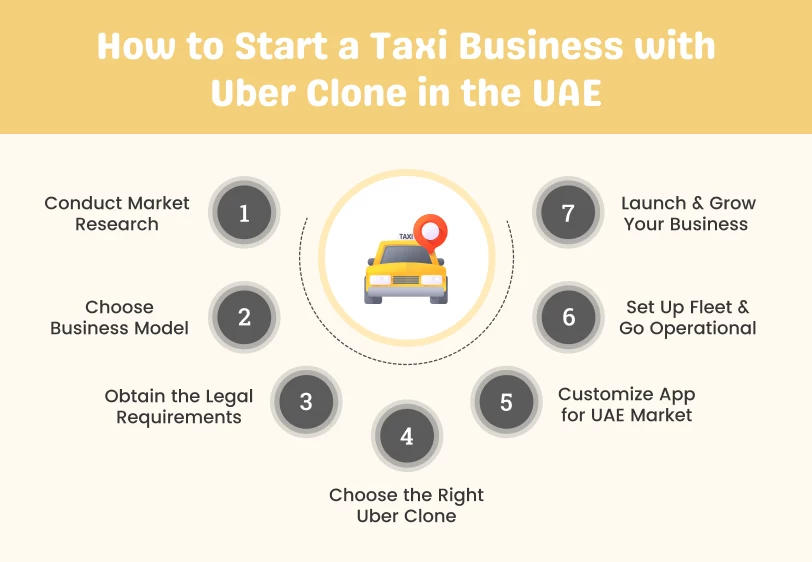
The step-wise guide below will help entrepreneurs who don’t know how to start a taxi business with an Uber clone in the UAE.
Step 1: Conduct Market Research & Define Your Niche
One of the reasons why taxi businesses fail isn’t a lack of funding, but because of improper market research and an undefined service niche. Before any further business planning, it’s essential for entrepreneurs to map the competitive landscape of major taxi players like Careem, InDrive, and other local taxi companies.
Analyze pain points of competitors and service areas that they’re lacking. For instance, service gaps such as
- Luxury rides in Dubai
- Corporate transport in Abu Dhabi
- Women-only taxis in Sharjah
- Airport transfers for travelers who prefer premium rides
Key research areas that you can cover
- Competitor pricing models and user reviews
- Peak demand hours and high-traffic zones in a single region
- Payment preference, such as card payment methods, but cash is still preferred in certain regions.
- Service gaps include luxury, accessibility, wait times, eco-friendly taxi services, and corporate accounts.
Step 2: Choose Your Business Structure
The business model you choose shapes everything your service provides, including cost structure, operational efficiency, and scalability of your business. Primarily, there are three types of business models in the UAE that you can choose from.
| Business model | What is it? | When you can choose this model | Scalability |
|---|---|---|---|
| Aggregator model | You own the platform and connect customers with independent drivers. | To launch quickly with low capital, and prefer a commission-based revenue, and don’t want to manage a fleet or employ drivers directly. | Scalability is high because independent drivers can join the platform. |
| Fleet ownership model | You own or lease vehicles and employ drivers for taxi services. | When service quality and brand consistency are your priority, and you’re targeting a premium or corporate market segment. | Limited opportunity because it requires a proportional fleet and high investment. |
| Hybrid model | A combination of both models, you own vehicles and also let independent drivers join your platform. | When you want multiple revenue streams, have moderate capital to start a small fleet, and plan to scale gradually by adding independent drivers over time. | While expanding the fleet requires high investment, the independent partner model could scale freely. |
Step 3: Obtain the Required Licenses & Regulatory Approvals
As an entrepreneur, underestimating legal requirements can affect your business. The UAE’s transport licensing system is emirate-specific. For example, in Dubai, the Roads and Transport Authority (RTA) regulates taxi and ride-hailing operations.
Similarly, Abu Dhabi falls under the Department of Transport (DoT), while Sharjah’s transport system operates under the Sharjah Roads and Transport Authority SRTA.
That is why attempting to launch without authority approvals can lead to fines and even a shutdown. Beyond the transport license, your platform must comply with the UAE Cybercrime Law, which covers user data handling, payment security, and app-based transactions.
Step 4: Choose the Right Uber Clone App Platform
Verifying your app’s overall workflow beyond features is essential. Start with deployment readiness and ask whether your technology vendor offers a white label app for both iOS and Android, including a fully functional admin panel, a separate driver and passenger app.
Assess the UAE-specific capabilities on the platform, such as Arabic language support, local payment gateway integration (e.g., Telr and PayTabs), and map accuracy for Dubai & Abu Dhabi address formats, which differ significantly from Western geocoding.
Prioritize partners with documented deployments in the UAE or the wider Middle East region, and clear Service Level Agreements (SLA) commitments on technical support. Ensure that the app is scalable as your fleet and operations grow.
Make sure to include standard ride-hailing features such as a dynamic geolocation for real-time GPS tracking, surge pricing, fare management, ride scheduling, airport pickup mode, two-way ratings, and performance analytics.
Step 5: Customize Your App for the UAE Market
Brand the app with your business name, customize UI colors, and onboarding screens. To position your taxi app in Dubai, your platform must reflect the behavioral expectations and service standards of the regional market.
Integrate your service category, such as airport transfers, hotel pickups, and corporate transportation, along with fleet variations, because the customer base in the UAE has varied preferences when it comes to service tier and fleet diversity.
Step 6: Set up Fleet, Hire Drivers & Start Operations
For initial lean launch city deployments in Dubai or Abu Dhabi, a fleet of 10 to 50 vehicles is realistic and manageable. Starting with the driver-partner segments where independent drivers offer taxi services with their own vehicles, and you provide a dispatch system, this dramatically reduces upfront capital compared to the cost of leasing a fleet.
Onboarding drivers in the UAE requires specific documentation, such as a driving license, background verification, authority-issued driver permits, and RTA-compliant vehicle registration.
If you want to own the fleet, then make a contract for drivers, make sure your vehicles meet transport authority standards for ride-hailing operations, and have commercial insurance coverage.
Step 7: Launch, Market & Grow Your Ride-Hailing Business
Before the public launch, deploy your taxi app to the App Store and Google Play Store with an ASO-optimized description, including app screenshots and a selected category.
A soft launch can let you validate dispatch performance, driver retention, and customer support workflows. For riders, use customer retention strategies such as offering first-ride discounts, which generate initial booking volume.
To drive early customer acquisition, leverage performance-driven advertising channels, such as Google Ads, to target high-intent search queries from customers actively seeking taxi services in the UAE. In the launch phase, this approach helps you convert ROI and lower costs.
Additionally, include built-in marketing tools such as promo codes, push notifications, and loyalty wallet mechanics in your ride-hailing app. This directly reduces your cost and dependence on an external marketing agency to validate your fresh launch in the UAE.
Expert Tip:
Startups can target underserved niches to differentiate from the saturated general ride-hailing segments.
| Niche | Opportunity Size | Entry Barrier |
|---|---|---|
| Corporate Rides | High | Contracts are a must |
| Women-only taxi services | Medium (safety-focused demand) | Driver training |
| EV luxury rides | Growing with 80% e-booking push | Fleet investment |
| Pet-friendly services | Emerging | Low regulatory barrier |
Schedule a Free Consultation With Elluminati’s Expert Team to Turn Your Taxi Business Idea into a Market-Ready Platform
Legal Requirements to Start a Taxi Business with Uber Clone in the UAE
To successfully launch a taxi business with an Uber clone in the UAE, you must comply with all required regulations. Here is a list of permits and legal requirements.
Choose the Right Business Jurisdiction
Starting a taxi business on the UAE Mainland allows you to operate across all emirates without geographic restrictions. Unlike the pre-2021 rules, foreign entrepreneurs can now own 100% of their Mainland company.
Moreover, if you choose to operate from a UAE free zone, you also benefit from 100% foreign ownership. However, this comes with a compromise: companies cannot directly serve the UAE Mainland. To scale gradually in the Mainland, you have to appoint a local established separate Mainland branch.
Obtain Taxi & Transport Authority Licenses
In Dubai, the Roads & Transportation Authority (RTA) regulates app-based ride-hailing businesses; without it, you cannot operate a single vehicle. Similarly, if you want to operate in Abu Dhabi, then you need to register under the Department of Transport (DoT), which oversees vehicle licenses, driver certification, and platform compliance.
That is how permit types and license timelines vary by emirate and business structure, so build a strategy to fulfill legal requirements before scheduling the launch.
Vehicle Registration & Compliance Requirements
If you’re going to purchase or lease vehicles, then you need to register your fleet under RTA regulations and meet standards for commercial passenger use. Including vehicle age, condition, metered or app-based taxi service type, and other inspections.
Additionally, Commercial insurance is also mandatory and must cover passenger liability and driver’s insurance. Non-compliant vehicles can lead to unwanted penalties for your business.
Driver Permits & Employment Regulations
You must also ensure that drivers hold a valid UAE license and other authority-issued permits, depending on the different cities and states. Moreover, for employed drivers, compliance with the UAE labor law and valid residency visa documentation is required.
Entrepreneurs can create a legally structured working contract to avoid any disputes for independent drivers. This contract clearly defines responsibilities and service expectations, minimizing the risk of operational obstacles. A well-drafted agreement also gives you control over the service quality and lets you enhance operational efficiency.
App Compliance & Data Protection Regulations
Operating an app-based taxi business in the UAE means you must comply with the UAE cyber laws and regulations governing user data protection, including ride history, locations, and phone numbers. New entrants must integrate a secure payment gateway to enable seamless end-to-end payments.
Key Features Your Uber Clone App Must Have for the UAE Market
Below are the features that your platform must have for a standard ride-hailing app in the UAE.
Passenger App
- Live driver tracking
- Multiple payment options
- Language toggle – Arabic/English is mandatory
- Scheduled rides
- Emergency/Safety features
- Transparent fare estimate
Driver App
- Real-time ride requests with accept/decline control
- Optimized navigation
- Route suggestions
- Earning dashboard
- Driver rating, visibility, and performance reports
Admin Panel
- Full driver and fleet management dashboard
- Dynamic surge pricing controls
- Promo and discount campaign manager
- Business analytics: trip data, revenue, peak zones
- Dispute and support ticket management
How Much Does it Cost to Launch a Taxi Business in the UAE with Uber Clone?
Cost is one of the top concerns for any founder planning to start a ride-hailing business with an Uber like app in the UAE. Here’s a realistic breakdown:
| Cost Component | Estimated Range (AED) | Notes |
|---|---|---|
| Uber Clone App Development | AED 18,363 – AED 91,813 | On-time or Subscription model, depending on the vendor |
| UAE Business License | AED 11,018 – AED 29,380 | Vary by Free Zone vs. Mainland |
| RTA/Transport Authority License | AED 7,345 – AED 18,363 | Per emirate, annual renewal |
| App Customization & Branding | AED 3,673 – AED 18,363 | Localization, language, UI |
| Marketing & Launch Budget | AED 18,363 – AED 55,088 | Ads, ASO, promo campaigns |
| Fleet (if owned) | AED 183,625+ | Optional — driver partner model saves this cost |
| Total Estimated (Lean Launch) | AED 55,088 – AED 183,625 |
Want an Estimate Quote Aligned with Your Business Model? Let Our Experts Guide You to Launch a Taxi App in the UAE on an Effective Budget
Common Mistakes to Avoid When Starting a Taxi Business with Uber Clone in the UAE
Here are some common mistakes to avoid when you start a ride-hailing business with an Uber like app in the UAE.
Ignoring RTA & Transport Authority License Requirements
The most common and costly mistake is ignoring RTA regulations and launching operations without transport authority license approvals. Rules violations can lead to fines, legal penalties, and a potential ban on business. Build a strategy to follow the timeline for legal documentation work from day one of launching the plan.
Not Offering Arabic Language in the App
In the UAE, the official language is Arabic, and the majority of people speak that language. Not offering Arabic language in the app can typically lead to a lower retention rate because non-expat customers mostly prefer apps with multilingual integration. This can lead to reduced app store discoverability in Arabic language search queries.
Choosing the Wrong Uber Clone Development Partner
Choosing a technology partner who doesn’t have app deployment experience for the UAE or GCC region can cost you time and money, which delays your launch. A tech vendor must have knowledge of local compliance requirements, Arabic right-to-left (RTL) interface standards, and UAE map accuracy.
Underestimating Driver Acquisition and Retention
Drivers are the core of your platform, and ignoring driver acquisition can lead to long wait times and inconsistent service availability, which harms your platform’s reliability and stalls operations. To build a strong driver network, plan a dedicated driver-acquisition budget that includes joining bonuses and guaranteed minimum earnings before launch.
Trying to Compete Directly with Uber from Day One
Positioning your launch as a head-on challenge to Uber is a capital-inefficient strategy for a new entrant. These platforms have brand recognition, driver supply depth, and rider trust that took years and hundreds of millions of dollars to build.
New operators can enter the ride-hailing market of the UAE, focusing on niche services that remain untapped by giant taxi business competitors.
Marketing Strategies for Launching a Taxi Business with Uber Clone in the UAE
Now that you’ve seen the whole guide on how to start a taxi business with an Uber clone in the UAE, it’s essential for you to understand key marketing strategies for your services.
App Launch & Go-to Market Strategy
Soft launching in one emirate gradually is far better than scaling directly to multiple cities. This approach allows you to test the dispatch performance, customer support workflows, and driver supply before you commit to a full marketing budget.
For the application, App Store and Google Play deployments should be completed and approved by ASO validation before any public promotion begins. Once your operations are stable, implement marketing strategies like Uber for your ride-hailing services. After launching, offer first ride discounts and promo codes for early customers, which generate initial ride volume.
Local SEO & App Store Optimization (ASO)
Entrepreneurs can invest in local SEO and create city-specific landing pages with targeting keywords like “taxi service Dubai” and “cab app Sharjah.” Additionally, your app store listing should be optimized with keywords in both Arabic and English descriptions. By investing in SEO and ASO, you can easily validate high ROI in the UAE.
Paid Advertising & User Acquisition
You can opt for Google Ads to target high-intent, location-specific queries, or Meta Ads for app installs with UAE geo-targeted audiences based on early customer data. Once your platform gains an initial user base, run customer campaigns at launch and spread awareness among them.
Driver Acquisition Strategies
Driver acquisition cost is as important as the rider acquisition plan. You can structure this cost by using driver retention strategies, such as referral programs, where existing drivers earn bonuses for referring your platform to new independent drivers.
Offer drivers guaranteed earnings for the first 30 to 60 days. By doing this, your platform reduces the risk of driver churn and gains more driver supply.
Customer Retention & Loyalty Programs
Offer In-app loyalty wallets with cashback on repeat rides, push notifications triggered by usage patterns, and referral rewards to customers who bring new users. Plan a strategic corporate account program with monthly billing and dedicated support that creates high-retention and lifetime value customer segments.
How Elluminati Can Help You Launch a Taxi Business with Uber Clone in the UAE?
Starting a ride-hailing business with an Uber like app in the UAE is one of the smartest approaches to enter the rising taxi service industry. The demand is increasing, infrastructure is developing, and the UAE has specific niche opportunities.
At Elluminati, we offer an Uber clone that aligns with your vision, helps you to scale across multiple emirates, and supports long-term growth. Our solution has in-built features like real-time tracking, multiple language support, and dedicated apps for passengers & drivers, which help you drive your business towards growth strategically.
FAQs
The total estimated cost to start a taxi business with an Uber clone in the UAE typically ranges from AED 55,000 to AED 184,000. The final costing may vary based on factors such as app customization, special licensing requirements, and level of complexity. The fleet ownership cost is excluded.
Yes, by targeting a specific niche and choosing the right business model, you can layer multiple revenue streams, such as surge pricing, in-app advertising, and platform fees.
Yes, RTA approval is mandatory, especially in Dubai, for commercial ride-hailing operations. The specific licensing authority varies by city, including the Department of Transport (DoT), which governs Abu Dhabi, and the Sharjah Roads and Transport Authority (SRTA) that covers Sharjah. Operating without the appropriate license in any emirate is a regulatory violation.
Yes, from 2022, the UAE commercial law has expanded eligibility for foreign ownership across several sectors. Free Zone registration offers 100% foreign ownership, though the operational scope is geographically limited.
With a white label Uber clone platform, the app configuration and deployment timeline typically takes 2 to 3 weeks. Whether the custom taxi app development process could take upto 4 to 6 months.