Key Takeaways (or TL;DR)
- Uber is strongly focused on the US’s metro regions like Dallas and New York, which creates opportunities for new businesses in suburban and rural areas it underserves.
- State-level regulations with licensing, insurance, and driver policies from the beginning change the competitive math city by city.
- Fixed and transparent pricing models can build trust among customers in the markets where surge pricing often faces criticism.
- A smaller driver network ensures effective management and consistent service quality.
- Serving specialized segments like NEMT (Non-emergency Medical Transport), university towns, tribal lands, and rural regions can help you differentiate your brand from Uber.
- A ready-made white-label ride-hailing platform gives complete brand ownership and helps you launch faster.
Uber dominates the US ride-hailing market, but that dominance is not evenly distributed. The gaps are largest exactly where a regional operator can afford to compete. If you are planning to launch or grow a ride-hailing business, understanding those gaps will help you compete with Uber in the USA effectively.
This article will help you understand where and how to position specifically against Uber, in the US market, using the regulatory and geographic terrain Uber’s scale leaves exposed.
Where is Uber Actually Vulnerable in the US Right Now?
The US ride-sharing industry continues to grow, with Uber and Lyft together dominating the market, holding roughly 76% and 24% market share.
But this dominance does not mean there are no opportunities left for new businesses. There are some areas where Uber falls short and opens a way for new operators.
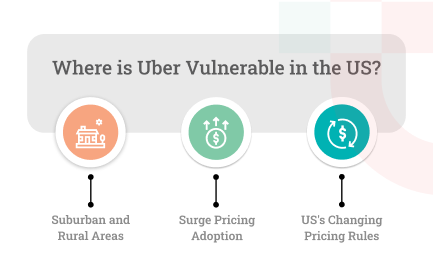
Suburban and Rural Areas
In its FY2025 10-K report, Uber clearly stated that the company heavily relies on large metropolitan markets and airport trips for operations. That’s the reason the platform is operating mostly in the US’s metro cities like New York, Dallas, Los Angeles, Atlanta, and more. This is because in suburban and rural regions,
- Most people own cars for daily commuting, which creates less demand for ride-hailing services.
- Due to the low cost of living, people in these regions are less willing to pay premium fares.
- Drivers have to travel longer distances between pickup and drop-off points, which burns more fuel and increases operational costs. However, fares are charged at a lower rate.
Regional operators can compete in these regions by offering specialized services like airport transfers or corporate transportation, which do not depend on car-owning commuters.
Surge Pricing Adoption
Uber operates on a dynamic pricing model in which fares increase automatically during high-demand periods like peak times, special occasions, and bad weather conditions. Higher fares encourage drivers to remain available during busy times.
Although Uber has explained how surge pricing works on its official website, many riders still consider it to be unpredictable and are skeptical of it. However, most riders consider it to be unpredictable. You can turn this into a competitive advantage by offering transparent or fixed pricing structures.
US’s Evolving Pricing Rules
Every state and some cities in the country have varied regulations for pricing. And they continuously keep evolving.
Uber, operating across all 50 states and thousands of cities, finds it difficult to keep adjusting its pricing model in every region. Businesses serving a handful of locations can adapt to changing regulations faster compared to Uber, which becomes a clear competitive advantage.
How State-Level Regulation Becomes Your Advantage to Compete Against Uber?
Legal requirements in the US for taxi businesses vary across regions. Since Uber operates in multiple states, it becomes challenging for it to manage different regulatory frameworks. Small mobility businesses can turn this complexity into an advantage for them. Here’s how.
Shape Market Choice
TNC licensing requirements differ in every state. Texas imposes state-level regulations for ride-hailing businesses and restricts its cities from adding additional rules.
Many cities like Seattle and Tacoma in Washington State require both state- and city-level licensing along with a physical decal. For Uber, it becomes complex to manage these differences across every region it operates in.
But small mobility businesses can turn this gap into an effective launch strategy. Select a market like Texas where a single licensing requirement works in multiple cities. This makes legal compliance manageable and quickens the launch process.
Affect Insurance Costs
Each US state requires a different amount for insurance coverage based on the phase of the trip. For instance, California mandates $60,000 per person and $300,000 per incident in uninsured/underinsured motorist coverage once a rider is in the vehicle, on top of $1 million primary liability coverage.
Colorado, on the contrary, sets $200,000 per person and $400,000 per incident once the driver is on a trip, along with $1 million primary liability coverage.
Uber can easily fulfill such a high requirement as it conducts millions of trips. But for small operators, these expenses can eat into margins. However, launching in states that have recently lowered these requirements can help you operate profitably.
Strengthen Driver Recruitment
Different states follow diverse approaches for classifying drivers operating on ride-hailing platforms. Some recognize them as independent contractors, while others recognize them as employees. Moreover, the rules keep evolving.
Being a larger organization, Uber finds it difficult to handle these policy updates across multiple regions. But an operator working in one or two states can easily adjust to changing norms. And in competitive markets, drivers prefer working with companies that maintain transparency about earnings and policies.
Create Service Gaps
In September 2025, the US Department of Justice sued Uber after its drivers routinely refused to serve riders with disabilities, including those who traveled with service animals or stowable wheelchairs.
Moreover, the company also charged cleaning fees for service animals and cancellation fees to riders who were denied service.
The company operates hundreds of thousands of drivers in several states. So, it becomes difficult to maintain consistency in driver behavior and accessibility standards. This highlights a service gap that you can fill by offering wheelchair accessible vehicles and training drivers on the ADA (Americans with Disabilities Act).
Target Services and Markets That Uber Underserves
The best way to beat Uber in the USA is to focus on services and markets that Uber does not serve.
Non-Emergency Medical Transport (NEMT)
NEMT is a specialized service for patients who require transportation to travel to healthcare centers like hospitals, dialysis facilities, and rehabilitation centers for routine checkups.
Although Uber serves this sector through Uber Health, it allows medical professionals and clinics to book and handle rides for patients through a centralized platform. So, you can benefit by offering these services directly to the customers.
Small and Mid-Size Metros
Many small and mid-size US cities like Boise, Knoxville, and Huntsville are continuously growing with a rising number of businesses setting up there. You can grow easily by capturing demand in such growing regions.
University Towns
Towns like College Station in Texas and Ann Arbor in Michigan have a large concentration of universities and colleges. This creates predictable demand for reliable transportation services throughout the academic year. You can capture these regions by offering student-focused mobility options.
Rural Counties
Many rural areas in the US, like Montana, involve several transportation gaps, such as the absence of public transport systems and long travel distances between medical and commercial hubs.
You can lead these markets by prioritizing medical transport and essential local trips, while facing less competition from global giants like Uber.
Tribal Lands
US tribal areas like the Navajo Nation and Pine Ridge Reservation have a limited presence of major ride-hailing platforms like Uber.
This is because these regions have lower population density, large geographical distances, and poor digital infrastructure. You can establish a strong brand presence by building services tailored to local transportation needs.
Corporate and Airport Transport
US secondary cities like Tulsa in Oklahoma and Greenville in South Carolina are witnessing an increase in the number of corporate organizations, which creates a steady demand for mobility solutions for corporate and airport transfers. You can win this demand by offering dedicated services.
Launch Your Ride-Hailing Business in the US with Elluminati’s Taxi App Solution and Dominate the Markets That Uber Still Overlooks
Win the Markets on Transparent and Affordable Pricing Where Surge Erodes Trust
We discussed earlier how Uber has faced frequent criticism from its riders for surge pricing. That’s why price alone cannot help you beat Uber.
Instead, you can win by offering upfront pricing for common and repeatable routes like daily commutes, airport transfers, and corporate travel.
This will provide an idea of fares to riders before booking, which will remove uncertainty and build trust. In addition, you can even introduce flat-rate packages or monthly subscription programs for frequent commuters.
This way, you can build long-term loyalty among riders who have to book rides on a regular basis and do not have time to calculate fares every day.
Moreover, it will also help you meet the pricing rules set by different US states. For instance, New York City requires ride-hailing platforms to account for several government-mandated fees, including the state congestion surcharge and MTA fees added to every ride.
Besides, Colorado’s SB24-075 forces mobility platforms to disclose complete information about how rider fares are calculated. So, implementing transparent pricing models from the start also lets you navigate state-level regulations with ease.
Make Driver Loyalty Your Competitive Advantage
In late 2025, Uber had approximately 1 million active drivers, with California having around 209,000 and New York City accounting for 80,000. Such a huge driver network poses several challenges for management, especially when the ride-hailing platform has a global presence.
Moreover, the platform uses a dynamic pricing model to calculate fares, in which pricing changes based on demand, time, and traffic conditions. This makes earnings unpredictable for drivers, which also affects their retention.
You can turn this gap into a competitive advantage by implementing driver retention strategies. Transparent payouts, faster support, incentives, and loyalty programs help you build a loyal driver network. This approach not only helps you keep drivers but also ensures consistent service availability and quality for customers.
Create Local Relevance That a National Platform Struggles to Match
Uber’s brand is built for national recognition and not for any specific region. That’s the gap that you can overcome by creating a strong local connection with residents of the region where you operate.
You can localize your brand by:
- Partnering with local hotels, hospitals, corporate offices, and event venues to secure recurring ride demand.
- Working with local chambers of commerce and business associations to identify companies that require reliable transportation solutions for their employees and clients.
- Offer special ride discounts during local festivals and community programs.
- Collaborate with regional schools, universities, and colleges for long-term transportation services.
- Sponsor local news segments and radio shows that make people believe that you are an established local platform.
- Post updates and promotions on platforms like Nextdoor and Facebook, which easily reach the local audience and build trust.
- Create and optimize your Google Business Profile with service areas, hours, photos, and local keywords like “taxi service near me” or “ride service in my [city name]”.
- Encourage your regular customers to leave reviews on Google to build trust among new users.
Choose Your Technology Path – Build, Partner, or License
Simply copying the Uber business model cannot help you compete with it. It also requires choosing the right technology approach. You can build a custom platform, join as a fleet partner, or launch a white-label solution depending on your business goals, budget, and timeline. Here’s a look at all three approaches.
| Approach |
What Does it Mean? |
Best for | Disadvantage |
|---|---|---|---|
| Build a Custom Platform |
Build a ride-hailing platform from the ground up with complete control over your brand, pricing rules, and each feature |
Established businesses with unique operational requirements that off-the-shelf solutions cannot cover |
Requires significant time and money to build |
|
Join as a Fleet Partner on Platforms like Uber |
Operate your fleet on a ride-hailing platform like Uber and use its customer base for ride opportunities |
Fleet owners who want to enter the market quickly and don’t want to invest in building their own brand |
The platform has complete control over branding, pricing, and customers |
|
Launch a White-Label Solution |
You get a ready-made, white-label ride-hailing platform with complete control over your branding, customers, and pricing |
Startups that want to enter the market quickly without spending significantly |
May offer less flexibility than a custom build for advanced requirements |
Businesses that choose a white-label approach often opt for a ready-made, white-label Uber clone platform as it reduces development time and cost, enabling faster entry to market.
Aggregator or Franchise Model: What to Choose?
Not every type of taxi business needs to launch its own platform. This choice depends on your business needs.
If you have your own fleet and aim to increase its utilization and generate revenue, then it will be better to partner with a reliable ride-hailing platform like Uber. And it will be better to opt for an aggregator model if you want to establish your own mobility brand.
Want to Launch Your Own Ride-Hailing in the US Market? Connect with Elluminati to Know the Technology Approach That Best Fits Your Business Goals
Where is the US Ride-Hailing Industry Heading?
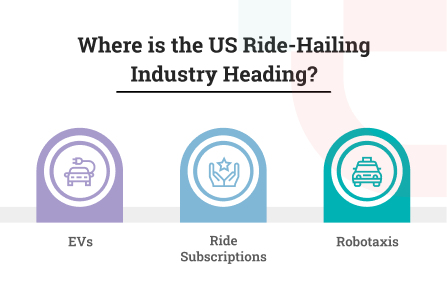
The US ride-hailing market is evolving rapidly with EVs, subscriptions, and robotaxis. Here’s a detailed overview of the future of the US ride-hailing market to keep you ready for what’s coming.
EVs
To reduce the carbon footprint, the US government is encouraging the adoption of electric vehicles with rebates, tax credits, and charging infrastructure investment. California and Colorado are among many such states.
Starting an online EV taxi business allows you to lower operational costs and position your brand as a sustainable solution for eco-conscious customers.
Ride Subscriptions
US ride-hailing companies are making investments in subscription programs as they help improve customer retention by offering ride discounts. You can implement membership models for users using the platform repeatedly and build long-term loyalty.
Robotaxis
Autonomous ride-hailing services are increasing in the US, but at a gradual pace with a state-by-state approach as regulations and demand vary across markets. This means traditional ride-hailing businesses will be able to serve in many regions for years to come.
However, you should still keep a watch on your target market for AV deployment to know when it affects customer demand and competition. This will help you decide the right time to start a robotaxi business.
How Elluminati Helps You Compete with Uber in the USA?
To compete with Uber in the USA, you need to identify the underserved markets, invest in driver retention, build local relevance, and adapt to different state-level regulations. However, success becomes possible when you combine your strategies with the right technology solution.
That’s where Elluminati comes in. Our taxi app development company has 14+ years of experience in building and deploying solutions for 450+ mobility businesses across the globe. We have also helped Tesla on Call, a California-based luxury black car service provider, expand across several US cities.
With an automated dispatch engine, multi-city support, a multilingual interface, and an advanced taxation system, our solutions help businesses launch and scale ride-hailing operations with ease.
FAQs
Yes, a small ride-hailing company can compete against Uber effectively by focusing on underserved cities or specialized services like NEMT, corporate transfers, and airport travel.
Markets like small or mid-sized cities growing rapidly, regions with limited ride-hailing solutions, and suburban areas prove to be better starting points for new companies.
No, you don’t need feature parity with Uber to compete with it. You should focus on the specific features that your target market actually needs.
There is no fixed timeline. It depends on several factors like your launch market, operating costs, pricing strategy, fleet size, and user acquisition expenses.
For startups and small businesses, it will be better to serve a specific niche like airport transfers, NEMT, or accessible transportation to achieve long-term growth.