
Key Takeaways (or TL;DR)
- Customer retention directly impacts the revenue stability of the taxi business.
- Slow customer support, lack of personalization, and inconsistent ride experience create negative impressions in customers, resulting in drop-off.
- Transparent pricing, loyalty programs, subscriptions, personalized offers, consistent ride experience, easy payment processing, and instant support are the most effective customer retention strategies for the taxi business.
- Tracking metrics like churn rate, customer lifetime value, and repeat ride frequency helps you determine if your retention efforts are actually working.
- Implementing the right taxi app technology, like smart dispatch, dynamic pricing, real-time analytics, driver performance monitoring, and live ride tracking, helps build long-term loyalty.
Most taxi businesses focus heavily on acquiring customers. However, the real profitability comes from customer retention, as acquiring new users costs significantly more than retaining the existing ones. Frequent app switching, price competition, and inconsistent ride experiences can make retention challenging for businesses.
That’s why it becomes essential to implement customer retention strategies for the taxi business. The right practices build long-term loyalty and achieve sustainable growth in the competitive market.
This article explores the 10 best strategies for retention, the common mistakes to avoid, and the role of technology in building loyalty, so you can build a profitable ride-hailing business.
Why is it Essential to Implement Customer Retention Strategies for the Taxi Business?
For taxi businesses operating in urban markets, customers have multiple app options for ride booking. One poor experience and they will immediately switch to a competitor. So, retention is not a growth tactic but a survival requirement in the competitive space. Here is what poor retention can cost your business.
Rising Churn Silently Kills Your Revenue
Higher churn rate negatively impacts your business revenue and growth. Frequent switching forces you to spend heavily on paid ads and promotions to maintain booking volume. This ultimately increases operational costs and reduces profitability.
Higher Retention Means Higher Lifetime Value
A retained customer contributes more revenue over time compared to one-time users. Because they book rides frequently, opt for subscription plans, and even refer your services to their friends and family. This increases customer lifetime value, which ultimately improves long-term profitability.
Repeat Customers Reduce Acquisition Costs
You have to spend continuously on marketing to acquire new users. But customers who are satisfied with your services will refer others, which will help you bring new users organically and also optimize marketing costs more effectively.
Strong Retention Gives Competitive Advantage
The ride-hailing market is becoming highly competitive. In such scenarios, competing only on the basis of pricing can give short-term success. But when you build long-term loyalty in customers through consistent ride experiences, fair pricing, and better support, it builds long-term loyalty that becomes your strongest competitive advantage.
Expert Tip:
Many taxi businesses focus on acquiring new customers quickly, but do not calculate how much revenue they lose from inactive repeat customers. Retention analysis provides more profitable growth opportunities than acquisition campaigns.
Top 10 Customer Retention Strategies for the Taxi Business To Apply
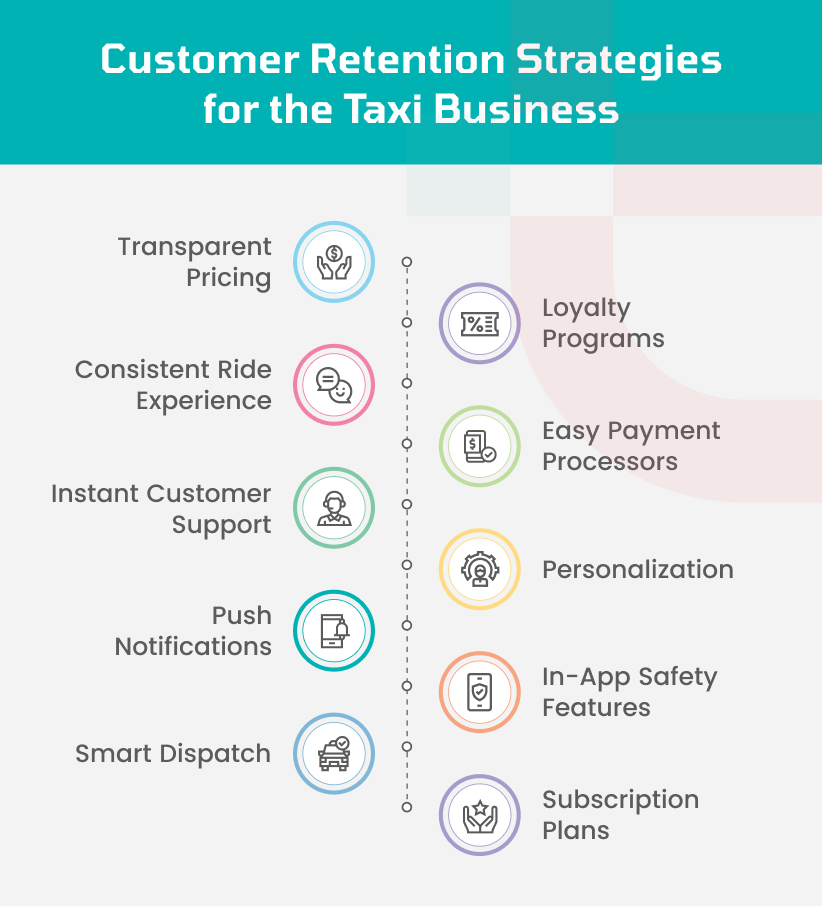
Retention does not simply mean offering discounts. There are several things that drive retention. The following are the 10 proven customer retention strategies for the taxi business that will help you reduce churn and build long-term loyalty.
1. Build Trust with Transparent Pricing
When the final cost exceeds expectations, it creates distrust among customers, which pushes them towards competitors. To prevent this, display fare estimates with a breakdown of all applied charges, like surge pricing, taxes, and additional fees, within the app.
Transparent pricing prevents last-minute surprises and builds confidence in users to use the platform.
2. Encourage Repeat Usage with Loyalty Programs
Customers are likely to repeatedly use the platform when they get additional value for frequent bookings. Without any reward system, the app feels like just another option easily replaced by competitors offering better benefits.
For instance, platforms like Uber offer first-ride discounts to attract new customers and encourage them to continue booking rides through the app.
So, introduce loyalty programs in the platform like ride credits, cashback rewards, and referral bonuses. These are one of the effective taxi business growth strategies to improve repeat bookings and build long-term loyalty.
Expert Tip:
Instead of offering the same reward to every customer, segment users based on ride frequency and spending patterns. This helps you manage reward costs more effectively while increasing engagement.
3. Reduce Cancellations with a Consistent Ride Experience
Nothing frustrates a customer more than a confirmed booking getting canceled at the last minute or experiencing delayed pickups. Such experiences make customers feel hesitant in using your services.
Implement a driver rating system that allows you to identify low-rated drivers and train them. And, regularly monitor each driver’s performance to maintain service quality. In addition to this, track cancellation patterns in real time, find exceptions, and solve operational issues quickly.
A reliable experience increases the platform’s repeat usage, leading to long-term retention.
4. Simplify Payments for Frictionless Checkout
Payment issues during checkout, like frequent transaction failures, unreliable payment processors, and limited options, create negative impressions in customers.
So, make sure that the platform supports multiple payment methods, including cards, digital wallets, UPI, and cash payments. Furthermore, integrate local payment options relevant to the market you operate in.
A smooth payment process makes ride booking more convenient for customers, which increases repeat usage.
5. Strengthen Customer Support with Fast Resolution
Customers want immediate assistance when they face any issue on the ride-hailing platform. No or slow response makes them feel ignored.
Provide in-app chat support and proper ticket tracking systems to solve queries instantly. Besides, set clear resolution timeframes for common issues like ride complaints, refunds, and driver reports.
Fast and reliable support will help you increase customer satisfaction.
6. Improve Engagement Through Personalization
Generic offers and notifications irrelevant to the user’s behavior make them feel less valued, which makes them feel disconnected from the platform.
Use ride history data to suggest ride destinations, preferred pickup points, time-based ride reminders, and targeted offers to customers. For instance, offering a discount to a customer who books rides every Monday morning but has not made any bookings in the last week. You can even allow regular customers to save their preferred drivers and routes in the app.
Personalization makes users feel recognized and keeps them coming back.
Expert Tip:
Customers are more likely to respond to contextual offers triggered by behavior patterns like frequent airport rides or weekend travels. So, creating such offers helps you keep your existing customer base engaged in the long term.
7. Increase Engagement with Push Notifications
Receiving too many irrelevant notifications irritates customers, causing them to ignore or disable them entirely. This closes an important communication channel that keeps customers informed about exclusive discounts and important updates.
So, always make sure to send value-driven notifications like ride reminders, peak-hour alerts, loyalty reward updates, and personalized offers. Additionally, avoid sending promotional messages daily until it’s necessary.
Relevant notifications help you keep customers engaged and bring them back at the right time.
8. Build Trust with In-App Safety Features
Safety concerns are a silent but powerful churn driver. A customer will feel uncertain in using the platform again if they have faced any issues in the past, like driver misbehavior or personal safety-related issues.
Add customer safety features like SOS buttons and live ride-sharing options in the taxi app. Beyond this, onboard drivers after performing thorough background checks and a verification process.
Strong safety standards help improve customer confidence and repeat ride bookings.
9. Reduce Wait Time Using Smart Dispatch
A customer opts for ride-hailing services to get quick travel solutions. However, long wait times can frustrate them and result in booking cancellations.
Smart dispatch systems automatically assign the nearest available driver to each incoming ride request, reducing wait times and improving completion rates. You should also deploy a heatmap-based dispatch where you can pre-position operators in high-demand zones during peak hours.
This drives stronger long-term retention.
10. Build Long-Term Loyalty with Subscription Plans
Frequent customers often look for affordable travel options for their daily transportation needs. For this, they will compare across multiple taxi apps for lower fares and long-term value. If your business does not provide additional benefits to regular customers, you can easily lose them to competitors offering greater savings.
So offer monthly or annual subscription plans to users with benefits like priority service and exclusive discounts. For instance, Uber One membership program offers exclusive benefits like ride credits, top-rated drivers, and priority support to encourage repeat usage. This not only increases retention but also creates recurring revenue opportunities for your business.
Expert Tip:
Always track driver availability zone-wise during peak hours to maintain supply-demand balance.
| Retention Strategy | Impact | Outcome |
|---|---|---|
| Transparent Pricing | High | Reduces churn rate |
| Loyalty Programs | Very High | Encourages repeat usage of your services |
| Consistent Ride Experience | High | Helps enhance satisfaction |
| Personalization | Medium-High | Makes users feel valued |
| Payments | High | Reduces friction at the time of booking |
| Customer Support | High | Improves satisfaction, which builds long-term relations |
| Push Notifications | Medium | Brings repeat booking opportunities |
| Safety Features | High | Builds long-term trust |
| Smart Dispatch | Very High | Reduces wait times and ensures better user experience |
| Subscription Plans | High | Creates recurring revenue opportunities |
Enhance Customer Experiences and Build Long-Term Loyalty with Elluminati’s Expert Strategies and Taxi App Solution
How to Measure the Success of Customer Retention Strategies
Implementing strategies is not enough to drive success. You need to track key metrics regularly to see what is working and what is not. Metrics give you clear visuals about customer engagement rates and help you identify churn possibilities before they happen.
Important Customer Retention Metrics You Should Track
- Calculate how many customers continue using your taxi platform over a specific period of time.
- Track how often a particular customer books rides after their first trip.
- Measure the total revenue a single user generates over their entire time on the platform (CLV). A higher CLV means your retention strategies are working, while a declining CLV means higher drop-offs.
- Examine the percentage of customers who stop using the platform within a given timeframe.
How to Improve Retention with the Help of Data
- First, identify where exactly the customer abandons the platform, that is, whether at the beginning stage or during checkout.
- Then analyze customer booking behavior to create personalized offers and discounts.
- Use app usage data to ensure smooth booking flow and overall app usability.
Challenges You Face for Retaining Customers in Ride-Hailing Businesses
Retaining today’s customers is difficult because of their changing expectations. They expect quick pickups, affordable fares, and a smooth ride-hailing experience. Even a small operational gap can negatively impact user satisfaction, prompting them to switch to other platforms. Below are the potential challenges that you may face during retention.
Price Sensitivity
There are several app options available for ride booking in the market. And so most customers compare fares across multiple platforms before confirming a booking. A slight pricing difference or competitor discount is enough to pull your regular users away.
Inconsistent Ride Experience
Ride experience plays a critical role in retaining customers. Delayed pickups, inappropriate driver behavior, poor vehicle conditions, and frequent ride cancellations can negatively impact user satisfaction as they expect consistent service quality every time they book your services.
Lack of Personalization in Offers and Services
Generic offers and non-personalized experiences immediately signal customers that your platform does not know them. Modern users expect relevant offers, preferred ride options, and personalized recommendations based on their usage patterns. A one-size-fits-all approach makes the app feel transactional rather than valuable, which reduces loyalty.
Poor and Slow Customer Support
Whenever users face an issue, such as incorrect charges or payment failures, they expect a fast resolution. In such scenarios, slow response time frustrates customers, which pushes them to abandon the platform completely.
App Performance Issues
For on-demand taxi businesses, app performance is as important as the platform itself. Slow loading speed and frequent crashes create friction during the process, which discourages customers from using your platform.
Payment Friction and Refund Delays
Complicated payment processes and slow refund processing can easily create distrust among customers. Users want secure transactions, multiple payment options, and quick refund settlements. Financial friction at any point in the ride booking process directly impacts retention.
Common Mistakes You Should Avoid While Planning for Customer Retention
Most taxi businesses focus only on customer acquisition rather than on their retention. Let’s understand the common mistakes that you should avoid to reduce churn rate.
Competing Only on Price
Lowering fares to match or beat competitors might help you attract customers for the short term, but it does not build loyalty. Such users will easily switch platforms when they find cheaper alternatives.
Ignoring Customer Feedback
Customer feedback gives you valuable insights about operational issues and service gaps. By ignoring them, you make users feel less valued, which directly impacts retention.
Poor Driver Quality
Driver behavior plays a vital role in retention. Rude behavior, poor vehicle condition, and inconsistent ride quality damage customer trust faster.
Excessive Use of Discounts
Although discounts help re-engage customers, overusing them attracts price-sensitive users with low loyalty — and erodes profit margins.
Slow Customer Support
A delayed response to complaints makes customers feel that their concerns are not important to your business. This ultimately results in switching to other apps.
How Technology Helps to Retain Customers in the Taxi Business
According to TGM Research, customers choose a ride-hailing platform based on factors like price, wait times, app reliability, and safety. The right app infrastructure lets you maintain service quality, personalize user experiences, and resolve issues faster before they lead to churn.
Smart Ride Matching for Faster Pickups
Long wait times are the leading cause of app abandonment. Smart ride-matching systems help you assign the nearest available and highest-rated drivers to the ride request. This reduces pickup time and ensures a faster ride experience, which encourages repeat usage.
Dynamic Pricing for Better Satisfaction
Customers often feel frustrated when ride fares increase suddenly during peak hours without a clear explanation. Dynamic pricing adjusts fares based on demand, traffic conditions, and driver availability. As a result, you can maintain a balance between demand and supply while reducing customer dissatisfaction.
Real-Time Analytics for Personalized Experiences
Modern customers prefer platforms offering personalized experiences instead of generic offers and services. Real-time analytics tools allow you to track individual booking patterns, identify high-value customers, and deliver personalized offers and suggestions to them. Over time, this improves customer engagement and drives better retention.
Driver Performance Monitoring for Service Consistency
Even a single bad driver experience can easily create negative impressions in customers. Driver performance monitoring tools track ratings, cancellation rates, behavior reports, and trip completion details. This allows you to identify underperforming drivers, take action quickly, and maintain consistent service standards for your business.
Real-Time Ride Tracking to Build Trust
Customers prefer taxi platforms that offer greater ride visibility and transparency. Real-time ride tracking allows customers to monitor the driver’s location, estimated arrival time, and trip progress directly from the app. The outcome is stronger trust and confidence among customers.
Technology-driven features directly influence customer satisfaction and retention. And if you are planning to start your taxi business with a ready-made Uber like app, these advanced features are already integrated in the platform, helping you build loyalty right from the initial stage of your business.
Expert Tip:
Retention technology works best when smart dispatch, customer data, driver management, and support systems are connected through a single system instead of separate tools.
How Elluminati Helps You Retain Customers Through Its Taxi App Solution?
Implementing the right customer retention strategies for the taxi business is essential to building loyalty. However, maintaining loyalty becomes difficult without the right technological infrastructure in place.
Elluminati is a reliable taxi app development company with 14+ years of experience in building scalable ride-hailing solutions for 450+ global businesses. With features like dynamic pricing, automated dispatch, real-time ride-sharing, and multiple payment integration, our solutions help enhance customer satisfaction and retention.
Along with technology development, we also provide strategic consultation to help businesses optimize operations, improve customer experience, and achieve sustainable growth.
FAQs
The best customer retention strategies for the taxi business include:
- Transparent pricing
- Loyalty programs
- Smooth, reliable payment methods
- In-app chat support
- Smart dispatch systems
- Subscription plans
- Push notifications
- Personalization
- Consistent ride experience
Customers would switch taxi apps due to pricing differences, poor ride experiences, delayed pickups, limited payment options, and slow customer support.
Pricing plays a critical role in retention because customers routinely compare fares across multiple apps before confirming a booking.
Yes, loyalty programs like ride credits, referral rewards, and subscriptions create value for customers, which encourages repeat bookings.
Technology helps improve customer retention through features like automated dispatch, real-time analytics, live ride tracking, driver performance monitoring, and dynamic pricing.