
Key Takeaways (or TL;DR)
- With strong demand for convenient transportation solutions, Latin America presents a high opportunity for businesses to launch ride-hailing operations.
- To start a taxi business with an Uber clone in Latin America, you need to follow a step-by-step process to choose the region, understand local regulations, choose the right white label platform, and operate it according to local needs.
- The rules for business registration, licensing, and data privacy vary across each country and city.
- Brazil, Mexico, Peru, Chile, Argentina, and Colombia are the major market segments to launch a ride-hailing business with an Uber clone in Latin America.
- By implementing local payment methods and languages in an app, running targeted ads, doing local SEO, App Store Optimization, and using WhatsApp for communication, you can easily attract and retain users in LATAM.
In Latin America, constant gaps in public transport and growing urban expansion have created a strong demand for ride-hailing services. This has made Uber achieve success in such a competitive space. Getting inspired by Uber’s success, most entrepreneurs are considering entering the market quickly with an app similar to it.
However, it requires careful planning and consideration to start a taxi business with an Uber clone in Latin America.
This guide will walk you through everything you need to know. From choosing the first city and understanding the local regulations to knowing the common mistakes and marketing strategies you must follow to grow your user base. This will give you a complete roadmap to launch your ride-hailing business in LATAM with confidence.
Why Start a Taxi Business with an Uber Clone in Latin America?
There are several benefits of launching a taxi business with an Uber clone in Latin America. Let’s have a look at each of them.
Market Size & Growth Numbers to Know
The ride-hailing market of Latin America is growing rapidly as more people are relying on apps for daily commuting and not just occasional trips. Let’s have some important insights about Latin America’s ride-hailing industry.
- According to Grand View Research, the Latin America ride-hailing market is projected to reach USD 11,473.6 million at a CAGR of 17.8% from 2026 to 2033.
- Country-wise, Brazil is expected to register the highest CAGR during the forecast period.
- Over 80% of people live in cities, and public transportation in many cities is still not developed, which creates a consistent demand for ride-hailing services for daily commuting.
- Around 90% of users in Latin America have used ride-hailing services in the past 12 months.
- Also, ride-hailing has now become an integral part of people’s daily commuting needs.
These market stats highlight the massive growth potential of Latin America’s ride-hailing industry and why now is the right time to enter it.
Lower Time-to-Market with Uber Clone Apps
As seen, the ride-hailing market is growing competitive, and so speed matters the most while entering it. A custom app usually takes around 8 to 12 months for development, which will surely delay the launch time.
A white label Uber clone on the other side helps you get live in 2 to 3 weeks. Early market entry helps you establish a strong brand presence before your competitors do.
Cost-Effective Alternative to Custom App Development
The cost to build a taxi app from scratch in Latin America ranges between $150,000 to $300,000+.
However, custom development involves significant risks of technology failure. But a white label Uber clone costs from $5,000 to $25,000 with minimal risk involved, as it is embedded with market-tested features. A pre-built solution becomes helpful for startups with limited budgets.
Strong Revenue Potential Across Multiple Income Streams
A standard taxi booking app mostly relies on a single income source, that is, commissions. But since a clone app is built on Uber’s revenue model, it opens additional revenue streams like surge pricing, advertising, and subscriptions besides commissions for your business. This helps you make money from all directions.
Proven Business Model
Uber’s business model is already validated globally, including Latin America. Brazil and Mexico are its largest and fastest-growing markets with millions of users and drivers.
This shows that rider behavior and the market are established, which reduces the risk for your business. With a ready-made solution, you will be able to enter the market faster and focus on core operations without needing to validate the business model.
How to Start a Taxi Business with an Uber Clone in Latin America – A Step-by-Step Process
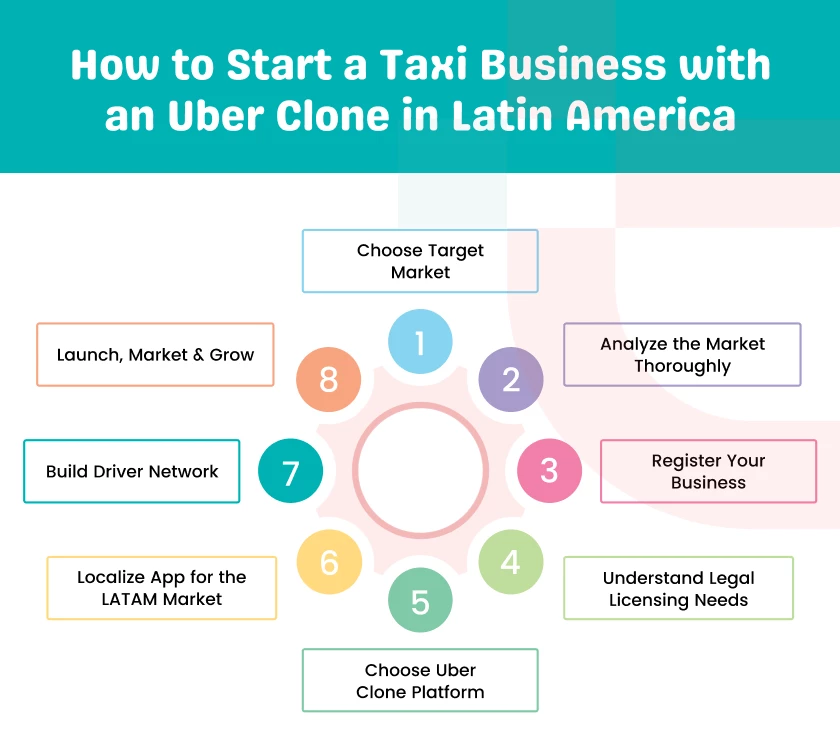
To start a taxi business with an Uber clone in Latin America, you need to understand the local needs, comply with legal rules, and market it effectively. Here is a complete step-by-step process to follow.
Step 1: Choose Your Target Country and City
Most founders launch their operations all at once in multiple regions. This results in operational chaos, regulatory complexity, and inconsistent service quality, ultimately leading to business failure.
Starting with one city helps you test demand and scale effectively. Choose from cities like Mexico, Lima, Sao Paulo, and Bogota, where demand is consistently high for taxi apps among people for daily commuting.
Step 2: Conduct Thorough Market Research
Improper research is one of the most common reasons why online taxi businesses fail. You need to evaluate the market thoroughly to understand the demand in the target region, find gaps in existing players, and make strategies to attract riders and drivers in the competitive space.
Step 3: Register Your Business and Choose the Right Legal Structure
Before you start planning to launch your operations, it is essential to register them in the region where you want to operate. Choosing the right legal structure is important as it determines how your company will be taxed, compliance with local regulations, and the level of personal liability protection.
Latin America is a diverse region with every city and country having its own specific rules and regulations for registration.
For instance, Colombia involves a flexible business structure, SAS (Sociedad por Acciones Simplificada), where owners only risk their capital and can run the business with minimal strict rules. Peru allows 100% foreign ownership, which makes it a perfect market for foreign founders to step into.
Step 4: Understand Local Licensing and Legal Requirements
Once your business is registered, the next step involves knowing the licensing and legal requirements in the region you want to operate. Many businesses think of fulfilling compliance requirements post-launch, which becomes a costly mistake.
Make sure you identify the transport authority needs in your desired city, understand vehicle compliance and insurance requirements, and check for driver registration and background verification rules.
Expert Tips: From Our Past Experience in LATAM Market Launches
- You should start configuring your clone platform the moment you apply for a license. This will help you go live immediately once approval comes.
- Partnering with a local legal advisor will give you complete knowledge about the region-specific regulations, leading to better compliance and preventing costly penalties.
Step 5: Choose the Right Uber Clone Platform
Your platform choice will directly impact the launch speed, cost, and scalability. Instead of building from scratch, most founders today are opting for ready-made Uber clone apps. However, not every app is built the right way.
Some would lack key features like real-time tracking, multi-ride options, or fleet management tools. While others may allow limited customizations and fewer admin controls. So, always check if your desired platform.
- Is white label ready or not
- Includes advanced features like dynamic pricing, automated dispatch, and smart route optimization
- Has a proven track record of getting launched in LATAM
The right platform will help you focus on growth instead of solving technical complexities.
Step 6: Localize Your App for Each LATAM Market
Inclusion of core features in the app is not enough to succeed in the competitive space. Localization is what will help you win the market. But it goes beyond translations. Your Uber clone should adapt to how users in each LATAM region ride, pay, and trust the service. Make sure the platform supports:
- Local languages like Spanish and Portuguese
- Tailor pricing according to local market sensitivity
- Display fares in local currency and support both digital and cash payments
- Include passenger safety features like real-time ride sharing and SOS
Step 7: Build Your Driver Network and Onboard Your Fleet
Drivers are the core engine of your ride-hailing business. Without sufficient driver supply, even the best-built platform will fail. That’s why you should build a strong and reliable network of drivers before starting the operations.
Begin with 50-150 drivers initially in one city zone, so you can maintain the service quality. Make sure you onboard drivers by performing strict background checks and verification processes so that riders feel confident and safe while using your services.
Expert Tips: What We Have Seen Work For Driver Acquisition in LATAM
- WhatsApp becomes your powerful medium to find and onboard reliable drivers.
- Instead of spreading drivers across the entire city, it will be better to find high-demand zones and strategically position them there.
Step 8: Launch, Market, and Grow Your Ride-Hailing Business
Once you have fulfilled all compliance requirements, chosen the Uber clone vendor, and built a driver network, the final step is to launch your app. However, launching is just the beginning. You will have to conduct marketing campaigns to reach customers.
Run targeted ads for smartphone users in your launch city. Also, offer special discounts on first rides. At the same time, continuously monitor the app performance, gather user feedback, and optimize your service quality accordingly to drive long-term success in the market.
Launch Your Ride-Hailing Business in Latin America Quickly and Successfully with Elluminati’s Expert Guidance and Solutions
Understanding the Latin America Ride-Hailing Market Before You Launch
Before you start a ride-hailing business with an Uber like app in Latin America, it is essential to have a closer look at its six major markets and understand demand patterns, local regulations, payment habits, and user expectations in each.
Brazil
It has a well-established ride-hailing ecosystem, with millions of rides happening daily in São Paulo and Rio de Janeiro. This region has a higher demand for daily commuting, corporate travel, and airport transfers. Moreover, it involves a strong digital payment ecosystem, including cards and Pix, to ensure smooth transactions.
However, success in Brazil requires ensuring a Portuguese-first experience while complying with state-wise varying regulations.
Mexico
In Mexico, cities like Monterrey, Guadalajara, and Mexico City experience strong demand for ride-hailing services due to high traffic congestion, a growing digitally savvy middle class, and safety concerns regarding public transport.
In these regions, implementing a hybrid payment model including cash and digital options helps you attract a wider user base. However, regulations differ city by city in Mexico. So, it becomes essential to opt for a flexible platform that allows you to adapt compliance rules based on each city’s requirements.
Colombia
Cities like Bogota and Medellin are the key urban centers in Colombia where adoption of taxi apps is growing steadily. These regions face issues like limited parking infrastructure, severe traffic congestion, and safety concerns with traditional taxi systems.
Riders opt for ride-hailing apps in these regions mainly because they offer speed, convenience, and reliability. But you might face strong resistance from local taxi unions due to concerns over competition, and so you need to build a strong brand presence.
Argentina
In major urban areas, especially in the Autonomous City of Buenos Aires (CABA) and its surrounding metropolitan area (GBA), and high-density cities like Rosario, Mendoza, and Cordoba, demand for app-based transport is influenced by higher smartphone penetration and extreme urban congestion.
Besides, there is also an increasing preference for cost-efficient transportation solutions amid economic volatility. And so by implementing an affordable pricing structure, your app can attract both riders and drivers with ease.
Chile
People in regions like Valparaiso, Santiago Metropolitan Region, and Concepcion prefer using ride-hailing platforms more.
Busy lifestyles and the desire for seamless transportation solutions have fueled the demand. However, Santiago, being the capital city, involves high competition, which requires your app to stand out in terms of service and niche.
Peru
In Peru, on-demand cab services have gained popularity due to the country’s high crime rate and unreliable public transportation. And so by including passenger safety features like real-time location sharing and SOS, you can easily position your brand as a safety-first service.
The major regions experiencing demand in Peru include urban coastal regions like Lima and major tourist hubs like Trujillo and Arequipa.
Expert Tips:
- Tier II and suburban cities like Campinas in Brazil and Chiclayo in Peru have lower competition. So starting from such regions helps you build a strong brand presence with ease.
- In major cities in Brazil, Mexico, and Chile, demand for corporate ride-hailing services is growing fast, which creates high-volume booking opportunities.
Legal Requirements to Start a Taxi Business with an Uber Clone in Latin America
Compliance with legal requirements is necessary to save your business from costly penalties. Below are mentioned the regulatory needs to launch a taxi business with an Uber clone in Latin America.
Choose the Right Business Structure for Your Target Country
A ride-hailing business requires a proper business structure, that is, how it is registered, operated, and owned in a specific country. But each country offers different options.
For instance, Mexico offers 100% foreign ownership in transportation technology and technology-based ride-hailing app services. At the same time, Brazil requires LTDA (Limitada) or S/A along with CNPJ registration, a local bank account, and a Brazilian resident legal representative.
Obtain Ride-Hailing & Transport Authority Licenses
Simply registering your business is not enough. You also need to acquire licenses specific to ride-hailing and transport authority.
The license type depends on the city or country you desire to operate in. For instance, in Colombia, both driver and vehicle registration need to be approved by the National Unified Transport Registry. At the same time, Peru requires MTC authorization and municipality approval.
Vehicle Registration & Insurance Compliance
Every vehicle operating on your platform needs to meet commercial usage standards. This usually includes proper registration, insurance coverage, and meeting vehicle age limits.
The regulations for fleet compliance will vary across cities. Although this is the responsibility of drivers, you should also once validate compliance to avoid major operating risks.
Driver Permits & Employment Regulations
To build trust among riders for your services, it is essential that your business involves reliable drivers. That’s why they always onboard them by performing strict background checks, validating their driving licenses, and also checking if they are verified by local transport authorities.
App Compliance & Data Privacy Laws
Since your app will collect and process users’ sensitive information like location and payment details, it is mandatory for it to adhere to local regulations for digital transactions and data protection.
Every market in LATAM requires secure payment gateway integration and encrypted storage of user data. However, the regulations will differ in name across each country.
For instance, in Brazil, LGPD (Lei Geral de Protecao de Dados) sets strict requirements on data handling and processing. While in Colombia, there is a Habeas Data Law. However, each law is kept to keep user data safe and secure.
Key Features Your Uber Clone App Must Have for the Latin America Market
Now, let’s have a look at the important features to include in your Uber clone app.
Rider App
- Instant ride booking and scheduling
- Multiple payment options, including cash, card, and digital wallet
- Multilingual support, including Spanish and Portuguese
- Safety features like real-time location sharing
- Transparent fare estimation
- Real-time tracking of the assigned driver’s location
Driver App
- Registration with a strict verification process
- In-app navigation systems
- Overview of weekly earnings
- Trip request management
- Availability (online/offline) toggle
Admin Web Panel
- Centralized dashboard for driver, vehicle, and rider management
- Region-specific pricing configuration
- Promo code and discount campaign manager
- Ride monitoring in real time
- Multi-country / multi-currency support for regional expansion
How Much Does it Cost to Launch a Taxi Business in Latin America with an Uber Clone?
The total cost to start a ride-hailing business with an Uber like app in Latin America ranges from $50,000 to $120,000+. It varies depending on numerous factors like white label platform cost, expenses of company registration and licensing, and marketing. Below is the complete cost breakdown.
| Cost Factor | Estimated Range (USD) | |
|---|---|---|
| Uber Clone App (White-label) | $5,000 – $25,000 | One-time or subscription-based, depending on the vendor you choose |
| Company Registration (per country) | $1,500 – $10,000 | Registration costs vary from city to city and country to country, and so do their costs |
| Licensing | At least $15,000 | Depends on the region you desire to operate in |
| App Localization & Branding | $2,000 – $15,000 | The app needs to include local payment gateways, a region-specific user interface, and local languages |
| Local Payment Gateway Setup | $10,000 – $31,000 | The fees for transactions and setup vary depending on the processor. MercadoPago, Pix, Culqi, and PayU are popular payment gateways |
| Launching and Marketing | $5,000 – $20,000 | Implementing digital marketing methods like SEO, ASO, targeted ads, and conducting loyalty programs |
| Fleet (driver-partner model) | $5,000 – $25,000+ | Onboarding drivers with their own fleet |
| Total Cost | $50,000 – $120,000+ | The exact cost depends on the region you want to operate in |
Your Quick-Start Checklist to Start a Ride-Hailing Business with an Uber Like App in Latin America
| Action Item | Notes | |
|---|---|---|
| 1 | Choose your target region | Start with one city instead of multiple areas at once. Lima, São Paulo, Mexico City, and Bogotá are great places to start |
| 2 | Conduct market research | Have a detailed understanding of competitors, pricing, and rider pain points in your targeted region |
| 3 | Register your business | Choose the appropriate legal structure in your desired country |
| 4 | Obtain your ride-hailing license | Legal requirements will vary by country and city. So, carefully understand the regulations for perfect compliance |
| 5 | Select your Uber clone vendor | Check for their prior deployment experience in any LATAM region, support for local payment processors, and languages like Portuguese and Spanish |
| 6 | Localize your app | Ensure your app includes local languages, payment gateways, currencies, and cash support |
| 7 | Ensure data privacy compliance | Comply with local regulations for data security, like LGPD in Brazil and Habeas Data in Colombia |
| 8 | Recruit and onboard your first drivers | Initially start with 50 to 150 reliable drivers in any one zone of the target city |
| 9 | Submit to App Store and Google Play | Create app descriptions in Spanish or Portuguese languages |
| 10 | Run a soft launch in one zone | Validate demand by going live in one zone of any city |
Start Your On-Demand Taxi Business Faster in Latin America with Elluminati’s Market-Ready Uber Clone
Common Mistakes to Avoid When Launching a Ride-Hailing Business in Latin America
Many founders make mistakes when they launch a taxi business with an Uber clone in Latin America, costing them time and money. We have listed below some common mistakes that you can avoid.
Launching in Multiple Countries Simultaneously
Starting in multiple regions at once makes it difficult to maintain service quality. Instead, begin with one region, build a strong brand presence, and gradually expand operations to other areas.
Building Without Portuguese Support for Brazil
Brazil is the largest ride-hailing market in LATAM, and its people prefer using apps with Portuguese language support. The Spanish user interface will not build trust among users. So make sure to launch the platform with a Portuguese-first experience.
Choosing a Vendor with No LATAM Deployment History
Each country and city in Latin America has its own legal regulations, payment preferences, and mapping requirements. Choosing a vendor with no prior experience in deployment in the region will leave you dealing with expensive challenges after launch. So, it’s always better to partner with an experienced vendor.
Ignoring Cash Payment Support
Major rider segments in Colombia and Mexico prefer cash over digital payment modes. Not supporting cash payments can limit user adoption. That’s why make sure to include cash mode in the app.
Underestimating Driver Acquisition Cost and Time
Without a strong driver network, your business would not operate effectively. Ensure to build strong strategies in driver acquisition and retention.
Expert Tips: Patterns We Have Observed in Failed LATAM Launches
- Most founders skip market validation and directly launch the app with features that were not needed at all, and miss the ones that were really required.
- The startups that scaled faster were those that paid close attention to retaining the drivers through incentives and reward programs.
Marketing Strategies for Launching a Taxi Business with Uber Clone in Latin America
Having a market-tested Uber clone is half a win. The actual success depends on how well you promote it and attract riders and drivers. Below are the marketing strategies you can follow to grow your business in Latin America.
App Launch & Go-to-Market Strategy
A well-planned launch helps you build strong initial traction without overwhelming your operations. In the beginning, launch your app in one city zone instead of the entire city. This will help you maintain service quality while attracting more users.
Local SEO & App Store Optimization (ASO)
Most ride-hailing startups underinvest in optimizing the app for local searches. But in today’s digital era, local SEO and ASO play a crucial role in driving riders.
Targeting city-specific keywords like “taxi app in Mexico” or “Uber alternative in Sao Paulo” will help you extend your reach to local users. Also, optimize app title and description in local languages in app stores that your target audience understands. This will help build trust among users.
Paid Advertising & User Acquisition
Riders and drivers won’t know about your platform by themselves. So, run targeted ads on Google and social media platforms like Facebook and Instagram. This will let you generate early demand in the launched region and also reach riders with ease.
Women-Focused Safety Campaigns
Uber had recently launched the “Women’s Preferences” campaign to enhance safety and build trust among female riders. Campaigns like this not only help improve rider confidence but also encourage more women drivers to join the platform. This ultimately helps in strengthening brand credibility while expanding the user base.
WhatsApp Marketing & Driver Acquisition
In Latin America, WhatsApp is considered to be a powerful channel for business growth. With WhatsApp Business, you can provide instant support to riders and drivers, which helps improve user experience. Besides, the broadcast lists and groups become an effective means to reach drivers and recruit them.
Customer Retention & Loyalty Programs
Retaining riders is more cost-efficient than acquiring them. With loyalty programs, referral rewards, and cashback offers, you can encourage users to use your ride-hailing services for the long term. Moreover, real-time push notifications let you keep them informed about ongoing or upcoming offers.
How Elluminati Can Help You Launch an Uber Clone in Latin America?
You might have now gotten the complete roadmap to how to start a ride-hailing business with Uber clones in Latin America. The market is growing and already has demand. However, the success depends on localizing your approach and having a reliable technology platform similar to the leading platform, Uber.
This is where Elluminati comes in. With 14+ years of experience in on-demand technology, we have helped 450+ mobility businesses across the globe to launch and scale successfully with our Uber clone app.
By supporting LATAM-specific payment gateways and local languages and also including compliance-specific workflows, our solution helps you build a strong brand presence from day one. Beyond technology, we help you plan launch strategies according to your business needs and goals to lead the competitive market of Latin America with ease.
FAQs
The cost to start a ride-hailing business with an Uber like app in Latin America ranges from $50,000 to $120,000+. It varies depending on numerous factors like whether you opt for a pre-built platform or custom development, regulatory compliance needs, and ongoing operations.
It typically takes around 2 to 3 weeks to launch a taxi business with an Uber clone in Latin America. The exact timeline depends on the customization levels your business needs.
Brazil and Mexico are the best countries to start a ride-hailing business with an Uber like app in Latin America due to higher smartphone penetration, increasing demand, and a massive urban population.
Yes, you need to comply with specific local regulations and acquire licenses to run a taxi app similar to Uber in Latin America. However, requirements vary by city and country.
Yes, many popular countries like Mexico have a large unbanked population, and so by supporting cash payments, you can easily enhance your user base.