Key Takeaways (or TL;DR)
- Entrepreneurs who want to step into the ride-hailing industry quickly can start with an Uber clone, which reduces the launch delay and technical complexity.
- Uber clone app works similarly to the original Uber app in terms of functions and features. Allows you to enter the market with your USP and brand guidelines.
- To start a taxi business with an Uber clone, new entrants should follow the steps of market & niche research, fulfilling legal requirements, evaluating the app, onboarding the driver network, and advertising services through social media.
- To choose the right ready-made solution, ensure key points like source code ownership, proper API integration within the platform, check for scalability, see if the vendor offers a live demo, and look for white-label depth of the solution.
- The total cost of starting a taxi business with an Uber clone totally depends on the type of solution, brand customization, and add-on feature integration.
The ride-hailing market has grown exponentially over the past decade due to successful businesses like Uber. The demand for taxi services among customers is increasing as new ride-hailing startups emerge.
An Uber clone is a pre-built ride-hailing application that replicates the core functionality of the Uber app. This solution helps businesses like yours to enter the market quickly, within a few weeks of customization & integrations as per your requirements.
If you’re an entrepreneur and looking forward to entering the on-demand ride-hailing market, an online taxi business can be a great opportunity. In this article, we will walk you through a detailed guide on how to start a taxi business with Uber Clone, including the success factors.
Why Start a Taxi Business With Uber Clone?
Before we dive into the process, it’s worth understanding why to launch a taxi business with an Uber clone.
1. A Market Growing Too Fast To Ignore
- The global ride-hailing market is mushrooming and experiencing wider growth on a global scale. According to research, the market size is projected to reach $181.54 billion by 2033, with an increasing growth rate of 18.6% from 2026 to 2033.
- Regions like the Asia-Pacific are adapting to online ride-hailing services, while North America, Europe, the Middle East, and Latin America are experiencing the expansion of the taxi business market.
- The growth of the urban population is supporting the ride-hailing market expansion because urban areas have a higher demand for convenient and smart app-based mobility solutions.
- For new entrants, all of the above market criteria signal a significant amount of growth in the taxi industry, with a wide space for regional and niche operators.
2. The Economics of Building from Scratch Don’t Work for Most Startups
Developing an app from scratch will cost you around $150,000+, and it will take approximately 12-18 months, with no guarantee that the final product will perform under real operational load. For first-time entrepreneurs like you, that timeline and budget make it difficult to achieve early market validation.
Instead, an Uber clone eliminates that financial risk entirely and enables faster integration so that your investment goes straight into expanding your business, not building the technology that delays your launch.
3. The Technology Complexity is Already Solved
Complex processes & features such as geolocation for real-time tracking, dynamic pricing algorithms, payment gateway integrations, and driver matching logic are technically crucial to build and integrate correctly. These features are a core part of any ride-hailing app.
Whereas leveraging an Uber clone means all of these features have already been engineered, tested, and deployed in live markets, so you can focus on market positioning, driver recruitment, and overall business growth.
4. The Business Model Has Been Validated at Scale
Validates operational efficiency, like service flow, driver economics, rider behavior, and monetization logic, so that entrepreneurs can benefit from entering the market quickly. In addition, if you look closely, startups that adopt the white label solution inherit a proven framework rather than an untested hypothesis, which doesn’t scale according to a business’s needs.
5. Faster Time to Market Enables Earlier Learning
Helps you launch your business months earlier than a competitor who is building an app from scratch, which means you make decisions based on data-driven insights. Additionally, you can get a significant advantage as a first-mover in underserved or suburban corridors in competitive local markets.
6. Scalability Is Built Into The Architecture
Integrating an Uber Clone can help entrepreneurs like you to scale your operations across multiple cities and countries because it does not require a separate technology rebuild. This solution lets you integrate multiple languages and currencies according to your selected regions because architecture is foundational in the modern Uber clone platform.
How to Start a Taxi Business With Uber Clone?
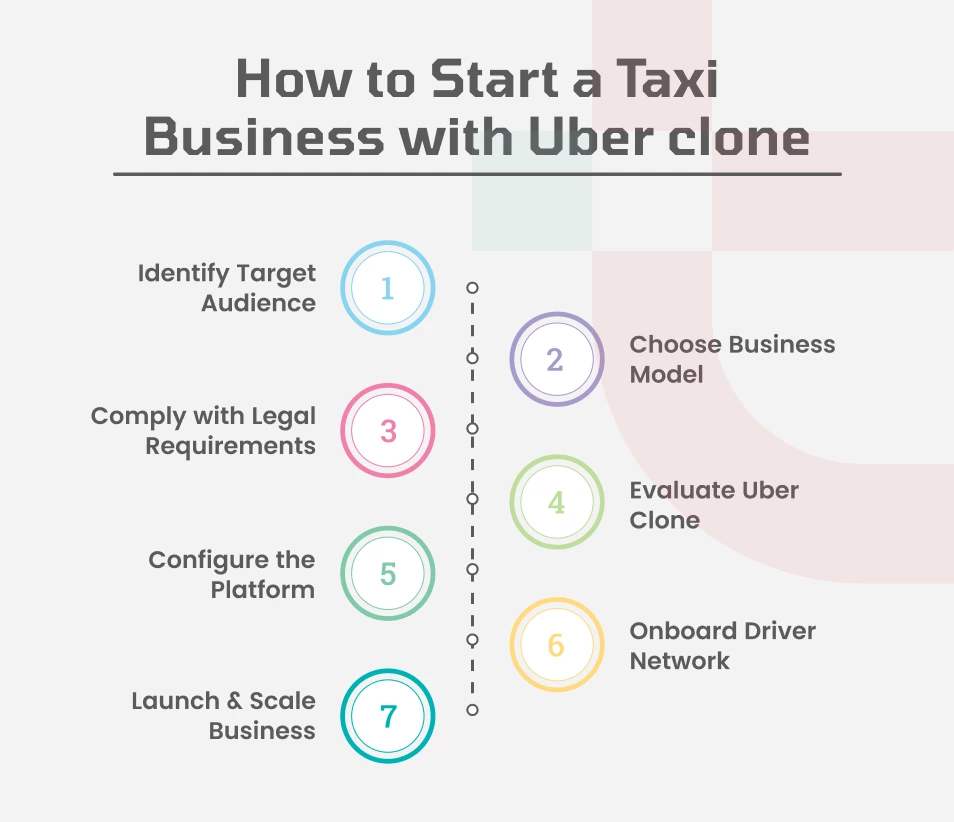
Now that you have understood the benefits of Uber clone, let’s take a closer look at the step-by-step process to launch a taxi business with Uber clone.
Step 1: Research Your Target Market & Define Your Service Area
Conduct research related to the underserved or suburban areas where demand is high, but competition is significantly low, so you can better understand public preferences and fill the gap between demand and supply. Look for cities with limited ride-hailing coverage and high-car dependency. Identify audience preferences such as corporate rides, airport transfers, and particular areas where needed.
Step 2: Choose Your Business Model & Service Niche
Choosing a niche business model helps new entrants to avoid direct competition with giant taxi companies, so that startups can serve in targeted, underserved areas and build strong loyalty & trust among customers. Here are options for business models and specific niches to consider:
1. Standard ride-hailing
The on-demand taxi business model is the most popular, where you act as an operator that connects local riders and drivers through an app and charge commissions without owning a fleet. For example, mega ride-hailing businesses like Uber and Lyft.
2. B2B Corporate transport
Corporate companies require a reliable transportation service for employees, clients, meetings, and daily office commuters. Offering a seamless corporate transportation service is a smart approach to secure long-term profitability.
The main advantage of this model is that corporate clients prefer fixed billing, monthly or yearly subscriptions, predictable prices, and guaranteed transport availability. The B2B subscription-based model helps you maintain a stable income stream and helps you operate at higher margins.
3. Airport transfers
Airport transfer services are in high demand. Customers want reliable, hassle-free, on-time taxi service. You can offer modern services like VIP pickups, luggage assistance, and scheduled bookings. Airports are the most crowded places; starting a taxi business near an airport is the most profitable ride-hailing business idea.
4. Senior citizen assistant mobility
Elderly customers often face challenges to safe and dependable transportation for hospital visits, grocery shopping, and daily errands. By offering comfortable rides and creating a specific taxi app for senior citizens, you can fulfill this gap.
If you select this niche, then you will require vehicles that include wheelchair access, medical support tools, and drivers who understand seniors’ behavior and needs. This model is based on a loyal customer base and low competition.
5. Non-Emergency Medical Transportation(NEMT)
NEMT is a taxi service for health-related trips, which takes people to medical appointments, physical therapy, dialysis, and the pharmacy. The demand for NEMT is increasing; according to a report, the NEMT market size is estimated at USD 12.77 billion in 2026. By offering this service, you’re not only earning profit but also building an impactful business that helps people travel safely for medical checkups.
Step 3: Understand Legal & Licensing Requirements In Your Region
Legal compliance is an operationally crucial yet important step before launching a taxi business. Unlike traditional taxis, the app-based ride-hailing businesses operate under a distinct legal framework, such as a transport operator license or a Transportation Network Company (TNC). These legal requirements vary by city, country, and region.
Key Areas to Address
Business entity registration is the first legal milestone; you need to register your business as an LLC, a private limited company, or another recognized entity, and comply with the specific operator permit rules and vehicle standards.
Driver Requirements
Driver eligibility is a matter of legal accountability, not just operational preference. Make sure to conduct driver background verification, driving record checks, and ensure that the driver has no criminal history, and cross-verify vehicle inspection standards.
Insurance
Here’s something that most new entrants get the wrong idea about insurance: just a driver’s own car insurance won’t cover ride-hailing trips. If the driver gets into a road accident while carrying a passenger, then it becomes your responsibility to cover it, and if not, then that’s a huge legal and financial problem for your business.
And that’s why you will need a special commercial insurance that covers these types of situations. Remember, getting the right insurance from day one will save you from troubles like financial loss and customer trust issues.
Keep User Data Safe
Your app will collect a lot of personal data of users, including name, phone numbers, live location, payment details, and trip history. Which means you’re legally accountable for keeping that data safe and using it properly. Different countries have their specific digital privacy rules that your platform must comply with.
For example, in Europe it’s called the General Data Protection Regulation (GDPR), in Brazil it’s called LGPD, and in California it’s CCPA. Basically, all regulation acts say the same thing, which is that businesses should be transparent about what data they collect, store it securely, don’t misuse the data, and let users delete it if they want. Building your app with these rules from the start is much easier than fixing it later.
Step 4: Select & Evaluate an Uber Clone Solution
Choosing the right Uber clone solution is a consequential decision you’ll ever make as a taxi startup. The platform you select will directly determine how fast you launch a business and how much control you have over your services. Evaluating technical companies on basic features is a financial risk because real differentiation relies on the platform’s overall capabilities.
What to look for when evaluating any tech company?
- Source code ownership
- Supported payment gateways
- Scalability
- Compliance architecture
- Post-launch support
Questions to ask every software development company
- Do I own the source code?
- What payment gateways are supported natively?
- How is driver background check integration handled?
- Can the platform scale to multiple cities without a rebuild?
Understand the Difference – SaaS vs. Ready-Made App.
A SaaS-based platform operates on a subscription-based model where the software company hosts and maintains your platform. This offers faster setup and lower upfront cost, but you will be operating on shared technological infrastructure with limited customization authority and ongoing dependency on the software company.
A ready-made app is a copy of the source code that you deploy and manage independently. The upfront cost may be higher, but you retain full control over your platform in the future. We strongly suggest investing in a licensed white label solution for scalable business and long-term growth because it offers a stronger ROI over time.
Red flags to look for
- Lock-in clauses that restrict your ability to migrate and modify independently.
- No live product demo
- Vague post-launch support claims with no documented Service Level Agreement (SLA) indicate that support quality will collapse once the deal is closed.
- Absence of documented real deployments – no previous case studies, online references, or verifiable client examples.
Step 5: Customize and Configure the Platform
Once you opt for the clone model, the next step will be customizing and configuring your platform. Configuration is where your platform transitions from a developed asset to a market-ready application. Here are four core aspects to check when customizing your app.
Branding
Replace every default element with your company’s name, color palette, splash screen, and in-app typography. With a specific identity that reflects your business.
Operational Setup
Define the geographic boundaries, geofences, and service zones within your platform. Configuring these zones accurately will prevent the booking requests that come outside of your serviceable area and keep your driver supply and demand balanced within defined regions.
Another operational setup is integrating the vehicle categories, which depends on your actual composition of fleet variation. Such car categories as economy, XL, or any other specialized cars. This initial step will improve your fleet category during configuration.
Lastly, setting up fare prices based on your vehicles is essential because these prices vary by car type. Integrate surge pricing parameters, cancellation fees, and minimum fare price; all of these should be integrated before the time of launch, as this will have a direct effect on your driver earnings and driver retention.
Payment Gateway Integration
The payment feature should match the transaction behavior of your targeted market. Globally recognized gateways such as Stripe, Paystack, and PayPal offer reliable integration support and broad geographic coverage. However, other alternatives like mobile wallets, bank transfers, and cash payments are also frequently preferred by the local region’s customer base.
Driver Onboarding
The driver onboarding function is as necessary as the operational one. Your platform should support structured document uploads, such as driver’s license, vehicle registration, insurance certificate, and any region-specific permits, with clear validation requirements for each submission.
For driver background checks, integrate an API that automates the verification process and reduces manual checks at scale. Companies like Checkr and Sterling are usually the better alternatives for background checks.
Step 6: Recruit and Onboard Your Driver Network
Driver supply determines whether your platform survives the first 3 months of launch or not, because riders don’t usually prefer taxi rides when wait times are long. Without an active driver base from day one, even a technically flawless app loses users fast.
That is why strategies like reaching local job boards, targeted social media posts, and direct outreach to drivers already active on competing platforms are the most effective starting points. Drivers who are already familiar with the gig model are easier to onboard and faster to activate.
In order to increase the onboarding of drivers, provide early incentives, guaranteed earnings windows, reduced commission rates during the first few weeks, and sign-up bonuses. This strategy helps you to lower the barrier for drivers who are new to the platform.
Lastly, the onboarding process should always be structured from document verification to app walkthroughs. Drivers who understand the platform before their first live trip perform better and churn less, which eventually increases your network with drivers and enhances customer experience.
Step 7: Launch and Grow
Starting within a defined geographic zone is a better step on day one rather than a city-wide launch because a single district allows you to control supply-demand balance and fix operational issues.
In order to reach the first baseline of rider acquisition, conduct referral programs, offer first-ride promotions, and partner with high-traffic local businesses like hotels, hospitals, and corporate campuses. By using this method, your business can generate early demand from audiences who already have a constant need for seamless transportation.
For advertising, use digital marketing tools like geo-targeted Google Ads, localized social media campaigns, and App store optimization that ensures your budget reaches riders in your actual service area rather than any other type of ad strategy that converts nothing.
Thus, post-launch tracks what actually reflects your business’s health. Additionally, important metrics like trip completion rate, average wait time, driver supply, rider churn rate, and customer acquisition cost will help you to analyze what to fix before the problems start to compound.
Essential Features of a Platform to Start a Ride-Hailing Business with an Uber Like App
Understanding what powers a ride-hailing platform helps entrepreneurs ask the right questions. Here’s what a complete solution looks like across all three interfaces.
Rider App – What Passengers Experience
- Account registration with social login support
- Instant and scheduled ride booking
- Real-time driver tracking on a live map
- Fare estimation before trip confirmation
- Multiple payment methods: card, digital wallet, cash, and integrations like PayPal
- In-app chat and call with the driver
- Trip history, receipts, and digital invoices
- Ratings and reviews
- SOS / emergency safety button
Driver App – What Service Provider Needs
- Online/offline availability toggle
- Incoming ride request with trip preview before acceptance
- Turn-by-turn navigation (Google Maps / Waze integration)
- Earnings dashboard with daily, weekly, and monthly breakdowns
- Document upload portal (license, insurance, background check)
- Trip history and rating visibility
Admin Panel – How Operators Manage the Business
- Live map view of all active drivers and rides
- Driver and rider account management
- Dynamic (surge) pricing configuration
- Revenue reporting and analytics
- Commission and promotion management
- Dispute and complaint resolution
- Zone and geofence configuration
Launch Your Taxi Business With Our Feature-rich Uber Clone App That is Designed For Scalability & Long-Term Growth
How to Choose the Right Uber Clone App to Start a Taxi Business?
There are many sources that offer an Uber clone, but all of them differ widely in features, scalability, and support quality. That is exactly where this framework will guide you to choose the right app.
1. Source Code Ownership
Source code ownership means your total control over the whole platform, whereas SaaS means renting the platform. This distinction matters the moment when you need a compliance modification, a feature addition, or a migration to new infrastructure.
2. Compliance-Ready Architecture
All the non-negotiable operational requirements, like driver background check API, insurance documentation flow, and driver deactivation triggers, should be integrated seamlessly. A platform that doesn’t support this architecture natively will create compliance issues that are expensive to rectify.
3. Scalability
The platform you launch with should be the same platform you scale with. Confirm if it can handle multiple service zones, vehicle categories, and city expansions without requiring a full rebuild every time the business grows.
4. Post-Launch Support
Going live is when the real work begins. Understand exactly what the technical partner provides after launch, such as important things like bug fixes, updates, new feature development, at what cost, and on what response timeline. Vague answers from the vendor predict a poor post-sale experience.
5. Demo Availability
Any credible and trustworthy technical vendor provides a live and functioning demo of the rider app, driver app, and admin panel, as these are the core of your platform. Along with that, if an app development company does not show you a live product, then there may be an underlying issue that is affecting the app’s performance.
6. Track Record
Request references or case studies from real-world deployments, ideally in markets similar to your target region. A solution without a verifiable deployment history carries significant execution risk.
7. White-Label Depth
Full white-labeling means the app goes to market entirely under your brand, including deployment in the App Store and Google Play under your own developer accounts. Anything short of that is partial white-labeling, and the distinction matters.
How Much Does it Cost to Start a Taxi Business with Uber Clone?
Now that you have understood how you can launch a taxi business with Uber clone, let’s move on to the cost breakdown. This platform mainly costs under three aspects, which are the type of solution you want, customization requirements, and specific feature integration needs. Below is a brief breakdown.
| Cost structure | Estimated Range (USD) | Notes |
|---|---|---|
|
Uber Clone Software License |
$1,000 – $15,000+ |
SaaS subscription vs. one-time source code license |
|
App Customization & Branding |
$500 – $5,000 |
Logo, UI colors, app name, feature configuration |
|
Payment Gateway Setup |
$500 – $1000 |
Stripe / Braintree / PayPal integration fees |
|
Maps API Integration |
$200 – $1,000/month |
Scales with ride volume |
|
SMS / OTP Verification |
$50 – $300/month |
Per-message pricing (e.g., Twilio) |
|
App Store Publishing |
$125 one-time |
Apple ($99/yr) + Google ($25 one-time) |
|
Server / Cloud Hosting |
$100 – $500/month |
Scales with active users and ride volume |
|
Licensing / Legal Fees |
$500 – $5,000+ |
Varies by region and regulatory framework |
|
Driver Background Checks |
$20 – $50 per driver |
Via a third-party verification provider |
|
Launch Marketing Budget |
$1,000 – $10,000 |
Google Ads, social media, referral programs |
| Total Estimated Launch Investment | $5,000 – $40,000+ | Depends on scale, region, and solution type |
Launch Smarter. Scale Faster. Dominate the Ride-Hailing Market With Our AI-Powered Uber Clone
Real Challenges Start a Ride-Hailing Business with an Uber Like App and How to Navigate Them
Here are key challenges you can expect when you launch a taxi business with Uber clone and how to solve them.
1: Driver Supply is the Hardest Part of Launch
The cold-start problem is real. Riders won’t book on a platform with no drivers, and drivers won’t join a platform with no demand. It’s a circular problem that requires deliberate sequencing to break.
Solution – Start driver onboarding 4–6 weeks before launch with a defined fleet size target for your launch zone. Guaranteed earnings for the first two to four weeks, reduced initial commission rates, and direct partnerships with local fleet owners help accelerate supply.
2: Regulatory Complexity Varies by Region
Licensing requirements differ significantly across countries, states, and cities. Some markets have well-defined TNC frameworks. Others are still developing them, which can create confusion that can decrease operational efficiency.
Solution – Research your local regulatory environment thoroughly before a single dollar is spent on development. Engage a transportation attorney or compliance consultant early in the process. Build document verification workflows into the platform so that adapting to regulatory changes doesn’t require rebuilding core functionality.
3: Competing with Established Platforms on Brand Recognition
Matching the brand recall of Uber or Lyft in a new market isn’t a great strategy, and attempting to do so burns budget. New entrants can start with niche-specific operations.
Solution – Focus on underserved niches, airport transfers, suburban corridors, corporate accounts, or specialized services that dominant taxi players ignore. Geo-targeted promotions and local business partnerships generate more meaningful traction than mass awareness campaigns at this stage.
4: Maintaining App Performance Under Real-World Load
A platform that performs flawlessly in testing can degrade under actual peak traffic. Even minor glitches during high-demand periods generate negative reviews and user drop-offs that are difficult to recover from.
Solution – Stress test before launch. Deploy on scalable cloud infrastructure, monitor ride-matching time and crash rates actively, and keep technical support available and responsive during the initial weeks of peak demand season.
5: Driver Retention is an Ongoing Operational Reality
Driver churn is a persistent issue in the online taxi business industry, not a launch-phase problem. Entrepreneurs who treat it as temporary consistently find themselves rebuilding supply at the worst possible moments.
Solution – Integrating modules like transparent earnings dashboards, fast payout cycles, and genuinely responsive driver support can solve the issue of driver churn. Drivers who trust the platform will be loyal to provide enhanced taxi service, which leads to business growth.
Common Mistakes to Avoid When Starting a Ride-Hailing Business with an Uber Like app
1: Skipping Proper Market Research And Launching in an Over-saturated Area
Entering a market where established platforms already dominate and launching without a clear positioning angle is the most common early failure point. Market research isn’t optional; it determines whether the opportunity is real before funding gets wasted.
2: Ignoring Local Licensing Requirements Until Post-Launch
Operating without the correct permits exposes the business to fines, forced shutdowns, and liability regardless of which region you’re in. Compliance that isn’t built into launch planning becomes a crisis that disrupts an early operation that is still underway.
3: Underestimating Driver Acquisition Time & Cost
Building an adequate driver supply base consistently takes longer than you can expect as an entrepreneur. Launching without sufficient driver density leads to a poor rider experience, high early churn, and a platform that never gains enough momentum.
4: Treating “Build the App and Customers Will Come” as a Strategy
A live app with no pre-planned rider acquisition strategy typically results in low early downloads and even lower retention. Distribution is as important as the product itself, and it requires planning before, not after launch day.
5: Choosing the Cheapest Script Over a Scalable Solution
Choosing the cheapest clone over a scalable and dynamic solution will lead to poor performance of the app. Limited customization, absent post-launch support, and the eventual need for a full rebuild cost significantly more than the premium quality solution.
What Makes Uber Clone Taxi Startup a Successful Business?
1. Hyper-Local Focus
Operators who scale sustainably start by owning one well-defined service area, not by attempting to cover an entire metro city from day one. At an early stage, scaling to only one market deeply will always outperform a competitor that scales across many regions.
2. Driver Experience is as Important as Rider Experience
Driver churn is the primary operational risk in early-stage ride-hailing. Operators who treat drivers as business partners by offering competitive earnings, fast payouts, and genuine support can retain the driver supply more effectively than those operators who treat them as independent available workers.
3. Speed of Pickup is the Primary Rider Retention Variable
Across markets and demographics, wait time is the single reason riders abandon a platform. Minimizing wait times through smart zone management, demand forecasting, and driver deployment should be an operational priority from the first week of launch.
4. Corporate and B2B Accounts Provide a Stable & High-Value Revenue
Landing early B2B transport contracts creates predictable, recurring revenue through a subscription-based revenue model. That stability fund helps to increase consumer market growth and reduces the platform’s dependency on ride-by-ride volume during the most vulnerable phase of scaling.
5. Consistent App Performance Builds the Brand Faster
In a trust-dependent service category, any single mistake, like a missed pickup, a payment error, or a safety incident, can harm your business’s reputation. That is why consistent & reliable app performance is non-negotiable for taxi startups.
How Elluminati Can Help You Start a Taxi Business with Uber Clone?
The ride-hailing market opportunity & increasing demand for taxi services are real, and the technological path to enter this market is drastically changing the online taxi business industry. With an Uber clone, startups can easily operate their services without any hassle. Moreover, entrepreneurs who want to launch taxi business with Uber clone should prepare for thorough market research, comply with legal requirements, plan financially, and evaluate the Uber clone before scaling.
At Elluminati, we offer an Uber Clone that is backed by 14+ years of technical experience and global industrial knowledge. Our solution is built to align with your business goals and offer you a seamless and dynamic experience with feature-rich integrations.
FAQs
To start a taxi business with an Uber clone, you have to follow the steps below,
- Conduct market research & define your service area
- Specify your niche and choose a business model
- Fulfill legal requirements before launch
- Select and evaluate the Uber clone solution
- Customize and integrate add-ons
- Grow your driver network 4-6 weeks before launch
- Launch and scale your business
Yes, you will need a TNC license or equivalent operator permit. These licenses and rules vary by country, state, and city.
With a licensed Uber clone solution, the technical setup takes approximately two to four weeks, which depends on your company’s customization and add-on tools.
The total cost ranges from $5000 to $40,000, depending on the solution type (SaaS vs. source code), branding, payment gateway setup, maps API integration, SMS verification, app store publishing, legal fees, and server hosting.
Core features include real-time tracking, fare estimation, multiple payment options, in-app communication, an earnings dashboard for drivers, and a comprehensive admin panel covering surge pricing, analytics, and geofence management. Compliance-related features, such as document upload, background check integration, and driver deactivation controls, are equally essential for regulated markets.
It depends on your requirements. If you want to quickly launch your business with minimal cost, then an Uber clone can be a better option.
The most consistent challenges are the driver supply problem, navigating regional licensing complexity, competing against established platforms, maintaining app performance during peak demand, and managing ongoing driver retention.