Key Takeaways(or TL;DR)
- The Uber clone app development cost ranges from $20,000 to $300,000+, depending on several factors like UI/UX design, development team location, app complexity, and development timeline.
- Key components like core development, backend, third-party integrations, testing, and maintenance needs affect the overall app cost to a greater extent.
- The app costs can increase based on the number and type of features you want to include.
- Hidden costs related to cloud hosting, third-party APIs, data security standards, customer support tools, and scaling and infrastructure also contribute to app development costs.
- By starting with an MVP, prioritizing essential features, and opting for a ready-made clone script, you can create and launch an Uber like app quickly and affordably.
Planning to launch a ride-hailing platform like Uber? Then the first question that would come to your mind will be about the development cost. However, there is no fixed number.
The Uber clone app development cost can vary widely depending on different factors like interface design, feature complexity, time to market, testing, maintenance, and more.
Usually, an app with basic features like ride booking, location tracking, and payment gateways costs in the range of $20,000 to $50,000. At the same time, the cost to create an app with advanced features like smart route optimization, driver-rider matching, and multilingual support falls in the range of $80,000 to $300,000+.
In this article, we will break down the different factors, key app components, features, and hidden expenses influencing the cost of building an app like Uber. Also, you will get to learn proven strategies to make the development process cost-efficient.
Why Do You Need an Uber Clone?
Launching a successful ride-hailing business requires a solution that can manage riders, drivers, payments, and all operations easily and efficiently. It offers a ready-to-use platform embedded with all essential features that are required by businesses to start their operations. Here are the key benefits of choosing an Uber clone.
Faster Time to Market
Building a ride-hailing app from scratch usually requires 6 to 12 months of development. But a pre-built app is already embedded with all essential features like ride booking, GPS tracking, multiple payment methods, and fare calculation. This allows businesses to launch their operations quickly without wasting time in long development cycles.
Cost Efficiency
Custom development for a ride-hailing platform requires a significant investment for app designing, programming, and testing. A ready-made app like Uber reduces such upfront costs as it incorporates all core features and functionalities. This allows businesses to save on development costs and utilize the saved resources for effective marketing and scaling.
Tested Business Model
An Uber clone incorporates features and workflows like dynamic pricing, driver passenger matching, and secure payments based on the Uber business model that is already validated among users worldwide. This eliminates guesswork and allows businesses to start with a proven approach that aligns with user needs.
High Customizations
Despite being pre-built, an app like Uber offers a high number of customization options to add your brand name, logo, and additional features according to your needs. This flexibility allows you to launch your business faster while completely reflecting your brand identity.
High-End Scalability
An Uber clone is created while keeping future scalability in mind. With a scalable architecture, businesses can easily expand their services by adding new features, cities, or vehicles without needing to rebuild the entire system from scratch.
Understanding Uber Clone App Development Cost
The Uber clone app development cost simply means the total investment required to design, implement, and launch a similar platform. The total cost is not fixed. It varies depending on numerous factors like the features to be embedded, the level of complexity, the mobile platforms you choose (iOS or Android), and the location of your development team.
For instance, an app with basic features like ride booking, GPS tracking, basic payment integration, and fare calculations will cost around $25k to $50k. But an advanced app with features like dynamic pricing, smart route optimization, demand prediction, and multi-lingual support will cost in the range between $100k and $200k or more.
Get Expert Guidance to Plan the Right Features, Technology, and Budget for Your Uber Clone App.
Key Components Affecting Uber Clone Development Cost
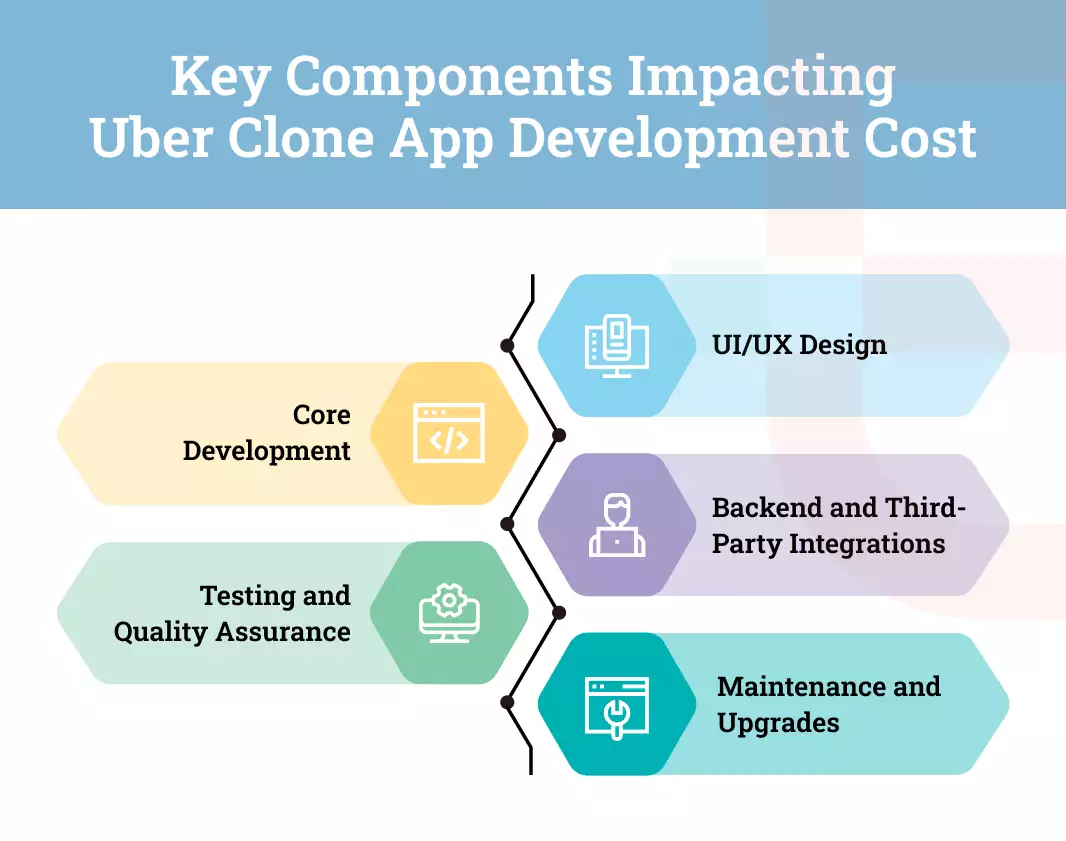
How much does it cost to build an app like Uber depends on different components of the development process, like UI/UX, core functionality, backend, third-party integrations, testing, and maintenance. Let’s have a detailed look at how each of these components influences the cost.
UI/UX Design
App design determines how users will interact with the app. A user-intuitive interface allows passengers to book rides faster and navigate the app easily. Moreover, it also makes it easy for drivers to manage trips and their earnings.
Usually, a high-quality app design with advanced animations, a user-friendly interface, and branded elements will cost more compared to one with a standard layout.
However, a clean and visually appealing design helps businesses enhance user experience and also increase retention rate. According to AppsFlyer, more than 1 in every 2 apps are uninstalled within 30 days of download, with poor user experience being one of the key contributors to it.
Core Development (Passenger, Driver, Admin Apps)
An Uber clone is not a single entity. It basically includes three apps: for admin, driver, and passenger. The passenger apps allow riders to book rides, make payments, and track rides. At the same time, the driver app is meant for managing ride requests and earnings. Admin dashboards allow businesses to manage users, monitor trips, and handle overall operations.
Since each app has different users and purposes, all three need to be developed and tested separately. Moreover, it is essential for all three apps to work in sync to ensure smooth operations. This requires a high development effort, which ultimately impacts the cost to a greater extent.
Backend and Third-Party Integrations
The backend runs in the background and manages all core operations from storing user information and managing ride requests to calculating fares and processing payments. Without the backend, your app would not be able to function properly.
In addition to backend systems, ride-hailing apps also rely on third-party services like maps, payment systems, and in-app messaging APIs. Although backend development and third-party integrations enhance your app’s functionality, they significantly impact the costs due to API licensing and usage charges and extra development effort.
Testing and Quality Assurance
Thorough testing is essential to ensure that your app is perfectly functional before launch. Identifying and resolving issues related to performance and security earlier saves you from costly iterations post-launch.
The number of features integrated in your app will significantly influence the testing time and cost. More features mean more scenarios to be tested, which will require more effort, ultimately increasing the overall development expenses.
Maintenance and Upgrades
Regular app maintenance is critical to keep your Uber clone functional and compatible with evolving technologies and security standards. This mainly includes bug fixes, platform upgrades, and feature enhancements. As your ride-hailing app scales with time, updates become necessary, making maintenance a long-term investment rather than a one-time cost.
Factors That Influence the Cost to Build an App Like Uber
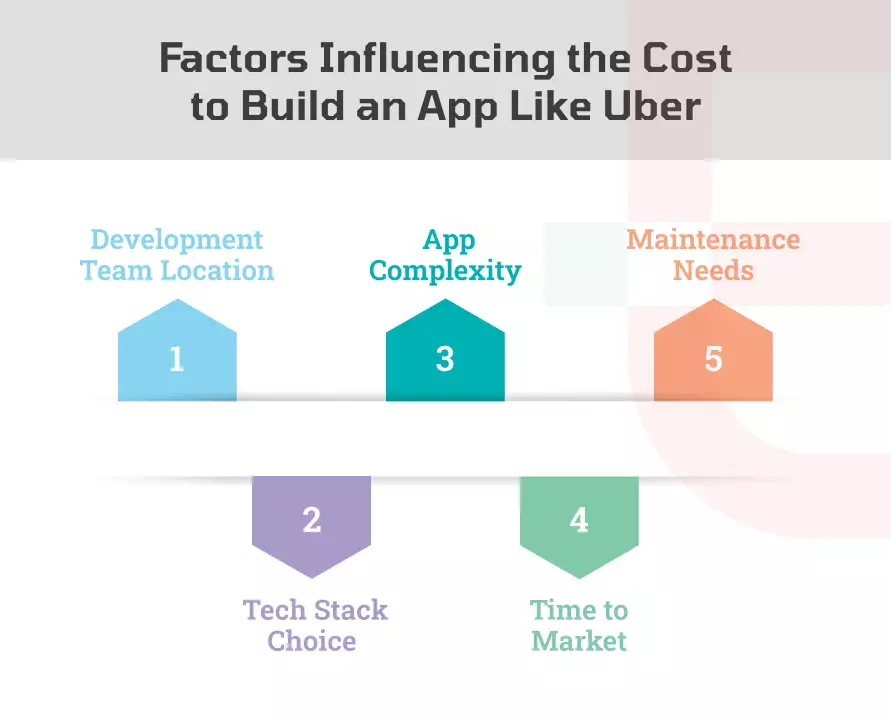
Development Team Location
The expertise and location of your development team also greatly impact the Uber app development cost. Developer rates vary across different countries due to differences in hourly rates, availability of skilled talent, and operational expenses.
For instance, development teams in North America and Western Europe will charge higher hourly rates compared to those in Asia or Eastern Europe.
Technology Stack Choice
The technology stack refers to the tools and technologies used to create your app. This includes programming languages, frameworks, and infrastructure. Your tech stack choice increases cost by influencing building speed, maintenance costs, and required expertise.
Cross-platform tools like Flutter and React ensure a faster process as they require a single codebase for both Android and iOS platforms. This reduces the overall effort and costs. However, for large-scale platforms with a higher user base, native technologies like Swift for iOS and Kotlin for Android are preferred for better performance and scalability, which will significantly increase the overall implementation and maintenance costs.
App Complexity
The complexity of the app depends on the number and type of features you want to include in the app. Because the more features you add, the more development time is needed.
For instance, building an app with minimal features like ride booking, location tracking, and secure payments will require fewer hours and cost for creation. At the same time, the app with advanced features like multilingual support, dynamic pricing, real-time location tracking, and custom workflows will require more time, which will significantly increase the cost.
Time to Market and Maintenance Needs
The timeline to launch your app also impacts the development budget. If you want the app to be developed in a shorter time frame, it will require more resources and developers. This will increase the upfront costs.
Moreover, post-launch maintenance like bug fixes, security and feature upgrades, and performance improvements will require continuous technical support. This ultimately adds to long-term operational costs and not just one-time spending.
Features that Affect Uber Clone App Development Cost
The development cost is also affected by the features you want to integrate into your platform like Uber. As more features are added, development effort and time required also increase, which impacts the total cost. Let’s have a look at some of the critical features for ride-hailing apps.
User Registration
Registration is the first step taken by users to access your app. Both passengers and drivers will have to create accounts. However, the information needed from both will be different.
Passengers will have to include information like name, email address, and phone number for signing up. In contrast, drivers will have to upload documents like ID proof, driving license, photo, and vehicle details. You can even add social media login options like Facebook or Google to make registration faster.
This detailed registration process requires more development effort to ensure the system handles all user information smoothly and efficiently. The estimated cost to develop a registration feature ranges between $3,000 and $5,000, depending on how detailed the verification process is.
GPS
Location tracking is the backbone of any on-demand taxi app. It allows the app to detect user locations, match riders with nearby drivers, and display live routes on the maps. Without GPS, your app would not be able to function properly as fare estimation and navigation completely depend on it.
Developers usually integrate third-party mapping services like Google Maps to enable features like real-time driver tracking, route navigation, pickup points, and drop-off locations.
As this feature requires continuous data updates and third-party integrations, it requires more backend processing and development time. The embedment of the GPS feature costs around $6,000 or more.
Messaging and Push Notifications
This feature is used to keep both drivers and passengers updated about ride status, driver arrival, and payment confirmations.
It provides a more convenient and faster means of communication to passengers compared to phone calls. Building this feature requires setting up real-time communication systems and notification services in the background. The average cost to build this feature ranges between $2,000 and $3,000.
In-App Payment Systems
Digital payment options allow users to complete transactions directly within the app using wallets, cards, or UPI. To enable the in-app payment feature in your app, you will need to integrate third-party payment gateways like Stripe and also comply with financial security standards to prevent data breaches.
The development cost for an in-app payment feature ranges from $6,000 or more, depending on the number of payment methods you want to include.
Driver Reports
To ensure smooth and efficient ride-hailing operations, tracking driver performance is essential. The driver reports provide a detailed glimpse into driver activity through completed trips, earnings, customer ratings, and service quality.
For building this feature, you will need to collect a large amount of data and present it in an organized way in the admin dashboard when required. This requires extensive development effort and time, due to which its approximate cost starts from $2,000 or even more.
Hidden Costs in Uber Clone App Development
Apart from development, there are several ongoing expenses involved in creating an app like Uber. Having a key understanding of hidden costs allows you to avoid last-minute surprises. So, let’s explore the hidden costs involved in the development process.
Cloud hosting
Your ride-hailing app will require cloud servers like AWS (Amazon Web Services), Microsoft Azure, or Google Cloud Platform to store user data, handle ride requests, and ensure smooth app performance.
In the beginning, hosting costs may seem to be low, but they increase significantly as your user base grows, increasing the need for server usage, data storage, and effective performance. This makes cloud hosting a recurring expense in app development.
Third-party APIs
Ride-hailing apps heavily rely on third-party services like Google Maps for navigation, Stripe or PayPal for payment gateways, and Twilio or Firebase for in-app messaging and notifications. These services follow usage-based pricing. This means the overall cost will increase significantly over time as more users use your app.
Compliance and Security Standards
Users will be storing crucial information like payment card details, location history, and personal information in your app. And so data protection becomes vital for your business to maintain user trust.
For this, businesses have to perform regular system audits, security updates, and compliance with privacy regulations. Since these standards keep evolving with time, compliance and data security become recurring costs rather than a one-time investment.
Customer Support
Drivers and passengers can face issues related to bookings, payments, cancellations, or technical errors while using the app. This creates a need for constant customer support.
To provide reliable support, businesses have to invest in hiring customer support staff, embedding chatbots, and setting up helpdesk systems. As the number of app users grows over time, support needs also increase, which makes it a recurring operational expense.
Scaling and Infrastructure
When your ride-hailing app starts getting more users, it will need to handle higher traffic, more ride requests, and real-time updates efficiently without facing any performance issues. This will require stronger servers, better load management, and regular backend infrastructure upgrades.
While scaling helps maintain smooth performance, it also increases costs related to backend systems and performance optimization.
How Much Does It Cost to Build an App Like Uber?
Based on different factors like core app components, feature complexity, development approach, technology stack, long-term maintenance, and hidden costs, the overall cost to build an app like Uber ranges from $20,000 to $300,000+.
| App Type | Ideal For | Key Features Included | Estimated Cost Range |
| MVP | Startups testing market demand | User registration, ride booking, GPS tracking, basic payments, driver matching, and an admin dashboard | $20,000 to $45,000 |
| Mid-Range | Growing businesses | Advanced ride management, multiple payment methods, in-app chat, ratings & reviews, promo codes, analytics | $50,000 to $80,000 |
| Enterprise-Level | Large-scale platforms | Real-time analytics, dynamic pricing, multi-city operations, multilingual support, and AI-based demand prediction | $90,000 to $300,000+ |
Ready-Made Uber Clone or Custom Development: What to Choose?
When it comes to creating a ride-hailing platform like Uber, businesses often struggle with choosing between a ready-made Uber like app and a custom-built app. However, the right choice depends on your goals, budget, and time to market.
- A pre-built solution involves all the necessary features. It becomes an ideal way for startups and growing businesses for whom a faster app launch matters in the competitive landscape. Also, since its functioning is already tested in the market, it requires lower development effort and cost.
- In custom app development, you have to start everything from scratch, from market research and planning to development and testing. While this approach offers high-end flexibility, it also requires longer development cycles and higher investment compared to using a ready-made app.
Reduce Development Costs and Launch Your Ride-Hailing Business Faster with Elluminati’s Uber Clone
Strategies to Reduce Uber Clone App Development Cost
Now, let’s have a look at some of the common strategies to reduce Uber clone app development costs.
Start with an MVP Instead of Creating a Complete App
Rather than creating a full-feature app, it would be smarter to launch an MVP (Minimum Viable Product) with core ride-booking features. This approach will help you validate market demand based on user feedback early and will also save you from spending on unnecessary features.
Opt for a Readymade Uber Clone Script for Quick Launch
A ready-made Uber like app is embedded with all essential ride-hailing features and functionalities that are needed to step into the market. This tactic cuts down development time and cost as you will only have to modify specific features rather than building everything from the ground up.
Choose an Experienced Development Team in the Right Location
The development team’s experience and location greatly influence your app quality and cost. Partnering with an experienced company in a cost-effective region like India helps you build a high-performing app while keeping the budget under control.
Build for a single platform (Android or iOS) Initially
One common mistake that most startups make is launching the app on both Android and iOS all at once, which significantly increases the initial development cost. Instead, you should first launch it on a single platform. This not only reduces the overall expenses, but it also helps in identifying what works and what doesn’t, and refines the app before investing in a multi-platform rollout.
Prioritize Features Based on User Needs
Instead of wasting time and money on adding every possible feature, it would be better to focus on features that users actually need. You can add advanced or niche-specific features later as your platform grows.
Choose Third-Party APIs Over Custom Development
Building features like maps, payments, and notifications from scratch would consume significant time and money. Integrating third-party APIs instead makes the process faster and cost-efficient.
Invest in Scalable Architecture from Day One
As the user base grows, your app will have to be ready to handle more traffic and ride requests. In such scenarios, planning a scalable architecture from day one helps you avoid costly rework later.
Outsource for App Maintenance & Updates
Regular app maintenance is crucial to ensure the smooth performance of your app. But it becomes costly with an in-house team. Outsourcing ongoing maintenance helps control recurring expenses while ensuring your app always stays updated, secure, and high-performing.
How Elluminati Can Help You Develop an Uber Clone Effectively
Having a key understanding of Uber clone app development costs allows you to plan your budget wisely and also avoid unnecessary spending during the development phase. By knowing what factors influence the overall cost, you can choose the right technologies, features, and approach to build your ride-hailing platform.
And when it comes to developing an Uber clone app, Elluminati becomes your ideal partner. With 14+ years of experience, we have acquired profound expertise in creating ride-hailing solutions with scalable architecture and customized features tailored to your business needs. By blending modern technology with expert knowledge, we make creating an Uber like app easy and cost-efficient.
FAQs
The Uber clone app development cost ranges from $20,000 to $300,000+, depending on numerous factors like app components, technology stack, development team location, number of features, hidden expenses, and more.
The most common factors influencing the cost of an Uber like app are development team expertise and location, technology stack, app complexity, number of features, time to market, and long-term maintenance expenses.
Yes, developing an Uber clone is much more affordable than building from scratch. An Uber clone is a ready-made app that is embedded with all core features and functionalities. This reduces the time to build and test the application from scratch, which ultimately lowers the development expenses.