Key Takeaways (or TL;DR)
- The journey of Uber began as a premium luxury ride service (Uber Black) in 2010 and has evolved its transportation services into a diverse ecosystem, including Uber Eats, Uber Freight, and Uber Health.
- The Uber business model functions as a multi-sided marketplace, connecting independent drivers to riders through a mobile application to fulfill their services.
- The Uber workflow is user-friendly, involving straightforward steps from registration to entering a location, sending a request to driver matching, trip completion, payments, and a final review and ratings process.
- The company receives monetary benefits from diverse channels, including commissions, delivery fees, service charges, corporate travel, subscription programs, and in-app advertising.
- The future of Uber continues to evolve, driven by electric vehicles, autonomous mobility, and sustainability initiatives.
Uber has reshaped the transportation industry with its innovative ride-sharing platform, which connects riders and drivers through advanced mobile applications. By utilizing the Uber business model, the company uses its algorithms and flexible pricing to manage its multi-model ecosystem, including food delivery, logistics & medical transport.
In today’s gig economy, Uber is the key standard for asset-light scaling. Whether you are a startup founder aiming to build a ride-hailing platform or an established entrepreneur looking forward to growing a taxi business, understanding Uber’s strategies is vital. It reveals how to use data-driven technology to disrupt traditional industries without owning a single vehicle.
In this guide, we will walk you through how does Uber work, its diversified revenue sources, key components, and more to help you prepare a strategy that leads your business toward success.
About Uber: A Journey to a Multi-Model Ecosystem
Back in 2008, when Travis Kalanick and Garrett Camp went to Paris to attend a conference and found it difficult to hail a taxi, this disappointment spurred them to think,“What if we could simply tap on a phone to request a ride?”And that was how UberCab was started!
Uber Technologies, Inc.
Founded In: March 2009
Founders: Garrett Camp and Travis Kalanick
Key People: Ronald Sugar as Chairman, and Dara Khosrowshahi as CEO
Headquarters: 1725 3rd St., San Francisco, California, United States
Industry: Transportation & Mobility as a Service
Operations: Over 70 countries and 10,500 cities worldwide
Total Revenue by 2025: $49.61 Billion , 18.25% increase year over year.
Uber Technologies, Inc., formerly known as UberCab, made waves in 2009 with its aim of evolving ground transportation services. Founded by Travis Kalanick and Garrett Camp, its headquarters are in San Francisco, California, United States.
The idea, which began as a luxury black car service (Uber Black) to make ride-hailing services more efficient, has now evolved into a mass-market mobility platform. Today, it operates worldwide with over 180 million monthly active users and 6 million active drivers and couriers. Also, it has subsequently launched several services, which we will briefly discuss below.
| Evolution of Uber Taxi Services | ||
| Types of Uber Taxi Service | Launched Year | Specialty |
| Uber Black | 2010 | Premium luxury ride options. |
| UberX | 2012 | Launched standard taxi services. |
| UberXL | 2013 | For larger groups or with extra luggage. |
| UberX Share | 2014 | Previously known as UberPool, it delivers cost-efficient service by allowing customers to share a ride with others on a similar route for a lower fare. |
| Uber WAV | 2014 | Ride services with “Wheelchair Accessible Vehicles.” |
| Uber Transit | 2015 | To make a multi-modal journey by integrating public transport schedules like bus, train, & metro and booking tickets directly through the app. |
| Uber Comfort | 2019 | Mid-tier Uber service to deliver a more spacious and comfortable ride experience. |
| Uber Electric | 2025 | Rebranded from Uber Green to focus exclusively on fully electric vehicles. |
| Uber Saarthi | 2025 | Uber launched a private car ride-sharing service in Assam, India. |
In November 2025, Uber driverless taxis rolled out in Abu Dhabi, in partnership with WeRide, a Chinese autonomous vehicle company.
The company holds a leading position in this growing ride-hailing market, driving significant changes in global mobility through its scale of operations and technological innovation. With billions of trips completed, it serves as a primary transportation option for millions of users worldwide.
Also, Uber’s global expansion has been supported by strategic investments, acquisitions, and partnerships.
Let’s have a brief ideaabout its investors, funding rounds, and expansion acquisition strategies behind it:
- Uber has raised a total of $13.2B across 26 funding rounds, and its key investors include PayPal, Toyota, and SoftBank Vision Fund, among others.
- In 2016, the company acquired Otto, a self-driving truck company, for $625 million.
- In mid-2016, it also acquired Geometric Intelligence to form Uber AI, which it discontinued in May 2020.
- In 2018, Uber partnered with Autzu to enable its drivers to rent electric Teslas on an hourly basis.
- On May 10, 2019, Uber became a public company via IPO, raising $1,150 million.
- In late 2025, Uber announced major global sports sponsorships with FC Barcelona and the Milano-Cortina 2026 Olympic and Paralympic Winter Games.
Now, beyond Mobility-as-a-Service, the company also reports its operations across delivery through Uber Eats and freight logistics through Uber Freight.
So, let’s get a better understanding of the other types of services that Uber offers:
What Services Does Uber Offer Besides Ridesharing?
Uber Eats
Back in August 2014, Uber launched its online food ordering and delivery service under the name UberFRESH, which was later renamed Uber Eats. It is one of the largest global food delivery services, competing with DoorDash, Grubhub, and Deliveroo.
Uber Freight
Uber Freight, a technology-first platform for digital freight brokerage, launched in May 2017 with a mission to simplify the movement of goods and help communities thrive.
This digital logistics platform leverages advanced technologies to connect shippers with truck drivers and streamline freight matching with available carriers for efficient booking and transportation.
The market for Uber Freight is growing steadily, with major expansion in Europe, where the aim is to reach 200 million euros in Freight Under Management (FUM) by 2028.
Uber Health
Uber Health, launched in March 2018, is a HIPAA-compliant platform that helps healthcare organizations arrange NEMT (non-emergency medical transport) and deliver prescriptions and healthy food to patients and staff by integrating with pharmacy systems.
Businesses worldwide are inspired by how Uber balances profitability with an effortless user experience. But to build the next Uber-like powerhouse, one must first understand the pivotal milestone and business logic that fueled its rise to the top.
The following timeline highlights the strategic decisions, expansions, leadership changes, and technological advancements that transformed Uber from a ride-hailing startup into a global, AI-driven mobility ecosystem.
Uber Success Timeline:
-
2008 – Garrett Camp & Travis Kalanick met at LeWeb, a tech conference in Paris.
-
2009 – UberCab was founded in San Francisco by Garrett Camp & Travis Kalanick.
-
2010 – UberCab launches its beta in San Francisco, and Ryan Graves becomes the first CEO.
-
2011 – The company rebranded as Uber and expanded its services to New York City, Seattle, and Paris.
-
2012 – Standard Ride Services was launched under the name of UberX.
-
2013 – Uber expanded its business to 100 cities and grew its global footprint in India & China.
-
2014 – UberPool, later rebranded as UberX Share, launched in August. That same year, the company launched UberFRESH in Santa Monica.
-
2015 – UberFRESH was rebranded as Uber Eats and launched as a standalone app in Toronto.
-
2016 – Uber sells its China business to DiDi in exchange for a stake.
-
2017 – Crisis year for Uber due to workplace scandals; Travis Kalanick resigns, and Dara Khosrowshahi becomes the new CEO. The same year, the company launched its Uber Freight.
-
2018 – Uber acquired JUMP (e-bikes) and expanded its model into multimodal transportation services. They also launched Uber Health in March.
-
2019 – Uber becomes a public company by announcing its first IPO.
-
2020 – The company’s ride-hailing market goes down due to COVID-19, while Uber Eats revenue increases & Uber acquires Postmates.
-
2021 – Uber also acquired the Drizly (alcohol delivery) platform and Careem.
-
2022 – The company records its first-ever positive cash flow.
-
2023 – Uber achieved its first full GAAP operating profit and was added to the S&P 500 index in December.
-
2024 – Announced its first $7 billion share buyback. Also, in the same year, they partnered with Waymo and Instacart to expand their “Autonomous & Everything” strategy.
-
2025 – The company also launched its new ride-sharing service, Uber Saarthi, in Assam, India. Also, Uber partnered with NVIDIA to scale its robotaxi network globally.
Collaborate with Elluminati to Build a Unified, Scalable Digital Ecosystem for Ride-Sharing, Delivery, and Courier Operations
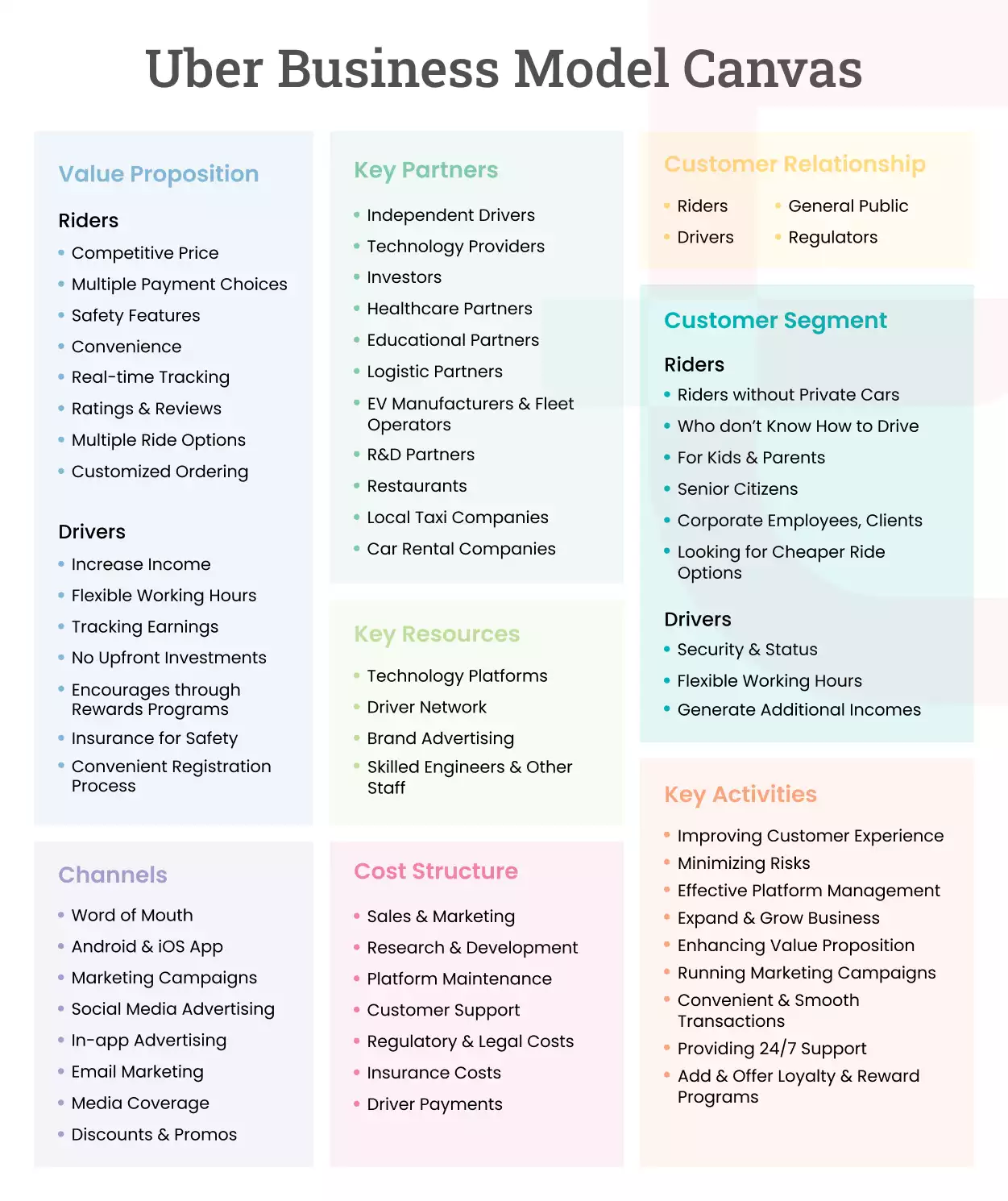
Uber Business Model Canvas
Uber is much more than just a taxi-hailing business. The Uber business model is flexible, and its elements can be adopted by any business segment, regardless of its size.
Let’s make it simple by breaking down the model into key factors.
Key Partners
To expand the business globally, the firm needs to build a strong partnership with users connected to their platforms, including
- Independent drivers who provide ride-hailing services.
- Tech and payment partners like NVIDIA for AI & AVs, Stripe for payments, and Oracle for core infrastructure.
- For public transit, Uber partnered with several transit agencies, including Denver’s RTD and London’s TfL, to integrate bus and train schedules into the app or to provide last-mile connectivity.
- Healthcare organizations such as Boston Medical Center and Modivcare also partnered with the company to provide non-emergency medical transportation (NEMT) for patients through Uber Health.
- Car rental companies like Hertz and Enterprise are enabling vehicle leasing options.
- Restaurants are making their delivery services accessible to customers through digital platforms.
- Educational partners like Rosetta Stone offer language learning to eligible drivers through their Uber Pro program.
- Partnership with a logistics company like Shadowfax to extend its two-wheeler delivery and ride services.
- EV manufacturers and fleet operators like BYD and Lithium focus on further electrifying Uber’s fleet.
- R&D Partners, which works with Uber on longer-term business opportunities.
Key Activities
Once the firm has actively balanced its work operations, it needs several things to perform regularly, which include:
- Effective platform management involves continuously monitoring the app and improving its technology infrastructure.
- Marketing campaigns and social media to build robust customer engagement.
- Expanding and growing opportunities.
- Developing or adding new, engaging loyalty and rewards programs.
- Convenient and smooth transactions through a secure payment gateway.
- 24/7 support to resolve issues of both riders and drivers.
Value Proposition
Uber’s compelling value proposition is winning over its users. From prioritizing trip convenience and accessibility for riders to increasing earning opportunities for drivers, it serves different purposes for both its users.
For Riders:
- Riders have complete access to transportation services . They can use the app to reserve a taxi at any time, from anywhere.
- Enables riders to track trips in real time.
- Competitive prices that let them enjoy pocket-friendly trips.
- Payment methods : e-wallet, debit or credit card, cash, etc.
- Allows riders to utilize promo codes to save extra on rides.
For Drivers:
- It creates a gig-economy model for drivers, allowing them to set their own schedules and choose how much time they want to work each day.
- Convenient registration and easy validation procedure.
- They can also select a payment option that is convenient for them.
Key Resources
Resources are the reservoirs of support and expertise that help businesses stay afloat.
- Technical platforms like apps and web panels across operating systems.
- Proprietary software infrastructures that enable real-time matching, payment processing, and customer analytics.
- A strong, globally recognized brand that attracts both riders and drivers.
- It continuously focuses on improving its algorithms and data analysis .
Customer Segment
Uber’s core customer segment includes both riders and drivers.
Riders:
- Riders who don’t own a vehicle.
- Riders who don’t know how to drive.
- Riders want cost-efficient taxi services at their doorstep.
- Riders opt for a luxury traveling experience & VIP treatment.
Aside from this, Uber also has special services to deliver for their special customers, which include
- Uber for kids,
- Uber for senior citizens,
- Uber for professionals
Drivers:
- Drivers are seeking opportunities to generate additional income.
- Drivers who want to work flexible hours.
- Drivers who are seeking a way to live a life with security and status.
Customer Relationships at Uber
Uber’s customer relationships consist of four key elements: drivers, riders, the general public, and the regulators.
Riders: To maintain a strong relationship with riders, it is essential to build transparency around timing and pricing, as well as confidence in security and privacy.
Drivers: Even though drivers are not Uber employees and their vehicles are not Uber’s property, there are still several lawsuits worldwide. The company needs to offer them encouragement to work and payment conditions to keep the business running.
General Public: Uber has already portrayed a positive image to the general public through its services, marketing campaigns, and more.
Regulators: The company also seeks compliance and responsibility within the law, within a threshold, allowing it to obey the laws of the market itself.
Cost Structure
The key expenses of Uber involve
- The company spends significant effort, time, and resources in its customer acquisition process , including sales, marketing, and promotion.
- The cost of settling legal disputes.
- It also covers insurance costs for drivers, riders, and platform-related risks.
- To enhance the platform’s technology and drive innovation in its flow, the firm invests heavily in research & development.
- To keep the platform running smoothly, the company incurs regular maintenance costs .
-
Paying remuneration and other incentive benefits to employees.
Channels
The following are the channels the company primarily uses to connect with its customers, including
- Earlier, it used word-of-mouth strategies to reach users more effectively.
- One of the most compelling ways is through social media advertisements.
-
In-app advertising to promote businesses’ offerings directly within the app.
-
Strategic partnerships with other brands to expand their services.
- Uber also sponsors the events to enhance its brand visibility.
- Dedicated apps for riders and drivers on the Android and iOS platforms.
- Through affiliate programs , it encourages members to make new registrations.
How Does Uber Works? Insights Into Its Impressive Working Pattern
Advanced technology has become the turning point for the overall transportation industry. In fact, people from all over the globe prefer online taxi services, driving the overall taxi market value to USD 366.91 Bn by 2031.
Not only that, but major players, including Uber, already dominate the taxi market. Uber’s operating model is simple, and its unique approach attracts users worldwide.
Below is a step-by-step overview of how Uber works for its riders.
- Account Registration
Riders are required to create an account using an email ID or by filling out their contact details.
- Set Pickup & Drop-off Location
Once the account is created successfully, the rider needs to set their pickup and destination addresses.
- Send Ride Request
After adding the location details, the rider can submit a ride request by selecting a suitable vehicle type.
- Driver Matching
Uber’s algorithm matches the rider’s request with a nearby driver, which they can accept. Also, the app constantly notifies the rider regarding their trip status.
- Ride Completion & Payment
Once the trip is completed, the rider must pay using any convenient method, including credit or debit cards, digital wallets, Uber Cash, or gift cards.
- Ratings & Feedback
Lastly, the app asks the rider to share their reviews of their trip. Also, they are free to share tips with the driver based on their experience.
The Roads Are Open & the Market Is Waiting! With Our Customizable Uber Clone, Take a Chance to Outdrive the Competition
How Uber Earns Money: 7 Diverse Revenue Streams
While it operates in several countries worldwide, the United States remains its most profitable market, accounting for nearly 50% of the company’s revenue.
This strong domestic performance provides Uber with a financial backbone, enabling it to expand globally while experimenting with various revenue strategies.
So, let’s explore diverse Uber revenue models from below.
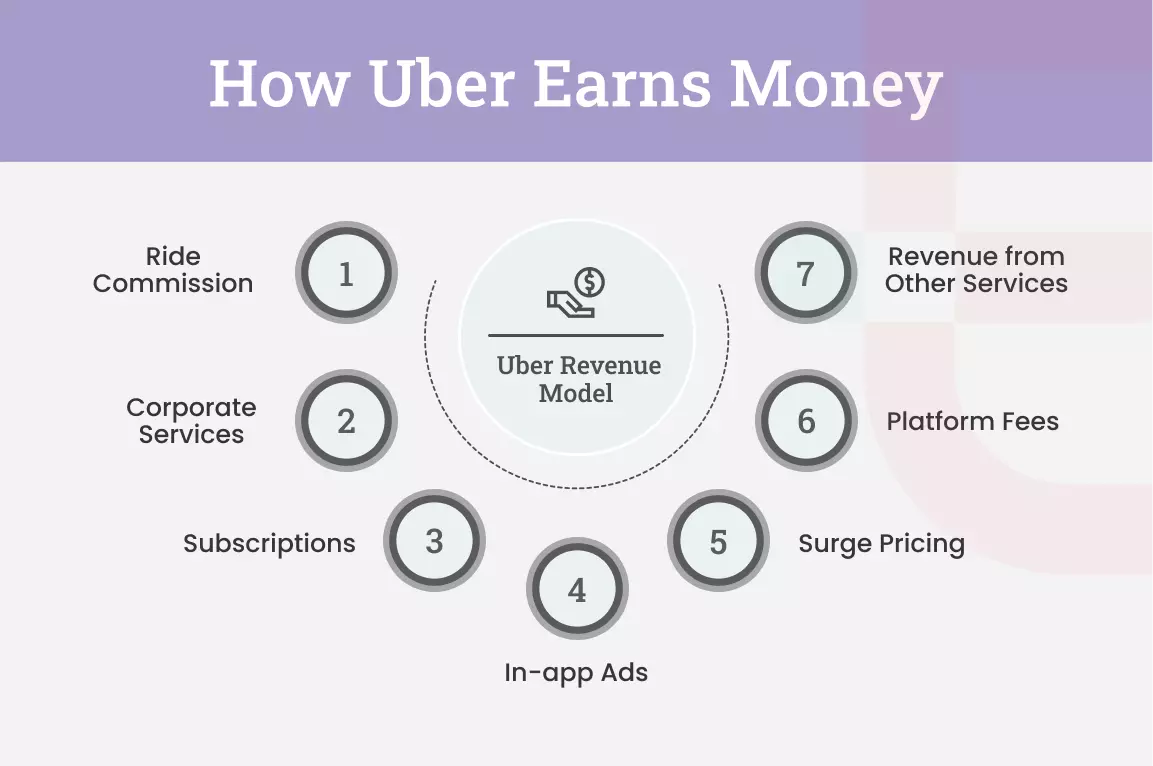
Ride Commission
The most direct way Uber makes money is by taking a commission on every ride booked through the platform.
Here’s how it works:
- The rider pays a fare for the trip.
- The majority goes to the driver, but Uber takes a cut, which can range from 15% to 30%, depending on factors such as city regulations, ride type, demand, and incentives.
- Also, many healthcare providers pay Uber a set percentage commission for arranging special transportation services for their patients and staff.
This commission model ensures that Uber earns on volume, even if individual margins vary. The more rides are completed, the more revenue flows in.
And because Uber operates across different ride categories (like UberX, Uber Pool, Premier, or XL), it captures different user segments, from budget travelers to premium ride seekers.
Corporate Services
Uber’s corporate offering, calledUber for Business, is a major revenue stream for the company. Corporations use this service to provide, manage, and track employee rides.
Whether it’s daily office commutes, airport rides, or guest travel, the platform allows businesses to:
- Set the travel ride service amount limit
- Monitor employee ride history
- Download employee travel details
This service reduces friction for corporates and gives Uber consistent, high-volume bookings.
Subscriptions
Uber offers premium subscription-based plans called Uber One to generate steady, recurring income.
These subscription plans offer users:
- Discounted ride fares and instant cash back.
- Also, it provides its members with an extra Surge Saving benefit.
- Priority support and better driver availability.
In-App Ads
In the first quarter of 2025, Uber Ads surpassed a $1.5 billion annual revenue run rate, growing 60% year over year, making it one of the fastest-growing parts of the company.
Uber isn’t just a mobility app; it also runs in-app ads. When users open the app, browse services, or wait for their ride, Uber displays targeted, location-based ads.
These ads may promote:
- Premium fees for ads based on destination
- Sponsored ride offers
- JourneyTV, where the brands pay for airtime on these screens
Surge Pricing
Uber smartly balances the demand and supply without lowering their profit through surge pricing. When a ride request or any order is in peak demand, such as during holidays, office hours, or special occasions, its rates temporarily increase.
This boosts Uber’s revenue and encourages providers to earn more, ultimately making it a win-win for the business and users.
Platform Fees
Uber has partnered with Waymo or Lucid to list their autonomous vehicles on Uber’s app and charges a fixed fee to the companies for using its platform.
Revenue from Other Services
Deliveries
The Uber Eats business model has become a prominent example in the on-demand delivery sector. It generates revenue in diverse ways, such as
- Delivery fees & service charges from customers
- Sponsored listings from restaurants
- In-app advertising & partnership fees
- Subscription benefits include free delivery on orders
- Commission from restaurants & non-restaurant venues like grocery stores
Logistics
Uber Freight generates revenue in the following ways:
- By charging transaction fees.
- It’s proprietary software called the “Transportation Management System.”
- Incurred charges for any value-added services like load tracking, payment processing, and more.
What Will Be the Future Outlook of Uber?
Uber’s future outlook is shaped by two defining priorities: sustainability and autonomous mobility. As the company evolves from a ride-hailing platform into a global mobility and logistics ecosystem, its long-term strategy focuses on reducing environmental impact while improving efficiency through automation.
From zero-emission commitments to large-scale investments in autonomous rides, deliveries, and freight, Uber is positioning itself at the intersection of clean energy, AI-driven transportation, and urban mobility transformation.
Zero Emission Strategy with “The Greener Path”
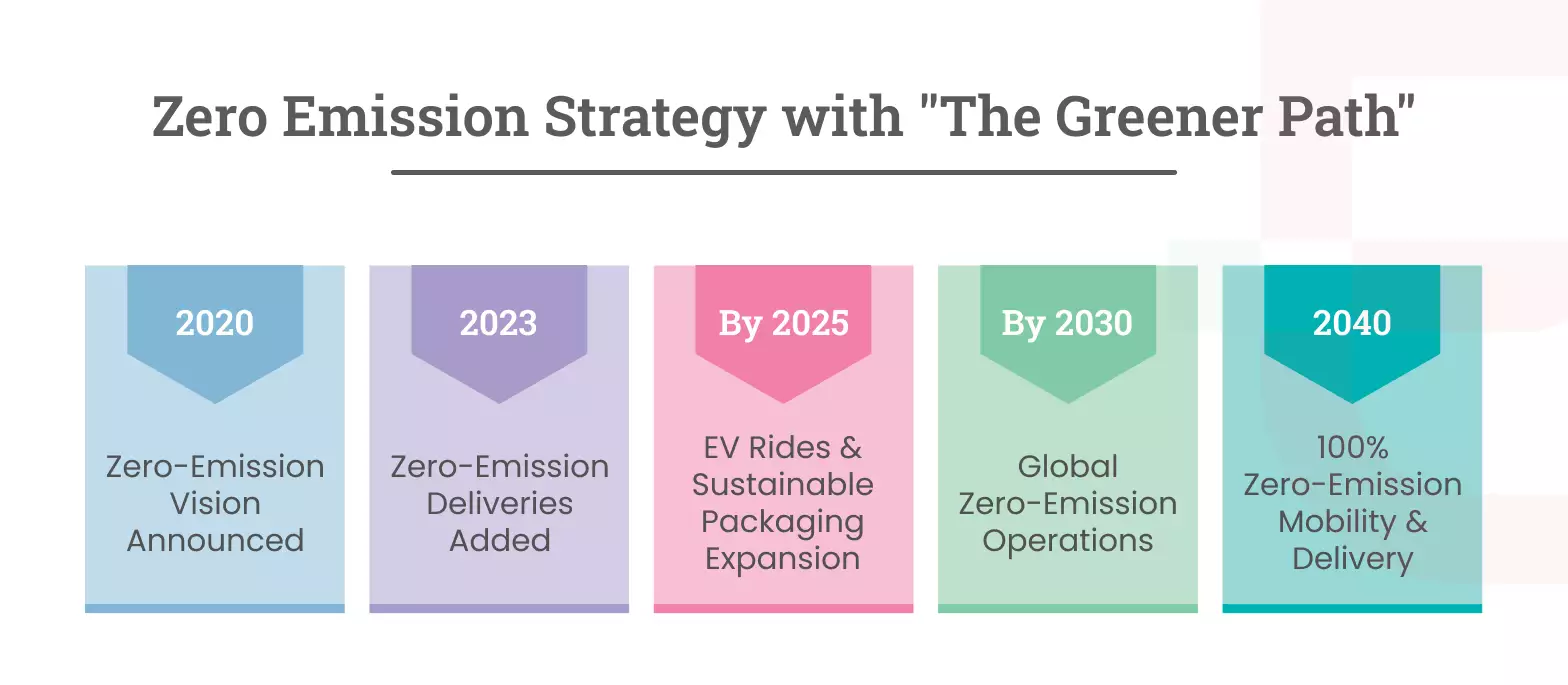
“Transforming Uber into a zero-emission platform by 2040,”said CEO Dara Khosrowshahi!
2020-
- Announced a global goal to become a zero-emission mobility platform by 2040.
2023-
- Expand the global goal to include zero-emission delivery trips by promoting sustainable packaging.
By the end of 2025-
- Plans to achieve zero-emission rides in key European cities.
- Also, shifting most Uber Eats orders in Europe and the Asia Pacific cities to sustainable packing options.
By the end of 2030-
- Uber aims to expand its zero-emission ride operations across the U.S., Canada, and Europe.
- Making all deliveries in major European capitals emission-free.
- Transition all Uber Eats restaurant merchants globally to sustainable packaging.
Achievement by 2040-
- Ensuring 100% of trips and deliveries worldwide are made in zero-emission vehicles, public transport, or micromobility.
Autonomous Expansion
“To reimagine the way the world moves for the better” is Uber’s future mission, and autonomy plays a crucial role in achieving it.
Mobility
Uber is increasingly investing in autonomous ride-hailing as a long-term growth lever. By partnering with companies such as Waymo, Avride, and WeRide, Uber can deploy driverless fleets without owning vehicles, allowing it to focus on platform orchestration and demand generation.
This asset-light approach closely mirrors the foundational principles behind starting a robotaxi business , where success depends on regulatory readiness, fleet partnerships, and AI-driven operations rather than traditional ownership models.
“By the end of 2026, the company is aiming to have robotaxi services available in over 10 markets, including key areas like London with Wayve and San Francisco with Lucid and Nuro.”
Deliveries
Uber also partnered with Avride, Cartken, Coco, Nuro, and Serve Robotics for autonomous sidewalk delivery robots and Waymo for robotaxi deliveries. Cities like Tokyo, Dallas, and Jersey, among others, are currently receiving the autonomous Uber Eats deliveries via robots.
Logistics
Uber Freight, the logistics business spun out of Uber, is also betting big on autonomous trucking. Uber partnered with Aurora Innovation to conduct autonomous truck deliveries on a commercial route between Dallas and Houston, Texas.
How Can Elluminati Help You Build an App Like Uber
The Uber business model has contributed significantly to society. After delving into its journey, models, and revenue streams, it becomes evident that Uber’s success lies in its ability to adapt and innovate.
Entrepreneurs like you can draw several lessons from how Uber operates. For example, you not only need equity to start a business but also need to identify the industry’s real pain points and bring a solution that rules the taxi market.
If you are looking to accelerate your taxi app deployment and achieve a rapid market entry, then Elluminati will be your ideal tech partner. We provide a robust and highly adaptable Uber clone solution, backed by a skilled team with extensive domain knowledge. Also, we ensure you maintain 100% source code ownership, giving you complete control over your platform as you confidently launch it into the taxi market.
With over 14 years of experience delivering scalable solutions to diverse industries, our portfolio is a testament to our impact. It showcases how we solved our clients’ pain points and turned their operations into high-yielding assets, boosting their ROI.
FAQs
The Uber business model is a multi-sided platform that touches digital app aggregators and on-demand services. Through its marketplace, it has expanded its services to include Uber Eats, Uber Freight, and Uber Direct; the on-demand economy remains at its core.
Uber faces significant challenges, including.
- Regulatory Hurdles
- Safety & Security Concerns
- Driver Economics & Retention
- Technology & Disruptions
Uber’s business model is built with all the key components, which include:
- Key Partners
- Key Resources
- Value Propositions
- Cost Structure
- Diverse Revenue Streams
- Channels, etc.
Uber revenue model primarily includes
- Commission
- Delivery Charges
- Services Fees
- Surge Pricing
- Corporate Trips
- In-app Advertising
- Sponsorship
- Subscriptions
Yes, Uber has made progress towards sustained profitability, attaining positive cash flow and operating profits in recent years. This achievement has been driven by enhanced cost management, the expansion of higher-margin services such as advertising and subscriptions, and the growth of Uber Eats and freight operations.