Key Takeaways (or TL;DR)
- Blinkit is a quick-commerce platform that delivers groceries and daily essentials to customers within 10-20 minutes by using nearby fulfillment centers.
- It works in a simple way where customers browse products and place orders on the app, and items are packed and delivered through a local delivery network.
- The platform generates revenue from multiple sources, such as order commissions, product markups, delivery charges, surge pricing, in-app advertising, private label products, membership plans, and partnerships.
- The company has been operating successfully because of its smart marketing strategies, including a strong focus on speed, app-first shopping experience, exclusive discounts, and use of Zomato’s ecosystem.
- It is also planning to achieve sustainable growth in the future by expanding its dark store network, adopting AI technology, and adding different product categories like electronics to the catalog.
Blinkit has become one of the most popular names in India’s instant grocery delivery space, mainly because of its ability to simplify everyday shopping for customers through faster fulfillment and a mobile-first shopping experience.
For businesses planning to launch a similar venture, understanding the Blinkit business model is essential. It explains how technology, local inventory systems, and delivery networks work together to enable faster deliveries, generate revenue from multiple channels, and grow operations in different regions.
This article will walk you through how Blinkit works, its business model, revenue channels, marketing strategies, and future plans to help you launch your business confidently.
What is Blinkit?
Blinkit is India’s leading quick commerce service that delivers groceries, household essentials, personal care products, and other daily-use items to customers’ doorsteps in 10-20 minutes.
The company operates through a network of dark stores located in major urban areas to ensure faster order fulfillment compared to traditional grocery delivery services.
Company Overview:
Founded in: December 2013
Founders: Albinder Dhindsa and Saurabh Kumar
Headquarters: Gurgaon, Haryana, India
Services: Online grocery delivery
Key People: Albinder Dhindsa (CEO)
Annual Revenue (FY 2025-26): US$6,001 million according to ECDB
From Grofers to Blinkit: How a Rebrand Sparked a Q-Commerce Leader
The company was initially founded in 2013 as a conventional grocery delivery service by Albinder Dhindsa and Saurabh Kumar under the name “Grofers”.
Then it gradually moved towards an ultra-fast delivery model, and in 2021, it was rebranded as “Blinkit” to align its identity with an instant delivery model. It gained immense popularity because of its hyperlocal delivery operations and faster order fulfillment system.
Fast forward to today, the company is operating in over 200 cities in India with more than 2,200 dark stores. Moreover, it has an active customer base of around 27 million+ customers and more than 400,000 delivery partners.
Let’s have a glimpse of Blinkit’s journey from a mere grocery delivery service to a quick commerce giant.
Success Journey of Blinkit:
2013
- Launched as “Grofers”, an online grocery delivery service in Gurgaon
2019
- Secured around $200 million in funding led by SoftBank’s Vision Fund
2021
- Introduced express grocery delivery services in Gurgaon
- Acquired unicorn status with Zomato’s $100 million investment
- Introduced 10-minute delivery services in 12 large cities of India
- Renamed as “Blinkit” to provide faster deliveries
2022
- Zomato acquired Blinkit for $568 million to enter the instant grocery delivery market.
2023
- It turned Zomato’s contribution positive for the first time in Q2 FY24, with the margin improving from -7.3% in Q2 FY23 to +1.3%.
2025
- Introduced Blinkit Ambulance to provide emergency medical assistance in minutes in select parts of Delhi.
A Closer Look at the Funding Rounds of Blinkit
The company has secured $1.4 billion in funding in 23 rounds since its launch, with Zomato, KTB Ventures, and Tiger Global Management being the major investors.
| Date | Funding Type | Lead Investors | Amount Raised |
|---|---|---|---|
| 29 June, 2021 | Series G | Zomato | $120 million |
| 29 September, 2021 | Series G | KTB Ventures | $16.7 million |
| 3 February, 2022 | Secondary Market | Tiger Global Management | – |
| 10 March, 2022 | Convertible Note | Zomato | $100 million |
| 15 March, 2022 | Debt Financing | Zomato | $150 million |
| 11 June, 2024 | Corporate Round | Zomato | $3 billion |
| 19 January, 2025 | Corporate Round | Zomato | $5 billion |
| 24 February, 2025 | Corporate Round | Zomato | $15 billion |
| 26 November, 2025 | Corporate Round | Zomato | $6 billion |
| 12 March, 2026 | Corporate Round | Zomato | $4.5 billion |
Source: Crunchbase
Understanding the Blinkit Business Model
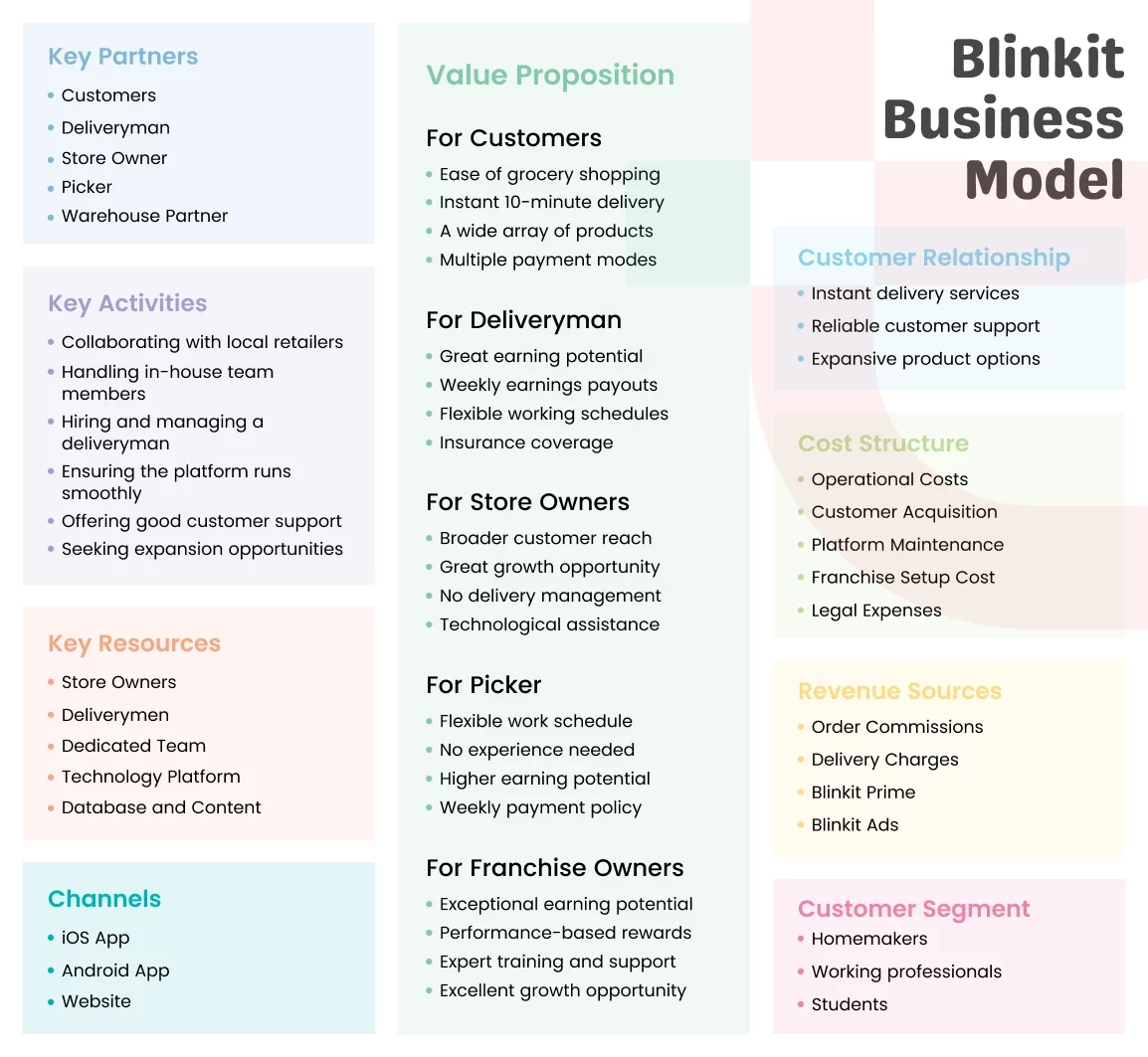
The Blinkit business model focuses on enabling faster deliveries of groceries and daily essentials through nearby dark stores, technology-driven order management, and a local delivery network. Here is the detailed breakdown of key aspects behind its operational structure.
Key Partners
Several stakeholders work together to fulfill deliveries faster and ensure smooth operations.
- Customers rely on the platform to get groceries and daily essentials delivered within minutes.
- Delivery partners handle last-mile dispatch, ensuring orders reach customers within minutes.
- Store owners list their items on the platform to reach a wider customer base.
- Pickers work inside dark stores, collecting and packing ordered items for fast dispatch.
- Warehouse partners set up and operate Blinkit’s franchise dark store locations.
Value Proposition
The platform creates value for each user by focusing on convenience and speed.
For Customers
- The customers can smoothly shop for groceries and other daily essentials.
- With quick delivery services, they can instantly receive orders in just about 10 minutes.
- The app’s wide product catalog lets them shop across dozens of categories in one place.
- The customers get to choose their preferred payment mode from multiple options.
For Delivery Partners
- The platform offers higher earning potential with competitive salaries and rewards.
- The weekly earnings payout policy helps generate a consistent cash flow.
- With flexible timing, a delivery partner can create their own work schedule.
- The platform also offers benefits like accidental and medical insurance coverage.
For Store Owners
- Store owners can extend their reach to a broader customer base with the online platform.
- They can receive higher growth opportunities by serving the masses.
- The platform’s delivery management services take the hassle of delivery off their shoulders.
- Store owners can use the technical assistance from the company’s support channels.
For Picker
- The flexible timing policy allows pickers to create their own work schedule based on their availability.
- Working as a picker doesn’t require any prior experience, allowing anyone to start their job as a picker.
- Pickers can earn as they go. The more items they pick and pack, the more they earn.
- The payments are transferred directly into their bank accounts every week.
For Franchise Owners
- Franchise owners can earn 30% of the investment value every year.
- The performance-based reward policy increases the scope of earnings with higher performance.
- The company offers comprehensive training and support, which helps manage the franchise store more easily.
- Being part of the thriving grocery delivery platform offers higher growth opportunities.
Key Activities
The platform performs several activities daily to maintain consistency in fast order fulfillment and customer engagement.
- One of the critical activities involves collaborating with local retailers to source grocery items for their dark stores.
- The company also has to hire, train, and manage in-house team members who handle various business tasks.
- Other crucial activities are onboarding, training, and managing deliverymen to ensure rapid order dispatch.
- The technology platform is the foundation of the company. Therefore, they have to ensure it runs smoothly and offers an unhindered shopping experience.
- The company offers responsive and effective customer service, resolving its customers’ queries and concerns.
- The team continuously identifies and pursues expansion opportunities as the network grows.
Customer Segment
It mainly targets urban customers who want a more convenient way to shop for groceries and daily essentials.
- Homemakers are looking for a faster, more convenient alternative to in-store grocery shopping.
- Working professionals who lack time for regular grocery runs rely on Blinkit for quick, on-demand fulfillment.
- Students who are looking for faster and more affordable ways to source grocery items.
Customer Relationship
Blinkit has been able to build strong relations with customers through its faster service.
- Blinkit is committed to instant services with its 10-minute delivery.
- The company offers reliable customer support and helps its customers resolve their issues.
- The platform has an expansive range of products that allow customers to source everything from one place.
How Blinkit Works: Step-by-Step Working Model Explained
Blinkit operates in a simple way. Customers order items from nearby dark stores, and delivery partners deliver them within 10-20 minutes. It combines hyperlocal delivery operations with advanced grocery delivery app features like real-time tracking, order scheduling, and smart inventory management.
- Customers first log into the app, enter their location, and browse items according to their needs.
- Once items are selected, customers place an order by choosing their preferred payment method, either online or cash-on-delivery.
- After the order is confirmed, a countdown timer appears in the app, showing the estimated delivery time.
- In the meantime, the system places the order request to the nearest available dark store.
- Dark stores have pickers who collect and pack the ordered items for dispatch.
- The system helps the picker find items quickly by generating a list with the exact shelf location of each item.
- The platform simultaneously finds and assigns the order to the nearest available delivery partner.
- Customers can track the order in real time until the items are delivered to their doorsteps.
- After the order is delivered, customers can rate their experience and give feedback.
How Blinkit Makes Money: A Look into Its Revenue Model
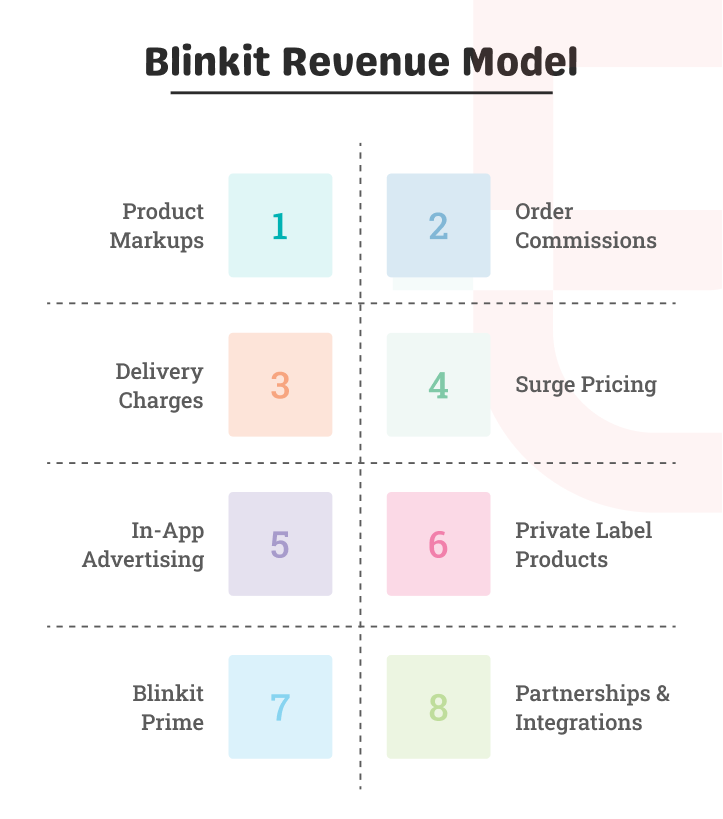
Instead of relying on a single source for income, Blinkit generates revenue from multiple streams.
Product Markups
The platform purchases items from wholesalers and sells them at slightly marked-up prices. The difference between the purchase price and the selling price generates revenue.
Order Commissions
The company earns commissions from every order placed on its platform. It partners with brands and local shops to allow them to list their products on its platform. Whenever a customer orders something from this grocery delivery app, the company earns a commission from that product’s value.
Delivery Charges
Blinkit is known for its fast dispatch services. It charges a set fee to deliver items to customers’ doorsteps. While most of these fees go to the delivery partner’s account, Blinkit keeps a small percentage as a delivery charge, thus creating an additional revenue stream.
Surge Pricing
The Q-commerce giant increases pricing during high-demand periods like bad weather conditions, late nights, or special occasions. This helps it manage demand, compensate delivery partners better during peak times, and also generate extra revenue.
In-App Advertising
Local brands, sellers, and suppliers pay a considerable amount to appear at the top of search results, category pages, and the app’s home page. This revenue stream provides a two-way advantage. Businesses can extend their reach because of the marketplace’s larger customer base, while for Blinkit, it creates an additional income source.
Private Label Products
Blinkit also sells its own in-house products in several categories. Private label products allow Blinkit to earn higher profit margins compared to third-party products because it provides complete control over pricing and distribution.
Blinkit Prime
It has a subscription program called Blinkit Prime that offers its customers several additional benefits that its standard customers don’t get. This plan is not only great at generating revenue for the company but also boosts customer loyalty as they’re more likely to use Blinkit over other apps.
Partnerships and Integrations
The company partners with several brands, payment providers, and service companies to enhance customer experiences and expand its operational ecosystem. These partnerships ensure long-term revenue growth while creating additional business opportunities.
The Strategies Behind Blinkit’s Rise in India’s Q-Commerce Market
Blinkit’s success was not just because of shorter delivery windows. It came from the combination of powerful brand positioning, smart marketing strategies, and strategic use of Zomato’s ecosystem. Here is the breakdown of key factors that made it successful.
Strong Focus on Convenience and Speed
Blinkit’s entire brand identity is built around speed. From its name to the logo, everything communicates one thing: instant order completion. Moreover, it established dark stores in nearby locations to reduce delivery times, which set it apart from traditional delivery services.
Brown Paper Bags
Blinkit uses every customer touchpoint for marketing. And its brown paper bags are a strong example of this. Besides packaging, the company uses these bags as part of creative marketing campaigns throughout the year.
In February 2026, the company launched a Valentine’s Day campaign where it turned its paper bags into DIY bouquets. This not only made the occasion more special, but it also helped enhance its reach on social media organically.
App-First Shopping Experience
The platform also invested heavily in technology infrastructure to ensure a user-friendly mobile experience. It includes features like quick searching, instant checkout, real-time tracking, and saved preferences that allow it to attract urban customers easily, who prefer speed and convenience.
Choosing Influencers for Endorsements
Rather than spending significantly on celebrities for promotion, it partners with micro-influencers. They create relatable content that instantly connects with the target audience, which brings higher engagement and more authenticity. This is also an affordable marketing tactic.
Growing Through Zomato’s Ecosystem
Zomato’s acquisition brought numerous benefits for Blinkit. It grew its customer base quickly by gaining access to Zomato’s active urban users without additional marketing spend.
In addition to this, it also got financial backing for dark store expansion and a wider logistics ecosystem to strengthen its delivery network. This ultimately helped the platform compound its growth, which even a standalone investment would not have been able to match.
Exclusive Discounts and Offers
The quick commerce marketplace implements several measures like special discounts, cashbacks, and limited-time offers to attract and retain customers. Besides that, it also has membership plans that include different perks like free delivery to encourage repeat purchases and build long-term loyalty.
Exploring Blinkit’s Future Plans for Growth
Blinkit is continuously working to expand its quick commerce ecosystem. It is planning to expand its network to around 3,000+ dark stores by 2027. This will help it improve fulfillment speed and also strengthen its hyperlocal operations in the country.
Along with infrastructure expansion, it is also adopting AI technology for demand forecasting, route optimization, inventory allocation, and personalized product recommendations. Blinkit also secured around $12 million to accelerate the integration of AI across its operations. This shows how businesses can operate efficiently in the quick commerce market by introducing AI in grocery delivery apps.
Further, besides groceries, it is expanding to newer categories like electronics, home appliances, beauty, and healthcare products to increase order volume. This way, Blinkit is steadily strengthening its position in India’s Q-commerce market.
How Elluminati Can Help You Launch an App Like Blinkit?
The Blinkit business model operates as a quick commerce marketplace where products are stored in nearby dark stores and delivered to customers within 10-20 minutes. Its operational approach highlights how fulfillment efficiency, rapid order dispatch, and inventory management play a critical role in succeeding in the Q-commerce space.
If you are planning to launch a similar platform, Elluminati is a reliable technology partner through its 14+ years of expertise. Our Blinkit clone is embedded with features like dark store and user management, advanced taxation, multilingual support, and multiple payment integrations to ensure faster operations and long-term business growth.
FAQs
Blinkit operates as a quick commerce marketplace that delivers groceries and daily essentials within 10-20 minutes. It uses a hyperlocal network of dark stores to ensure faster deliveries to its customers.
Blinkit follows a simple working mechanism.
- Customers log into the app, browse products, and place orders.
- The platform identifies and assigns orders to the nearest available dark store.
- The picker in the store finds and packs the ordered items.
- The platform simultaneously matches the order with the nearest delivery partner to deliver products quickly.
You can generate revenue from multiple sources with the help of our Blinkit clone app:
- Order commissions
- Delivery charges
- Surge pricing
- In-app advertising
- Private label products
- Subscriptions
- Product markups
The platform cost ranges from around $10,000 to $50,000+, depending on the tech stack, level of customization, and the number and types of features you want to include.
Yes, it is important to have a dark store to operate a business like Blinkit, as it helps store products and fulfill orders quickly. However, you can either own dark stores or partner with local stores and warehouses, depending on the operational model.
Blinkit’s competitors are mainly Zepto, BigBasket, and Swiggy Instamart.