Key Takeaways (or TL;DR)
- HungerStation is Saudi Arabia’s leading multi-category delivery marketplace that allows customers to order meals, groceries, flowers, medicines, and more through a mobile app.
- The HungerStation business model works by connecting customers with nearby restaurants and stores through a digital platform.
- The HungerStation revenue model is based on multiple income sources, including restaurant commissions, delivery fees, subscriptions, and in-app advertising.
- The company plans to maintain its leading position in Saudi Arabia through expansion in new service categories, environmental sustainability initiatives, and streamlining its logistics operations with AI.
The HungerStation business model is a multi-sided marketplace platform that connects customers, restaurants, and delivery partners through a mobile app to provide food and grocery delivery. It was Saudi Arabia’s first food delivery app and gradually expanded its services as it gained more popularity in the region.
Studying the model helps aspiring entrepreneurs understand how a multi-category delivery platform operates and generates revenue. This article will give you detailed insights into how HungerStation works, its business model, revenue strategies, and future plans.
How HungerStation Began Its Journey and Became Successful?
HungerStation is a leading on-demand delivery app in Saudi Arabia. It allows customers to order meals, groceries, flowers, pharmacies, and more from a digital platform. In 2012, HungerStation was launched as Saudi Arabia’s first food delivery app by Ebrahim Al-Jassim and Hossein Bukhamseen.
Their aim was to simplify food ordering and delivery through a digital platform. By that time, Saudi Arabia’s food delivery market was not fully developed. And this served as the biggest advantage for HungerStation to dominate the market.
Initially, it operated as a website where customers would browse different local restaurant menus and place orders digitally. Then, as smartphone penetration started increasing in Saudi Arabia, HungerStation launched its mobile application to make online food ordering more convenient.
Over time, the company started expanding its operations in Saudi Arabia’s major cities like Riyadh, Jeddah, and Dammam. Within a few years, HungerStation evolved into a comprehensive delivery app by extending its delivery services.
Today, it is operating successfully in 102 cities of Saudi Arabia with a partner network of more than 55,000 restaurants, supermarkets, pharmacies, and more.
Insights About HungerStation’s Funding and Acquisitions
Like other food delivery apps, HungerStation has also gone through several investment stages before becoming Saudi’s dominant app.
Here is an overview of HungerStation’s acquisitions and funding history.
- 2013: The company raised its first seed funding from Saudi Arabia’s Oqal Angel Investors Network, which is known for supporting startups during their initial days in the Middle East.
- 2016: Foodpanda acquired HungerStation for an undisclosed amount to strengthen its position in Saudi Arabia.
- Dec 2016: Delivery Hero indirectly acquired some stakes of HungerStation by acquiring Foodpanda.
- July 2023: Delivery Hero fully acquired HungerStation by purchasing the remaining 37% stakes for $297 million.
What is the HungerStation Business Model?
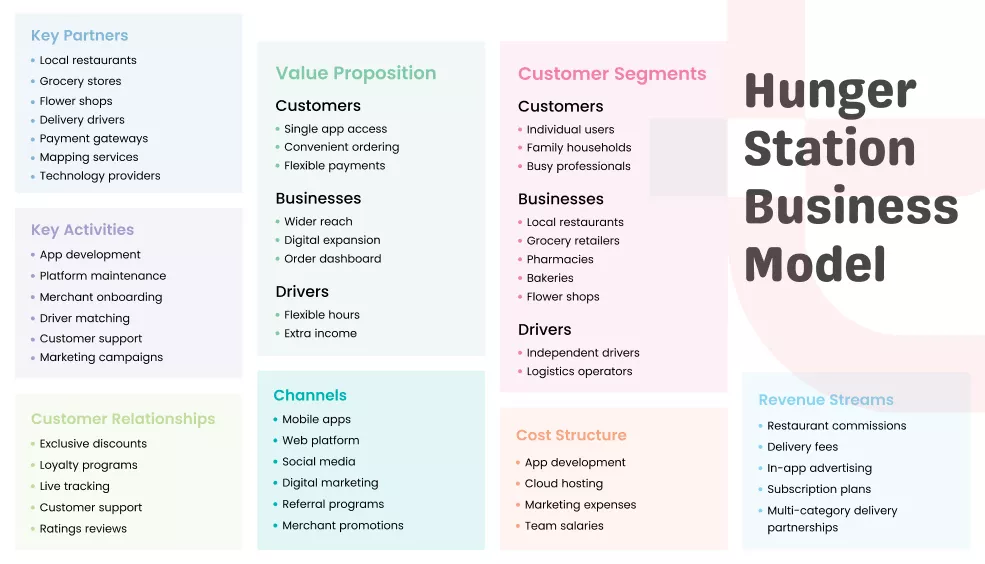
The HungerStation business model operates on a multi-sided marketplace approach that connects customers with nearby restaurants and stores through a mobile app. Below is the detailed explanation of key aspects of the business model.
Key Partners
HungerStation collaborates with several partners to operate efficiently.
- Local restaurants, grocery stores, bakeries, flower shops, and more are providing multi-catering delivery services.
- A strong network of drivers to provide deliveries to customers.
- Local payment gateways to support secure online transactions.
- Mapping and navigation partners for smart route optimization.
- Technology providers for delivery app development and maintenance.
Key Activities
The platform performs the following activities for smooth operations.
- Building and maintaining the web and mobile apps.
- Creating a strong network of restaurants, grocery stores, flower shops, and more.
- Smart matching nearby drivers for faster deliveries.
- Providing constant support to app users and solving their queries instantly.
- Conducting marketing campaigns to enhance its visibility and reach.
Customer Segments
The platform serves mainly three user segments.
Customers:
- Individuals who want to order food, groceries, and other daily essentials from the comfort of their space.
- Families looking to order meals and household goods online.
- Busy professionals who don’t have time to visit restaurants or grocery stores physically are looking for convenient delivery solutions.
Businesses:
- Local restaurants, grocery stores, pharmacies, bakeries, flower shops, and more that want to extend their reach without investing in physical infrastructure.
Drivers:
- Independent drivers who want to extend their earning opportunities.
- Logistics operators managing last-mile deliveries.
Value Proposition
HungerStation creates value for each of its users.
Customers:
- Get access to all local restaurants and stores from a single app.
- Receive the convenience of ordering meals and household goods from the comfort of their space.
- Cash-on-delivery and digital payment options offer flexibility according to their preferences.
Businesses:
- Get access to a large customer base without investing in any marketing effort.
- Can expand their services digitally without building their own physical infrastructure.
- Receive a centralized dashboard to manage daily orders and payments.
Drivers:
- Flexible working hours make it easy to work according to their preferences.
- Generate additional income opportunities through on-demand deliveries.
Customer Relationships
The platform creates long-term relations with its customers.
- Exclusive discounts on special occasions.
- Subscription programs like HungerStation Pro build customer loyalty through benefits like free delivery
- Live order tracking allows customers to receive updates about their orders in real time after confirmation.
- Customer support helps solve user queries and disputes instantly.
- A ratings and reviews system for drivers and delivery partners helps the platform improve and maintain service quality.
Channels
HungerStation uses diverse channels to extend its reach and brand visibility.
- Web and mobile apps to enhance digital presence.
- Marketing campaigns on digital channels like social media and Google.
- Referral programs to retain existing customers and attract new ones.
- Promotional restaurants and retail brands to increase the merchant network.
Cost Structure
The platform incurs various operational costs to ensure smooth user experiences.
- App development and maintenance
- Cloud hosting and infrastructure costs
- Marketing and customer acquisition costs are to increase the customer base.
- Salaries of operational and support teams.
Want to Launch a Multi-Category Delivery App Similar to HungerStation? Connect with Elluminati for Expert Technology
How HungerStation Works?
HungerStation works by connecting customers, service providers, and delivery partners through a single digital platform. The app simplifies the entire food ordering and delivery process for its customers. Here is a complete overview of how HungerStation works.
- Customers log into the app and enter their location.
- The platform then displays nearby available partner stores and restaurants based on the customer’s location and delivery category.
- Customers then select items they want to purchase and place the order. They can review items, customize the order, or add special instructions before checkout.
- After reviewing the order, customers make payments either digitally or by cash on delivery (COD).
- The restaurant or store receives the order through HungerStation’s merchant dashboard. They start preparing the order.
- After the order is ready, the platform assigns the nearest available delivery partner (driver) for delivery.
- Customers can track the order in real time through the app.
- The delivery partner delivers the item to the customer and completes the delivery process.
HungerStation Revenue Model – How HungerStation Makes Money
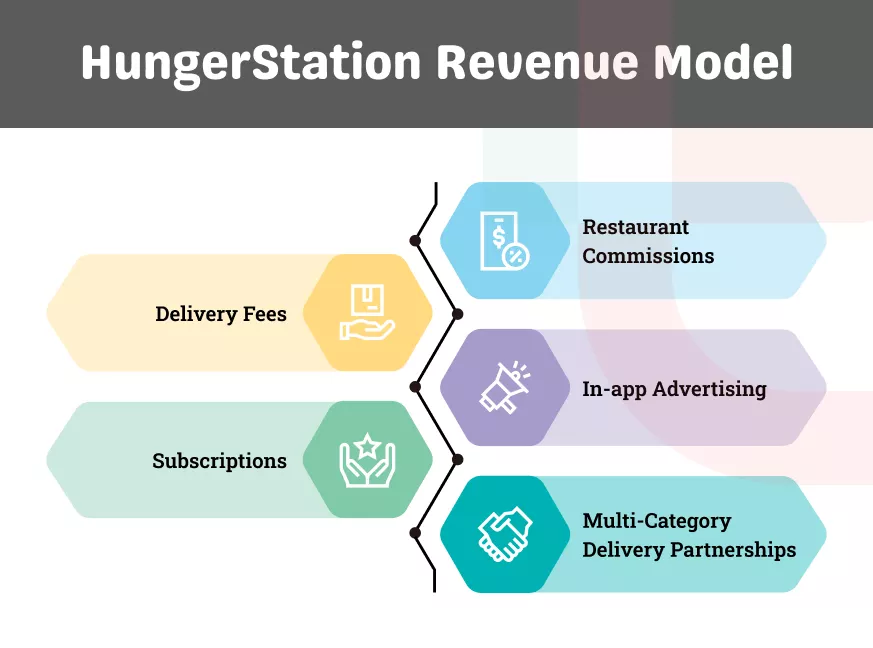
HungerStation generates revenue through diverse sources like commissions, delivery fees, and more. Understanding the revenue streams becomes useful for businesses considering starting a grocery delivery business or a food delivery platform. Let’s have a detailed glimpse of how HungerStation makes money.
Restaurant Commissions
It is the main revenue stream of HungerStation, in which the partnered restaurants pay a percentage of total order value for every order placed through the app. Commissions allow the platform to earn from each order and also cover the overall operational cost.
Delivery Fees
In this revenue source, the platform charges delivery fees from customers based on distance and demand in the particular area. Delivery fees help the company cover logistics and courier expenses.
In-App Advertising and Featured Listings
HungerStation allows businesses to appear at the top of the search results or in special banner sections of the app through in-app advertising and featured listings. For this, the platform charges a considerable amount from businesses. This revenue source helps businesses enhance their visibility while allowing the platform to generate additional income.
Subscription Plans (HungerStation Pro)
The platform offers a premium membership program to its customers called HungerStation Pro. Under this program, customers pay a set recurring fee to receive benefits like free delivery and special discounts. HungerStation creates a steady income through this revenue source.
Quick Market and Multi-Category Delivery Partnerships
Besides food delivery, HungerStation partners with local grocery stores, pharmacies, flower shops, and more to offer different delivery services. The multi-category delivery partnerships allow HungerStation to expand its offerings and also generate extra income.
Future Plans of HungerStation
To continue leading the Saudi market in the future, HungerStation is strongly focusing on improving its operational efficiency and diversifying its offerings. Here is a brief overview of its future plans.
Expansion into New Service Categories
The company is planning to expand its services beyond food delivery to groceries, pharmacies, flowers, and more.
It is partnering with several local retailers to strengthen its position for multi-category delivery services in Saudi Arabia. Recently, it partnered with Lulu Hypermarket (the Middle East’s leading retail chain) to allow its customers to order groceries and household goods with ease.
Sustainability and Net-Zero Delivery Initiatives
With Delivery Hero being its parent company, HungerStation is firmly committed to its sustainability goal of zero emissions in delivery operations.
The company is exploring the use of EVs, using sustainable packaging, and reducing the use of plastic cutlery among customers through its “No Cutlery” option. These initiatives help the company to strengthen its brand reputation.
Technology and AI-driven Delivery Optimization
The use of AI in food delivery apps is growing. And for HungerStation, this technology is the main focus for the company’s future growth strategy. The company is actively using it to improve its logistics operations.
Recently, it introduced an AI-powered “Shaded Route” for delivery drivers, which analyzes weather and route data to identify the fastest paths during extreme temperatures. It will help drivers complete deliveries efficiently in high temperature weather conditions while allowing the company to ensure faster deliveries always.
How Elluminati Can Help You Build an App Like HungerStation?
The HungerStation business model demonstrates how multi-category delivery platforms can scale rapidly by connecting customers, merchants, and delivery partners through a single digital ecosystem.
If you are considering building an app like HungerStation, then Elluminati becomes your reliable technology partner with an experience of 14+ years in on-demand development. Our HungerStation clone app helps businesses launch operations quickly through dedicated apps for customers, merchants, drivers, and admins.
Features like real-time order tracking, multiple payment options, and centralized management of delivery operations help businesses scale their on-demand delivery business easily.
FAQs
The HungerStation business model is an on-demand digital platform that connects customers with nearby restaurants, grocery stores, bakeries, pharmacies, and more through a mobile app.
The HungerStation revenue model generates income through multiple sources, which include:
- Restaurant commissions
- Delivery fees from customers
- In-app advertising and featured listings
- Subscriptions
- Quick Market and multi-category delivery partnerships
HungerStation charges a commission ranging from 5% to 30%. The exact percentage may vary depending on different factors like location and promotional agreements.