
Key Takeaways (or TL;DR)
- Understanding taxi booking business market statistics will help you make informed decisions at every growth level of your business.
- The global market value of the taxi business was $236.36 billion in 2025 and may reach up to $254.36 billion in 2026.
- The taxi booking market is expected to expand at a 7.62% CAGR from 2026 to 2031.
- The global ride-hailing user base (riders + drivers) is expected to reach ~2.34 billion users by 2030.
- The top five regions that dominate the market share are North America, Asia-Pacific, Europe, the Middle East & Africa, and South America.
- The ride-hailing market size is projected to reach US$229.98bn by 2030, at a CAGR of 5.08% during the forecast period.
- The top six industry leaders based on annual revenue are Uber, DiDi, Lyft, Grab, InDrive, and Bolt.
According to the latest taxi booking business market statistics, the industry has gone through a dramatic positive shift after the pandemic. The meter-based service has transformed into an app-powered mobility ecosystem for 3 billion users worldwide.
For ride-hailing players, the competition is tougher than before. They are under constant pressure to improve user experience for their customers to establish a firm ground in the market. For entrepreneurs and investors, this means making informed decisions at every stage of the growth funnel to keep the business profitable.
This article breaks down the latest global ride-hailing statistics, including market size, growth rates, segmentation, and regional performance trends shaping the business today. Use the valuable taxi booking business statistics shared in the article to identify the next source of demand, strong margins, and the upcoming wave of disruption in the ride-hailing industry.
Taxi Booking Business Market Statistics: Global Market Size & Growth Trends
The global taxi booking business market was valued at approximately $234.6 billion in 2024 and $236.36 billion in 2025. In 2026, the figures may reach up to $254.36 billion, including the broader ride-hailing and e-hailing ecosystem.
CAGR & Long-term Growth
- In the last five years (2021-2026), the taxi booking industry has been witnessing a decelerating growth momentum as the market matured.
- The taxi booking market is expected to expand at a 7.62% CAGR from 2026 to 2031.
- Two-wheeler taxis are gaining popularity, as the market is growing at a 7.71% CAGR, especially in Southeast Asia.
- Lower fuel costs, government subsidies, and city emissions are also leading towards increasing driving electric taxi adoptions, at an 8.05% CAGR.
Revenue Segmentation
- By type, the market can be divided into two segments: e‑hailing (app‑based booking) and traditional taxi systems (metered or hybrid).
- The former accounts for nearly 70% of the total bookings, with traditional taxi covering the remainder.
- When structured by application, the market can be segmented into two groups: ride‑hailing and taxi applications.
- Ride-hailing constitute 70% share of platform trips, while taxi applications retain the rest.
Post-pandemic Rebound Analysis
Like any other primary sector, the taxi sector was a target of the pandemic around the globe. However, there was a strong rebound by 2023. The industry benefited from high smartphone penetration and digital payments, especially in urban areas.
The global ride-sharing revenue growing ~18.4% year-over-year from 2022 to 2023 indicated a strong recovery from pandemic lows.
Regional Revenue Share Comparison
The global revenue distribution follows a clear regional hierarchy as follows.
|
Region |
Revenue Share |
|
North America |
35%-44.5% |
|
Asia-Pacific |
31%-49.3% |
|
Europe |
15%-18% |
|
Middle East & Africa |
5%-7% |
|
South America |
4%-6% |
Ride-hailing Market Forecast & Key Usage Metrics
Let’s examine online ride-hailing market statistics by looking at key KPIs, including global users, trip volumes, ARPU, average fares, app penetration, and rider retention trends.
Global Active Users (Riders + Drivers)
- The global ride-hailing user base (riders + drivers) has reached ~2.8 billion users by 2023. The figure is projected to cross the mark of 4.1 billion by 2028.
- As of 2023, there are 12.5 million active global drivers engaged on different ride-hailing platforms, which is 14% more than the previous year.
- Global female drivers 18% of the total rideshare workforce in 2023.
Total Annual Trips Completed
- Corporate users account for 22% of total ride-hailing trips worldwide in 2023.
- According to a recent market study report, the global ride-hailing industry recorded a total number of 13 billion trips in 2024, a 30% higher figure compared to 2022.
Average Revenue Per User (ARPU)
- According to Statista forecasts, the average revenue per ride-hailing user (ARPU) is estimated at ~US $96.95 (global average).
- According to projections, the annual revenue is expected to reach US$188.60bn by the year 2026.
Average Fare Per Ride
- Based on supplemental ridesharing data, the average U.S. ride fare was around $18.50 in 2023, up 7% inflation-adjusted.
- Over a four-day test in San Francisco, it was observed that the base fares for Uber and Lyft differed on average by 14 per cent, a gap of about $4.15 per trip.
App Penetration Rate
- As per the historical data from 2021 to 2024, the app penetration rate of the global online car-hailing business now exceeds 65% in the urban population.
- The penetration rate stood at 35% of the urban population in 2023, showing 42% YoY increase for Gen Z users.
Rider Retention Vs First-time User Growth
- The global average user retention rate for ride-hailing apps is 71% after the first month in 2023.
- In 2025, user retention rates will cross 60% on average, with some platforms exceeding 75% in Southeast Asia.
- Subscription models are turning out to be useful for major taxi booking platforms to retain 30% more customers compared to other business models.
Launch a Taxi App With Lower Map Costs, Smarter Monetization, and Global Scalability
Online Cab Booking Statistics by Region
The following section reveals online cab booking statistics by region, which are growing differently across major regions.
North America
- The United States ride-hailing market is forecasted to be the largest single-country market globally, valued at USD 65.81 billion in 2024.
- As per the Statista survey, 48% of ride-hailing passengers in the U.S. were women, 55% of them represented Lyft riders.
- Nearly 28% of the U.S. rideshare market represents low-income users (less than $50,000 per year).
- The average age of U.S. rideshare users is 34.2 years, and 56% of them are college graduates.
Europe
- The European ride-sharing market was valued at USD 43.88 billion in 2025 and is expected to cross USD 51.60 billion by 2026.
- Based on type, the e-hailing segment dominated the market in 2025.
- Based on commute type, users found the intercity ride-sharing model to be the most affordable travel option between major European cities.
- France witnessed the highest number of users, followed by the United Kingdom, supported by high smartphone penetration and flexible transport regulations.
Asia-Pacific
- The Asia-Pacific online ride-hailing market size is expected to reach around USD 184.49 billion by 2026 and USD 392.27 billion by 2031, growing at a CAGR of 16.29% during the forecast period (2026-2031).
- Passenger cars represented 62.88% of the total market share in 2025.
- Nearly 87.21% of the total number of bookings were registered as app-based transactions in 2025.
- Personal rides contributed the highest revenue (61.25%), while corporate bookings accounted for the highest CAGR.
- India’s ride-hailing market is expected to grow from USD 950.66 million in FY2024 to USD 3,766.79 million in FY2032, at a CAGR of 18.78% during the forecast period.
Latin America
- The Latin America ride-hailing services market generated a revenue of USD 3,161 million in 2025. E-hailing was the largest revenue contributor.
- Brazil is the largest ride-hailing market in Latin America, with over 30 million users from Uber alone.
Middle East & Emerging Markets
- The Middle East & Africa online ride-hailing market size was valued at USD 1.9 billion in 2025, with increasing demand from urban centers like Riyadh, Dubai, and Cairo.
- Saudi Arabia’s ride-hailing app revenue rose by 18.75% from 2024 to 2025.
- According to the World Bank, ride-hailing in Sub-Saharan Africa is rapidly expanding due to mobile penetration exceeding 50% across many nations.
Ride-Hailing Market Forecast Through 2030
The ride-hailing market forecast is about to experience huge growth with multiple changes in the industry over the next five years. The number of users is projected to reach 2.34bn with a market valuation of US$229.98bn by 2030, at a CAGR of 5.08% during the forecast period (2026-2031).
Key Growth Drivers of the Ride-Hailing Market
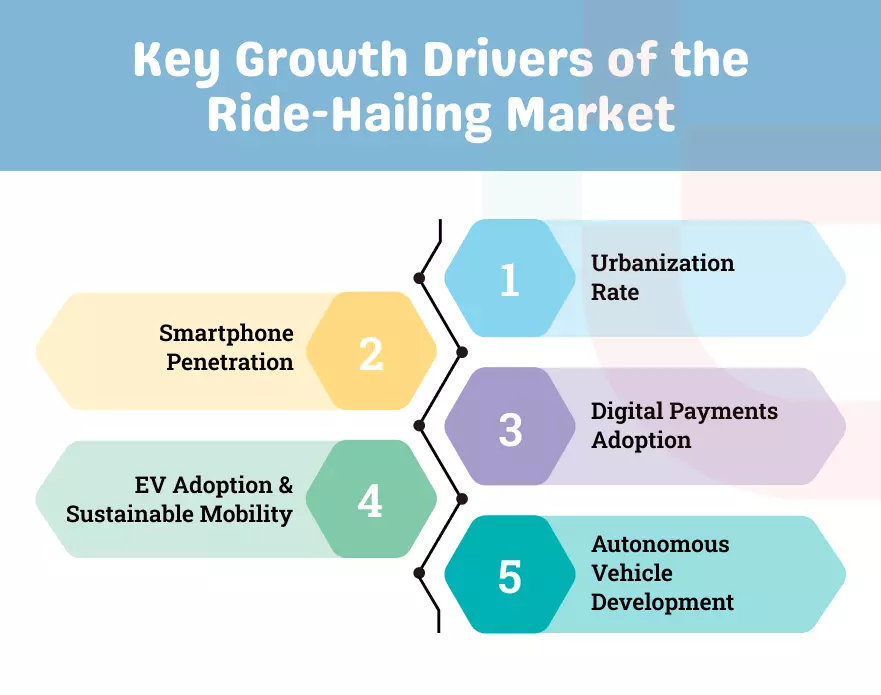
The following five growth drivers will serve as catalysts for the upcoming exponential growth in the ride-hailing market over the next five years.
Urbanization Rate
The increasing global urbanization is the primary source of demand for convenient, on-demand transport options in crowded cities. Ride-hailing services will become a more convenient option for users over private car ownership and congested public transport.
Smartphone Penetration
A majority of the ride-hailing bookings come from mobile apps. According to the GSMA Mobile Economy report, unique mobile subscribers will grow to 6.5 billion by 2030. With around 71% global penetration rate, it will be easier for platforms to scale their services rapidly across regions.
Digital Payments Adoption
Digital wallets and cashless payments are lowering the friction in fare transactions. In the next five years, the total transaction value in digital payments is expected to show an annual growth rate of 7.63%, according to Statista. Platforms will experience faster adoption in regions with a strong fintech ecosystem.
EV Adoption & Sustainable Mobility
The demand for electric vehicles (EVs) integration into ride-hailing fleets is increasing every year to meet sustainability goals and lower operating costs for drivers. According to the electric vehicle market report, the sector is expected to grow at a CAGR of 24.6% to reach an estimated value of USD 110.56 billion by 2031.
Autonomous Vehicle Development
As of early 2026, major ride-hailing players, like Uber, Tesla, and Lyft, have already started investing billions into autonomous fleets and robotaxi developments. This is going to redefine mobility economics and existing revenue models in the second half of this decade.
Investment Hotspots
The next five years will see Asia-Pacific and the Middle East become the primary hotspots for investment due to massive government infrastructure mandates.
China is currently the world’s most active testing ground. For the next five years, the country is going to focus on Vehicle-to-Everything (V2X) infrastructure. On the other hand, North America is going to lead the early R&D phase. Players like Waymo, Tesla, and Uber are swiftly switching from software development to fleet procurement.
Middle East countries like Saudi Arabia and the UAE are planning to invest heavily in the autonomous shuttles market, which is already valued at $1.2 billion based on a five-year historical analysis.
Turn Ride-Hailing Market Growth Into Your Business With a Readymade Taxi App
Top Industry Leaders Contributing to the Taxi Booking Business Statistics
To truly grasp the competitive pressure in the taxi booking business, it’s important to understand each player’s market share and regional dominance.
Market Share Comparison
Here are the top six leading platforms based on 2025-2026 data.
|
Platform |
Annual revenue |
|
Uber |
$43.9 billion |
|
DiDi |
$28.766 billion |
|
Lyft |
$5.7 – $5.8 billion |
|
Grab |
$2.797 billion |
|
InDrive |
2.2 billion |
|
Bolt |
2.15 billion |
Revenue Distribution by Platform Type
|
Platform Type |
Revenue dominance |
Growth rate (CAGR) |
|
Ride-hailing |
High |
11.34% |
|
Super Apps |
High |
19.47% |
|
Taxi aggregators |
Medium |
14.80% |
Geographic Dominance of Each Player
|
Platform |
Core region |
|
Uber |
Global |
|
DiDi |
China |
|
Lyft |
USA & Canada |
|
Grab |
South East Asia |
|
InDrive |
Global |
|
Bolt |
Europe & Africa |
Consolidation & Acquisitions
Here are some notable activities from the ride-hailing industry, involving established giants acquiring regional rivals to secure market density.
- In late 2025, Lyft acquired FreeNow, a major European mobility player, to have an immediate, large-scale access to the European market.
- In February 2026, Uber acquired the delivery business of Getir, the popular Turkish grocery delivery platform, for $335 million. This strategic move aims to increase Uber’s market density to support its YoY revenue growth.
- The mega-merger between Southeast Asian giants Grab and GoTo (Gojek) has been suspended due to disagreements over share pricing with minority stakeholders like Telkomsel.
- In March 2025, European challenger Bolt acquired the Danish EV-hailing platform Viggo to support Bolt’s green credentials and EV fleet in Scandinavia.
Why Are Entrepreneurs Investing in Ride-Hailing Apps?
As discussed above, the global ride-hailing market is going to see massive growth of US$229.98bn by 2030. Moreover, the user base is estimated to reach 2.34 billion. For this, factors like higher smartphone penetration, increased urbanization, and digital payment adoption are considered to be the major contributors.
Below are the key opportunities for your businesses that we identified from this study of different markets, key players, and key factors:
- Asia-Pacific is going to be the fastest-growing market with 16.29% CAGR, in which India alone is expected to grow at 18.78%.
- North America is expected to become the biggest market to generate higher revenue in the taxi industry.
- The increasing demand for EVs and autonomous taxis in the market will create additional earning opportunities for businesses rather than simply relying on standard mobility solutions.
Claim Your Market Share: Building Your Taxi Booking App with Elluminati
According to taxi booking business market statistics, this sector is one of the most lucrative yet competitive domains in 2026. With digital payments and mobile penetration at their peak, urban mobility is shifting toward app-based booking. If you want to dominate others in that growth spectrum, you need a stellar Uber like booking application with all the significant features modern users would look for.
That’s exactly where the core expertise of Elluminati lies. As an ideal taxi app development company, Elluminati empowers you to launch a powerful and scalable ride-hailing application, tailored to your business model. With over 14 years of experience, we have worked with taxi businesses in multiple countries, with different business strategies. It gives us the core understanding of the industry, business, end customer preferences, revenue potentials, and growth opportunities.
Let’s partner so that we can make your business stronger with an advanced tech suite.
FAQs
The market size of the taxi booking business was valued at approximately $234.6 billion in 2024 and $236.36 billion in 2025. By the end of 2026, the figures are expected to soar up to $254.36 billion, including the broader ride-hailing and e-hailing ecosystem.
The global ride-hailing user base (riders + drivers) crossed 2.8 billion in 2023, projected to reach 4.1 billion by 2028. The 2023 study approximated 12.5 million active global drivers engaged on different ride-hailing platforms, including 18% of the total rideshare workforce being women.
The Asia-Pacific and the North America regions are going to be the primary hotspots for growth. Countries like Beijing, Shanghai, India, and the United States of America will provide grounds for seamless market growth by 2030.
The rising cost of vehicle ownership in urban cities and the lower operational costs for players due to autonomous vehicles are going to push the ride-hailing industry into the hyper-growth phase.