Key Takeaways (or TL;DR)
- Zomato, formerly known as FoodieBay, has become a household name in the food tech industry by offering services such as food delivery, dine-in, and subscription-based offerings.
- Its user-friendly app workflow lets customers easily explore restaurants, add delicious items to their cart, and enjoy their food at their doorstep. For its delivery partners, it offers special tips & rating features to encourage them.
- The Zomato business model operates as a multifaceted platform that connects customers with restaurant partners through its app and website.
- Since the company has diversified its services, held events, and offered special white label access, it has opened numerous revenue channels.
- Even though it is in a prominent position, several factors could affect its growth, including intense competition and market backlash.
- The rebranding to Eternal Ltd. marks a turning point for Zomato, making it a diversified, multi-business holding company and giving wings to its initiatives to transition to zero-emission deliveries.
In today’s market, where online food ordering is in the spotlight, one of the Indian platforms that has risen and grown since its launch is Zomato. An online food ordering and delivery platform connecting millions of users with restaurants to explore, order, and enjoy a meal at their doorstep, offering a seamless food ordering experience.
Zomato has become a renowned brand, fostering a friendly vibe and a strong connection with people. Its winning factors include a hyperlocal network, ease of access, and data-driven customer services, the Zomato business model proves that a well-designed model can turn convenience into a billion-dollar opportunity for an entrepreneur.
If you are an aspiring startup or entrepreneur eager to develop a roadmap that will help your food delivery business succeed like Zomato, this guide is perfect for you. Here, we will break down how Zomato works, its key revenue streams, and its future initiatives, providing actionable insights you can apply to your business to grow.
What is Zomato—An Insight into Its Timeless Achievements
The journey of Zomato is no less than an inspiration! Its consistency, quality of service, and clear mission, “Better food for more people,” are the results that make Zomato the most preferred food delivery platform in India.
Zomato, previously known as Foodiebay, is an Indian restaurant aggregator and food delivery company, founded on the 10th of July, 2008, by the two IIT graduates, Deepinder Goyal & Pankaj Chaddah.
Zomato Company Overview:
Founded on: 10th July, 2008
Founders: Deepinder Goyal & Pankaj Chaddah
Headquarters: Gurugram, Haryana, India
Parent Company: Eternal Ltd.
Services: Food Delivery, Table Reservation & Local Search
Revenue increased by 29% in Q3 FY26, reaching Rs. 2,676 crore
Net Profit: As per Q3 FY26, its net profit has surged by 72.88%
Foodiebay began as a platform for restaurant listings and recommendations and was rebranded to Zomato by November 2010 to avoid potential naming conflicts with eBay and to reflect a broader, more scalable identity that extended beyond food.
Within a very short time, the company has expanded its services across India and internationally, serving countries such as the United Kingdom, South Africa, Sri Lanka, Brazil, and others. Later, by analyzing the growing demand in the food delivery market, they made a smart move to enter the Indian market in 2015.
Beyond the basic food delivery app features, what made the company people’s favorite was its table reservation feature, which was officially launched in January 2016, especially for its application running in India. Later, they also launched their paid membership program, Zomato Gold, in India, offering free food & drink to customers.
Zomato also has an enthusiastic team that visits each restaurant to ensure its data is secure. Users can share reviews, opinions, and stories about their food experiences. This initiative makes Zomato more social.
As of today, the company operates in over 800 cities in India and has already targeted establishing 2000 dark stores (for Blinkit) by the end of 2026, clearly outlining its three key pillars: Delivery, Dining-Out, and Sustainability.
Zomato’s Success Timeline:
2008: The journey of Foodiebay started in July 2008 as a directory of scanned restaurant menus in Delhi-NCR.
2010: Rebranded to Zomato to build a global identity & avoid a conflict with eBay for the brand name.
2011-2012: Expanded services across India and launched the first mobile app.
2013-2014: Made a global expansion of services by covering areas like the UK, South Africa, and Southeast Asia.
2015: Officially launched food delivery service in India.
2017: Introduced Zomato Gold, a loyalty program to offer free drinks and food services in India.
2018: Became a unicorn with a valuation of $1.1 billion and launched Hyperpure, a B2B supply chain for restaurant ingredients.
2020: Acquired Uber Eats India in an all-stock deal
2021: The company went public by publishing its first IPO and raising a fund of $1.3 billion.
2022: Acquired Blinkit for $568 million to enter the quick commerce industry.
2023: Achieved profitability for the first time in company history, with its quarter ending June 2023.
2024: Purchased Paytm’s entertainment & ticketing business for roughly Rs. 2,048 crore, diversifying into events.
2025 – Rebranded the parent company to Eternal Limited, a firm now covering four distinct brands: Zomato, Blinkit, Hyperpure, & District.
What Other Services Does Zomato Offer?
Hyperpure
The company launched Hyperpure in August 2018 as a B2B platform to supply fresh, high-quality ingredients, such as fruits, vegetables, and dairy, directly from farmers to restaurants.
District
Districts is an app operated by Zomato that lets customers easily discover and reserve restaurant tables and book movie and live event tickets. Launched in November 2024, after the company acquired Paytm’s entertainment & ticketing business, Orbgen Technologies Pvt. Ltd. (TicketNew) and Wasteland Entertainment Pvt. Ltd. (Insider).
The app primarily focuses on India & the UAE, bridging digital convenience with offline, in-person experiences, and consolidates services previously managed under Zomato Live and Paytm Insider into a single, user-friendly interface.
Blinkit
Previously known as Grofers, Blinkit is another popular quick-commerce delivery platform in India that Zomato acquired in August for approximately Rs. 4,447 Crores ($568 Million). The purpose of this acquisition is to expand the company’s footprint in the high-growth instant, quick-commerce market by challenging Swiggy Instamart.
Zomato Kitchens
Zomato Kitchen was originally launched as Zomato Infrastructure Services (ZIS) in early 2017 to provide ready-to-use kitchen infrastructure to restaurant partners. Also, it was designed to help start a cloud kitchen venture online by allowing them to offer a delivery-only food court in areas with high demand but limited restaurant availability.
Feeding India
Feeding India is a nonprofit organization that now operates under the Zomato CSR initiative, dedicated to reducing food waste and eradicating hunger and malnutrition by providing free, nutritious meals to underserved communities. In July 2019, the company acquired this NGO to provide support with funding, technology, and logistics.
Funding History & Financial Insights:
Zomato raised a total of $1.69 Bn across 19 rounds. The company raised its recent funding through its post-IPO held on 28th November, 2024. Info Edge is a leading investor in Zomato, and other key investors who contributed major stakes in the company include Ant Financial, Delivery Hero, Vy Capital, and Shunwei Capital, among others.
Now, let’s delve deep into some of the latest funding rounds held by Zomato to raise funds.
| Latest Funding Rounds Held by Zomato | ||
| Announcement Date | Funding Name | Amount Raised |
| November 28th, 2024 | Post IPO | $1 Billion |
| February 4th, 2021 | Series J | $252 Million |
| August 31st, 2020 | Series J | $660 Million |
| March 24th, 2020 | Series J | $5 Million |
| January 10th, 2020 | Series J | $50 Million |
Zomato’s Financial Insights:
According to the latest Eternal Ltd. shareholder report for Q3 FY26, the company reported significant year-on-year (YoY) improvement across all core business segments.
And here’s the key financial highlight from Q3 FY26:
- Total revenue increased by 29%, reaching Rs 2,676 crore.
- Net profit has surged by 72.88%.
- Adjusted revenue reached INR 16,692 crore.
- Adjusted EBITDA stood at INR 364 crore, a 28% increase YoY.
Essential Updates About Zomato:
- The parent company of Zomato was rebranded as Eternal Ltd., a holding company for Zomato, Blinkit, Hyperpure, & District.
- Following the shocking resignation of Deepinder Goyal as CEO of Eternal Ltd., he will now focus on long-term strategy as vice chairman.
- Albinder Dhindsa, a founder of Blinkit, is to become the new Group CEO of Eternal Ltd.
- A strategic initiative, now operated by two key persons, where Albinder Dhindsa will lead the daily operations, while Deepinder Goyal will lead all future innovation.
How Zomato Works? A Step-Wise Breakdown of Its Process
The company has set up a straightforward yet highly efficient workflow for its customers. Its user-friendly flow makes ordering convenient for customers while allowing restaurants to reach a large customer base.
Now, let’s see how Zomato works to deliver delicious food options to its users through its app, without them leaving the comfort of their homes.
- Customers can register in the app or on the website and enter their location to discover nearby restaurants and their best deals.
- After selecting a restaurant, the customer can add their dishes to the cart and submit the order request for further processing.
- Upon receiving the order request, the restaurant owner begins preparing it.
- Once the food is ready, the app’s algorithm connects the restaurant owner with the nearby, available delivery partner to pick up the order.
- By accepting the delivery request, the delivery partner delivers the order to the specified location, and customers can track it until it reaches their doorstep.
- After handing over the parcel, the app prompts customers to provide feedback, which helps the company improve its services and helps other customers make well-informed decisions when placing orders.
Become the Next Market Leader in Food Delivery. Build Your Scalable Enterprise-Grade Solution with Elluminati to Outperform the Competition
Zomato Business Model Canvas Explained:
The company represents innovation and transformation in the food technology industry. This restaurant aggregator and food delivery company operates mainly with its QAAA model, which is Quality, Accessibility, Affordability & Assortment, that is, Range.
Now, let’s delve into the intricate workings of the Zomato business model to understand how each component is contributing to making the firm a food-industry giant.

Key Partners
- A large network of delivery partners worked on independent contracts to fulfill deliveries.
- The core pillar for Zomato business model is its vast network of restaurants, small food vendors, etc., to provide them with online visibility.
- Logistics & technology partnerships, including point-of-sale integrators Petpooja & Restroworks, for seamless order management.
- Collaborate with various financial institutions and digital payment processes to offer secure payment options.
- Hyperpure suppliers, such as farmers, mills, and producers, provide high-quality ingredients directly to restaurant partners through Zomato’s B2B vertical.
- Strategic partners with Uber Taxi to offer a seamless dining & logistic services
- Financial investors like Info Edge and Ant Financial, who invest major stakes to help companies grow their business.
- It partnered with cloud kitchens to offer diverse, specialized food options while helping them scale the brand quickly.
Key Activities
- Managing multiple networks
- Manage advertising and sponsored content
- Enhance customer service
- Increase brand image
Value Proposition
Customers:
- It offers customers a wide range of restaurant options for ordering their favorite meals.
- Zomato Gold provides exclusive benefits, including complimentary dishes and beverages, as well as hefty discounts.
- Provides customers with access to schedule a table reservation.
- Ensures high-quality food through its Hyperpure model.
- Smooth & secure online payment process, as it partners with PayPal.
- No restrictions on minimum item orders.
Restaurants:
- Helping restaurant owners easily expand their customer base.
- Delivers analytical and data-driven insights to understand customer preferences and order trends and to optimize operations.
- Increasing customer retention by offering a table reservation feature.
- It helps restaurants rank their food items, including newly added dishes, by placing them in top listings.
- In-app advertisements lead to robust customer relationships.
Delivery Partner:
- It allows delivery partners to work on flexible hours to generate additional, steady income.
- With Zomato, they receive a 5-pillar support system covering financial, social, physical, mental, and professional support.
- A user-friendly app allowing you to manage order requests and track delivery locations, ensuring quick delivery service.
- It helps the delivery partner improve their standards of living
Customer Segment
Customers:
Customers can download the app, browse the restaurant menu, read reviews, and place a delivery order to their doorstep.
Restaurants:
It helps restaurant owners grow their internet presence, attract more customers, and boost their revenue.
Delivery Partner:
The company also works with an independent delivery partner to help them generate extra income by fulfilling meal orders via the app.
How Zomato Makes Money: 9 Key Revenue Streams
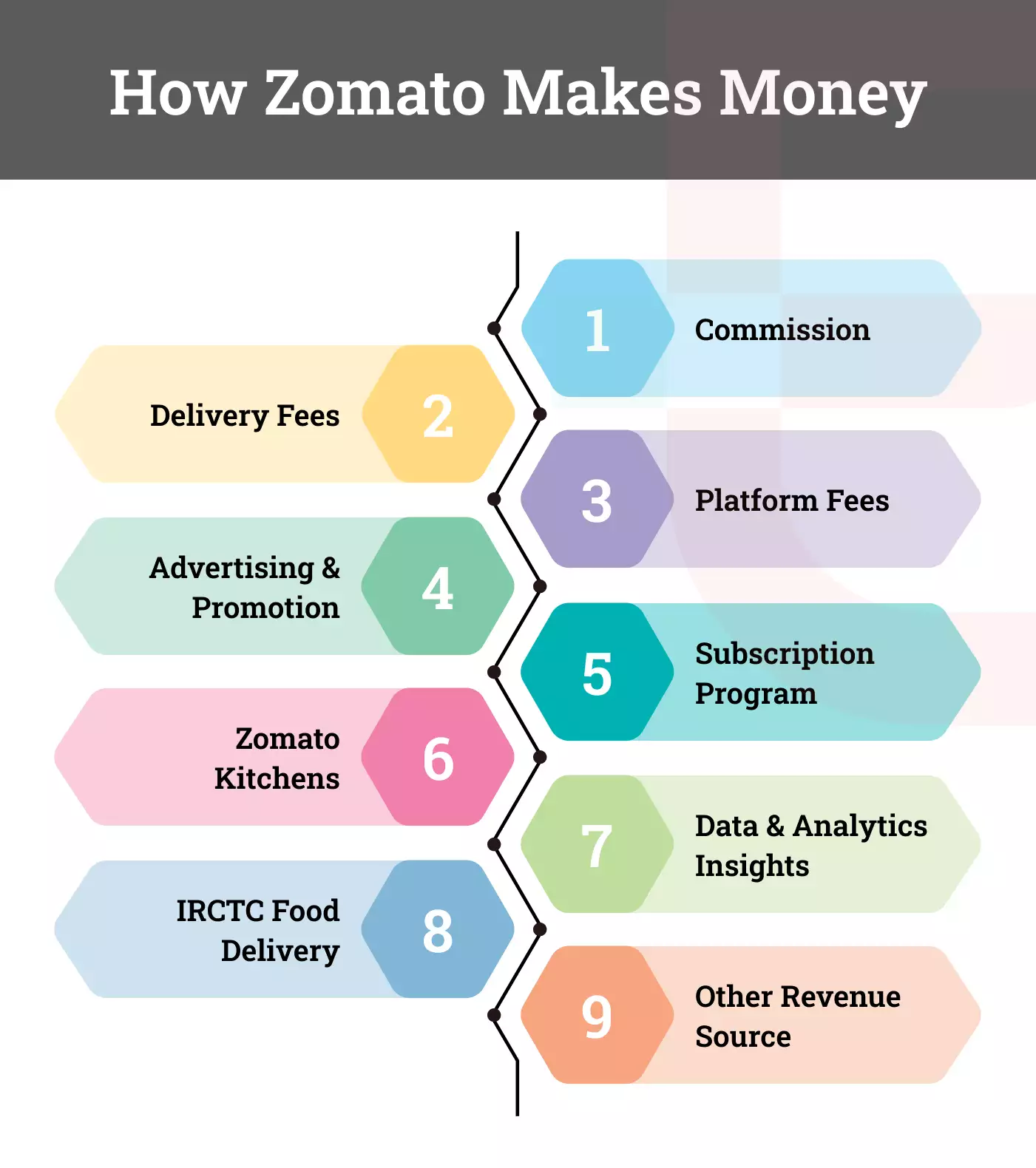
Since its establishment, the company has grown into a major force in the food industry. The Zomato revenue model has diversified beyond a simple commission to include advertising and other key streams.
Commission
Zomato charges a 15% to 30% commission on each order placed by the restaurant. Also, the percentage may vary based on factors like
- Whether the restaurant uses its own drivers
- Location
- Restaurant popularity, and more.
Delivery Fees
Aside from the commission, the company incurred delivery fees of approximately 20 to 50 rupees per customer order, with higher fees for longer distances.
Platform Fees
The company is also charging restaurants a 20% platform fee per order, from Rs. 10 to Rs. 12 by September 2025, to boost profitability and manage high delivery demand during surge hours.
Advertising & Promotion
Advertisements are one of Zomato’s main and trusted sources of income, as it offers advertising policies to help restaurants maximize their profits and customer base. It generates more than 70% of its revenue through this channel. It allows restaurant owners to put their banners on their sites to increase visibility.
Below are the key advertising and promotional strategies Zomato adopts to generate income:
- Through sponsored listings
- Running targeted advertisements
- Ad campaigns
- In-app advertisements
Subscription Program
One of the company’s steady sources of income is its Zomato Gold subscription program. Customers can access perks and benefits, such as complimentary orders and free deliveries, by subscribing.
Restaurants can also use their program to access various services, including live tracking, tamper resistance, and Zomato branding packages.
Zomato Kitchens
This is a kitchen infrastructure service offered by Zomato, in which they work with certain restaurant owners who want to expand their businesses to more locations at minimal cost. It means entrepreneurs can easily establish a restaurant in the right location with minimal fixed and operating costs.
Data & Analytics Insights
One of Zomato’s impressive sourcing channels is its data & analytics, which collects extensive data on customer preferences, dining habits & restaurant performance. This data is highly valuable and can be monetized by providing insights and analytics services to restaurants, helping them make informed decisions about their menus, pricing, and marketing strategies.
IRCTC Food Delivery
IRCTC food delivery is a significant growth driver for Zomato. To deliver an order, the company charges a commission in various ways, including
- Taking a restaurant commission of 18 to 25%.
- Delivery & convenience fees are around Rs. 50.
- Platform fees range from Rs. 6 to 10.
“The company also pays a part of its revenue back to the IRCTC as a partnership fee for using its e-catering API & platform access.”
Other Revenue Source
Live Events
Zomato also generates income from its live events, which primarily fall under the “Going-out” segment and include its flagship food-and-entertainment carnival, Zomaland, as well as other ticketing partnerships.
| Income Through Live Events | |
| Entry Fees to Attend an Event | The company incurred an entry fee from its audience. |
| Event Advertising & Promotions | Restaurant & event organizers pay Zomato a fee to promote their events on the platform. |
| Ticketing Platform Fees | The company also charged a fee on ticket bookings for movies, sports, and live performances via its app, District. |
| Sponsorships | As Zomaland is one of the biggest events, it attracts brand sponsorships, which provide another revenue opportunity for the company. |
Hyperpure
Acting as a wholesaler for restaurants, this B2B supply chain directly sells fresh ingredients from farmers and other producers to partner restaurants, enabling Zomato to profit from markup margins while also providing the restaurants with high-quality ingredients.
Blinkit
The company has become a key source of stable income for the company.
- Through commission
- Delivery fees
- In-app advertisements
What are the Key Challenges Affecting Zomato’s Growth?
Although Zomato is one of the prominent players in the food delivery market, there are several challenges the firm is facing, which include:
Intense Competition
Even though the company leads the Indian food delivery market, it has difficulty competing with players like Swiggy. Not only in the food market but also with Zepto’s marketing strategy, increasing competition in the quick-commerce market is pushing the company to develop a strategic plan to compete.
Operational Challenges
As the business expanded, it became difficult for the company to manage a large fleet of delivery partners. Ensuring timely deliveries and maintaining service quality posed operational challenges that could directly impact customer satisfaction.
Marketing Backlash
Even though the company leads the market, it often faces backlash for misreading social, cultural, and labor-related sentiments, which leads to public outrage and brand damage. It must take immediate action to protect its reputation.
One example is its Kachra ad campaign, which launched in 2023 and drew criticism for addressing sensitive cultural topics.
Regulatory Issues
We all know that businesses in the food delivery industry must comply with legal and regulatory requirements with top-notch efficiency. Zomato is also one of them and must comply with various regulations, including food safety standards, taxes, and labor laws related to the gig economy. Complying with these regulations can be time- and cost-consuming.
How Can Elluminati Help You Build a Food Delivery App Like Zomato?
Zomato didn’t become a household name overnight. All the credit goes to Zomato’s business model, which perfectly masters the fundamentals, offers diversified revenue streams, and has a relentless focus on helping partner restaurants grow while also delivering a seamless order experience for customers.
Now that you have decided to join the growing food industry, which requires effective strategies, scalability, and innovation, connect with Elluminati.
With our Zomato clone, we will help you turn your delivery idea into a thriving business opportunity. Our experienced team won’t only build an app for you; it will also provide a robust solution that includes AI features, advanced tech support, and consulting services to help scale your food delivery business and make it future-ready.
FAQs:
Zomato primarily operates as a platform-based aggregator, enabling customers to easily connect with a wide range of restaurants and delivery partners to order and receive food.
Below are the four core pillars of Zomato that help them lead in a prominent position in the food delivery industry:
- Gross Order Value (GOV) is the total value of all orders placed on Zomato before applying any discounts or promotions.
- Average Order Value (AOV) is the average amount of money spent on each order.
- Monthly Transacting Customers are individuals who have placed at least one order in the Zomato app in a given month.
- Monthly Active Delivery Partners is the number of delivery partners who have fulfilled at least one order delivery in a month.
Zomato revenue models primarily include
- Commission Charges
- Delivery Fees
- Subscription Program
- Advertising
- Live Events
- Zomato Kitchen
The initial percentage Zomato takes from the restaurant ranges from 15% to 30% per order; however, it may vary by location, restaurant popularity, and negotiated terms. Additionally, the restaurant has to pay extra to run in-app ads or to highlight its dishes in the top listings.
The following are some of the significant benefits that a restaurant will leverage by adopting Zomato’s business model:
- Easy exposure to millions of users
- Opportunity to promote special offers
- Get real-time customer reviews
- Operational support for cloud kitchens
- Data analytics & insights for restaurant businesses