Key Takeaways (or TL;DR)
- Ola is a ride-hailing platform that offers on-demand taxi services in India.
- The Ola business model operates on an aggregator approach that connects riders with nearby available drivers.
- The Ola revenue model includes ride commissions, surge pricing, subscriptions, EV sales, and in-app advertising.
- Strategies like hyperlocal focus, product diversification, and a digital-first marketing approach have contributed to the company’s success in India.
- With the expansion of its EV sales and services, the company is expected to achieve sustainable growth in the coming years.
Ola is one of India’s popular ride-hailing platforms that allows users to book taxi services through an app. It offers multiple transportation options like cabs, bikes, auto rickshaws, and EVs to suit different commuting needs. Since its launch, the platform has made urban mobility convenient and affordable for Indian users.
Understanding how Ola works and earns revenue can help startups to launch and scale their ride-hailing businesses more effectively. This article will give you a detailed glimpse of the Ola business model and how it operates and makes money. Also, you will get to understand the future outlook of Ola.
What is Ola?
Launched in December 2010, Ola is India’s largest ride-hailing company, founded by Bhavish Aggarwal and Ankit Bhati. It allows its users to book transportation services through a mobile app.
The idea initially originated from the real-life experience of co-founder Bhavish Aggarwal. During his trip from Bandipur to Bangalore, the driver abandoned him midway after a fare dispute. This incident inspired Bhavish and Ankit to start a reliable cab booking platform.
Ola was first started as a trip planning company in Delhi. Then, recognizing the increasing demand for ride-hailing solutions, it was turned into an on-demand cab booking service.
Today it operates in 250+ cities of India and offers a wide range of services, including:
- Economy rides
- Premium rides
- Auto-rickshaws
- Bike taxis
- Hourly rentals
- Electric taxi rides
A Detailed Look into Ola’s Funding, Figures, and Facts
Founded in: December 2010
Founders: Bhavish Aggarwal, Ankit Bhati
Parent Company: ANI Technologies.
Headquarters: Bangalore, Karnataka, India
Industry: Transportation
Key People: Bhavish Aggarwal (Co-founder and CEO), Ankit Bhati (Co-founder)
Funding Stages : 25
Funding Amount : $5 billion
Ola’s Success Journey:
2011
- Pivoted from a trip-booking company to a cab-booking service.
2012:
- Launched its mobile app to allow online cab bookings.
2014:
- Introduced its auto rickshaw services in Bangalore and later expanded them to other Indian cities, including Delhi, Pune, Chennai, and Hyderabad.
2015:
- Reported the biggest market share by acquiring its rival TaxiForSure for $200 million.
- Launched its mobile payments and wallet product called Ola Money.
2016:
- Launched its bike taxi services.
2017:
- Launched Ola Electric, an electric vehicle manufacturing company in India.
2018:
- Stepped into its first international market in Australia.
- Later, it was launched in New Zealand and the UK in South Wales.
2020
- Introduced its ride-hailing services in London with the registration of over 25,000 drivers.
2024:
- Launched Ola Maps as an alternative to the Google Maps API.
- Exited all international markets, including Australia, the UK, and New Zealand, to focus completely on India.
- Further, in May 2024, it migrated from Microsoft Azure and launched its own cloud platform, Krutrim.
- It was rebranded as “Ola Consumer”.
2025:
- Ola Electric achieved a 1 million production milestone with the launch of Roadster X electric motorcycles.
How Does Ola Work?
Ola operates as a technology-based aggregator platform that connects passengers needing transportation services with drivers through a mobile app. Here’s a detailed glimpse of how the platform works.
Ola User (Rider)
The platform allows riders to book mobility services quickly and easily.
- The user will initially either sign up or log in to their account.
- After successful login, they enter their pickup and destination address, select vehicle type like Ola Auto, Mini, Prime, or bike, and confirm the booking.
- The platform assigns the nearest available driver based on the passenger’s location.
- Users receive complete ride details like driver arrival time and vehicle number.
- Payments are made through cash or digital methods.
- After the trip, users can rate their ride experience and provide feedback.
Ola Driver (Partner)
The app allows drivers to generate a considerable income by providing taxi services to customers.
- Drivers first register themselves on the app and complete the required verification process.
- Once approved, they can go “Online” to receive the ride requests.
- Drivers get complete trip details with pickup and destination addresses.
- They can either accept or reject the requests based on their availability.
- An in-app navigation system helps drivers reach pickup and destination points efficiently.
- After completing the trip, drivers receive their payment from which Ola deducts its commission.
- Drivers can also rate the user and give their feedback.
Understanding the Ola Business Model
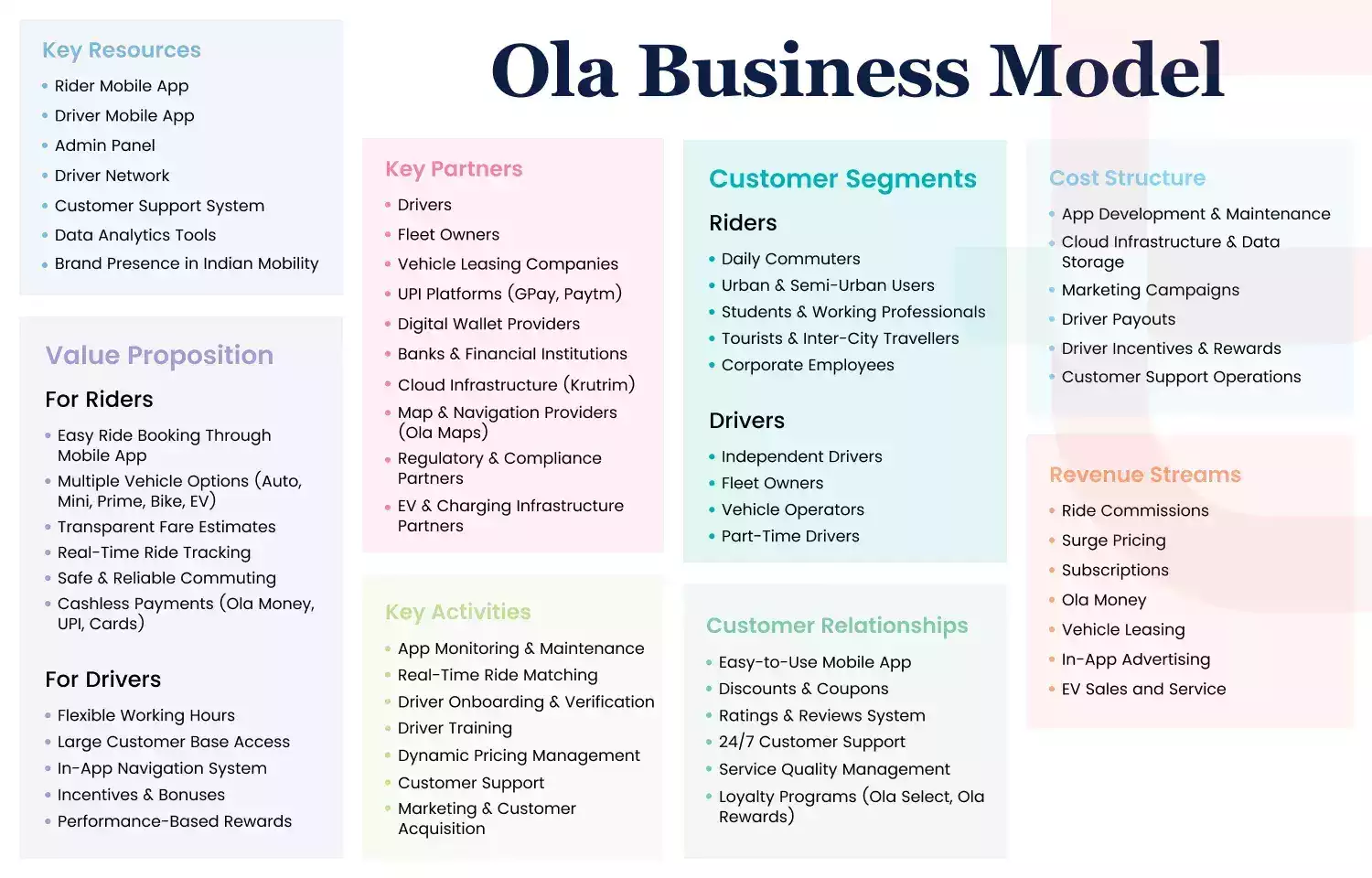
Ola operates on an app-based aggregator model that connects riders with nearby drivers through a digital ecosystem. Here is the breakdown of the key components of the Ola business model.
Value Proposition
Ola creates value for both drivers and riders. It makes booking urban transportation easy and convenient for riders while creating income opportunities for drivers.
For Riders:
- Rides can be booked easily through a mobile app.
- Multiple vehicle options like Ola Auto, Mini, Prime, and Bike are available to suit different budgets and travel needs.
- Riders get transparent fare estimates along with real-time ride tracking.
- The platform ensures a safe and reliable commuting experience.
- Riders can make cashless payments through different digital payment methods like Ola Money, UPI, and cards.
For Drivers:
- Drivers get flexible earning opportunities as they can operate at their preferred time.
- They get access to a large customer base without putting any marketing effort.
- With an in-app navigation system, drivers can fulfill the rides efficiently.
- Besides ride fares, drivers also receive incentives, bonuses, and performance-based rewards.
Key Partners
The company relies on a wide network of partners to ensure smooth operations.
- Drivers and fleet owners are to provide transportation services to customers.
- Vehicle leasing companies help drivers rent vehicles.
- Online payment systems like UPI platforms (GPay and Paytm), digital wallets, and banks are used to ensure secure transactions.
- Uses its own cloud platform, Krutrim, for data storage and app infrastructure
- Map and navigation systems powered by Ola Maps to provide real-time location tracking and routing.
- Regulatory and compliance partners to adhere to local transport laws and safety norms.
- EV and charging infrastructure partners to support its Ola Electric mobility services.
Key Activities
The key activities involved in Ola’s operations include:
- Monitoring and maintaining the mobile app to ensure smooth performance always.
- Matching riders with nearby available drivers in real time.
- Onboarding, verifying, and training new drivers.
- Managing dynamic pricing models for transparent and reliable pricing.
- Providing 24/7 instant customer support.
- Running marketing campaigns for customer acquisition.
Key Resources
Ola depends on several key resources to operate efficiently.
- A technology platform with separate apps for riders, drivers, and admins.
- A huge network of drivers in different cities across the country.
- A strong market presence in Indian mobility.
- Customer support system to handle service issues among drivers and riders.
- Data analytics tools to improve performance and user experience.
Customer Segment
The ride-hailing platform basically serves two customer segments:
Riders:
- Daily commuters in urban and semi-urban cities are looking for reliable mobility solutions.
- Students and working professionals need an affordable and convenient option for commuting.
- Tourists and inter-city travellers require ride-hailing services for short trips and outstation journeys.
- Corporate employees and clients need mobility solutions for office commute and business travel.
Drivers:
- Independent drivers looking for a primary or secondary income source.
- Fleet owners and vehicle operators who want to operate multiple vehicles.
- Drivers are looking for flexible working opportunities rather than fixed hours.
Customer Relationships
Ola builds long-term customer relations by strongly focusing on user experience and service quality.
- The app makes it easy and convenient for customers to book rides.
- Special discounts and coupons help in attracting new customers and retaining the existing ones.
- Loyalty programs like Ola Select and Ola Rewards encourage users to keep using the platform.
- The in-app ratings and review system helps in building trust among riders and drivers.
- 24/7 customer support helps in resolving user issues quickly.
Cost structure
The platform has to incur several operational costs to ensure smooth functioning.
- App development and maintenance for an effective user experience.
- Cloud infrastructure and data storage tools to store and manage user data.
- Marketing campaigns to increase the user base.
- Driver payouts and incentives to keep them active on the platform.
- Customer support teams are to handle user queries efficiently.
Launch Your Ride-Hailing Business Quickly and Effectively with Elluminati’s Ola Clone
Ola Revenue Model – How Ola Makes Money?
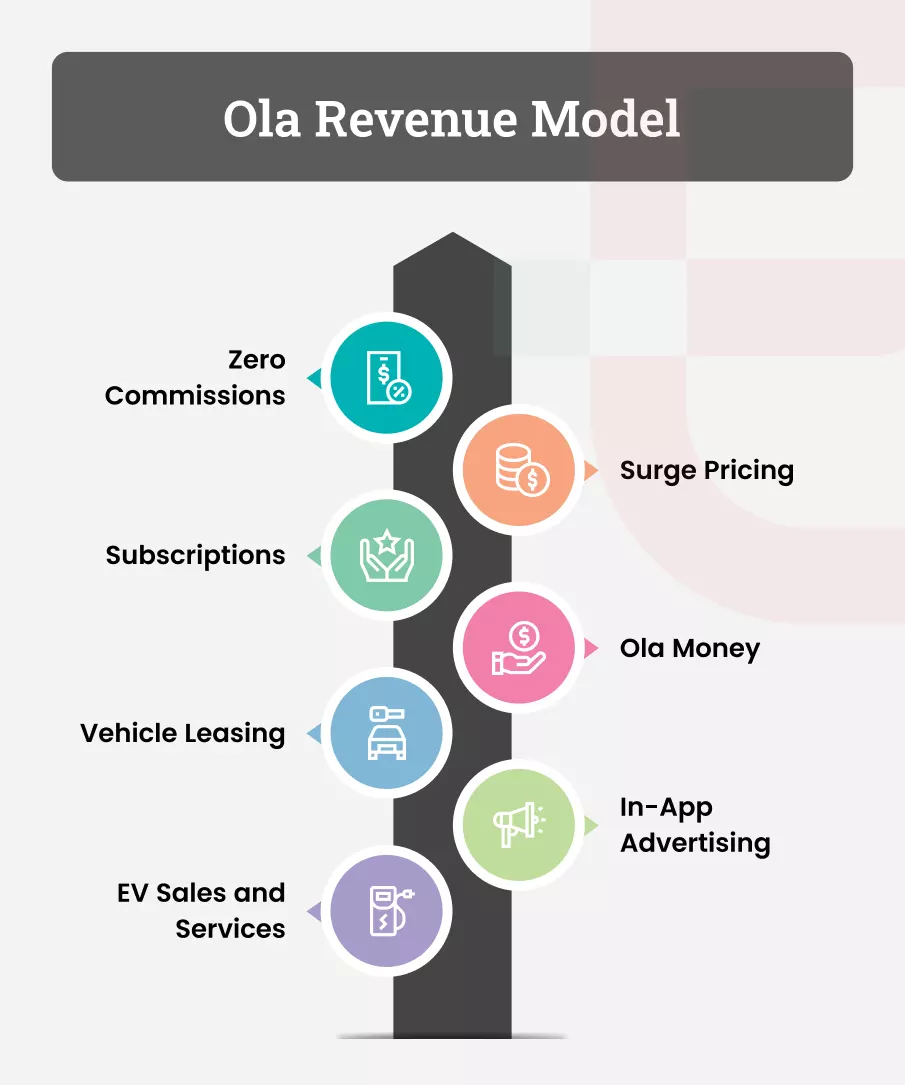
The Ola revenue model is diversified, which allows it to generate income from multiple sources instead of relying on a single source. Here’s a closer look at how Ola makes money.
Zero Commissions
Earlier, Ola charged a 20-30% commission for every ride completed by drivers. But since June 2025, it has shifted to a zero-commission model, where drivers keep 100% of their earnings and pay a one-time or subscription fee. This allows the company to improve driver retention while generating a recurring revenue source.
Surge Pricing
During high-demand periods like peak hours or festivals, Ola increases the ride fares. This encourages drivers to serve passengers when the demand is high. Moreover, it also helps Ola to earn more commission per ride.
Ola Select & Subscriptions
The platform offers subscription plans like “Ola Select” for customers who commute daily using Ola. These plans provide numerous benefits, such as zero surge and priority bookings to subscribers. Subscription plans generate recurring revenue for Ola.
Ola Money Wallet
Through its digital wallet service, “Ola Money,” the company generates revenue from transaction fees and merchant partnerships. This generates an additional income source for the platform besides ride commissions.
Vehicle Leasing
Drivers who do not own a vehicle can lease vehicles from Ola Fleet Technologies for commercial purposes. They have to pay a refundable security deposit and daily rentals to cover routine maintenance and insurance. This initiative allows Ola to generate extra income and also increase the number of vehicles available on its platform.
In-App Advertising & Partnerships
Ola partners with different local businesses like restaurants, e-commerce companies, and lifestyle brands to promote their offerings on its platform. In return, the platform charges these brands a fee for in-app promotions.
Electric Vehicle Sales & Charging Infrastructure
Ola Electric has been a strong revenue source for the company. It sells electric scooters to customers. Besides, the company makes money by offering different services like EV charging and maintenance packages, creating multiple income streams for its electric mobility ecosystem. Recently, Ola Electric sold around 3,59,221 units in 2025.
Ola’s Growth Strategies and Competitive Advantage
Ola has been able to grow rapidly in India because of its strong focus on customer needs. Let’s look at Ola’s key strategies that have helped it strengthen its position in the ride-hailing market.
Product Differentiation
The key differentiation for Ola is the diverse range of vehicles it offers. Rather than only offering sedans, the company provides options like auto rickshaws, bikes, compact cars, premium SUVs, and electric scooters. This diversification allows the platform to cater to customers with different needs and budgets.
Hyperlocal Focus & Cultural Adaptation
Ola tailors its services according to the culture and lifestyle of each city. Features like regional language support, local payment systems, and city-specific routing and navigation make the platform easy to use for customers. The hyperlocal focus allows the company to build long-term loyalty among users.
Targeted Audience
Every rider has different commuting needs, and Ola designs its services to match them. From daily commuters and students to tourists and corporate employees, Ola ensures that everyone can find rides according to their needs and budget. This has helped Ola to attract new customers and retain the existing ones easily.
Pricing Strategy
Rather than following a fixed pricing model, Ola uses a dynamic pricing model. Surge pricing during peak times, subscription plans, and special discounts make rides affordable for customers while also ensuring good profit margins for the company.
Digital-First & Social Media Marketing
With social media being the most used channel among people today, Ola uses it to promote its services and offers. It uses Instagram, Facebook, and YouTube to share new offers and launches with its customers. The digital-first approach allows the company to stay connected with its tech-savvy and young customers.
Strategic Partnerships
Ola ensures smooth operations by partnering with vehicle leasing companies, technology companies, EV firms, and charging stations. This allows it to strengthen its position among competitors. It also highlights how evolving ride-hailing standards are transforming the industry with a stronger focus on technology and innovation.
Sustainability-Driven Approach
With Ola Electric, the company sells electric vehicles and also offers services like EV charging and maintenance packages. This not only helps the firm attract environmentally conscious users but also generates additional revenue, which helps the company in achieving long-term growth.
Future Roadmap of Ola
Ola has been continuously evolving to lead the Indian ride-hailing market. Here’s how the company is planning to expand its services in the coming years.
Product Portfolio Expansion (Motorcycles & Scooters)
Ola has been expanding its electric vehicle range from scooters to motorcycles. The Roadster series and upcoming models like Cruiser, Adventure, and Diamondhead are expected to start deliveries in 2026. This will open opportunities for the company to increase its user base and also grow in the EV market.
Vertical Integration with In-House Battery Cells
Ola started using Bharat 4680 lithium-ion cells in 2026. This strategic move will allow the company to reduce manufacturing costs and improve EV performance. Moreover, in-house production will also help the firm to boost its profit margins.
Massive Expansion of Sales and Service Network
Ola introduced the Network Partner Programme to expand its sales and services in India. This made repairs and maintenance support for EVs easily accessible for customers in small towns. The growing network through this programme will help the company increase the EV adoption rate in the coming years.
Technological Innovation and Software Development
With its operating system MoveOS 5, Ola improved the performance of its 2-wheeler EVs with features like ADAS (Advanced Driver-Assistance Systems) and Krutrim AI assistant. The upcoming OS version, MoveOS 6, which is expected to be released in 2026, will help the company make riding experiences safer and more enjoyable for its customers.
How Elluminati Can Help You Build a Ride-Hailing App Like Ola?
Understanding how Ola works helps businesses know how a ride-hailing platform operates and generates revenue. Its business model has helped the company attract customers and scale its operations in different cities in India. For businesses considering entering the ride-hailing market, adopting a similar approach can help in launching their services confidently.
Elluminati helps you launch your ride-hailing business quickly with its Ola clone. With 14+ years of experience in building on-demand applications, we offer a customizable platform that helps businesses manage drivers, riders, and payments from a single ecosystem.
Contact us now to launch your ride-hailing business faster and grow successfully.
FAQs
Ola works as a digital platform that connects riders with nearby available drivers. Riders enter their pickup and destination addresses, choose their preferred vehicle type, and get matched with a nearby driver.
The Ola revenue model is based on multiple streams, which include ride commissions, surge pricing, subscription plans, vehicle leasing, EV sales, and in-app advertising.
Earlier, Ola expanded to Australia, the UK, and New Zealand, but later in 2025, it scaled down all its operations from international markets to focus completely on India. So, today Ola is operating in India.
Ola offers a diverse range of mobility services, which include scooters, cars, bikes, and auto rickshaws. It also offers electric scooter rides and vehicle leasing services for drivers.