
Key Takeaways (or TL;DR)
- Lyft is the US’s leading ride-hailing company that offers multi-modal mobility services like bikes, scooters, rentals, autonomous vehicles, and more.
- The Lyft business model connects riders with nearby drivers through a mobile app, ensuring high-end convenience and flexibility.
- The platform generates revenue through multiple streams, including commissions, subscriptions, surge pricing, and diverse service ride offerings.
- Technologies like mobile apps, GPS, AI, dynamic pricing, and cashless payments allow Lyft to have smooth and efficient operations.
- The future of Lyft highly focuses on having sustainable growth through autonomous mobility, AI-powered operations, and strategic partnerships.
Lyft is the US’s second-largest ride-hailing platform. It connects riders with nearby drivers through a mobile app. Since its launch, it has expanded its services with bikes, scooters, AVs, and enterprise mobility solutions, which makes it a key player in the digital market.
Understanding a Lyft business model becomes essential for entrepreneurs as it shows how a technology-driven ride-hailing platform can result in a successful business. This article will help you explore how Lyft works, its business model, and revenue model, along with the growth challenges and future outlook.
What is Lyft?
Lyft is a ride-hailing platform that allows users to book taxi rides through a mobile app by connecting them with nearby drivers. It was founded in 2012 by Logan Green and John Zimmer as an extension of their long-distance inter-city car pooling venture, Zimride.
Later, witnessing the increasing demand for on-demand urban transportation, the company got rebranded as Lyft. Over time, the company evolved from offering standard ride services to a multi-modal solution by including options like ride-sharing, corporate rides, bikes, and scooters. Today, it is the second-largest ride-hailing company in the US after Uber.
Lyft Overview and Important Stats
Founded in: June 2012
Founders: Logan Green and John Zimmer
Industry: Transportation and Mobility as a Service
Headquarters: California and San Francisco in the US
Areas Served: US and Canada
Key People: Logan Green (Chairman), John Zimmer (President), David Risher (CEO)
Total Revenue (2025): $6.27 billion, 14.9% increase year-over-year
Now, let’s have an overview of Lyft’s success journey:
- In May 2013, the company was renamed from Zimride to Lyft.
- In August 2014, Lyft introduced ride-sharing services.
- Later in December 2017, Lyft expanded its operations in Canada to Toronto, Hamilton, and Ottawa metropolitan areas.
- In March 2018, Lyft partnered with Allscripts (a major healthcare technology provider) to provide rides for patients who lack transportation.
- Further, in March 2019, it became a public company by launching an IPO, which raised 2.34 billion at a valuation of 24.3 billion.
- In August 2020, the company partnered with rental car company Sixt to launch its car rental services.
- The company then announced in December 2020 its plans to launch Robotaxi services by partnering with Motional.
- In July 2025, Lyft acquired Free Now (a mobility-as-a-service provider in Germany) to expand its operations in the region.
- Further, in September 2025, it partnered with Waymo to launch its Robotaxi services in Nashville.
- It also partnered with May Mobility to launch its self-driving ride-hailing services in Atlanta.
- Moreover, Lyft acquired TBR Global Chauffeuring (the world’s leading limousine services) for £83 million (approximately $110 million) in the year 2025.
How does Lyft Work?
Lyft’s main focus has always been to make on-demand ride-hailing services convenient and effortless for both riders and drivers. Here’s a glimpse of how it works.
For Riders
Lyft allows passengers to request and book rides in an easy way.
- Initially, riders log in to the Lyft app and enter their pickup and drop-off locations.
- Then they choose the ride type (Standard, XL, Extra Comfort, or Black SUV) according to their needs.
- Based on their location, they are matched with the nearest available driver.
- They also receive real-time pricing estimates based on location, distance, and the chosen ride type.
For Drivers:
Drivers get to earn income through Lyft’s platform by offering their taxi services.
- Drivers first have to register on the platform and complete the necessary verification process.
- They can access the ride requests based on their location and availability.
- The platform allows drivers with routing and navigation systems to complete trips on time.
- After completing the rides successfully, drivers get paid by Lyft after taking its commission from their earnings.
Taking a Deep Dive into the Lyft Business Model
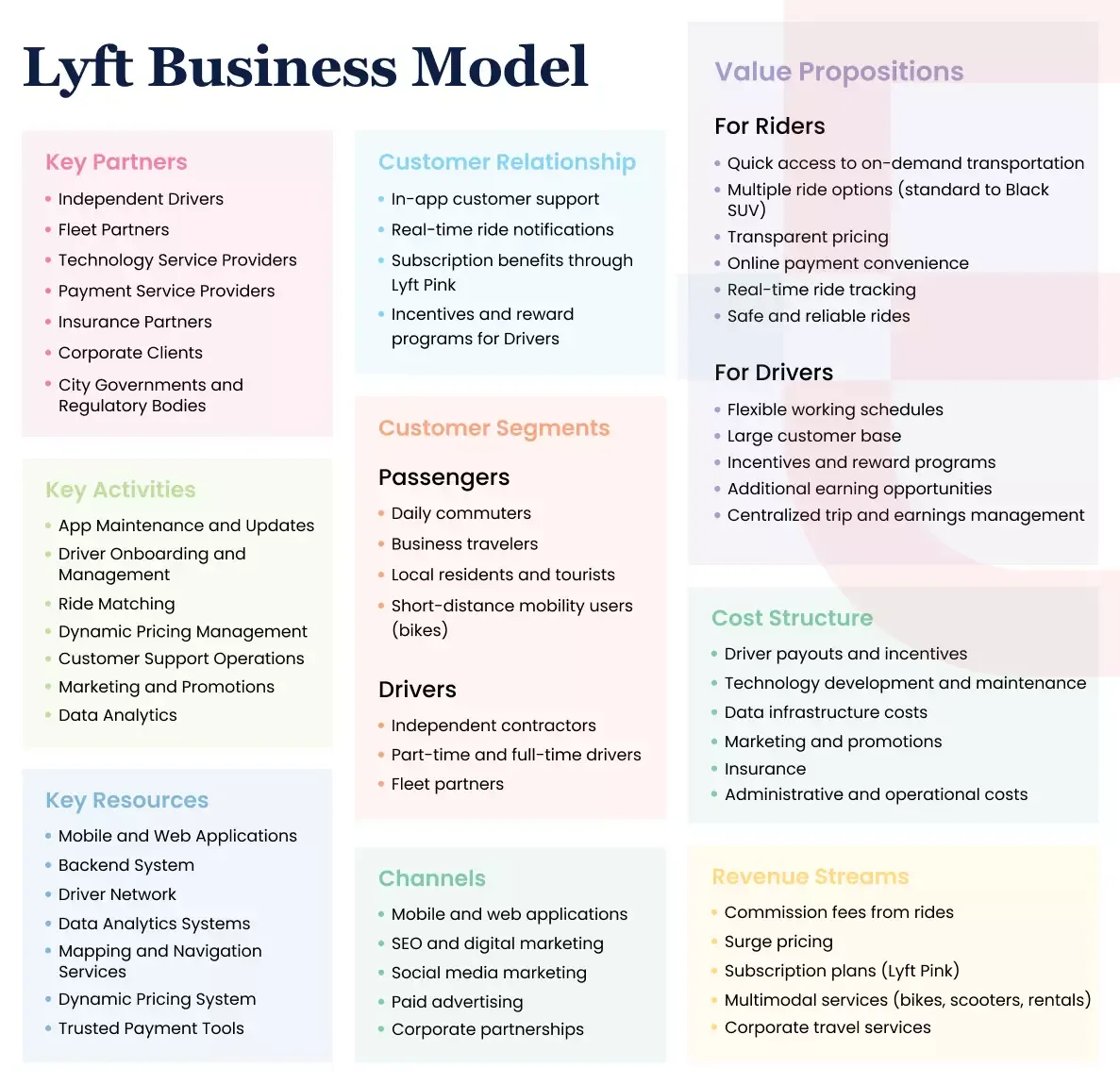
Lyft operates on a platform-based business model that connects passengers and drivers through a digital app. Here is the detailed overview of the major components of Lyft’s business model.
Value Proposition
Lyft creates value for both drivers and riders by offering easy accessibility, convenience, and high-end flexibility.
For Riders:
- Quick access to on-demand transportation whenever they need it.
- Multiple ride options from standard to Black SUV to suit different budgets and needs.
- Transparent pricing and the convenience of paying online
- Real-time tracking system to ensure safe and reliable rides.
For Drivers:
- Flexible working opportunities to operate according to their schedules.
- Get access to a large customer base without doing any marketing effort
- Incentives and reward programs like cashbacks and free roadside assistance for additional earnings.
- The platform offers a centralized way to manage trips and earnings.
Customer Segments
Lyft primarily serves two customer segments:
Passengers:
- Daily commuters require transportation for regular work travel and other daily activities.
- Business travellers need a time-efficient and convenient mobility solution.
- Local residents and tourists are looking for a convenient option to travel within cities.
- Users requiring on-demand services for short-distance travel using bikes.
Drivers:
- Independent contractors looking for flexible income opportunities.
- Part-time or full-time drivers who need an additional source of income
- Fleet partners who want to scale their operations in selected markets.
Key Partners
There are several important stakeholders in the platform’s ecosystem.
- Drivers and riders are the key players for the platform’s ride-hailing operations.
- Technology and payment service providers support on-demand app functionality and transactions.
- City governments and regulatory bodies are needed for legal compliance.
- Insurance partners ensure safety coverage during any accidental condition.
- Corporate clients use the platform on a contractual basis as a means of business transportation.
Channels
The platform uses different ways to reach its customers.
- Mobile and web applications act as a key access point for customers (both riders and drivers).
- Digital marketing channels like SEO, social media marketing, and paid ads help the app attract and retain users.
- Corporate partnerships help the platform expand its operations.
Key Resources
To ensure smooth operations, the Lyft app relies on different resources, such as:
- Mobile app and backend system to conduct efficient ride-hailing operations.
- Data analytics help in smart driver-rider matching.
- Dynamic pricing systems allow the platform to calculate fares in real time.
- Partnerships with trusted payment systems ensure safe and secure transactions.
- Embedment of mapping services allows for optimized routing and navigation to drivers.
Cost Structure
Lyft has to incur numerous operational costs to keep the platform running. It mainly includes:
- Driver Payouts: Payments and incentives paid to drivers after completing every ride.
- Technology Development: Expenses for app development, maintenance, and data infrastructure
- Marketing and Promotion: Continuous spending on the brand’s promotional campaigns
- Insurance and Operations: Costs related to driver and rider insurance coverage, customer support, and smooth administrative operations.
Collaborate with Our Experienced Team to Build a Powerful On-Demand Ride-Hailing App Aligning with Your Business Goals
How Lyft Makes Money: Lyft Revenue Model Explained
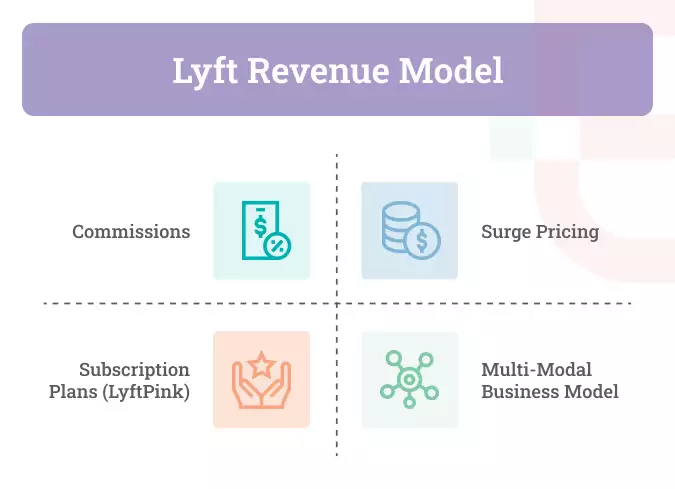
The Lyft revenue model is based on multiple streams, like commissions, subscriptions, and surge pricing. Here’s how Lyft makes money.
Commission Fees
This is considered to be the main revenue stream for Lyft. The platform charges a fixed percentage of commission fee from drivers’ earnings for every ride completed. This allows the app to scale its income easily as the number of rides increases.
Surge Pricing
Instead of following a fixed pricing model, the app increases the fares during peak times or in high-demand areas. This helps the platform maintain service availability during high demand while increasing revenue per trip.
Subscription Plans
With its subscription-based model, LyftPink is able to generate significant revenue. In this model, users pay a set recurring monthly or annual fee, and in return, they get exclusive perks like priority pickups, discounted rides, and even free or discounted access to bikes or scooters. This ensures a predictable income for the ride-hailing platform.
Multimodal Business Model
Beyond traditional ride-hailing, Lyft diversifies its offerings through bikes, scooters, car rentals, Robotaxis, and corporate travel. These services allow the platform to generate additional revenue while making it a comprehensive transportation-as-a-service (TAAS) ecosystem for urban mobility.
Technologies Behind Lyft’s Successful Operations
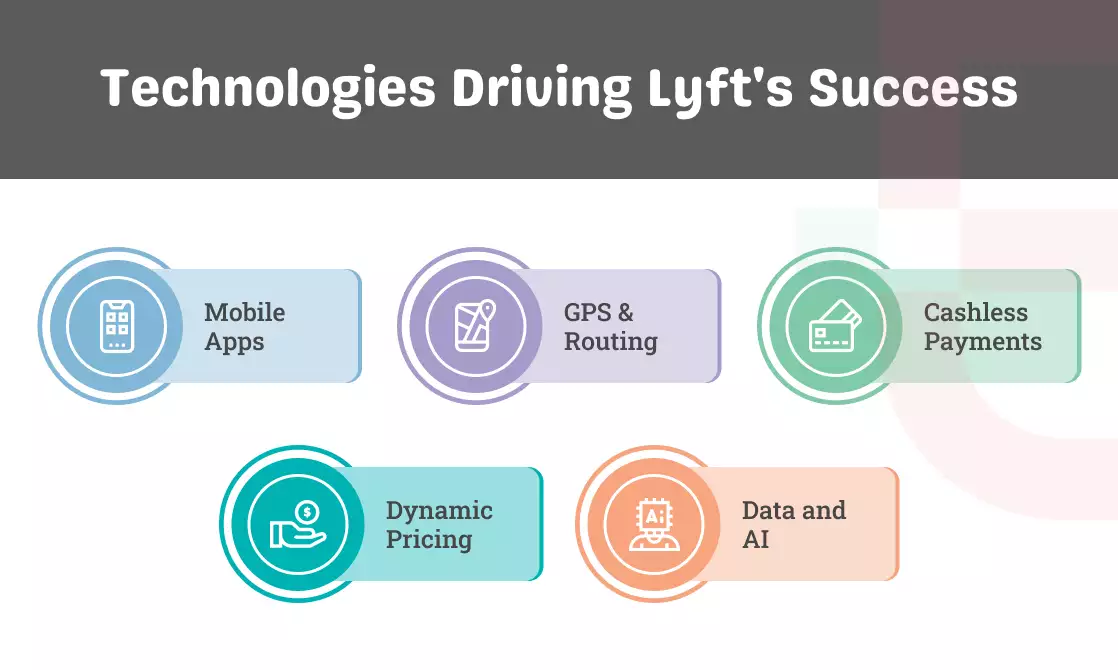
Since its launch, Lyft has become the second-largest ride-hailing company in the USA after Uber. This success has been largely driven by different technologies in its platform. Let’s have a look at the technologies driving Lyft.
Mobile Apps
Lyft’s mobile apps act as the main part of its ecosystem, as this is the medium through which riders and drivers can access and use the platform. They allow users to request rides, accept trip requests, track journeys, and manage payments and earnings. This ultimately helps the platform manage its ride-hailing operations easily and efficiently.
GPS and Routing
This technology can be considered to be the key aspect behind Lyft’s faster and more reliable service delivery. GPS and routing allow the app to match riders with nearby drivers and also help the driver navigate efficiently. This ultimately reduces waiting times for riders while helping Lyft handle higher ride volumes across urban areas with ease.
Cashless Payments
Lyft allows its users to make payments by using their cards and digital wallets through its secure in-app payment system. This eliminates the need for physical payment and speeds up the payment process. Moreover, it also helps Lyft to track and manage overall revenue and driver payouts easily.
Dynamic Pricing
This technology makes it easy for Lyft to calculate fares in real time based on ride demand and driver availability. Moreover, it also allows the platform to increase fares during peak times, which encourages drivers to offer services during high demand. Dynamic pricing allows Lyft to maximize its revenue during high demand.
Data and AI
User data and the latest artificial intelligence technology also play a major role in Lyft’s operations. The app uses AI-powered data analytics tools to analyze user behavior, predict demand, and smart ride matching based on driver availability and location. This helps the company make smart decisions and also enhances customer experience.
Launch Your Ride-Hailing Business Faster with Elluminati’s Lyft Clone Built for Scalability and Efficient Operations.
Growth Challenges Faced by Lyft
Despite owning one of the leading positions in the market, Lyft will have to face several challenges to maintain its growth in the coming years.
Intense Competition
Lyft operates in a highly competitive market in the US, with Uber being its major rival. Although it has stabilized its position in the market, it has to continuously innovate and defend its market share without engaging in price wars or excessive discounting. Otherwise, it can negatively impact the company’s profitability.
Regulatory Compliance
The company has to strictly follow local transportation laws and government rules to stay legally compliant. However, the regulations keep changing with time and also vary by country and city, which makes compliance a constant challenge for Lyft.
Driver Retention
Drivers are one of the integral aspects behind Lyft’s success. However, if drivers are dissatisfied with their earnings, incentives, or working conditions, they can easily switch to a competitor’s platform. This can negatively impact the service availability for Lyft, leading to longer wait times and unhappy riders.
Pricing Balance
It becomes very challenging for Lyft to keep ride fares affordable for passengers while ensuring fair earnings for drivers. Setting prices too high can affect the demand, while low pricing can impact the service availability, ultimately hurting the company’s profit margins. That’s why it becomes challenging for the platform to balance pricing.
Technology Risks
As a technology-driven company, Lyft heavily relies on its digital infrastructure. Any technical issues like app failures, data security problems, or system downtime can affect user experience and also overall business operations. Moreover, integrating new technologies and platforms can also create operational risk.
Future of Lyft
Lyft is strongly focusing on innovation, technology, and strong partnerships to have sustainable growth in the market.
Expand into Autonomous Mobility with Hybrid Network
With the increasing use of autonomous vehicles (AVs), the company is planning to move towards autonomous mobility in Europe. And for this, it has partnered with autonomous technology providers like Baidu’s Apollo Go.
However, human drivers have been the company’s growth drivers since launch, and it is building a hybrid network where human drivers and self-driving vehicles will operate together for ride fulfillment.
Diversify Mobility Options
Lyft is further expected to diversify its offerings, such as bikes, scooters, rental options, and autonomous vehicles. This will allow it to extend its reach and also position itself as a one-stop solution for urban mobility in the targeted markets.
It also highlights the overall growth of the taxi booking market, where platforms are evolving as complete mobility solutions.
Leverage AI for Smarter Operations
AI is considered to play a bigger role in driving Lyft’s success in the coming years. Artificial intelligence will help the platform optimize routes, predict demand, provide instant customer support, and even improve pricing accuracy. This will ultimately help the company enhance its service quality while reducing operational costs to a greater extent.
Build Strategic Partnerships
Lyft is continuously strengthening its ecosystem through partnerships with companies like Waymo, Mobileye, and May Mobility. Moreover, to expand its operations in Europe, the company recently acquired FreeNow.
Such strategic partnerships will help the company expand to new markets, enhance its service offerings, and also gain access to the latest and advanced technologies.
Focus on Sustainability
Environmental sustainability is becoming a major concern in the transportation sector. With its goal of achieving 100% electric vehicles on its platform by 2030, the company is working with drivers, partners, and cities to make EV adoption easy.
How Elluminati can help You Build an App Like Lyft
The Lyft business model highlights how a technology-driven ride-hailing platform can create a scalable and profitable business. Its success mainly lies in connecting riders with nearby drivers through a mobile app while ensuring convenience and flexibility.
If you are considering launching your ride-hailing business, then Elluminati can help you get started quickly with its ready-to-launch Lyft clone. Backed by 14+ years of experience in on-demand app development, our customizable platform covers everything from real-time tracking and smart route optimization to dynamic pricing and predicting demand.
Our Lyft like platform not only helps you launch your ride-hailing business quickly, but it also ensures smooth and efficient operations.
FAQs
Lyft’s business model operates on a two-sided marketplace that connects riders with drivers through a mobile app. Riders can book on-demand transportation services, while drivers can earn by completing the trips.
Lyft generates revenue in multiple ways, like commissions, dynamic pricing, subscription plans, and multi-modal integration.
The cost of a Lyft ride varies depending on different factors like distance, location, traffic conditions, travel time, local demand, and surge pricing.
While Lyft has faced financial challenges in its early years, it has generated profits by improving operational efficiency, increasing ride volume, and offering high-margin services like subscriptions and enterprise partnerships.