Key Takeaways (or TL;DR)
- BlaBlaCar began when the founder, Frederic Mazzella, was unable to find a ride home for Christmas, identified the problem of empty car seats.
- The BlaBlaCar business model operates as an online marketplace for carpooling, connecting drivers with empty car seats to customers heading in the same direction, via a digital platform.
- The company follows a user-friendly flow, where the driver posts trips, customers book seats online, and can share trips with other daily commuters, resulting in a pocket-friendly trip.
- The BlaBlaCar revenue model primarily comes from service charges, BlaBlaCar Bus, and SaaS subscriptions.
- The future of BlaBlaCar mainly centers around multimodal expansions, hyperlocal commuting, and sustainability and eco-conscious travel.
Many mobility entrepreneurs struggle to offer affordable ride experiences to their customers, which, in turn, has a major impact on their operations.
The BlaBlaCar business model is an online peer-to-peer carpooling platform connecting drivers with empty seats to passengers heading in the same direction, delivering a cost-sharing, affordable trip experience.
As a leading shared mobility provider, BlaBlaCar’s success has become a blueprint for entrepreneurs willing to enter the carpooling market. Now, if you are eager to explore further on how BlaBlaCar makes money, its operating model, and its future plans.
What is BlaBlaCar?
BlaBlaCar is a France-based online marketplace for carpooling that connects drivers with empty seats to customers who can easily reserve a space to travel in the same direction, sharing the cost while reducing the carbon footprint.
About BlaBlaCar: A Journey from French Startup to Go-to Marketplace for Shared Mobility
A small observation of empty car seats led to one of the most successful carpooling business models. This lays the foundation for BlaBlaCar!
Company Overview
- Founded In: 16th September 2006
- Founders: Frederic Mazzella, Francis Nappez, Nicolas Brusson, and Nicolas Deroche
- Company Type: Private
- Industry: Transportation
- Headquarters: Paris, France
- Area Served: Belgium, Brazil, Croatia, Czechia, France, Germany, among others
- Services: Carpooling
Over the last twenty years, BlaBlaCar has grown from a startup into the world’s leading carpooling online marketplace, connecting millions of users across the globe.
In the market, where ride-hailing standards change rapidly, the company adopted a unique way to attract customers: offering a pocket-friendly, easily accessible ride service through “Carpooling.”
Initiated as a carpooling concept, the company has evolved into a global shared mobility marketplace offering BlaBlaCar Bus, ticket booking, short-distance, and daily commute ride-sharing services.
This France-based platform, currently operating in 21 countries, has over 29 million active members and leads the carpool market through its unique strategies.
Now, let’s capture a brief about other services offered by the company
Multiple Services Offered by BlaBlaCar
The company evolved well beyond its original roots, that is, carpooling. Below are some of the other services available on BlaBlaCar’s platform:
BlaBlaCar Bus
BlaBlaCar Bus, previously known as BlaBlaBus or Ouibus, launched in the first half of 2019 to expand its mobility services. It currently operates in multiple European countries, including France, Germany, Benelux, Spain, and others.
BlaBlaCar Daily
BlaBlaLines, which later rebranded as BlaBlaCar Daily, was specifically designed for short-distance, daily commutes rather than long-distance intercity trips. It mainly operates as a business-to-government contract in France, where the municipalities subsidize carpooled commuter rides as a public transit alternative.
Zen App
Zen App, launched by BlaBlaCar in December 2024, is designed to fill gaps left by the company. Specifically, for short-distance, daily, or occasional carpooling trips, it streamlines customers’ experience by offering door-to-door, automated, highly flexible, and localized trips.
Train Ticket Booking
The company integrated the train ticket booking feature into their app on 15th May, 2025. They announced that users in France and Spain can now search for, book, and manage train tickets directly in the app and on the website.
The company cannot expand its services overnight! It has spent over a decade achieving this, and here’s a quick look at its key milestones.
Success Timeline:
- 2006: Officially founded the company and acquired the domain Covoiturage.fr, which means Carpooling in French (early version of BlaBlaCar).
- 2008: Soon, it became the largest carpool website in France.
- 2009: Reached 1 million members, as well as made an international expansion by launching its Spanish version, under the name of “Comuto”.
- 2011: Rebranded as BlaBlaCar, and stepped into the United Kingdom market.
- 2012: Introduced an online reservation service to its domain, Covoiturage.fr.
- 2013: The company BlaBlaCar was launched in Germany, and it was at this time that Covoiturage.fr was re-branded as BlaBlaCar.fr.
- 2014: The firm was introduced in the Ukraine & Russia markets, and successfully served 10 million users.
- 2015: Made its footprints in India and Latin America, and acquired multiple competitors, including Carpooling in Germany, Autohop in Central Europe, and Rides in Mexico.
- 2017: The company also partnered with Opel and ALD Automotive to offer long-term car rentals to its active drivers. In the same year, they also launched a daily carpooling app in France under the name “BlaBlaLines.”
- 2018: To expand its service, BlaBlaCar acquired the startup, Less. Also, it made a multimodal partnership with SNCF to acquire the long-distance coach operator Ouibus.
- 2019: Rebranded Ouibus as BlaBlaCar Bus. And, also acquired Busfor, a leading online bus ticketing platform in Russia and the CIS region.
- 2021: Acquired Octobus, a Ukrainian-based software company to help bus operators digitize their management.
- 2023: Acquired Klaxit, a French startup that enables carpools for daily commutes.
- 2024: To expand its ticketing platform, the company acquired Obilet, a leading platform based in Turkey.
- 2025: The company became a one-stop shop for shared travel by fully integrating its train ticket bookings.
- 2026-: It currently operates as a multimodal platform in 21 countries.
From a small business to becoming a multimodal platform, it requires strong financial backing, and here’s how the support of key investors at each step plays a vital role in giving the company strategic progress.
Fundings of BlaBlaCar
BlaBlaCar has raised $565 million across 11 rounds. Let’s explore some of its recent funding rounds and the amounts raised in each.
|
Funding Rounds of BlaBlaCar |
||
|
Date |
Funding Rounds |
Funding Amount |
|
April 3, 2024 |
Conventional Debt |
$108 Million |
|
June 15, 2022 |
Conventional Debt |
$15 Million |
|
April 20, 2021 |
Series E |
$115 Million |
BlaBlaCar Business Model Explained
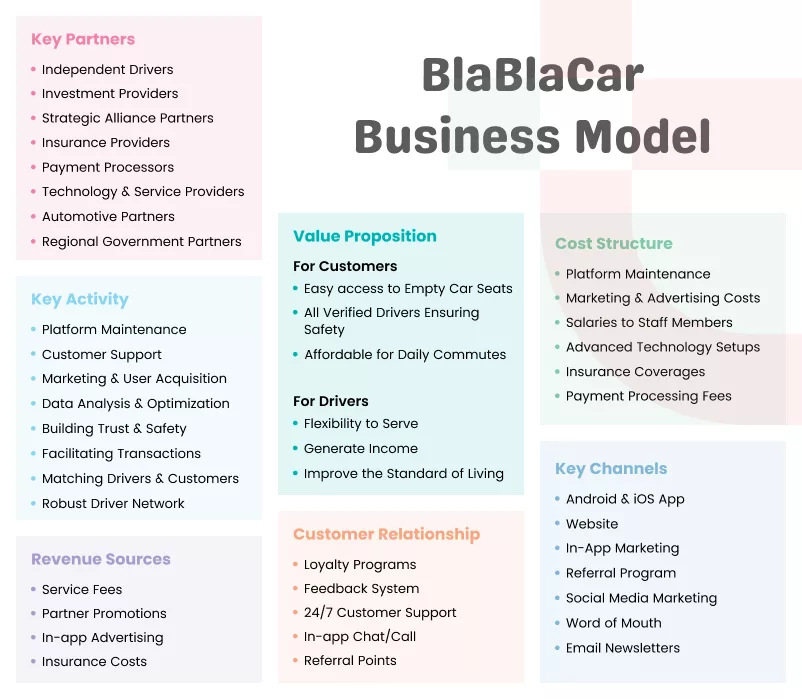
BlaBlaCar business model strategically operates as an online carpooling marketplace, connecting drivers with empty seats to customers heading in the same direction. Moreover, its key elements are vital to the company’s success.
Key Partners
- Over 6,000 bus operators complement its carpooling networks.
- Payment processors that handle secure transactions across multiple currencies and markets.
- Ride-sharing insurance underwritten by AXA covers all BlaBlaCar rides in France and the UK.
- The company also established a partnership with VINCI Autoroutes to offer automated payments for frequent carpoolers on their network.
- Also, the company collaborated with the Indian Railway and tourism subsidiary to promote its ride-sharing service.
- To secure financial support, the company also connected with key investors, including ISAI, Cabiedes Partners, and others.
- Strategic partnerships with local as well as established carpooling service providers to expand its business.
Key Activities
- Onboarding drivers and providing them with training.
- Ensuring a secure transaction process.
- Continuously enhancing UI/UX to deliver a user-friendly experience.
- Expanding business to new markets with new collaborations.
- Offering 24/7 customer support services to deliver a seamless experience.
Value Proposition:
For Customers:
- Easy, pocket-friendly ride-share access for short-distance, long-distance, and daily commuters.
- Easy seat reservation for intercity bus trips.
- The app also includes passenger safety features, including SOS, and all drivers registered on the platform have verified badges, ensuring trust and safety.
- Access to provide feedback about the drivers, building trust with the brand.
- Enables customers to book a train ticket via the app.
- Convenient payment options, with cash, cards or through wallet transfers.
For Drivers:
- Drivers can share their fuel and toll charges with others, significantly reducing their travel expenses.
- Flexibility to offer services by posting the ride availability and empty spaces for customers.
Cost Structure:
- The company incurs high expenses in its customer acquisition process, including sales, marketing, and promotion.
- Payment to be made to lawyers for settling the legal disputes.
- Payment to technology service providers, who maintain the platform up-to-date over time.
- Paying remuneration and other incentive benefits to employees.
Be the Next One to Lead the Carpooling Market with Elluminati’s Market-Tested BlaBlaCar Like App
How BlaBlaCar Works? A Step-by-Step Process
Here’s a breakdown of how BlaBlaCar works to offer a simplified booking experience for customers, while drivers have an extra earning opportunity:
For Customers
- Step 1: Customers can log in to the BlaBlaCar app or website to reserve an available car seat by entering their departure city, destination, date, and the number of seats they require.
- Step 2: They can then review the driver’s profile and other details, such as luggage restrictions and reviews, before booking a ride-sharing service.
- Step 3: Later, they can select a ride that meets their requirements and proceed with the booking confirmation.
- Step 4: The customer can confirm their ride by making an in-app payment or paying in cash before the trip begins.
- Step 5: Once the booking is confirmed, they can communicate with the driver using the in-app chat feature.
- Step 6: Then, the customer meets the driver at the agreed pickup location and completes the trip.
- Step 7: At the end, they both have the option to rate each other based on their experience.
For Drivers
- Step 1: Drivers can post a ride by entering required details, such as the route, departure city, time and date, available seats, luggage, etc.
- Step 2: Based on the posted trip, they receive customer bookings that they can accept or decline.
- Step 3: After accepting the request, the driver picks up the customer from the agreed pickup point and starts the ride-sharing.
- Step 4: After the customer confirms the ride completion, the company automatically releases or transfers the collected payment to the driver’s bank account or deposits it into the in-app wallet.
How BlaBlaCar Makes Money: Insights into Its Revenue Channels
Instead of relying on a single revenue stream, BlaBlaCar revenue model diversified its income from various sources, including service charges, car insurance, and more, ensuring operational stability and long-term scalability.
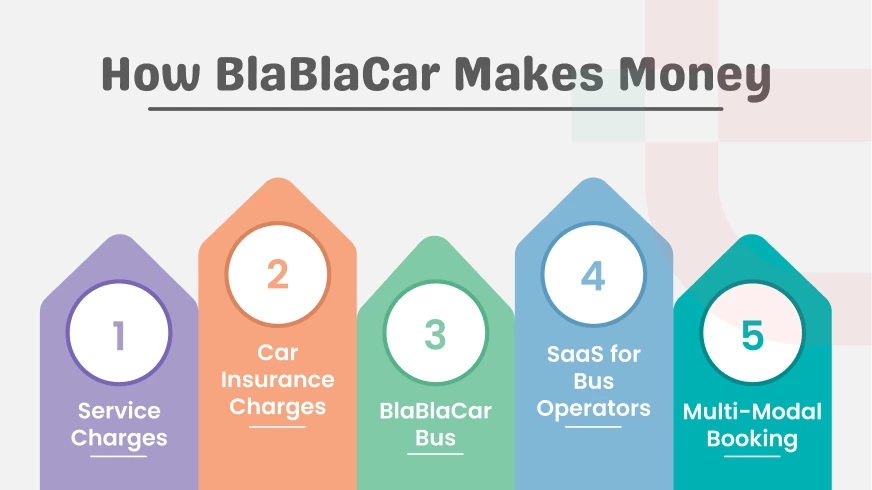
Service Charges
Instead of earning through commissions, BlaBlaCar generates its primary income from service charges.
The company takes approximately 10% to 12% of the total cost of a ride, and the fees are charged to customers at the time of booking a ride-share. Also, the charges can vary depending on the distance and the time of booking.
Car Insurance Coverages
The company partnered with insurance providers such as AXA and L’olivier Assurance to offer free additional insurance coverage for many trips, helping build trust.
However, instead of charging drivers directly, they earn referral fees from insurance companies for each policy or coverage facilitated through the platform.
BlaBlaCar Bus
Following the acquisition of Ouibus, the company launched BlaBlaBus to expand its peer-to-peer carpooling into a professionally operated bus service.
Here, bus tickets are sold directly on the platform, and the company earns approximately 20% to 30% on each ticket sale.
Multi-Modal Booking
By integrating train booking into its France and Spain applications, the company allows customers to use company carpooling, bus, and train options on the same platform before choosing the best option for their travel.
This enables the company to generate an income through:
- Distribution Fees
- Booking Commissions from Rail Operators
SaaS for Bus Operators
After acquiring Octobus, the company offers specialized software for bus operators that helps them manage their fleets, digitize their inventory, and distribute tickets.
The subscription for B2B is based on tiers:
- Basic
- Smart
- Pro
Excited to Thrive in the Ride-Sharing Market? Consult with Elluminati Today to Get Your Tailored BlaBlaCar Like App Solution
What Will be the Future Outlook of BlaBlaCar?
As shared and digital transport solutions continue to transform how people commute. BlaBlaCar is well-positioned to lead the next wave of the mobility revolution by expanding services and adopting sustainable approaches that will be the future eye of most mobility service providers.
Multimodal Expansion
Instead of focusing solely on carpooling, the company has also integrated a train ticket booking feature into the app, operates a BlaBlaCar Bus service, and enables its customers to choose from various travel options on a single platform.
This positions BlaBlaCar as a leading provider of shared ground transport across Europe.
Hyper-local & Commuting Focus
To meet local commuting needs, the company first launched BlaBlaCar Daily for the daily commuter market.
Further, the company collaborated with local governments in France, demonstrating that municipalities are willing to fund carpooled commutes as a cost-effective, low-carbon alternative to public transit expansion.
Based on these initiatives, the company launched its Zen app specifically for short-distance trips and other scenarios not fulfilled through its BlaBlaCar Daily.
Sustainability & Eco-conscious Travel
The company’s core service, the Zero Empty Seats approach, plays a major role in sustainability & Eco-conscious travel. Apart from this:
- The company significantly reduced 2.5 million tonnes of CO2, by combining carpooling, bus, and rail services.
- Increasing the vehicle occupancy to reduce the carbon footprint per person.
Moreover, BlaBlaCar partnered with PurProject and similar organizations to support forest conservation, including efforts in the Peruvian Amazon and across Africa & Asia.
Strategic Lessons for Entrepreneurs from the BlaBlaCar Business Model
The success of any leading business lies in its strategic planning, and BlaBlaCar was no exception. An entrepreneur must understand the choice of business model, target audience, and market expansion.
- Position your platform to align with regulations and customer affordability, as BlaBlaCar did with its cost-sharing approach rather than ride-hailing.
- Strengthen your core offering and increase user value before diversifying, as BlaBlaCar did by expanding into adjacent services such as BlaBlaBus and commuter ride-sharing.
- Instead of building from scratch, consider acquiring established players to gain immediate access to users, trust, and supply – as demonstrated by BlaBlaCar’s expansion strategy.
How Elluminati Can Help You Build an App Like BlaBlaCar?
“Fail. Learn. Succeed” is what the BlaBlaCar business model is built upon with! The way the company carved out a niche in transportation through carpooling was very impressive. What starts as an observation is currently leading the carpooling market across Europe and multiple countries, and is no less than an inspiration for entrepreneurs like you!
The conceptually clear BlaBlaCar revenue models and their operations are essential to understand if you have already pitched to this market. Also, to move forward, it’s essential to collaborate with a technical partner that delivers the best-fitting solution. And, here’s where Elluminati comes in.
With 14 years of experience, we have a team of professional developers who, instead of jumping directly into development, focus on building a solid foundation. Our team will analyze your pain points and target audience to help you deliver a tailored BlaBlaCar clone, which not only competes but also helps you dominate today’s market with confidence.
FAQs
BlaBlaCar business model operates as a two-sided platform that connects drivers with empty seats to passengers traveling in the same direction, allowing them to split the cost and making long-distance trips affordable and easily accessible via a mobile app.
The company follows a simplified booking flow, where:
- A driver can post their upcoming trips with available seats and prices.
- Customers can simply search for rides matching their destination.
- Reserve an available seat and pay through the platform.
- And, it ends with real-time feedback, maintaining overall transparency.
BlaBlaCar revenue model primarily includes:
- Service Fees
- BlaBlaCar Bus
- Ticket Booking
- SaaS Based Subscription Plan
Currently, BlaBlaCar operates in 21 countries with a strong presence in Europe, Latin America, and India.
Key services provided by the BlaBlaCar include;
- Carpooling
- BlaBlaCar Bus
- Train Ticket Booking
- BlaBlaCar Daily
- Zen App