Key Takeaways (or TL;DR)
- Grab is Southeast Asia’s leading super app that evolved from a ride-hailing app to a multi-service platform.
- The Grab business model works on a multi-service platform that integrates multiple services in one place and connects users with nearby service providers.
- The leading super app has achieved success by following a hyperlocal strategy and adapting its services to local cultures, languages, and payment preferences.
- The company generates revenue through commissions, transaction fees, advertising, and subscription plans.
- Its marketing strategies, like data-driven personalization, cross-selling, and loyalty programs, help it attract and retain customers for a long time.
Grab has grown from a simple ride-hailing platform to one of Southeast Asia’s leading super apps.
It was launched in 2012 as MyTeksi in Malaysia to make taxi bookings safer and more reliable in the region. Since then, it kept expanding its services by integrating food delivery, grocery shopping, parcel delivery, and digital payments into its services. As a result, today it has become an integral part of everyday life for millions of users in SEA.
For businesses looking to step into the multi-service market, studying Grab’s business model becomes important as it is built on a super app ecosystem that connects users, service partners, and businesses in one place. In this article, we will explore how Grab works, its business and revenue model, core services, challenges, and future outlook of the platform.
What is Grab?
Grab is a leading Southeast Asian super app that offers multiple services like ride-sharing, delivery, and digital payment services in one place. It was initially launched as MyTeksi by Anthony Tan and Tan Hooi Ling in 2012 in Malaysia to make taxi rides safer and more reliable while studying at Harvard Business School.
By 2016, the company had rebranded as “Grab” as it had expanded its operations from mere transportation to food delivery, logistics, and digital payments through GrabFood, GrabExpress, and GrabPay. Today, the company operates in 500+ cities and 8 countries. It is the first and biggest decacorn in Southeast Asia.
What makes Grab stand out is its strong focus on local markets and everyday user needs. Instead of following the same business model in each country, Grab designs its services according to the user behavior, infrastructure, and needs of different regions. This has helped the platform gain popularity in SEA.
Grab’s Journey from a Ride-Hailing Platform to a Super App:
2014:
- GrabTaxi was expanded to Vietnam and Jakarta in Indonesia.
- Launched the first GrabBike service in Ho Chi Minh, Vietnam.
2015:
- GrabBike’s motorcycle ride-hailing services expanded across Vietnam and Indonesia.
- Introduced GrabCar+ in the Philippines and GrabExpress courier service in Jakarta, Indonesia.
2016:
- The company got rebranded as “Grab” and launched GrabShare (car pooling service) in Singapore.
2017:
- Acquired Indonesian online payment startup Kudo and launched its digital payment service GrabPay.
2018:
- Acquired Uber’s assets and operations in Malaysia, Singapore, and Thailand to expand its food delivery services, GrabFood.
- Launched its eScooter rental service, GrabWheels
2019
- Launched GrabPet in Singapore, in which drivers proficient in pet handling would transport pets in their vehicles.
- Introduced its first cloud kitchen, GrabKitchen, under the food delivery service in Indonesia.
- Integrated all its services into one platform and launched its super app.
2021
- Launched its IPO.
- Acquired Malaysia’s Jaya Grocer to expand its grocery delivery services.
2022
- Introduced GrabMaps for use in local routes of Southeast Asian cities.
- Launched its digital banking service, GXS Bank.
2025
- Piloted its first digital cycle rickshaw service, “Grab Cyclo” in Vietnam.
- Got approval from the Land Transport Authority of Singapore to test autonomous vehicles with its partner WeRide.
- Partnered with Momenta to deploy autonomous driving technology in SEA.
2026
- Acquired Infermove (a Chinese AI robotics developer) to support its delivery operations.
Important Facts and Figures of Grab
| Launch Year | 2012 |
| Founders | Anthony Tan, Tan Hooi Ling |
| Headquarters | Singapore |
| Key People | Anthony Tan (Chairman & CEO), Alex Hungate (COO) |
| Operates In | 500+ cities and 8 countries |
| Funding Amount | $16.5 Billion |
| Funding Rounds | 32 |
| Major Investors | Altimeter Capital, Emtek Group, Signite Partners, Hanwha Asset Management, STIC Investment, Mitsubishi UFJ Financial Group |
| Annual Revenue (2025) | $3.38 – $3.40 billion |
| IPO Launch | Dec 2, 2021 |
| Industry | Ride-hailing and ride-sharing, Transportation, Vehicle rental, Food delivery, Grocery delivery, Parcel delivery, Online Payment, e-commerce platform, Insurance |
Core Services Offered by Grab
Grab offers numerous services to cover everyday mobility, delivery, and financial needs.
1. Mobility
Provides on-demand transportation solutions for daily commuting, specialized travel, or short-distance rides.
- GrabCar
- GrabTaxi
- GrabBike
-
Specialized Rides
- GrabFamily - Vehicles equipped with child seats
- GrabPet - Pet-friendly transportation
- GrabHitch - Social carpooling service
2. Delivery Services
Enables fast and convenient delivery for food, groceries, and parcels from nearby available businesses like restaurants, markets, and couriers.
- GrabFood
- GrabMart
- GrabExpress
3. Financial Services (GrabFin)
Offers digital financial solutions to people, making online payments, banking, and loans easily accessible.
- GrabPay
- Lending & Buy Now, Pay Later (BNPL)
- Insurance & Wealth Management
- Digital Banking
- Operation of GXS Bank in Singapore under a full digital banking license.
4. Enterprise Services
Supports business operations with tools related to marketing, management, and navigation-based services.
- GrabAds
An advertising platform that allows businesses to promote their services or products to Grab’s large user base through in-app ads and offline vehicle branding.
- GrabForBusiness
Corporate tools for businesses are useful to manage employee transportation, meal allowance programs, and digital gifting.
- GrabMaps
A B2B mapping solution providing businesses with hyperlocal map data, map-making tools, and necessary APIs.
How Grab Works: Step-by-Step User Flow
Grab operates as a digital aggregator that connects customers, service providers, and merchants through one integrated app. Here is the complete working flow of Grab.
For Customers:
Booking services on Grab just takes a few steps.
- Customers first log into the Grab app and choose the service they need, like ride-hailing, food delivery, grocery shopping, or parcel delivery.
- On receiving the request, the app captures user details like their location and destination address.
- Based on the collected information, the platform shows nearby providers along with their estimated pricing and arrival time.
- Users make the payment using their preferred payment method, such as cash, card, or GrabPay.
- After the completion of service, customers can rate and review their experience with Grab.
Driver Operation Flow
Earning through the app starts by opening the app and accepting the nearby ride or delivery requests.
- Initially, service providers have to register on the platform and complete the verification process.
- After account confirmation, providers can go online and start receiving service requests.
- Grab distributes service requests based on the provider’s location and availability.
- The app provides optimized routes and service details to complete the requested service efficiently.
- Providers receive earnings in their accounts after completing services, along with performance metrics and incentives.
For Merchants
Businesses can start selling on Grab by creating a merchant account and listing the services they want to sell to their customers.
- Merchants sign up on the Grab Merchant Platform and create digital listings of their services.
- They receive the orders on their personalized dashboards.
- After confirmation, merchants start preparing the food or items based on order details.
- Grab assigns a driver or delivery partner to pick up the order and deliver it to the customer.
- After order fulfillment, Grab pays the merchant digitally after deducting its commission.
- Besides receiving orders, merchants can also promote their services through GrabAds and in-app advertising.
Launch Your Own Multi-Service Platform with Elluminati’s Proven Technology and Expert Support
Understanding the Grab Business Model

Grab operates on a multi-sided platform business model, which brings customers, service partners, and merchants in one app to deliver multiple services. Let’s have a detailed overview of the different components of the Grab business model.
Value Propositions of Grab
The platform creates value for the customers and service providers by offering convenience and income opportunities.
For Consumers (Users)
- Convenience & Efficiency
As multiple services like ride-hailing and delivery are available on one platform, customers do not have to switch between different apps, making everyday tasks faster and more efficient.
- Safety & Reliability
Features like real-time tracking, driver verification, in-app chatting, and emergency support ensure a safe and reliable experience for customers.
- >Affordability & Rewards
Seasonal discounts, promo offers, and reward programs make services affordable and also encourage frequent use.
- Financial Inclusion
Digital wallets and pay-later options allow customers to make cashless payments even without having a traditional bank account or credit card.
For Service Providers (Drivers & Delivery Partners)
- Flexible Income
Service partners can work on their own schedule and also decide when to accept a request, making it a flexible source of income.
- Productivity Tools
Features like smart matching and route optimization allow service providers to fulfill service requests on time with higher efficiency.
- Welfare & Protection
Personal accident insurance, in-app safety features like emergency SOS, and training programs ensure a safe working environment.
- For Businesses
Local businesses like cab providers, restaurants, retailers, and couriers get access to a larger customer base without building their own delivery infrastructure. Moreover, order management tools, digital payments, and in-app promotions make it easy for businesses to operate and scale efficiently.
Key Partners
Grab has managed to engage consumers in multiple ways, and simultaneously, it has also worked for the higher employment opportunities in the SEA. Key partners of Grab are
- Customers
They are an important part of the platform as they create demand for different services like ride-hailing, grocery shopping, and food delivery.
- Drivers
They support the company by providing rides and deliveries to fulfill customer needs.
- Restaurants
The local restaurants partner with Grab to sell their food to a larger number of customers online.
- Banks
The banks help Grab by managing payments and financial services like digital wallets and loans.
- Investors
They provide funding that enables Grab to improve its technology and expand its operations in new markets.
Customer Segments
Grab serves different user segments in SEA by meeting everyday essential needs like mobility, delivery, and digital payments.
-
Customers
- It mainly includes users who prefer using one platform for multiple services instead of installing separate apps for each service.
- People who are always on the lookout for convenient solutions for transportation, food, groceries, and delivery.
- Customers who prefer using secure and digital payment solutions.
-
Service Providers
- Drivers and delivery partners who are looking for an additional income source for their ride and logistics services.
- Local restaurants and retailers who want to sell their products or services without managing their own delivery infrastructure.
-
Businesses
- Small and medium enterprises that need financial services like loans, insurance, and digital payments.
- Businesses are aiming to increase their customer base through online promotions.
Marketing Strategies of Grab

Grab’s marketing strategies heavily focus on driving user engagement and retention. Let’s have a look at its key strategies.
Hyperlocal Customization
One of the strongest marketing strategies of Grab is its focus on local market needs. It adapts its platform and services to local languages, payment systems, and user behavior in each country. This allows Grab to make its services relevant and easy to use for local people.
The “Super-App” Ecosystem and Cross-Selling
By offering multiple services in one app, Grab strategically cross-sells its other services. For instance, users logging into the app for ride-hailing services are likely to discover other services, like food delivery and grocery shopping. This ultimately helps the platform promote and sell its other offerings without putting any additional marketing effort.
GrabUnlimited Loyalty Program
Another cornerstone of Grab’s marketing strategy is its subscription-based loyalty program, GrabUnlimited. In this program, subscribers pay a fixed recurring monthly or annual fee and, in return, they receive high-volume discounts on different services like rides, groceries, food deliveries, and more. Loyalty programs encourage customers to use the app frequently, resulting in higher retention rates.
Data-Driven Personalization & Automation
Grab uses AI technology to analyze user data and behavior to recommend relevant services and offers. It also uses automated systems to handle repetitive tasks, such as sending reminders and running personalized marketing campaigns. The blend of personalization and automation helps Grab increase conversions and engagement.
Strategic Partnerships and Brand Visibility
To extend its reach and visibility, Grab partners with established brands and local businesses in Southeast Asia. Partnerships with Coca-Cola and Kudo are key examples. Such collaborations help the company enter new markets and strengthen brand awareness.
Start Your Multi-Service Business Instantly with Our Grab Clone Built With Advanced Features and High-End Scalability
Grab Revenue Model Explained: How it Makes Money?
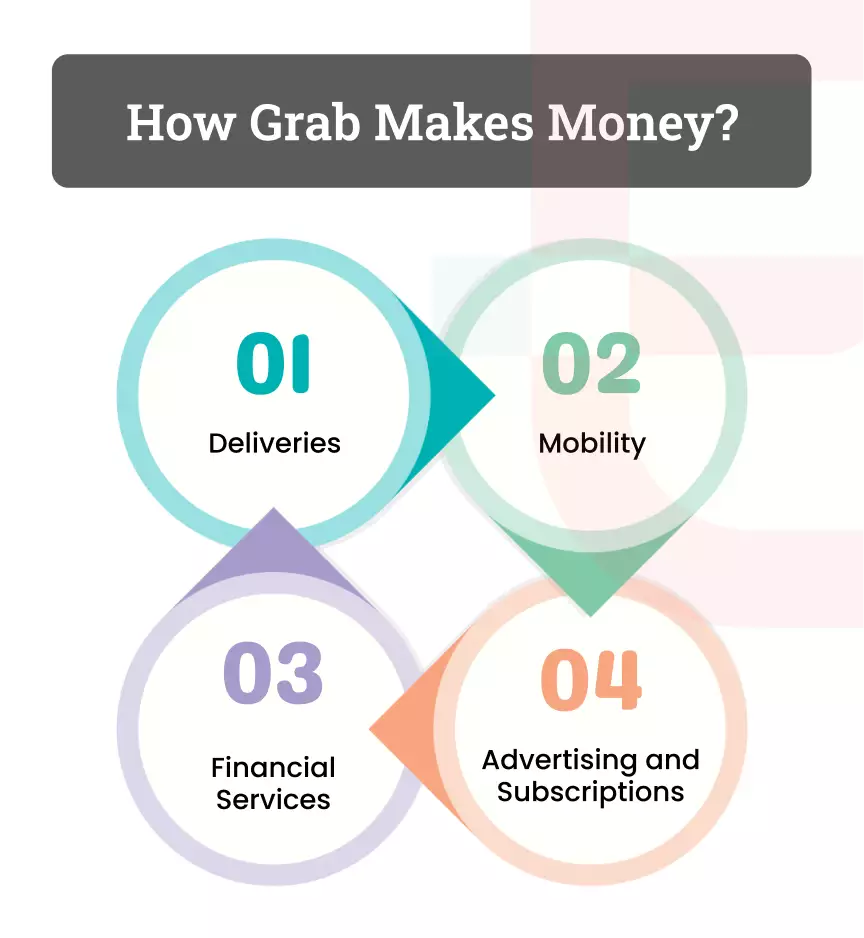
Grab generates revenue through multiple streams, which makes it one of the most profitable on-demand services in Southeast Asia. Here is the breakdown of how Grab makes money.
Deliveries
These services are considered to be Grab’s biggest revenue source. This segment includes GrabFood for restaurant orders, GrabMart for groceries, and GrabExpress for parcel delivery. Grab charges a set percentage of commission on each delivery order. The exact commission amount varies depending on the type of delivery service and city.
Mobility
This was exactly where Grab started its journey. It covers a wide range of on-demand transportation options like JustGrab for taxis and private cars, GrabHitch for carpooling, and GrabBike for motorbike rides. The platform generates revenue by charging ride commissions, booking fees, and surge pricing during peak demand.
Financial Services
Grab’s financial services are the fastest-growing and highest-margin revenue segment. It includes services such as the GrabPay digital wallet, lending services like loans, and “buy now, pay later” options through GrabFin.
Besides, it also includes partnerships with digital banks like GXS Bank and GX Bank, along with insurance offerings. The app makes money by charging transaction fees, interest rates on loans, and commissions on insurance policies.
Advertising & Subscriptions
Another major income source for Grab is advertising and subscription services. It involves the GrabAds platform, which charges a set amount from third-party businesses to promote their products and services to Grab’s larger user base.
Besides subscription plans, GrabUnlimited offers different perks to users, like free deliveries, discounts on rides, or priority services. In exchange, the platform charges a fixed monthly or annual fee. This creates a recurring income for Grab.
Challenges Faced by Grab
Despite being Southeast Asia’s leading super app, Grab faces several challenges in its operations, scalability, and profitability.
Intense Competition
Grab operates in a highly competitive market with strong rivals like Gojek, Foodpanda, AirAsia (Move), and more. This creates constant pressure on the brand to make powerful strategies to attract and retain users.
Profitability & Funding
Even though Grab generates high revenue, consistently gaining profits is still a big challenge for it. The company has to invest in expansion, technology, and promotions. Also, investors expect profitable returns. This puts pressure on the company to grow while ensuring profitability.
Service Quality & Driver Management
Grab relies on a huge network of drivers and delivery partners who are independent contractors. As a result, maintaining service quality becomes challenging for it. Issues like unprofessional behavior and delays can impact user experiences and brand reputation.
Operational Complexity
Managing multiple services like mobility, groceries, food delivery, and fintech at the same time requires strong logistics, smart resource allocation, and a smooth user experience. Inefficiency in any area can easily lead to negative consequences.
Differentiation
Another challenge for Grab is to stand out from other regional super apps offering similar services. This requires constant innovation. Without differentiation, users can easily switch to its competitors.
Future Outlook of Grab
Grab aims at strengthening its position and attaining long-term sustainability in SEA. Here’s how:
Achieving Sustained Profitability
The company is planning to expand its services and improve operational efficiency while keeping costs under control. It is looking forward to creating a financially sustainable business that can satisfy both its users and investors.
Expansion of Financial Services (Fintech)
Grab is heavily investing in its Grab Financial Group to make this segment profitable by the end of the second half of 2026. The company is strongly focusing on expanding digital banking, lending, and AI-based insurance products in Southeast Asia.
Advancement of Autonomous Vehicles (AVs)
The super app Grab is planning to integrate driverless technology in its ride-hailing network in 2026. For this, it has partnered with companies like WeRide, Motional, Momenta, and May Mobility.
Enhancing the super app Ecosystem & User Retention
Increasing user engagement and retention is Grab’s core focus in the coming years. For this, the company is continuously updating its app with new features, offers, and technologies like AI-powered personalization.
How Elluminati Can Help You Build a Super App Like Grab
The Grab business model proves that bringing multiple everyday services to one digital platform can drive successful growth. That’s why most businesses today are planning to build a similar platform like Grab to launch their multi-service business.
For this, Elluminati becomes your effective partner with 14+ years of building on-demand applications. Our Grab clone helps you launch faster with a ready-to-use platform. With advanced automation, scalable architecture, and powerful admin controls, our app makes it easy to manage and scale operations.
Instead of spending significant time and money on custom development, you get a proven solution that can be easily customized according to your needs and goals.
FAQs
Grab works as a multi-service digital platform that connects users with service providers. Customers place a request for any service like ride-hailing, groceries, or food delivery, and the platform matches them with nearby service providers.
Grab offers a wide range of everyday services like ride-hailing, grocery shopping, food delivery, and digital payments. It also offers financial services like money lending and insurance.
Grab’s main competitors include Gojek and Uber. Besides, local ride-hailing and delivery startups, like Foodpanda, operating in specific countries, are their local competitors.
The Grab revenue model is based on multiple income sources. It charges commissions on rides and deliveries, service fees from merchants, transaction fees from digital payments, and a fixed set fee from advertising and subscription plans like GrabUnlimited.
Grab is successful because of its strong focus on local market needs. Its hyperlocal strategy, partnerships with established and local brands, and continuous innovation have helped Grab acquire a huge user base in Southeast Asia.