Key Takeaways (or TL;DR)
- Gojek is an Indonesian super app that has the ability to serve multiple “daily needs” (transport, food, payments) within a single platform.
- Gojek’s growth journey highlights strategic funding, regional expansion, acquisitions, AI adoption, and the landmark merger with Tokopedia to form the GoTo Group.
- Gojek’s business model focuses on multiple services that connect customers, merchants, and drivers, maintaining sa upply-demand balance.
- Gojek makes money from commissions, service and delivery charges, advertising charges, fintech income (GoPay & BNPL), and subscriptions- having a multi-channel revenue model.
- Gojek successfully navigated regulatory hurdles, fierce competition, profitability pressure, driver unrest, scaling issues, and the pandemic through adaptability and ecosystem thinking.
- The company is prioritizing fintech centralization, AI-powered personalization, ad monetization, operational efficiency, and expansion into tier-2 and tier-3 cities.
The Gojek business model includes impactful strategies to offer multiple facilities within an app that successfully grabs a significant Indonesian market. It is a notable example of a decacorn and also known as a “super app” based in Jakarta, Indonesia, serving in over 180+ cities in multiple countries of Southeast Asia.
Gojek, in its starting years, wasn’t performing well enough. When it was launched, it wasn’t serving these many solutions like meals, rides, daily needs, couriers, etc. There is a lot more to know about this startup, inspiring entrepreneurs to build multi-service businesses. So, here is this article to discuss everything about it – how Gojek works, the business model of Gojek, revenue channels, and other important facts about it.
Gojek: The Super App That Shaped On-Demand Businesses
Gojek is a super app, a single mobile app that combines multiple services, including payments, e-commerce, ride-hailing, food delivery, and entertainment into one seamless user experience. One major benefit a user gets from the super app is that it eliminates the need to switch between various apps for different daily life purposes.
Gojek was built by Nadiem Makarim with Kevin Aluwi and Michaelangelo Moran in 2010, first as a ride-hailing company in Jakarta, Indonesia. It is the most treasured firm in Indonesia. Besides, it serves in the Philippines, Vietnam, Thailand, Malaysia, etc.
Gojek is a “one-stop shop” evolved to become one of the best examples of a super app in Southeast Asia.
- Started as a motorcycle taxi service
- Evolved to include 20+ services in one app
- Users can seamlessly switch between services without leaving the app
Why Gojek is a “Super App”:
- Convenience: Everything is accessible for users to get from one app
- Integrated Payments: Offers multiple payment modules work across all services
- Network Effect: Same drivers can provide rides, deliver food, or transport packages
- Daily Facility: Covers transportation, meals, shopping, payments, and services people need on daily basis
What Services does Gojek Offer?
The Gojek ecosystem is categorized into four main pillars:
1. Transport & Mobility
- GoRide: On-demand motorcycle taxi (ojek) hailing.
- GoCar: Private car-hailing services.
- GoBlueBird: Integrated booking for Blue Bird group taxis.
- GoTransit: Multi-modal trip planning and public transport ticket purchasing.
- GoCorp: Specialized mobility and expense management for corporate clients.
2. Food & Groceries
- GoFood: Southeast Asia’s leading food delivery service.
- GoMart: On-demand delivery from supermarkets and convenience stores.
- GoShop: A personal concierge service for shopping at any retail outlet.
- GoMed: Serving all medicines and vitamin needs from licensed pharmacies.
3. Logistics
- GoSend: Instant and same-day courier service for consumers and small businesses.
- GoBox: On-demand truck booking for moving large items or freight.
- GoSend API: B2B2C logistics solutions for e-commerce and business partners.
4. Financial Services (GoTo Financial)
While integrated into the Gojek app, these are often branded under the broader GoTo Financial umbrella:
- GoPay: A digital wallet for in-app payments, offline merchants, and bill payments.
- Pay Later: A “Buy Now, Pay Later” (BNPL) credit service.
- GoBiz: A specialized app for merchants to manage orders, payments, and business analytics.
- Moka: A point-of-sale (POS) system for physical retail businesses
- GoPulsa: to buy data or talktime, top-up on the go.
- GoGive: Platform to donate to what matters for lives.
- GoInvestasi: Offering service to invest smartly and save better.
- GoSure: A digital app allowing you to get valuable insurance.
5. Digital Needs
- GoFitness: Allows users to access exercises such as yoga, pilates, Pound Fit, barre, muay thai, and Zumba.
6. Business
- GoBiz: A merchant #SuperApp to run and grow business.
7. New and Entertainment
- GoTix: App to book a show digitally and skip the queue.
- GoPlay: A Gojek app to watch movies and series on a digital platform.
- GoPlay: For Gaming tips, trends, top-ups, and more.
- GoNews: Daily broadcasting top news from top aggregators
Important Facts and Figures of Gojek
Launch Years: 2010
Founders and Co-founders: Nadiem Makari, Kevin Aluwi, Michaelangelo Moran
Headquarters: Jakarta, Indonesia
Parent Company: PT GoTo Gojek Tokopedia
Funding Rounds: 11, spanning from Seed (2014) to Series F (2021)
Funding Amount: $4.72 billion to $5.3 billion (estimates vary slightly by source). It is now part of a public entity (GoTo Group), which had its IPO in 2022.
Number of Investors: 31 institutional investors. Key names include Google, Tencent, Temasek, KKR, Facebook (Meta), PayPal, and Mitsubishi.
Acquisitions: 13
Number of Investments: 19
Customer Base: 100 million monthly active users (MAU).
Source: (Crunchbase)
Growth History of Gojek
| Year | Key Milestone | Update and Impact |
| 2010 | Founding |
|
| 2014 | Seed Funding |
|
| 2015 | App Launch |
|
| 2016 | Unicorn Status |
|
| 2017 | Rapid Diversification |
|
| 2018 | Regional Expansion |
|
| 2019 | Decacorn Status |
|
| 2020 | Global Consolidation |
|
| 2021 | The Mega Merger |
|
| 2022 | Public Listing |
|
| 2023-2024 | Strategic Realignment |
|
| 2025 | AI Integration |
|
Source: Gojek
Ready to Launch Your Own Super App in Weeks? Get Our Readymade, Fully-Functional Platform With Scalable Strategy
How Gojek Works: Step-by-Step User Flow
Let us look at how Gojek works for user convenience offering a seamless user experience, even being a multi-service app
1. Gojek for Customers
- Users open the app and select from services (e.g., GoRide for transport, GoFood for food, or GoSend for logistics)
- They can enter their order and user details. They pay via GoPay (digital wallet), credit card, or cash.
- Once a service provider is assigned, they can track their location in real time on a map and can communicate via in-app chat.
- After completion, users give feedback and can tip the service provider directly through the app.
2. Gojek for Merchants (The Fulfillment)
- Merchants can register via the GoBiz app, uploading their documents, menu/catalog and verifying their bank details for payouts.
- They receive instant notifications of new bookings. They choose to “Accept” and prepare the order and assign it to the driver when they arrive.
- Payments are handled within the app. It deducts a commission, and the net profit is settled into the merchant’s account (usually the next day).
- Merchants use the dashboard to create “flash sales,” set promo codes, and analyze sales data to grow their business.
3. Gojek for Drivers (Taxi and Delivery)
- Drivers sign up, submit background documents (ID, License, Vehicle Reg), and undergo a verification process.
- Drivers toggle their status to “Online.” When a request pops up, they see the estimated fare/distance and hit “Accept.”
- The app provides integrated GPS navigation to the pickup point and then to the final destination.
- Drivers see their daily earnings and performance points in real-time. High ratings help them unlock better incentives and priority for orders.
Gojek Business Model Canvas
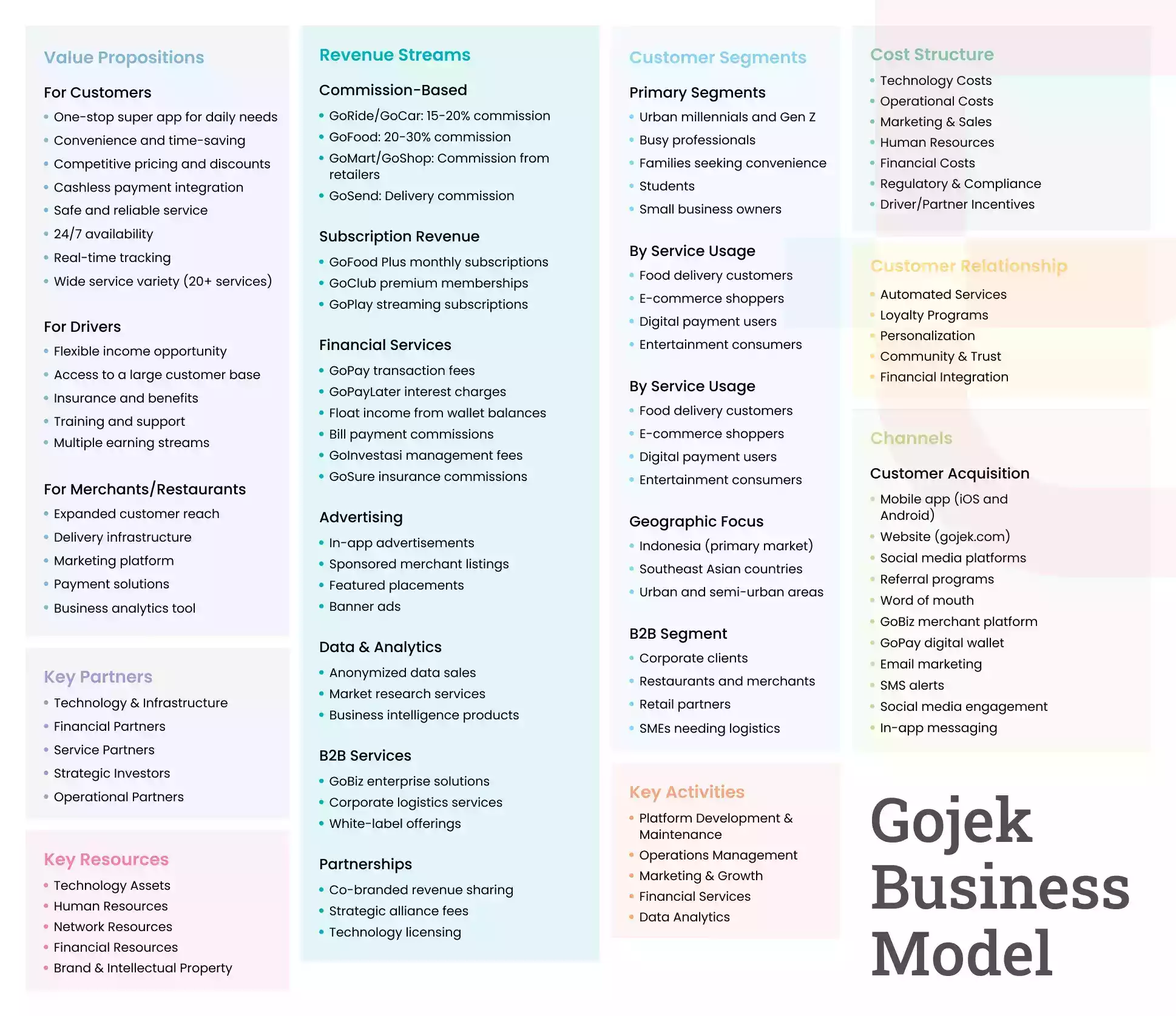
Gojek is a multiple amenity company, and its business model consists of three sectors of a marketplace: customers, merchants, and agents for delivery and rides.
Gojek Key Stakeholders
The collaboration with Bluebird, Tokopedia, was also a remarkable step for the organization, opening the doors for numerous opportunities. Today, it has multiple partners as listed down:
- Gojek has fund raisers like Google, PayPal, Visa, Banks, Meta, Telkomsel, etc.
- Drivers who provide delivery services, rides, and other shipping facilities
- Service providers who offer multiple services
- Transportation companies, merchants, service providers, third-party payment handlers, and online medical companies
- The Indonesian Government is supporting Gojek for two-wheel EV transportation in the country
Value Propositions of Gojek
Value Proposition for Customers
Gojek smoothens to get served for daily needs in a single app. By combining this convenience with secure GPS tracking and seamless payment tools, it provides a trustworthy, all-in-one lifestyle ecosystem that saves time and promotes financial inclusion.
Value Proposition for Drivers
It serves as a bridge to the formal economy and long-term financial stability for driver partners. Through a constant stream of demand and the Gojek Swadaya program, partners gain access to performance incentives, health insurance, and specialized loans, transforming their vehicles into sustainable livelihoods with a built-in social safety net.
Value Proposition for Merchants
Gojek empowers merchants by providing instant access to millions of users through the GoBiz platform. Handling “last-mile” logistics and sales analytics, it helps local vendors scale and handle digital payments without the overhead of private delivery fleets or marketing costs.
Customer Segments of Gojek
- Users: Users who need quick, affordable transportation, food delivery, online payment solutions, and on-demand services through a single interface.
- Drivers / Service Providers: Individuals owning bikes or cars who want flexible income opportunities.
- Merchants/Businesses: Restaurants, grocery stores, and local businesses looking to reach a wider digital customer base.
Customer Relationships
In-app Customer Support
- Allows an all-time customer help center within the app
- Solves problems with chat support, FAQs, and the ticket system
- Quick assistance for order issues, payments, or service complaints
Loyalty Programs like Points and Rewards
- Users earn points (GoPoints) for every transaction
- Points come with different values for users, such as discounts on future rides, food orders, or other services
- Encourages repeat usage across all Gojek services
GoClub Loyalty Program
- Tiered membership system (Bronze, Silver, Gold, Platinum)
- Higher tiers unlock exclusive perks like bigger discounts, priority support, and special deals
GoFood Plus Subscription
- Monthly subscription service for frequent food delivery users
- Provides unlimited free delivery and exclusive restaurant discounts
- Converts occasional users into committed, regular customers
Discounts, Promos, and Offers
- Regular promotional campaigns and flash deals
- Vouchers and discount codes for first-time users and retention
- Seasonal offers to drive usage during specific periods
Ratings and Review Systems to Build Trust
- Two-way rating system: customers rate drivers/merchants, drivers rate customers
- Builds accountability and trust in the platform
- Reviews help users make informed choices about restaurants and services
- Maintains quality standards across the network
GoPay Digital Wallet
The integrated payment system creates seamless, cashless experiences across all services.
- GoPay Coins offers cashback rewards, auto-pay options for subscriptions, split payment capabilities for group orders,
- GoPay Later offers buy now, pay later functionality increases switching costs and platform stickiness.
Personalization & AI-Driven Engagement
- It provides personalized food and service recommendations that make each user’s experience feel unique and relevant.
- Daily challenges to earn extra points, streak rewards for consecutive usage, and achievement badges create an engaging, game-like experience that encourages habitual platform use.
Community Building & Social Features
- GoFood allows users to share favorite restaurants with friends, order in groups, and social proof creates a community-oriented experience that goes beyond transactional relationships.
- Gojek fosters communities among its supply-side partners through forums, support networks, and regular engagement, recognizing that driver and merchant satisfaction directly impacts customer experience.
GoPlay Entertainment
The streaming service offering movies, series, and original content increases time spent within the Gojek ecosystem and creates emotional connections beyond utilitarian service usage.
GoMed Healthcare Services
Telemedicine consultations, medicine delivery, and health information resources position Gojek as a partner in users’ wellbeing, deepening the relationship beyond convenience services.
GoBiz for Merchants
A separate application providing business partners with order management tools, analytics dashboards, and promotional capabilities creates strong B2B relationships that complement the B2C customer experience.
Gojek Revenue Model: Understanding How it Makes Money?
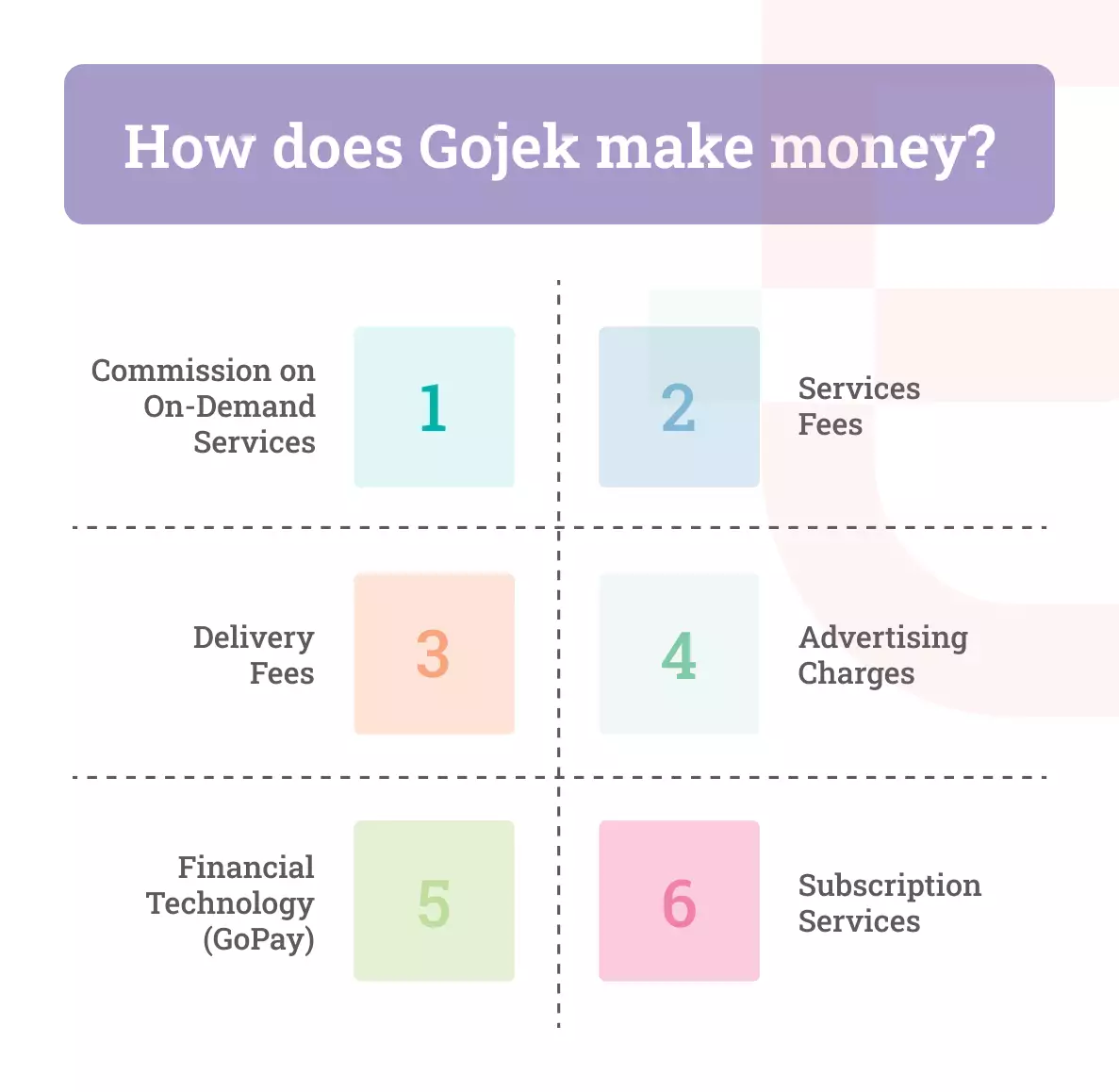
Gojek’s revenue generation strategies are impressive, managing to reach new heights in competitive markets with its workflow. Here is how Gojek makes money:
Commission on On-Demand Services
Gojek has a wide list of features allowed to consumers in return for a significant amount. When any service is completed from the app, an amount is reserved for Gojek, which serves as their charge for the facility. For example:
- GoRide/GoCar: Commission (15-20%) on each ride from driver earnings
- GoFood: Commission (20-30%) from restaurants on each order
- GoMart/GoShop: Commission from retail partners on delivered items
- GoSend: Commission on courier and delivery services
Services Fees
- Booking fees are charged to customers on top of base fares
- Platform fees for using certain services
- Surge pricing during peak hours (dynamic pricing)
Delivery Fees
- Charged to customers for GoFood, GoMart deliveries
- Distance-based and time-based delivery charges
- Express delivery premium fees
Advertising Charges
With a huge user base on the app, Gojek does cross-platform advertising and merchant-funded promotions within its delivery services. The company earns from:
- In-app advertisements and promotional banners
- Sponsored restaurant listings and featured placements
- Banner ads on the home screen and service pages
- Promoted merchant positions in search results
Financial Technology (GoPay)
Gojek has multiple revenue streams from its financial services, some of which are:
- GoPay Transaction Fees: Fees on merchant transactions
- GoPayLater Interest: Interest on credit/installment payments
- Float Income: Interest earned on GoPay wallet balances
- Bill Payment Commissions: Fees from utility and service providers
Subscription Services
- GoFood Plus: Monthly subscription for unlimited free delivery
- GoClub Premium Tiers: Paid memberships for exclusive benefits
- GoPlay: Streaming service subscription fees
Cost Structure of Gojek
1. Technology & Infrastructure Costs
Gojek, being a super app, has to invest heavily in maintaining the platform, including
- Cloud hosting services (likely AWS or Google Cloud)
- Server infrastructure to handle millions of daily transactions
- Payment processing systems
- GPS and mapping technologies
- Cybersecurity measures
- Costs for app maintenance, bug fixes, data storage,
In 2025, GoTo completed cloud migration, expected to cut annual cloud expenses by 50%+. This was a major driver of profitability gains.
2. Marketing & Customer Acquisition
Gojek spends significantly on brilliant marketing strategies, brand awareness campaigns, TV and digital advertising, social media marketing, and promotional offers to engage new users. Besides that, customer acquisition costs include
- Referral bonuses
- First-ride discounts
- Cashback promotions
- Partnership deals with merchants
3. Driver & Partner Incentives
Gojel’s major cost component involves
- Incentivizing drivers and service providers through bonuses
- Guaranteed minimum earnings during low-demand periods
- Fuel subsidies
- Insurance coverage
- Performance-based rewards
Gojek also provides training programs, equipment subsidies (like helmets or phone mounts), and runs loyalty programs to retain quality drivers and service providers.
4. Operational Support & Staff
Gojek employs thousands of people for customer service centers, driver support teams, merchant relationship management, local operations in different cities, safety and compliance teams, and administrative staff.
It includes costs of salaries, office space, call center infrastructure, and on-ground teams who handle driver onboarding, verify documents, resolve disputes, and manage day-to-day operations across their multi-service platform.
5. R&D & Product Development
The company invests in software engineers, data scientists, UX/UI designers, and product managers who continuously develop new features, optimize algorithms, core features, and workflow.
R&D costs also cover AI and machine learning development for demand forecasting, fraud detection, personalization engines, and innovation labs exploring future technologies like electric vehicles or autonomous delivery solutions.
Save Heavy Technology Investment With Our Prebuilt App like Gojek Which, Not Just a Code Script
Challenges Gojek Faces
Gojek’s journey to becoming a “Super App” has been far from easy. The challenges it faced can be categorized into four key areas: operational, competitive, regulatory, and recent structural shifts.
1. Legal & Regulatory Gray Areas
Motorbikes weren’t legally recognized as taxis, leading to police crackdowns and local bans in the country. For that issue, Gojek lobbied the government to write new laws, eventually turning the platform into a “National Champion”.
2. Fierce Competition (Uber & Grab)
Competitors were trying to “buy” the market with massive discounts, making it difficult to retain customers. By offering food and payments, they became so useful for everyday use that customers stayed even without the cheapest ride.
3. Path to Profitability
The company was losing too much money on subsidies given to drivers and multiple non-essential services. They merged with Tokopedia to share resources and shut down unpopular services to focus on things that actually make money, like digital banking.
4. Driver Unrest & Strikes
Drivers were angry about lower bonuses and higher costs (fuel/maintenance). Instead of just giving cash, Gojek provided “Swadaya”– a benefits program that gives drivers cheaper health insurance, fuel, and better loan options.
5. Technology Scaling
The app was “breaking” because too many people were using it at once. They hired a world-class engineering team to restructure the app’s “brain,” so it could handle millions of orders without crashing.
Future Roadmap: What’s Next for Gojek?
Multi-service applications are widely accepted and are thriving in the on-demand industry market anywhere around the world, and are getting much more popular due to an increase in demand among users. Innovation plays a major role in businesses nowadays, which also leads to exciting trends in the multi-service platform.
Fintech Centralization
Gojek is positioning GoPay and its financial services as the central nervous system of its ecosystem. With this, Gojek can capture more value from each transaction, retain users through financial lock-in, and tap into Southeast Asia’s massive underbanked population.
AI-Driven Hyper-Personalization
Gojek is leveraging AI and machine learning to create personalized experiences for each user. It offers personalized service recommendations, customized promotions and discounts, dynamic pricing tailored to individual willingness to pay, optimized food suggestions based on past orders and time of day, and predictive features that anticipate user needs before they even search.
Operational Efficiency & Ad Monetization
Gojek started maximizing profitability through operational excellence and new revenue streams. This includes optimizing driver routes and reducing idle time, implementing automated customer service through chatbots, and streamlining backend operations to reduce costs. Simultaneously, Gojek is building an advertising business within its app, creating high-margin revenue similar to how Google and Amazon monetize their platforms.
Tier-2 City Penetration
Gojek is also now focusing on smaller expanding services to tier-2 and tier-3 cities where smartphone adoption is growing, the middle class is expanding, and competition is less intense. It will increase Gojek’s total addressable market significantly while establishing an early-mover advantage before competitors arrive.
How Elluminati can Help you Build a Super App like Gojek
Gojek’s business model has enabled entrepreneurs to open several gates for startup ideas, enabling them to forge success in unique ways. The firm has multiple wings of facilities like meal orders, ride-hailing, logistics, digital money transfer, automobiles, and several others.
It showcases how technology can democratize access to services. If you want to enter the multi-service industry with strong technology, we are ready to help you with our prebuilt Gojek clone script. You can launch the business, eliminating the hefty investments and long development phases.
Our readymade solutions are feature-packed, which are tested to work in real-world scenarios without any technology drawbacks initially and even in the future. Partner with us and get industry expertise around the globe.
FAQs
Gojek is an Indonesian super app offering users access to a unified ecosystem offering multiple services like ride-hailing, food delivery, bill payments, parcel delivery, entertainment, house cleaning, and many more.
Gojek uses a diversified commission-based model:
- It takes a 10%-20% commission from every transaction (rides, food orders, or deliveries).
- Small flat fees are charged to consumers for any service orders and platform usage.
- Transaction fees on GoPay and interest from “PayLater” or lending services via Bank Jago.
- Merchants pay for “GoBiz” ads to appear higher in search results.
As of 2026, Gojek offers over 20 services grouped into three main categories:
- Mobility: GoRide (motorbikes), GoCar, GoBlueBird (taxis), and GoTransit (public transport planning).
- On-Demand: GoFood (meals), GoMart (groceries), GoSend (parcels), and GoMed (medicine).
- Fintech: GoPay (wallet), GoPayLater (credit), and various insurance/investment products.
The cost to develop an app like Gojek ranges from $3,000 to $300,000. This wide range depends on various factors, like development stages, such as MVP, mid-level, and enterprise-grade. Moreover, cost also depends on the features integrated, the technologies used, third-party integrations, and many more.