Key Takeaways (or TL;DR)
- Glovo is a leading quick commerce application operating in Europe, Central Asia, and Africa.
- The Glovo business model is a multi-category delivery strategy that connects customers with nearby local businesses for quick delivery of meals, groceries, and household items.
- Glovo follows a simple workflow where customers order items on the application, merchants receive orders, prepare them, and delivery partners deliver them to customers’ doorsteps.
- The Glovo revenue model generates income from multiple channels like restaurant commissions, subscriptions, delivery and service charges, and their own dark stores.
- In the future, Glovo desires to strengthen its position in the market through expansions, AI technology inclusion, and following environmentally friendly practices.
The Glovo business model operates on a multi-category delivery approach, connecting customers with local vendors and delivery providers via a digital platform. It stands out by focusing on delivering meals, groceries, and other household goods quickly, within just a few minutes to customers’ locations.
By studying the model, entrepreneurs get a clear idea about how a digital platform can help in running and handling quick commerce operations efficiently while generating revenue through diverse ways.
This article will give you complete knowledge about how Glovo works, its business model, revenue strategies, and future outlook, so you can plan your business effectively with a similar approach.
What is Glovo?
Glovo is a quick-commerce platform that allows customers to order food, groceries, pharmacy items, and more from the comfort of their home. It was launched in 2015 by Oscar Pierre and Sacha Michaud in Barcelona.
A Glimpse of Glovo’s Successful Journey
Glovo’s idea was inspired by Uber and the Postmates business model, which Pierre observed in the US as the on-demand gig economy rose. Initially, it was launched as an “Order Anything” platform.
Company Overview
Founded in:2015
Industry:Delivery services
Headquarters: Barcelona, Spain
Founders:Oscar Pierre, Sacha Michaud
However, it soon became a quick-commerce giant across Europe, Asia, and Africa by expanding its product categories and delivering items in just a few minutes.
Fast forward to today, Glovo operates in 23 countries, with a network of 120,000 delivery providers and 150,000 store partners. Witnessing its huge potential and success, Delivery Hero acquired Glovo’s operations in Latin America for up to EUR 230 million.
Now, let’s have a look at Glovo’s success journey over the years.
Success Timeline of Glovo
The rise of Glovo is linked to the rapidly growing quick-commerce industry. In fact, the global Q-commerce market size is expected to grow to US$385.36 billion by 2034 at a CAGR of 8.55% over the forecast period 2026-2034.
This growth will be driven by increasing demand for convenient delivery solutions among customers. Moreover, it also shows why businesses are opting for multi-category delivery models.
2015:
- Glovo was launched in the Spanish cities such as Barcelona, Madrid, and Valencia by Oscar Pierre and Sacha Michaud
- Later, it extended its reach to Italy.
2016:
- The company officially launched its food delivery service within the app, listing local restaurants in Barcelona, Madrid, and Valencia.
2017:
- Glovo signed an exclusive delivery partnership with McDonald’s in different Spanish and Italian cities to grow its food delivery operations.
2018:
- The firm introduced grocery and pharmacy delivery categories in the app.
- It started partnering with different local supermarkets and pharmacy stores to strengthen its operations.
2020:
- Glovo entered the quick commerce market by launching its own dark stores and building partnerships with retail brands like Unilever, Nestle, and L’Oréal, as well as supermarket chains like Walmart and Carrefour.
- It sold its Latin American operations to Delivery Hero for €230 million.
2021:
- Created the new Courier’s Pledge initiative to establish clearer pay structures and social rights for its courier delivery partners.
2024:
- Glovo expanded its partnership with Mars in Europe, Central Asia, and Africa after it achieved 50% growth in Mars products on its app within 1 year.
2025:
- The company redesigned its app to create personalized customer experiences, adding an AI-powered gifting assistant that suggests gifts based on the occasion.
Glovo’s Funding Insights
|
Date |
Investor |
Amount |
Fund Type |
|
2016 |
Entree Capital, Caixa Capital Risc, Seaya Ventures, Bonsai Venture Capital SCR, Antai Venture Builder, Javier Sanchez-Marco |
$5.6m |
Series A |
|
2017 |
Rakuten, Entree Capital, Caixa Capital Risc, Seaya Ventures, Cathay Innovation, Bonsai Venture Capital SCR |
$35.3m |
Series B |
|
2018 |
Rakuten, Seaya, Cathay, AmRest |
$134m |
Series C |
|
2019 |
Lakestar, Idinvest Partners, Dharmash Mistry, Korelya Capital, The Drake Group |
$169m |
Series D |
|
2019 |
Lakestar, Idinvest, Mubadala, Drake Enterprises |
$166.9m |
Series E |
|
2021 |
Luxor Capital Group, Delivery Hero, GP BullHound, Drake Enterprises, Lugard Road Capital |
$528.7m |
Series F |
Source: Crunchbase
Understanding the Glovo Business Model
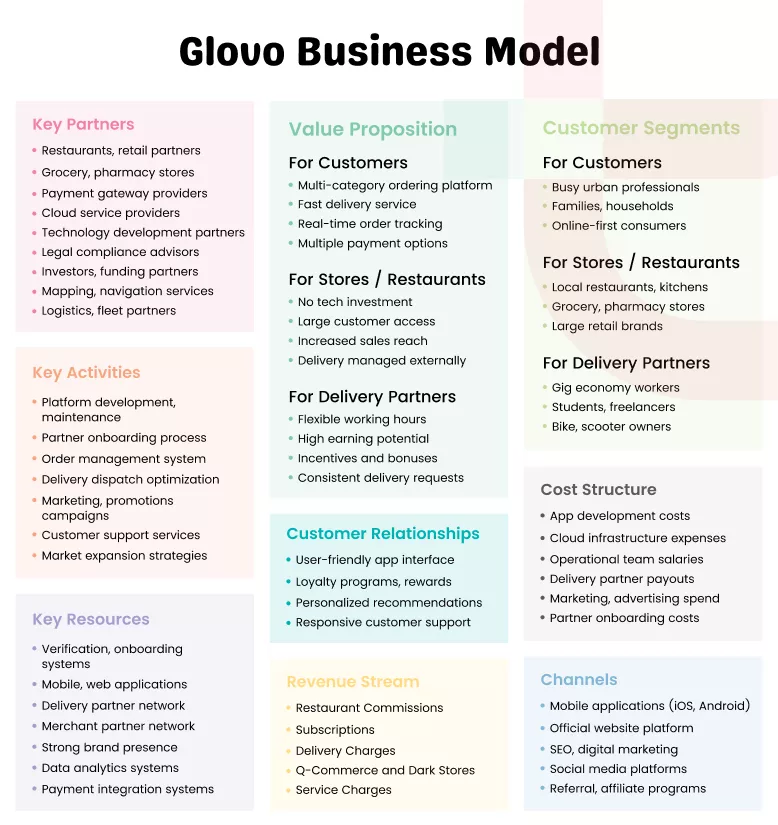
The Glovo business model operates on a three-sided marketplace approach, which brings together customers, service providers (restaurants and retailers), and delivery partners through a mobile application. Let’s have a detailed look at the key aspects of the model.
Value Proposition
For Customers:
- They can order meals, groceries, pharmacy items, and more from a single app.
- Customers get items delivered faster, often within 15 to 30 minutes.
- They can track the status of their ordered items from within the app in real time.
- They can pay according to their preferences with multiple payment options.
For Stores / Restaurants:
- Can sell online without needing to have their own technological infrastructure.
- Get access to a large customer base that helps increase sales.
- They do not need to own or manage a delivery infrastructure as Glovo handles the delivery operations.
For Delivery Partners:
- They get the flexibility to operate at their preferred time.
- Glovo’s large user base creates strong income opportunities for delivery providers.
- Incentives and bonuses increase overall earnings.
Key Partners
- Reliable technology provider to build and maintain the digital platform.
- Businesses like local restaurants, supermarkets, and retail chains need to enable online delivery.
- Payment gateway providers for secure online transactions within the app.
- Cloud service providers need to ensure future scalability with ease.
- Legal advisors help ensure compliance with local rules and regulations.
- Investors to provide funding for scaling operations and technological enhancements.
- Mapping and navigation partners like Google Maps and Mapbox for smart route optimization.
- Logistics and fleet operators to conduct delivery operations.
Key Activities
- Building and maintaining its technology platform to receive online orders.
- Continues to onboard new service providers to expand its network.
- Conducting marketing and promotional campaigns to attract new customers and retain existing ones.
- Expanding services to new locations.
- 24/7 customer support to provide quick resolution to user queries and disputes.
Key Resources
- Mobile and web applications to conduct online operations.
- A strong network of local businesses and delivery partners to fulfill orders quickly and efficiently.
- Strong brand presence to attract new customers and retain the existing ones.
- Data analytics tools for smart route optimization, navigation, and delivering personalized experiences to customers.
- Verification systems are used to onboard delivery partners and merchant companies for reliable operations.
- Integration of multiple payment processors to allow online transactions within the platform.
Customer Segment
Customers:
- Busy professionals who cannot travel to restaurants or supermarkets due to hectic routines.
- Families who need delivery of groceries, medicines, or other household essentials.
- People who prefer ordering meals and household goods online rather than visiting them physically.
Stores / Restaurants:
- Grocery stores and pharmacies want to offer their services online.
- Local restaurants and cloud kitchens want to increase their order volume.
- Large retail brands want to extend their brand reach and serve more customers.
Delivery Partners:
- Individuals with bikes or scooters who want to offer delivery services.
- Gig workers are looking for additional income opportunities.
- People who want to work on flexible schedules.
Customer Relationships
- The platform’s intuitive design makes the online order process easy and smooth.
- Loyalty programs and rewards encourage customers to use the app frequently.
- Strong customer support ensures faster query resolution, thereby enhancing the overall user experience.
- Personalized product suggestions enhance the customer experience.
Cost Structure
- Development and maintenance of dedicated platforms for customers, providers, and delivery partners.
- Cloud hosting and infrastructure expenses.
- Spending on operational and administrative teams for daily functioning.
- Incentives and payouts of delivery partners.
- Conducting marketing campaigns to reach new customers.
Channels
- Web and mobile applications to build a strong online presence.
- Digital marketing methods like SEO (Search Engine Optimization), Google Ads, and social media platforms are used to drive traffic online.
- Referral programs help in extending the user base while building brand credibility.
Launch Your Quick Commerce Business Quickly with Elluminati’s Proven Strategies and Market-Tested Glovo Clone
How does Glovo work?
Glovo follows a straightforward working approach. Customers order items from the app; restaurants or stores receive the order; and Glovo’s delivery partners deliver it to the customer’s doorstep. Here is a detailed glimpse of how Glovo works.
- The customer logs in to the app, enters their location, and browses product categories such as food, groceries, pharmacies, and more.
- After selecting their desired items, the customer places the order by choosing their preferred payment method, such as cards, digital wallets, or cash on delivery.
- Once order confirmation is received, the specific restaurant or store receives the order request. They can accept the request and start preparing for it.
- After the order is ready for delivery, the service provider notifies the app, and the platform finds and assigns the nearest available delivery partner.
- The delivery partner then collects the order from the provider and delivers it to the customer’s location using optimized routes provided by the app’s GPS system.
- The customer can track the order in real time within the app. They even receive information like delivery provider details and estimated arrival time in the app.
- Finally, the customer receives the order and is asked to rate their experience and provide feedback.
Glovo Revenue Model: Detailed Insights About Its Monetization Strategies
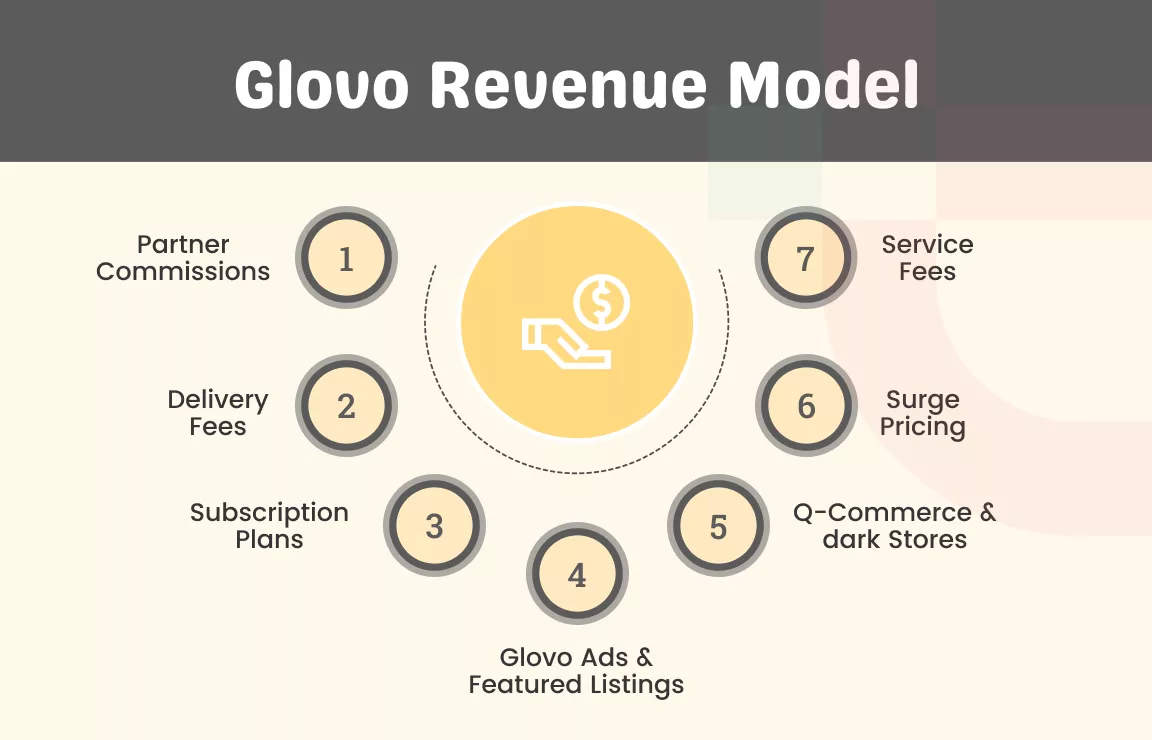
The Glovo revenue model involves multiple sources like commissions, subscriptions, delivery fees, and more. Let’s understand in detail how Glovo makes money.
Restaurant Commissions
This is the primary revenue source of Glovo, where the platform charges a set percentage of commission from restaurants and stores for each order received through the platform. The commission percentage ranges from 15% to 35%, depending on the order value.
Subscription Plans (Glovo Prime)
Glovo Prime is the platform’s primary source of stable income, where customers pay a set recurring fee on a monthly or annual basis to access benefits such as special discounts and free delivery. The exclusive benefits help encourage customers to use the platform more frequently.
Delivery Charges from Customers
The platform charges its customers a substantial fee to deliver the ordered items to their locations. However, these charges are not fixed. They vary depending on the distance between the store and the customer’s location, order type, and time of day. The delivery charges help the platform cover logistics costs.
Surge Pricing
During peak periods or high demand, the platform increases delivery charges to encourage delivery partners to continue providing services. This helps the platform meet service demand and also earn more.
Glovo Ads and Featured Listings
The platform charges partnered restaurants and stores a fee to appear at the top of search results, and also promotes their services in the app’s banner ads through Glovo Ads. Several businesses benefited from Glovo Ads, which include Burger Van, Krispy Kreme, Healthy Poke, and more
This revenue stream creates a win-win situation for both partnered businesses and Glovo. Partnered businesses can easily attract more customers, and Glovo can create an additional income stream.
Quick Commerce and Dark Stores
Glovo owns its own dark stores for groceries and other household essentials. This allows it to deliver ultra-fast through its delivery network, enhancing the overall customer experience and brand reputation.
Moreover, it allows it to earn higher profit margins than the commission it would receive from the partner store.
Service Charges
The company charges a small service fee to customers when they place an order in the app. These fees help Glovo cover the platform’s operational and maintenance costs. Though these fees are extremely small per order, they add up significantly given the app’s larger user base.
Want to Start Your Quick-Commerce Business Quickly and Efficiently? Partner with Elluminati for Strategic Guidance and Market-Tested Solution
Glovo’s Future Growth Strategies to Lead the Quick Commerce Market
As the quick-commerce market continues to evolve, Glovo is adapting to new strategies to stay competitive, meet changing customer demands, and improve operational efficiency.
Q-Commerce and Category Expansion
As the on-demand delivery market becomes increasingly competitive, Glovo is making efforts to stand out through its quick commerce services.
To this end, it is expanding service categories beyond meal and grocery delivery to include non-food items such as pharmacy, fashion, and beauty. Besides, the company’s partnerships with larger retail chains like Unilever and Carrefour highlight its strong focus on strengthening its Q-commerce services.
Focusing on Profitability
Glovo is now focusing on increasing its profitability by optimizing its operations and cost structure rather than simply expanding faster.
While the company is generating revenue from multiple streams, its current strategy is to reduce operational costs to strengthen its financial position. It has exited many unprofitable markets, such as Egypt and Ghana, to focus solely on improving margins.
Besides, the company is using smart technology to optimize routes, reduce delays, and control logistics expenses. This approach shows that Glovo is moving toward long-term, stable growth.
Using AI Technology
Today, AI in last-mile delivery plays a crucial role in improving delivery speed while reducing operational costs. Glovo is also using the technology to optimize delivery routes and predict demand, enabling it to plan delivery operations in advance.
In 2024, Glovo introduced social media features in the app. Customers could create a list of their favorite restaurants and meals using “Picks,” and the “Discovery Wall” showed them trendy restaurants and dishes based on what other users are ordering in their city.
This shows how the app plans to go beyond a mere transactional app and enhance the customer experience in every possible way.
Taking Sustainability Initiatives
In its delivery segment, which contributes to greenhouse gas emissions, Glovo has been taking measures to promote environmental sustainability. Since 2021, it has been neutralizing 100% of its footprint.
It plans to operate all its offices with renewable energy sources by 2030. Also, the company has opted for sustainable packaging instead of single-use plastic. Moreover, they are encouraging their delivery partners to use EVs more.
Besides, they are bundling orders to consolidate multiple orders through a single delivery trip. Implementing environmentally friendly strategies also helps Glovo attract eco-conscious customers with ease.
Lessons and Opportunities for Entrepreneurs
The Glovo business model shows that the success of a quick-commerce platform depends not only on delivering items. It also relies on smartly connecting customers, businesses, and delivery partners while ensuring faster deliveries.
By implementing the right strategies, entrepreneurs can easily grow and sustain their multi-category business in the competitive space. Below are the key lessons that Glovo teaches entrepreneurs:
- Focus on delivering items faster
- Build strong partnerships with local restaurants and stores
- Initially, start small and gradually expand to new categories after attaining success
- Use smart technology to streamline operations and boost overall efficiency
Implementation of these strategies not only helps businesses enter the market effectively but also provides access to long-term growth.
How Elluminati Can Help You Build an App Like Glovo?
The Glovo business model is built around connecting customers, businesses, and delivery partners through a digital platform, enabling faster deliveries and multiple revenue streams. By understanding these strategies, you can learn how a platform can handle operations and growth efficiently.
If you are considering launching a quick commerce business with a similar approach, then Elluminati becomes your reliable technology partner through its Glovo clone. As a white-label, market-tested solution, it allows businesses to enter the quick-commerce market quickly and streamline daily operations without encountering technical complexities.
FAQs
Glovo follows a simple operating approach.
- Customers log in to the app, enter their location, select items, and place the order.
- Restaurants or stores receive an order, accept the request, and start preparing it.
- Once the order is packed, the system assigns the nearest available delivery partner for quick delivery.
The Glovo revenue model generates income from multiple streams. It includes:
- Restaurant commissions
- Delivery charges from customers
- Glovo Prime subscription
- In-app advertising and featured listings
- Through its own dark stores
- Service fees
It currently operates in 23 countries across Europe, Africa, and Central Asia.
The platform provides quick commerce services for meals, groceries, pharmacies, electronics, and more.