Key Takeaways (or TL;DR)
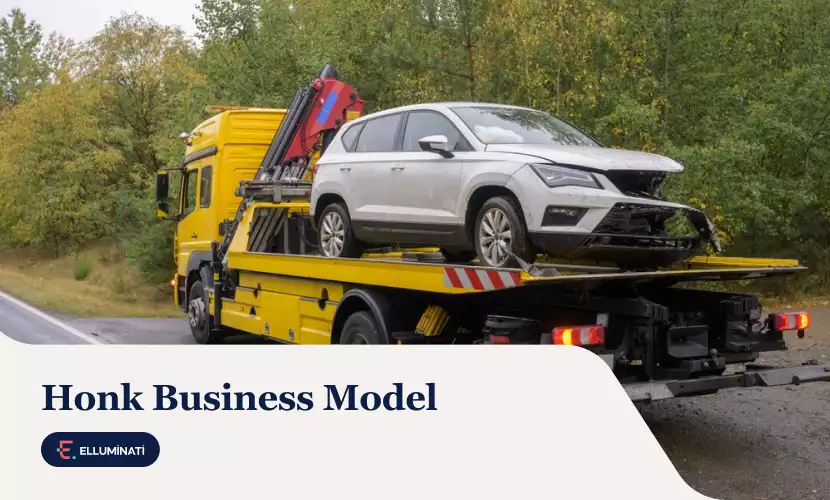
- Honk is a leading on-demand road assistance platform that connects users with nearby service providers through a mobile app.
- The Honk business model operates on a pay-per-use system that allows users to request services related to towing and roadside assistance as needed.
- Users can request services, choose the nearby service provider, and pay online after service completion.
- Honk revenue sources include service charges, waiting fees, partnerships, and solutions like accident data services.
- The cost to build an app like Honk depends on different factors, like feature complexity and development timeline.
Honk is a leading on-demand road assistance platform that connects users with nearby service providers.
With services like towing, fuel delivery, tire changes, and lockout assistance, Honk makes roadside assistance quick and convenient for car owners. It has been successful in North America because of its unique business model and multiple revenue-generating sources.
That’s why, for businesses considering entering the road assistance market, studying the Honk business model becomes very helpful. This article will tell you in detail about how Honk works, its business model, and revenue sources.
Honk History Timeline: Stepping Towards Success
With the increasing adoption of on-demand services, the roadside assistance industry has witnessed a lot of evolution in recent years.
According to a recent survey by Mordor Intelligence, the global roadside assistance market is expected to grow from $32.8 billion in 2026 to $41.33 billion in 2031 at a 4.73% CAGR. And platforms like Honk are considered to be the major players in this growing market.
In 2014, the introduction of Honk brought a turning point for the towing and roadside assistance services. Instead of relying on phone-based roadside assistance services, Honk provided a digital platform that allowed users to request help, track services in real time, and get instant support whenever they need it.
Since its inception, Honk has partnered with several insurance and automotive companies like Vault, Farmers Insurance Group, Spiffy, and Smartrac to include roadside assistance programs, vehicle logistics, towing, and transportation services to its users.
Today, it operates as one of the leading on-demand road assistance platforms in North America with a network of over 108,000 service vehicles nationwide. It is also a member of two popular organizations, the Towing and Recovery Association of America and the Women of the Towing and Recovery Association of America.
Exciting Facts and Figures About Honk Business
As discussed earlier, Honk is a popular roadside assistance and towing service provider. It’s also important for you to have an insight into its facts and figures, given below;
Founded in : 2014
Founder : Corey Brundage
Headquarters : Los Angeles
Total Funding : $31.8M
Latest Funding Round : On June 26, 2018
Honk Funding Insights
|
Year |
Funding Type |
Amount |
Investors |
|
June 26, 2018 |
Series B |
$18 million |
Altpoint Ventures |
|
March 26, 2015 |
Series A |
$12 million |
Altpoint Ventures |
|
November 19, 2014 |
Seed Round |
$1.8 million |
– |
Source : Crunchbase
Honk Business Model Explained

The Honk business model operates on a platform-based approach that connects drivers in need of roadside assistance with nearby service providers through a mobile app. Let’s have a quick look at the key elements of Honk’s business model.
Value Proposition
Honk creates value by connecting users with reliable roadside assistance providers through a digital platform.
For Users
- Easily connect with nearby service providers through an app.
- With the help of the app, users are easily able to connect with the providers.
- Quickly able to book their services
- Get multiple payment options
- Affordable price and transparent pricing
For Service Providers:
- An additional income source for part-time or freelancing operators.
- Flexible working hours
- Access to a large customer base without investing any effort in marketing
Key Activities
Honk’s activities focus on ensuring smooth operations.
- Handling the daily business operations and managing every basic requirement in the business
- Regularly updating the app with the latest features to deliver a better user experience.
- Creating a strong partnership with experienced service providers.
- Ensuring smooth and secure online transactions for its users.
Key Resources
The platform relies on several resources to operate effectively.
- Mobile and web apps for users and service providers.
- Backend systems to handle administrative operations.
- Strong network of reliable service providers.
- Data analytics tools for smart user-provider matching.
- Maps for real-time tracking and routing.
Key Partners
Honk collaborates with different partners to ensure smooth roadside assistance operations.
- Independent drivers and tow truck operators offering roadside assistance.
- Logistics and vehicle transport companies handling bulk vehicle movements.
- Technology partners for app development and maintenance.
- Insurance companies offering roadside coverage and claim support.
- Mapping service integration, like Google Maps, for real-time tracking and route optimization.
- Investors for strong business decisions and expansion
Customer Relationships
The app builds strong relations with its users and providers through instant support, feedback, and a reward system.
- Providing the users with constant customer support via a call or chat system
- Implement the user feedback systems to share their service experience
- Also, the users can get various discounts and referral benefits.
Customer segments
Honk mainly serves two customer segments: users requiring instant roadside assistance and providers offering services.
Users:
- Individual drivers and vehicle owners
- Fleet operators and logistics companies
- Insurance companies offering roadside assistance
Service Providers:
- Independent tow truck operators
- Logistics and vehicle transport companies
- Roadside assistance provider companies
Launch Your On-Demand Road Assistance and Towing Business Faster with Elluminati’s Ready-to-Use Honk Clone
How Honk Works: Understanding Its Workflow
Honk follows a simple process to connect customers with nearby service providers instantly. Let’s have a quick overview of how Honk works for its end users.
- Firstly, users have to sign up or log in to the Honk app.
- Then they need to enter their current location along with the type of service needed, like towing, fuel delivery, tire change, or lockout help.
- The app then shows all the nearby available providers based on the user’s location.
- Users review the provided details and choose the provider according to their needs.
- Before confirming the booking, users receive an estimated service cost along with multiple payment options.
- Once the request is placed, both users and service providers can track each other in real time using the in-app map system.
- Honk also offers an in-app chatting and calling feature to allow users and providers to communicate with each other without sharing their contact details.
- After the service is completed, users can rate their experience, give feedback, and even tip the providers for quick services.
What Are the Revenue Sources For Honk?

Honk generates revenue through multiple income streams by offering on-demand road assistance and towing services. Here’s the breakdown of the Honk revenue sources.
Add-On Service Charges
Honk earns extra income by charging for additional services added to a main request. For instance, a basic service like vehicle loading may cost around $15, but adding any additional services, like fuel delivery or a jump start, will increase the cost to $25. The add-on charges allow Honk to earn from every service request made.
Partnerships and Advertisements
Since its establishment, Honk has partnered with various brands to expand its business worldwide. By partnering with popular brands, the firm can provide services under their name to millions of users and generate more income.
On-Demand Roadside Assistance
Honk follows a pay-per-use model in which users pay for the services they use instead of monthly subscriptions. The charge is determined by the type of service chosen. For instance, towing costs start from around $49 with additional charges of $5 per mile. This approach creates a primary revenue source for Honk.
Accident Information Services (FirstOnScene)
Through its FirstOnScene product, Honk provides real-time accident information to insurance companies. This helps insurers reduce claim processing time by 3 to 5 days and save around $500 to $800 per claim. Honk makes money by offering this service to insurance companies on a paid basis.
Waiting Charges
Many service-providing sectors charge waiting fees after a fixed period is completed. For instance, Honk also has its waiting fees, which apply after the 10-minute wait. The waiting charge rate after 10 minutes is $1 per minute, and the maximum charge will go up to $15.
How Much Does It Cost to Build an App Like Honk?
Nowadays, the online service market is growing rapidly, and the success of platforms like Honk is inspiring many business owners to transform their traditional towing and roadside services into digital solutions.
However, very few people have an idea of app development costs, and others are still wondering about the cost of developing an app. Hence, the price of developing an app relies on various factors, including the type of app the owner wants to develop, the services, additional features, etc., which are affected by its cost.
Consulting with an experienced app development company can help you build a customized solution that aligns perfectly with your budget and business goals.
How Elluminati Can Help You Build an App Like Honk?
For businesses considering entering the roadside assistance market, understanding the Honk business model becomes very important. Its pay-per-use system and smart service matching make it an efficient solution for businesses. However, success lies in having a platform that can manage service requests and instant provider allocation efficiently.
That’s where Elluminati steps in as a trusted technology partner with its ready-to-launch Honk clone. With 14+ years of experience in on-demand app development, we focus on building scalable solutions.
With features like GPS tracking, secure in-app calling, chat support, and admin panels, our solution allows businesses to ensure efficient operations and a smooth user experience from day one.
FAQs
Honk connects users in need of roadside assistance with nearby service providers through an app. Users request the service, choose the nearby available provider, track in real time, and make the payment digitally.
The Honk revenue model is based on multiple income streams. This includes pay-per-use model, service charges, accident data services, waiting fees, and partnerships with insurance companies and automotive businesses.
Honk operates mainly in North America, including the US and Canada. It has built a huge network in the region by partnering with local towing and roadside assistance providers.
While specific profit figures are not disclosed by the company, it is growing rapidly through multiple revenue streams and strategic partnerships.