Key Takeaways (or TL;DR)
- Bolt is a European-based super app that offers ride-hailing, delivery, micromobility, and car-sharing services through a unified digital platform.
- It works as a digital platform that connects customers with nearby available service providers.
- The Bolt business model is based on a two-sided marketplace in which customers request services, and providers can either accept or reject them based on their availability.
- The Bolt revenue model primarily generates income through multiple sources, including commissions, in-app advertising, platform selling, and subscription plans.
- To achieve sustainable growth, Bolt plans to launch its self-driving ride-hailing services in African and European markets.
The global mobility industry has changed rapidly in the last few decades, driven by the quick adoption of on-demand digital platforms. Nowadays, customers prefer convenience when booking rides, ordering food, or accessing delivery services from the comfort of their homes.
Among the leading apps, Bolt is a super app that provides customers with multi-service access by connecting them with nearby drivers and service providers through a digital platform. Studying the Bolt business model helps entrepreneurs understand how a mere taxi-booking app can grow into a successful super app with powerful revenue and growth strategies.
This article will give you detailed insights about how Bolt works, its revenue strategies, and business model. Besides, you will also get an understanding of its future outlook.
What is Bolt?
Bolt is a multi-service platform that offers on-demand ride-hailing and delivery solutions. It was initially launched in Estonia to make taxi service easily accessible and affordable.
But nowadays, the platform allows customers to book cabs, order meals and groceries, and rent cars or 2 wheelers through a user-friendly app.
Bolt’s Company Overview
It was in 2013 when Markus Villig launched Bolt as Taxify in Estonia. Markus wanted to bring a solution to the most common problem people faced: traffic congestion. For this initiative, Martin and Oliver Leisalu joined Markus.
Soon after its launch, Bolt became the local market leader in Estonia, prompting Markus to expand its operations into other countries and cities.
Company Overview:
Founded In: August 2013
Founder: Markus Villig
Key People: Markus Villig (CEO), Martin Vilig (Co-founder & Chairman of the Board), and Oliver Leisalu (Co-founder & CTO)
Headquarters: Tallinn, Estonia
Industry: Transportation, Mobility as a Service
Total Revenue (2025): $4.5 Billion
Bolt initially launched as an on-demand taxi service but later became a multi-service platform after gaining immense traction in Estonia. Today, it operates in 850+ cities and 50 countries in Europe, Asia, Africa, North America, Oceania, and South America.
The company is operating successfully with a strong network of 4,500,000+ drivers and more than 200 million customers.
What Services Does Bolt Offer Besides Ride-Hailing?
Beyond ride-hailing, Bolt offers other services like micromobility, business travel, and food and grocery delivery. Let’s have a better understanding of the different kinds of services provided by Bolt.
Bolt Food
It is an online food-ordering platform that lets customers order meals from nearby restaurants.
Bolt Market
With Bolt Market, the company delivers groceries and daily essentials from local supermarkets to customers quickly.
Bolt Drive
It is a car-sharing service offered by Bolt that lets customers rent cars directly through the app for both short-term and long-term travel.
Micromobility (Scooters and E-bikes)
Bolt allows customers to rent electric scooters and e-bikes via the app for short-distance travel in dense urban areas with limited parking spaces and heavy traffic congestion.
Bolt Business
It is a dedicated corporate mobility platform that offers a centralized dashboard for companies to easily manage employee and client travel.
Now, let’s have insights into Bolt’s journey.
A Look into Bolt’s Successful Journey
2013:
- Markus launched Bolt as “Taxify” to address the issues of traffic congestion in Estonia.
2014:
- Expanded its taxi operations beyond Estonia to Latvia and Lithuania.
2016:
- It expanded its ride-hailing services in Kenya, Nigeria, and South Africa.
2018:
- It reported around €80 million in sales while expanding to more than 30 countries and 100 cities.
- Launched its electric scooter rental service in Tallinn, Parnu, and Riga.
2019:
- Changed its name from Taxify to Bolt.
- Launched its Bolt Food, a food delivery service in Tallinn.
- It also stepped into the UK market by launching its ride-hailing operations in London.
- Partnered with the University of Tartu for a research project on technology to develop self-driving cars.
2021:
- Launched its car-sharing service (Bolt Drive) and grocery delivery services (Bolt Market)
2022:
- Raised the largest funding of €628 million from Sequoia Capital and Fidelity Management and Research Co, which took the company’s valuation to €7.4 million.
2023:
- Expanded its micromobility operations in 260 cities of 25 countries with a network of over 250,000 rental vehicles.
2024:
- Expanded its ride-hailing services in the Middle East to Dubai.
2025:
- Launched e-scooters in Washington, D.C., and ride-hailing operations in the Greater Toronto Area under the brand name “Hopp“.
- Partnered with Pony AI and Stellantis to start driverless ride-hailing trials in Europe.
- Expanded its ride-hailing operations to New Zealand.
2026:
- Launched their sixth-generation e-scooter with sensors, microprocessors, data mining capabilities, and precision technologies.
Complete Funding Details of Bolt
Since its launch, Bolt has raised $2.3 billion in 20 rounds.
|
Date |
Funding Type |
Amount |
Investors |
|
May 26, 2020 |
Convertible Note |
€100M |
Naya Capital |
|
Dec 16, 2020 |
Series D |
€150M |
D1 Capital Partners |
|
Mar 4, 2021 |
Convertible Note |
€20M |
International Finance Corporation |
|
Mar 18, 2021 |
Private Equity |
– |
– |
|
Aug 2, 2021 |
Series E |
€600M |
Sequoia Capital |
|
Jan 11, 2022 |
Series F |
€628M |
Fidelity, Sequoia Capital |
|
Jul 19, 2022 |
Secondary Market |
£672.5K |
– |
|
Jan 1, 2023 |
Series F |
– |
– |
|
Feb 13, 2024 |
Secondary Market |
– |
BADideas.fund |
|
May 3, 2024 |
Debt Financing |
€220 million |
Source: Crunchbase
Understanding the Bolt Business Model
The Bolt business model operates as a multi-service super app that offers customers access to a wide range of services conveniently while enabling drivers, couriers, and merchants to reach a larger customer base with ease.
Now, here’s a detailed glimpse of the key elements of the model
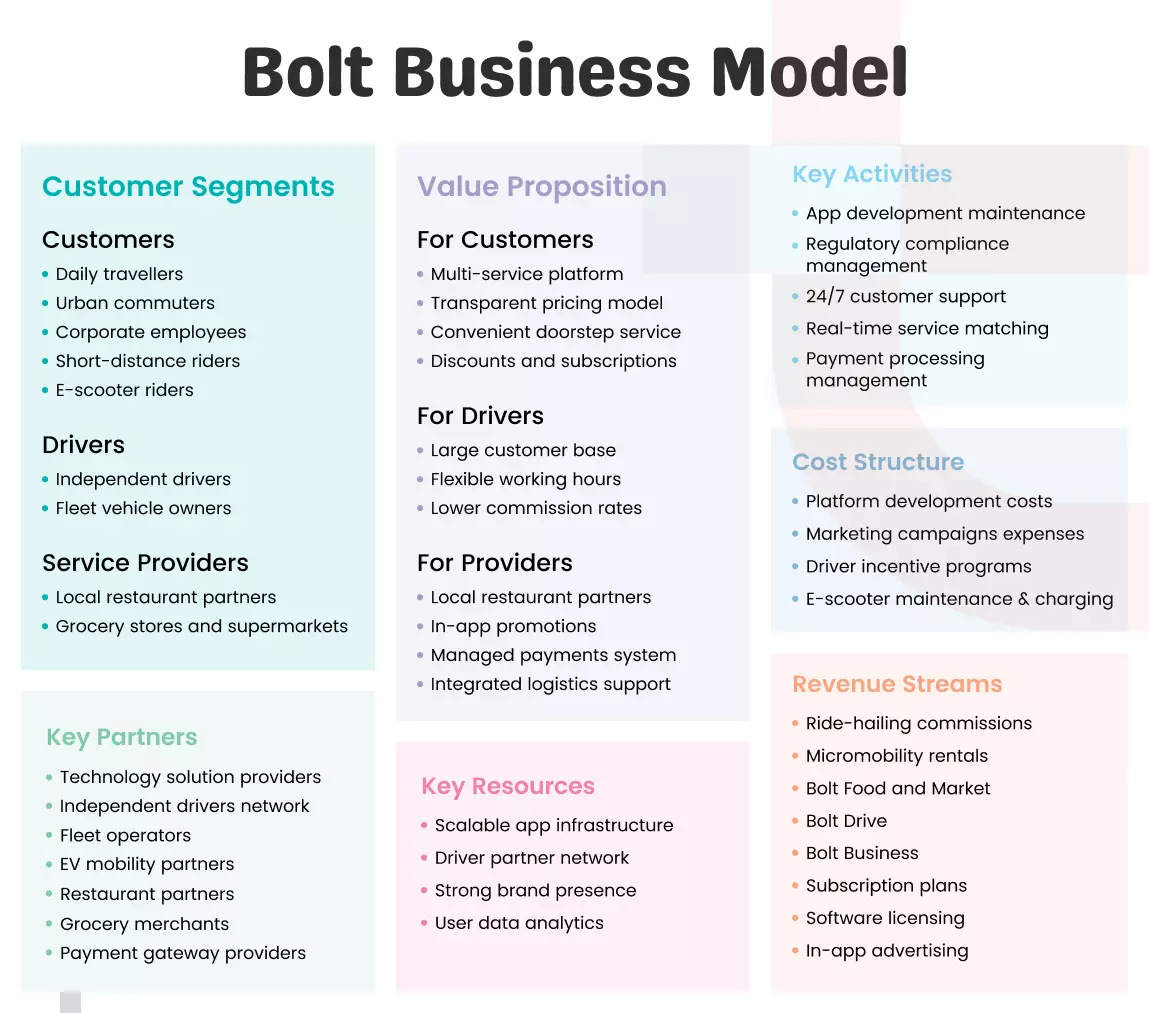
Customer Segments
Bolt serves three user groups:
Customers:
- Individuals who are looking for a convenient transportation solution.
- People who want to order meals or groceries from the comfort of their space.
- Corporate employees who require a reliable mobility solution for daily office travel.
- Urban travellers who need scooters or e-bikes for short trips.
Drivers:
- Independent drivers looking for an additional income source.
- Fleet owners who want to manage multiple drivers through one system.
Service Providers:
- Local restaurants that want to extend their reach digitally.
- Grocery stores that want to provide their services beyond physical stores.
Key Partners
The platform relies on several key partnerships to function effectively.
- Technology service providers for app development and maintenance.
- Independent drivers and fleet operators offering transportation services.
- EV companies for sustainable mobility solutions.
- Local restaurants and grocery stores who fulfill delivery orders.
- Payment processors for ensuring secure online transactions.
Key Activities
Bolt performs different activities to ensure efficient operations.
- Developing and maintaining the web and mobile apps.
- Managing payments, service tracking, and other operations from a single dashboard.
- Smartly matching customers with nearby available service providers.
- Complying with legal rules and regulations to prevent penalties.
- Providing 24/7 support to solve user queries instantly.
Key Resources
The super app relies on multiple resources to perform various operations.
- Scalable web and mobile app to provide on-demand services.
- A strong network of drivers and delivery partners to ensure on-time delivery.
- Strong brand presence to attract more customers.
- Data analytics tools to deliver personalized recommendations to users.
Value Proposition
Bolt creates value for all its customer segments:
Customers:
- Can book services from the comfort of their space.
- They get a transparent pricing system.
- Customers get access to multiple services from a single app.
- Subscription plans and special discounts make ride-hailing and delivery services affordable.
Drivers:
- They get access to a large customer base.
- Flexible working hours allow drivers to work according to their convenience.
- Lower commission rates allow for maximum earnings.
Service Providers:
- Restaurants and grocery stores get access to a large customer base.
- Merchants can easily boost sales through in-app promotional tools.
- Payment, order processing, and customer support are handled within the app.
Cost Structure
The app undergoes different expenses for multiple operations:
- App development and maintenance.
- Conducting marketing campaigns to boost visibility.
- Incentive programs to encourage drivers to use EVs.
- Micromobility fleets require frequent maintenance and charging costs.
Partner with Elluminati to Launch Your Super App Like Bolt Quickly and Affordably
How Does Bolt Work?
Bolt operates as a two-sided platform that matches customers with available service providers (drivers or delivery partners) through a mobile app. It handles all operations from smart matching to payments and real-time tracking. Here’s a complete breakdown of how Bolt works.
Customers:
- They log in to the app and select the required service from ride-hailing, rental scooters, car sharing, e-scooters, grocery, or food delivery.
- Based on the request details, the app shows the nearest available provider.
- The customer can select available providers and proceed with their booking.
- Once the provider accepts the request, the customer receives all information about them, such as their location and vehicle number.
- After the service is completed, customers can rate their experience and provide feedback.
Drivers or Delivery Providers:
- Delivery providers register on the platform by completing all required verification steps.
- After successful registration, they start receiving service requests from customers. They can either accept or reject the request based on their availability.
- After service completion, providers receive payments from Bolt after commission deductions.
- At last, they can rate customers based on their experience and provide feedback.
What is the Bolt Revenue Model?
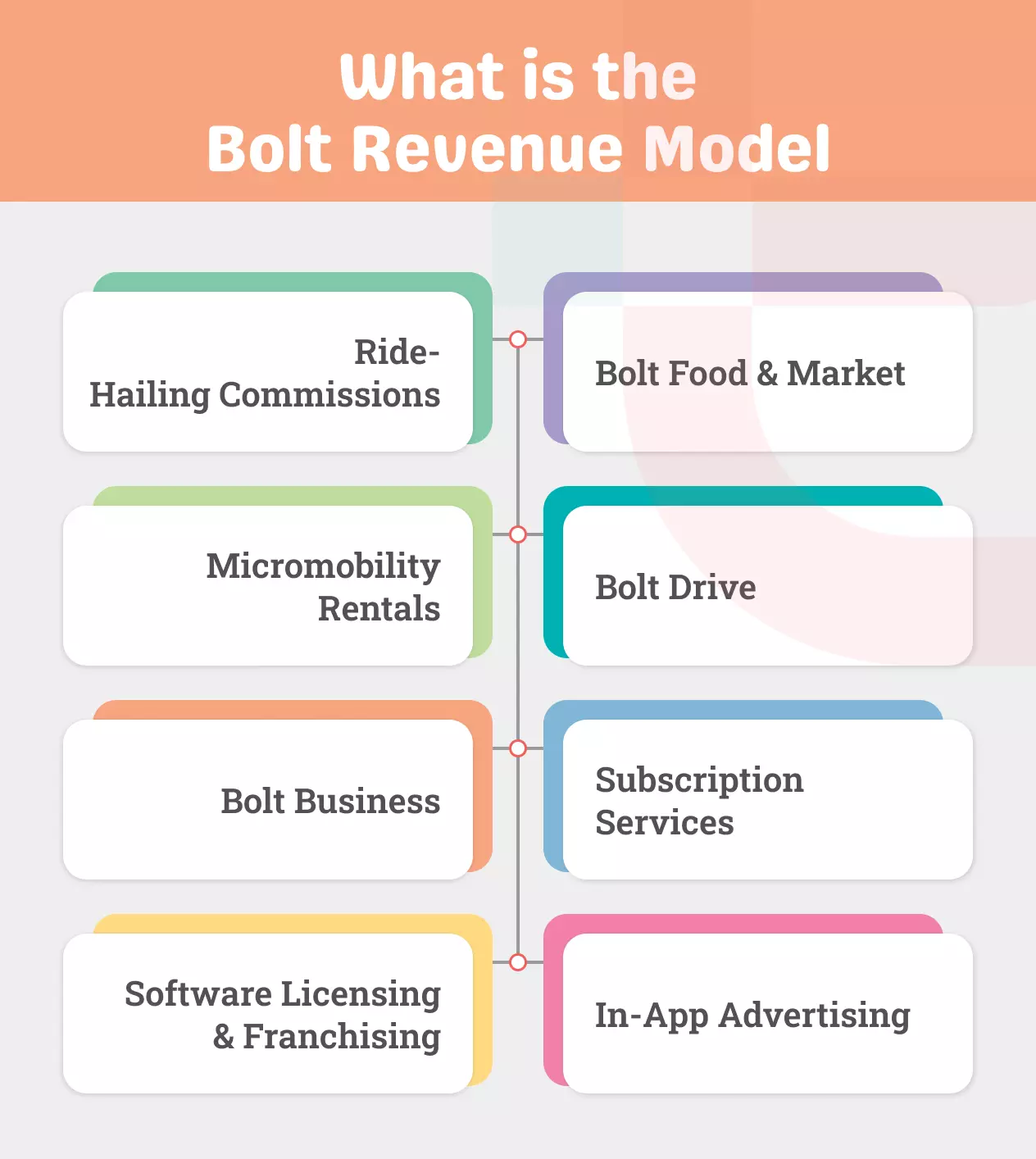
Bolt follows a multi-stream approach in which it generates revenue from multiple sources. Let’s understand how Bolt makes money in detail.
Ride-Hailing Commissions
This is considered to be the primary revenue source for Bolt. The company charges drivers 15% to 20% commission for each trip completed through the app. This allows Bolt to earn from every ride. Also, Bolt is known for charging the lowest commissions among its competitors.
Bolt Food and Market
The company generates considerable revenue from its delivery services, Bolt Food, and Market. It charges a commission from its partnered restaurants and grocery stores for every order placed through the app.
Commission rates typically range from 20% to 35%. Besides, it charges customers for delivery and service fees. This helps the company to significantly grow its delivery segment.
Micromobility Rentals
Bolt’s rental electric scooters and e-bikes also allow it to generate a good income. Customers must pay a small unlock fee, plus a per-minute usage charge that varies by location. This pay-per-use model allows the company to easily earn from short urban trips.
Bolt Drive
Another service that helps the company generate revenue is Bolt Drive, which allows users to rent vehicles, such as, SUVs, vans, and luxury models. Users are charged usage fees based on the time and distance travelled. Bolt generates revenue from rentals by charging customers for trip duration and additional service fees.
Bolt Business
It is the mobility solution provided to corporate employees and clients for office commuting. Companies pay fixed monthly or per-ride fees. This source generates a steady, predictable income for Bolt.
Subscription Services
Bolt offers subscription plans in selected markets across Europe and Africa. Bolt Plus offers numerous benefits to its customers, like 15% cashback on Bolt rides, free delivery, priority pickup, and more.
To access these benefits, customers have to pay a set subscription fee on a monthly or annual basis. This generates a stable income while building long-term customer loyalty for Bolt.
Software Licensing & Franchising
Besides providing ride-hailing and delivery services, Bolt also monetizes by selling its “Bolt Dispatcher” software to local fleet operators. The companies pay a fixed monthly fee per driver for using the solution.
Also, Bolt offers franchise-style agreements where local operators share a percentage of their revenue with it. This makes it easy for Bolt to expand their service into different regions without having the trouble of fleet management.
In-App Advertising
The platform generates additional revenue by enabling local brands and restaurants to promote their products and services through in-app advertising. The advertisements help businesses extend their reach while generating revenue for Bolt.
Future Roadmap of Bolt
Bolt’s future roadmap focuses on achieving long-term sustainability and operational efficiency. Let’s understand in detail what Bolt is planning for the coming years.
Autonomous Driving & Robotaxis
With driverless technology being the future of mobility, Bolt is building strategic partnerships to lead this curve. The company aims to operate around 100,000 AVs by 2035. It has partnered with leading autonomous technology giants Stellantis and Pony.ai to pilot fully driverless ride-hailing services in major European cities in 2026.
Sustainability & Electrification
Bolt has set a goal to become carbon net-zero by 2040, aiming to reduce carbon dioxide (CO2) emissions. For this, the company is encouraging drivers to switch to EVs through incentive programmes.
It is also expanding its electric micromobility fleet, including e-scooters and e-bikes. The company is also using 100% renewable electricity in its offices. Further, it aims to reuse or repurpose 90% of waste generated through circular-economy solutions by 2030.
Strategic Expansion & Financial Growth
To lead the super app market, Bolt is continually expanding its operations across different regions. It plans to launch operations in African and European markets to build a strong market position.
Besides, it is planning for an Initial Public Offering (IPO) in 2026 to become a public company. Bolt’s rapid expansion reflects the rise of super apps that bring multiple services onto a single platform.
AI & Operational Optimization
Bolt is continually working to optimize its operations using artificial intelligence (AI); that is, it designs personalized driver incentives, automates segmentation, and optimizes budgets.
Also, to ensure better operational efficiency, Bolt is conducting several training programs for drivers to maintain service quality and safety standards. The programs include training drivers on traffic regulations, safe driving practices, proper use of the driver app, and more. This will help the platform achieve better operational efficiency.
How can Elluminati Help You Build a Super App Like Bolt?
The Bolt business model follows a multi-service approach, connecting customers with nearby service providers for ride-hailing and delivery. By studying how it works, businesses can easily plan effective strategies to launch similar on-demand platforms in their targeted markets.
If you are looking for a reliable technology partner for super app development, then Elluminati is the one. With 14+ years of experience building on-demand solutions, we help you launch quickly while ensuring easy future growth.
FAQs
Bolt works in a simple way where customers book services according to their needs, the system matches them with a nearby available provider, and service providers can either accept or reject the request based on their availability.
The Bolt revenue model generates income through multiple sources, including:
- Commissions
- Subscriptions
- Bolt Business
- Software licensing
- In-app advertising
Based on its recent revenue updates, Bolt is operating profitably. By offering multiple services like ride-hailing and food and grocery delivery, Bolt generates income from different sources.
Bolt provides multiple services that include:
- Ride-hailing
- Car sharing
- Rental e-bikes
- Food and grocery delivery