Key Takeaways (or TL;DR)
- The car rental market is growing rapidly due to rising tourism, domestic travel, and customers’ increasing preferences for convenience.
- You can choose to start a car rental business using four business models: traditional fleet, peer-to-peer, self-drive, or corporate or long-term rentals.
- You need to fulfill certain legal requirements, including business registration, commercial auto insurance, state-specific licenses, and a rental agreement.
- A technology platform should include tools for booking, fleet tracking, and real-time analytics to ensure efficient operations.
Launching a profitable car rental business requires much more than owning a fleet and renting it out. You need the right business model, legal compliance, proper operational planning, and a reliable technology solution.
This article will walk you through the complete process of how to start a car rental business, from planning to execution, to help you launch the venture effectively.
Why Start a Car Rental Business?
The car rental market offers strong opportunities for businesses due to changing travel habits and increasing demand for flexible transportation solutions. Here’s why you should invest in a car rental venture.
Expanding Opportunities Across Rental Segments
Earlier, customers needed rental vehicles for traveling. But today, demand is increasing for airport pickups and drop-offs, corporate travel, and even relocation purposes. This allows businesses to attract customers from multiple segments instead of depending on a single use case.
Strong Potential for Consistent Revenue
Car rental businesses can generate revenue through multiple booking types, including daily rentals, weekly plans, corporate bookings, and long-term leases. This helps create consistent revenue opportunities while increasing fleet utilization.
Expert Insight
Before investing a single penny in any vehicle, confirm demand in the region you want to operate in. Search Google Trends, check local hotel occupancy rates, and even review the active listings on nearby rental platforms. This will save you from investing in a market with weak or no demand for rental cars.
How to Start a Car Rental Business – Step-by-Step Process
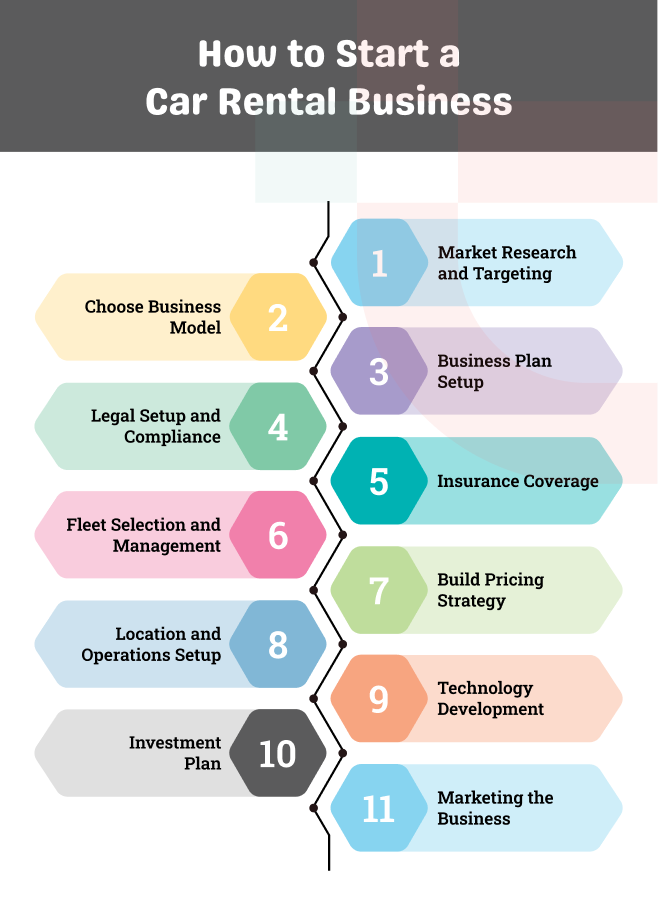
Having vehicles and a technology solution are not enough to launch a car rental business. You need to adopt a structured approach for market research, pricing setup, legal compliance, and platform development. Here is the step-by-step guide.
Step 1 – Research the Market Thoroughly and Define Your Target Audience
Before planning for anything, you first need to perform detailed market research.
- Observe your competitors. See what kind of vehicles they offer, their pricing strategies, their booking channels, and where they fall short.
- Define who your primary customers will be. Will they be tourists, local residents, corporates, or business travelers? Choosing one segment in the beginning helps you operate more effectively.
- Check the seasonal demand too. Tourist-specific locations spike demand only during a certain time period. At the same time, corporates create consistent demand throughout the year.
- Also, look for underserved segments in the region. Hourly city rentals, airport drop-offs, and luxury vehicles are often missed by businesses.
Detailed research makes it easier for you to identify customer needs and navigate the competition.
Expert Insight
Specialization helps win early market share. Instead of serving each segment at launch, pick any one customer type and design your operations around their specific needs. This will help you deliver better quality and also strengthen your brand position in the initial phase.
Step 2 – Select the Appropriate Business Model
A business model defines how your business will operate and make money. You should select the model by considering your target market, capital availability, and regulatory landscape. Below are the most common models.
Traditional Fleet-Based (independent Agency) Model
In this model, you own the fleet, manage the regional operations, and interact with customers directly. Although it requires a significant investment of around $60,000 to $400,000+, you get complete control over the business and margins. It best fits tourist locations, corporate-heavy cities, and airports.
Self-Drive / Chauffeur-Free Model
This is the type of model where customers pick up and drive vehicles themselves. Since there are no drivers involved, this approach cuts down operating costs and works well with a smaller fleet of 3-10 vehicles. Due to this, it becomes an affordable solution for entrepreneurs with limited capital.
Peer-to-Peer Model
Using this approach, you list vehicles on rental platforms or your own branded application. This is the easiest way to enter the market, as you do not need to have a large fleet or physical location to operate. It becomes an ideal way to test market demand without investing significantly. The Turo business model is a well-known example of how it works.
Corporate Model
You rent vehicles to companies, insurance replacement customers, or relocating professionals on a weekly or monthly basis. This allows vehicles to stay booked for longer and also makes income predictable.
Expert Insight
Initially begin with any one model that best fits your goal for the next three years. You can expand the model later once the fleet utilization grows.
Step 3 – Create a Solid Business Plan
A business plan is a comprehensive document that defines your business’s objectives, growth strategies, and operational roadmap. Entrepreneurs often overlook this step. But in a capital-intensive business like car rental, a wrong decision can lead to cash flow issues and lower fleet utilization. That’s why create a business plan which covers:
- Executive summary outlining your business model, target market, funding needs, and competitive positioning.
- Market analysis highlighting customer segments, competitors, and local demand data.
- Fleet plan involving vehicle types, depreciation schedule, acquisition type (buy/lease/finance), and maintenance costs.
- Key risks involved and strategies to mitigate them.
- Pricing strategy with daily, weekly, and monthly rates depending on the vehicle type, along with add-on services like GPS or insurance coverage.
- Financial projections, including startup expenses, revenue, and monthly operating costs, based on three scenarios: what happens when only 50% of vehicles are rented, what happens at 70%, and what will happen at 85% or above. Also, include the break-even timeline.
- Cost estimation involves startup investment (vehicles, insurance, licenses, and technology) and ongoing expenses for maintenance and marketing.
Step 4 – Register Your Business and Ensure Legal Compliance
Legal setup is the foundation of your business. Non-compliance can result in heavy fines, lawsuits, and shutdown of operations. Therefore, you must register your business and fulfill all legal requirements before starting operations
Select the Business Structure
The structure selection affects liability, taxes, and scalability of your business. There are 4 types of business structures for rental businesses.
- Limited Liability Company (LLC): The most preferred choice among car rental businesses, which separates personal assets from business liability while giving flexibility in taxation. most common for car rental businesses – separates personal and business liability, is tax-flexible, and relatively straightforward to establish.
- Sole proprietorship: A high-risk framework where the owner’s personal assets are exposed to risk in case of debts, damages, and lawsuits. It is the simplest to set up, but personal assets are fully exposed to business liability.
- Corporation: Suitable for large-scale enterprises with multiple investors and operating locations. It offers strong liability protection. suited for businesses planning to raise investor capital or expand to multiple locations.
After choosing the structure, you need to:
- Register your business with your chosen state’s Secretary of State
- Obtain a Federal EIN (Employer Identification Number) from the IRS (Internal Revenue Service)
- Open a dedicated business bank account before starting any financial transactions on the platform.
Acquire Necessary Licenses and Permits:
The following are the essential licenses and permits you should secure to operate legally.
- General business license at the state and local level.
- Vehicle rental dealer license, and most states also require a used motor vehicle dealer license. Check your state’s DMV (Department of Motor Vehicles) for exact requirements.
- An airport operating permit is required if you want to provide airport pickup and drop-off services.
- Zoning and land use permits to operate in any physical location
- Sales tax registration in most states requires you to collect and remit sales tax on rental transactions.
Create a Rental Agreement:
A rental agreement is as critical as securing any business license. That’s why you should get it created by a professional lawyer.
It should include all important clauses for damage liability, late return fees, geographic restrictions, vehicle condition at pickup, cancellation policy, and insurance obligations. You should get it reviewed by a licensed attorney before offering rentals to customers.
Expert Insight
A rental agreement is critical to safeguard your business from any dispute or liability after launch. So it will be better to have an experienced attorney draft it. This will cost you a fraction of what an unresolved dispute will do.
Step 5 – Secure the Right Insurance Coverage
Personal auto insurance does not work for car rental businesses as it is meant for private vehicle use and not for commercial purposes. You need to acquire specialized insurance to cover liability, damage, and theft in case of short-term renters.
Insurance Types Your Car Rental Business Requires:
- Commercial auto insurance: Covers vehicles the moment they are rented for commercial use. The annual cost ranges from $1,500 to $6,000 per vehicle, which varies depending on vehicle type, driver age restrictions, and location. However, it is mandatory in all states.
- General liability insurance: Helps fill in third-party injury and property damage caused by your vehicles during operations.
- Collision and comprehensive coverage: Protects fleet from theft, fire, and damage during any unforeseen weather conditions. It is an essential requirement if you operate your own fleet.
- Workers’ compensation: Needed if you hire staff for your business.
- Damage waiver program: An optional product you sell to renters that helps cover damage caused during the rental period. Creating an additional revenue stream for your business.
Verify Renter Insurance:
Besides requiring business insurance, you also need to verify renters’ personal insurance before renting them vehicles. Ask customers to show their personal auto insurance or purchase the damage waiver at the time of booking if they do not have any.
Also, make it a rule to photograph vehicles before pickup and after return with timestamps noted. This acts as evidence to resolve disputes (if any arise) for existing damage and protect customers from fraudulent claims.
Expert Insight
Always work with a commercial insurance broker who has expertise in auto fleet or rental vehicle coverage. Compare at least three quotes and also examine exclusion clauses thoroughly, along with premiums, to avoid any last-minute surprises.
Step 6 – Build and Manage Your Fleet
Your fleet will be the core asset for your business. That’s why you need to choose and manage it carefully.
How to Choose Your Initial Fleet:
- Vehicle types should be chosen based on your targeted customers. Economy cars work best for budget-conscious customers, sedans for corporate employees, SUVs for large families and tourists, and vans are suited for commercial purposes.
- Instead of purchasing altogether, initially start with 3 to 10 vehicles. Test the market demand in real time and then gradually expand the fleet as utilization grows.
- If the target market has a growing demand for sustainable travel, then adding EV or hybrid vehicles gives you a competitive edge. Moreover, it also reduces operational expenses as they remove fuel costs.
Four Ways to Acquire Vehicles:
- Buying outright: You own the vehicles completely with no usage restrictions. However, it requires significant upfront investment.
- Commercial auto loans: You can purchase vehicles without paying the full amount up front. You pay in monthly installments, and the fleet itself acts as the security for the loan.
- Leasing: It’s not necessary that you can rent out all leased vehicles. So, look for special fleet leasing options meant specifically for rental operations.
- Dealer partnership: Some car dealers offer rental vehicles under specific agreements. Allowing you to access the fleet with low investment.
Have a Close Eye on Fleet Utilization and Maintenance:
- Track the utilization rate with the number of days rented / total days available. Aim for 60% to 70%+ to achieve profitability.
- Sudden breakdowns can cost revenue and also frustrate customers. So, schedule maintenance to prevent downtime.
- Replace vehicles after 3 to 5 years or 100,000 miles to ensure effective performance always.
Step 7 – Create a Profitable Pricing Strategy
Pricing should be designed in such a way that it covers every expense tied to running a vehicle, from depreciation and maintenance to insurance and location, while still being affordable so customers choose you. Strategizing it wrong is the most common reason why most car rental businesses fail.
Build Pricing From Your Cost Base:
First, calculate the per-vehicle cost per day by applying the following formula:
Total annual expense (insurance, maintenance, financing, etc.) / expected rental days per year
Then add the overhead expenses for marketing, staffing, and more per vehicle per day to the above result.
This calculation will give you the break-even price per day. Anything above that will be your profit margin.
Types of Pricing Models and Revenue Streams:
- Offer 3 Rate Options: Weekly rates are typically 10% to 20% below daily pricing, encouraging customers to book for longer. And apply monthly rates with discounts to high volume bookings to corporates and long-term customers.
- Apply Dynamic pricing: Increase rates during peak times, local events, holidays, and in high-demand areas.
- Earn Extra Through Add-ons: GPS units, child seats, additional driver fees, damage waivers, and fuel service options add $10 to $30 per booking, helping you make money without any fleet cost.
Step 8 – Set Up Your Location, Operations, and Staffing
Operating location plays a key role in deciding how customers will access the service. Choose the location close to demand sources like airports, train stations, business districts, hotels, and tourist zones.
However, no matter which area you select, it is essential to first verify zoning regulations, as it is not necessary that all commercial properties will allow rental operations and vehicle storage.
In case you have a limited budget, start operating with a pickup and delivery model instead of having a fixed location. This eliminates the need for a permanent site and also reduces overhead costs.
Once done, you should define the operations clearly to ensure smooth running. Decide how you will verify customer identity, inspect vehicles and maintain them, and handle returns and delays. Also, you should train your staff for customer handling. This will help you avoid disputes and ensure a better service experience.
Step 9 – Build a Technology Platform for Bookings
Just like the fleet, technology is the backbone of your business. Most bookings happen online through smartphones. And so it is important for the platform to be fast, mobile-optimized, and friction-free to ensure smooth experiences for customers.
What to Include in the Technology Platform:
- Online Booking Engine: Customers can check vehicle availability in real time, get instant booking confirmations, see the full price before payment, and add any extra things they want.
- Payment Processing: Includes multiple payment methods, takes security deposits digitally, and generates invoices automatically for corporate clients.
- Customer Management: maintains a complete record of booking history, driver verification documents, and tracks repeat customers to keep them for longer.
- Admin Dashboard: A centralized place providing real-time insights about utilization rates, revenue by each vehicle, peak times, and customer acquisition rates.
Businesses often get confused about choosing between custom development and ready-made solutions. The choice depends on numerous factors like budget, timeline, and your needs. Building a platform from scratch would take significant time and money. At the same time, a white label solution allows you to launch faster under your own brand while ensuring scalability.
Expert Insight
Test the booking flow by yourself before making it live. Also, calculate the time it takes from landing on the page to receiving a booking confirmation. If it takes more than three minutes, it will impact customer experience, resulting in lost opportunities every single day.
Step 10 – Acquire Funding and Plan the Investment
Before approaching any lender or investor, you must know exactly how much funding your business would need and why. Below are some estimated expenses for different operations.
- Peer-to-Peer or Platform Model: $20,000 to $100,000+
- Operating as an Independent Agency with 10 to 25 Vehicles and a fixed location: $150,000 to $250,000
- Lean self-drive fleet: $50,000 to $80,000
- Franchise entry: $20,000 to $50,000+
If you have your own fleet and want to start a car rental business, the capital requirement reduces significantly as you would need investment primarily for technology development, rental agreements, commercial insurance restructuring, and marketing.
You can get funding from:
- Your own personal savings, which means no debt and no need to give any business shares to anyone. However, it is ideal when you have enough capital.
- SBA (Small Business Administration) loans are best suited for asset-heavy ventures like car rentals, as they offer longer repayment terms and lower interest rates.
- Commercial auto loans where your own vehicles are used as security. They prove to be an easier solution for startups than unsecured loans.
- Business line of credit gives you flexible credit to fill unexpected gaps in operations and planned fleet expansion.
- Asset finance, which lets you add one vehicle to the fleet at a time and pay for it as it starts making money.
Expert Insight
Instead of opting for personal auto loans, look for commercial auto loans or fleet financing products from lenders who work specifically with rental businesses. The terms will be structured properly according to your business operations.
Step 11 – Market Your Business Online
Once your business is set up successfully, you have to start attracting customers and generating bookings. Digital marketing helps you enhance visibility and reach people who are looking for car rental options.
First, start with Google Business Profile to capture local searches. Then build an SEO-optimized website optimized for location-specific search terms like “[city] car rental”. You can even use Google Ads to appear on local searches. Listing on travel platforms like Rentalcars.com helps you increase visibility in airport and tourist markets.
Besides, you can partner with local hotels, insurance companies, relocation agencies, and corporations to get access to high-volume bookings. Moreover, applying taxi business growth strategies like referral programs and customer discounts can help you increase bookings.
Launch Your Car Rental Business with Elluminati’s Expert Guidance
How Much Does it Cost to Start a Car Rental Business?
The cost to start a car rental business depends on the model you choose. A small independent business with 1 to 3 cars will cost around $10,000 to $50,000. While a more established setup will cost between $50,000 and $100,000+.
| Category | Estimated Cost | What does it cover? |
|---|---|---|
| Vehicle Acquisition | $15,000 to $30,000 | Purchase, lease, or finance expenses for 2 to 10 vehicles |
| Licenses and Permits | $500 to $1,500 | Business registration, rental agreement, and rental dealer license |
| Insurance Coverage | $5,000 to $10,000+ per year | Comprehensive protection, fleet coverage, and liability |
| Technology Development | $1,000 to $70,000+ | Booking management, fleet tracking, and a GPS system |
| Marketing | 10% to 15% of projected revenue | Google Ads, Google Business Profiles, listing on travel platforms, and an SEO-optimized website |
Common Mistakes to Avoid When Starting a Car Rental Business
Many entrepreneurs make some common mistakes that affect operations and profitability. Let’s have an overview of each mistake so you can avoid it when you launch a car rental business.
Underestimating Insurance Costs
Many businesses do not consider commercial fleet insurance costs while planning the overall budget. But commercial insurance is more expensive compared to personal coverage. Not planning for it in advance can result in a cash flow crisis within a few months. So, always get quotes in advance and include them in your financial plans.
Over-Investing in Fleet Before Testing Demand
Investing in too many vehicles before validating demand bounds capital without booking guarantees. Initially start with 2 or 3 vehicles, track utilization, and grow your fleet once bookings become consistent.
Using a Generic Rental Agreement
Generic online templates often miss important clauses in rental agreements, which creates disputes and losses. Work with an expert lawyer to draft a proper agreement aligned with your business operations before renting vehicles.
Treating Technology as an Afterthought
Many entrepreneurs launch a car rental business with manual bookings and spreadsheets, which create inefficiencies as the business grows. Build a scalable technology platform embedded with booking and fleet management before launch to ensure smooth operations.
Competing Only on Price
Lowering rents can help you beat the competitors, but it reduces your profit margins and attracts low-value customers. Instead, focus on service quality, booking experience, and reliability to have sustainable growth.
Challenges You May Face in Starting a Car Rental Business
There are several operational and financial challenges involved when you start a car rental business. Understanding them at an early stage helps you plan better strategies to avoid them.
High Initial Investment
Vehicle purchasing, licensing, insurance, and technology development involve high upfront costs.
Solution: Initially start lean with a peer-to-peer or self-drive model with a small fleet. This allows you to test demand while keeping investment lower. Then you can expand gradually once you start getting consistent bookings.
Managing Vehicles
Vehicles need constant attention for timely servicing, damage checks, cleaning, and availability tracking. It becomes difficult to manage them manually when the fleet volume increases.
Solution: Include a fleet management system in your rental platform that helps you schedule maintenance, monitor performance, and track utilization in real time. This will help you reduce downtime effectively.
Intense Competition
Established brands and local players have already built a strong market position and a larger customer base. So, it becomes challenging to compete with them.
Solution: Analyze them thoroughly and identify the gaps in their services. This will help you position your business around specific customer needs and attract them with ease.
Planning to Launch Your Car Rental Business with the Right Technology? Connect with Elluminati for Expert Solutions
How Elluminati Helps You Launch Your Car Rental Business?
Having a large fleet is not enough to start a car rental business. It needs systems for bookings, fleet tracking, customer verification, damage documentation, and operational reporting. Building them from scratch requires significant investment and time. A white label solution integrates all these functions in one place, which helps you launch faster and ensure smooth operations from day one.
Elluminati has 14+ years of experience in building 450+ on-demand mobility solutions for businesses worldwide. With features like vehicle availability tracking, automated bookings, smart pricing, fleet tracking, and detailed analytics, our car rental software helps you launch and grow your business effectively.
FAQs
Cost ranges from $10,000 to $50,000 for a small business with 1 to 3 vehicles, while for a more established, or larger-fleet online operation, costs can range from $50,000 to $100,000+. Major cost drivers include fleet acquisition, location, legal requirements, insurance, and technology infrastructure.
Yes, you need to register your business and acquire additional permits related to car rental operations. The requirements vary by state. So, you should check with the state’s DMV for better compliance.
Usually, you need to have commercial auto insurance, collision/comprehensive insurance, and general liability coverage for your fleet. Besides that, you can also have a damage waiver program, which provides both protection and an additional income-generating opportunity.
Yes, a fleet owner can easily transition to a car rental business without buying vehicles. They only need to invest in a technology platform, commercial insurance restructuring, marketing, and a legal rental agreement.
Profitability timeline differs for each business setup. It depends on the utilization rate, operational costs, and demand in the targeted market.
A car rental business needs to have a technology solution involving booking systems, fleet tracking tools, reporting dashboards, and payment processors to manage daily operations.
Profitability depends on the market demand. Common niches include corporate, luxury vehicles, long-term rentals, and airport services.
Yes, you can start with one car, test demand, and gradually expand the fleet as the utilization rate increases.
Car rental companies primarily make revenue through daily or long-term rentals. Besides, they also generate income by charging for add-ons like child seats and GPS systems.