Key Takeaways (or TL;DR)
- UberEats has transformed how people think about food delivery by creating a network among customers, restaurants, and delivery partners and streamlining their online ordering and delivery processes.
- The UberEats business model operates as a three-sided marketplace, involving the customers, restaurants, and delivery partners.
- The strategic SWOT analysis of UberEats helps businesses understand its key strengths, weaknesses, opportunities, and threats, thereby shaping their competitive position in the food delivery industry.
- The UberEats revenue model primarily revolves around several streams, including delivery fees, service fees, restaurant commissions, and advertising.
- Entrepreneurs across the globe, inspired by the UberEats model, can gain significant benefits, such as a proven model and global access, but building it may come with a set of core challenges, including legal and regulatory ones.
UberEats has become the unsung hero of the food delivery scene. Owned & operated by Uber Technologies, the UberEats business model simplified the process of ordering and delivering food by connecting customers, restaurants, and delivery partners through a single platform.
This is the perfect example of how technology can turn a single idea into a billion-dollar business for entrepreneurs. In this article, we will understand the business model. how UberEats works, its revenue strategies, and its future scope, which will help your delivery business run at its best.
What is UberEats? A Journey to Witness the Success from the Start
UberEats is an online food ordering and delivery platform that lets customers order meals from a wide range of local restaurants via its mobile app or website. Initially, a small-scale trial in Los Angeles, UberEats was officially launched in 2014 as UberFRESH by Uber Technologies, Inc., its parent company.
UberEats Company Overview:
Founded on: 26th August, 2014
Founded By: Travis Kalanick & Garrett Camp
Company Type: Subsidiary of Uber Technologies, Inc.
Headquarters: San Francisco, California, United States
Services:Food Delivery
Key People: Dara Khosrowshahi as CEO
Gross Bookings as per the second quarter of 2025 were approximately $21.73 Bn.
What began with a mission, “To make eating well effortless for everyone, everywhere,” has expanded to provide food services in Santa Monica, California. But in 2015, it was renamed and started offering services internationally from Canada, London, and Paris.
Fast forward to today, UberEats is one of the most popular food delivery platforms. It’s teamed up with around 800,000 restaurants and operates in over 6,000 cities. However, what started as a side project soon became a significant part of Uber’s business, contributing substantially to its overall revenue.
UberEats has positioned itself as more than just a food delivery service; below is how this subsidiary firm has built its own worldwide brand recognition.
UberEats Success Timeline:
- 2014: Launched as UberFRESH in Santa Monica, California.
- 2015: It was rebranded under the name UberEats and launched as a standalone app in Toronto, as well as expanded its services to New York, Chicago, and Barcelona.
- 2016-2018: It’s the time period when UberEats made a huge expansion and covered the food deliveries in 200 cities in 20 countries in the EMEA market, as well as doubled its revenue to $1.5 billion by 2018.
- 2019: Zomato acquired all the UberEats operations in India.
- 2020: This year is recognized as a revenue-jumping year for UberEats, as its revenue surged by 150%, and it also acquired Postmates, which worked as a separate entity, for $2.65 Bn to consolidate the U.S. market.
- 2021: It was another achievement year for the company, as it completed its first food delivery in space when it partnered with a Japanese billionaire, Yusaku Maezawa, to send food to the International Space Station. Also, they acquired Drizly for $1.1 Bn and partnered with retailers like Costco.
- 2022: A cross-platform subscription program was released for Uber and UberEats under the name of Uber One.
- 2023: It becomes EBITDA profitable, proving the delivery aggregator model could actually make money.
- 2024: Successfully reached the milestone of 1 million merchant partners globally, while also hitting the revenue of around $13.7 billion.
- 2025- Made a partnership with Kroger and has a future focused on providing an AI-driven personalization, as well as sustainable deliveries to reach its 2040s sustainability initiatives.
UberEats Business Model: A Business Strategy Canvas to Drive Success
UberEats is a three-sided marketplace connecting restaurants, customers, and delivery partners with the UberEats platform at the center. The UberEats business model allows restaurants to tap into a bigger market where many customers place orders online.
This aggregator follows a hyperlocal on-demand business model, enabling the company to perform all tasks efficiently and systematically.
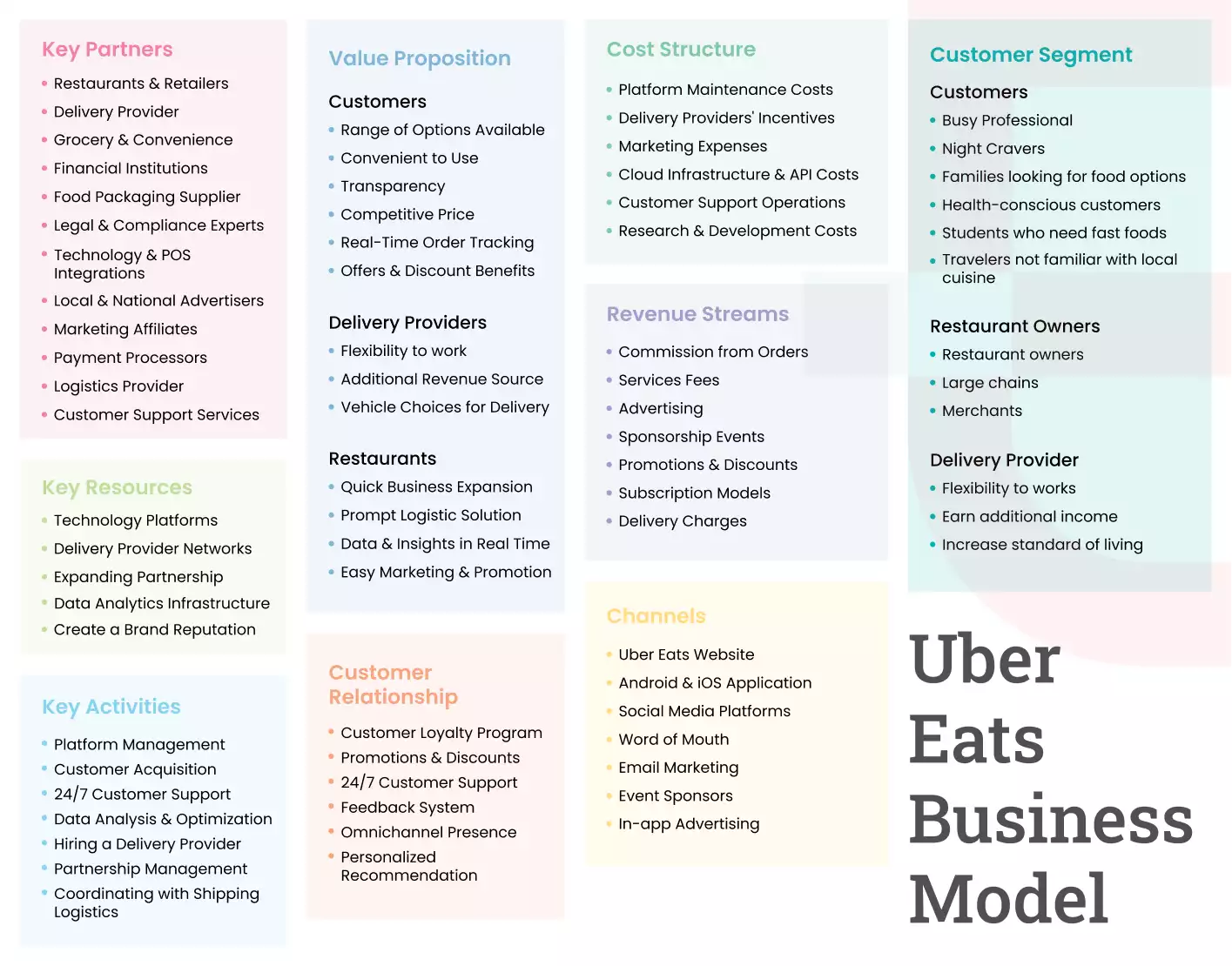
Key Partners
- Restaurants and national food chains offer customers easy access to their favorite food.
- Delivery providers are independent contractors who handle the deliveries.
- Beyond food services, the company also partnered with major grocery retailers, including Kroger, Albertsons & Costco, to offer customers a wider range of products.
- Investors provide the funds needed to grow the business and stay competitive.
- Technology & POS integration partners like Toast streamline order flow and partner with a company like Deliverect to manage online orders for restaurants.
- The company also partnered with a legal & compliance expert to ensure it obtained all required restaurant licenses and to address delivery partner safety and other regulatory requirements.
- UberEats also operates as a packaging marketplace by partnering with companies like Kinara International to offer merchants more discounted, sustainable packaging options.
- Payment processors securely perform the transactions between the parties.
Key Resources
- Digital platforms that connect all three aggregators-that is, customers, restaurants, and delivery providers-in one place.
- Advanced algorithms that calculate all the costs and timing.
- A vast network of partners to scale the business.
- Strong brand marketing to build customer engagement.
- Other operational resources, like efficient coordination for timely deliveries, 24/7 customer support, and more.
Key Activities
- Managing the platforms by updating the technologies
- Continuously exploring and expanding the new partnership with brands
- Building a strategy for customer acquisition & retention
- Diversifying the services from food to groceries, alcohol, and other items.
- Providing 24/7 customer support to both delivery providers and the restaurants.
Value Propositions
Customers:
- Customers’ waiting time to get food delivered at home is minimal
- Who wants to experience luxurious food dishes from a wide range of restaurants
- Competitive ordering, pricing, and discounts
- Real-time tracking of orders as well as delivery providers
- Customers can get an idea about the food before even confirming the order
Delivery Providers:
- The platform offers delivery providers an extra source of income
- Delivery schedules are flexible
- Flexibility to accept or reject the delivery requests
- They even have the chance to make extra money through tips for their services.
Restaurants:
- Restaurant owners have the flexibility to go online to offer service.
- Easy business scaling and expansion.
- Those who want to expand their customer base.
Cost Structure
- To keep the platform running smoothly, the company must spend certain amounts on maintenance.
- Paying remuneration and other incentives to its delivery providers and other employees.
- The firm has to invest a certain amount in research & development.
- Also, the key factor affecting the cost structure is the customer acquisition process, including marketing and sales, promotions, and more.
Customer Segment
Customers
Customers who create an account on the UberEats app can order food from their favorite restaurants after browsing the wide range of restaurants listed on the app.
Delivery Providers
Independent delivery providers who offer reliable delivery services at their flexible time slots aim to earn enough revenue.
Restaurants
Local restaurants and large national food chains collaborate with UberEats to get their dishes listed on its app in exchange for a commission to list their items at the top.
Channels
- Targeted ads are run on the UberEats platform to reach potential customers.
- In-app advertising to promote other restaurants’ specialties.
- Push notifications and email marketing to capture its end customers’ attention.
- Loyalty programs and special references to retain the customers.
Ready to Build Your Own Food Delivery App Like UberEats? We will Help you Design a Tailored Delivery Solution for Your Business
How UberEats Work? A Step-by-Step Guide
UberEats operates on a three-sided business model, acting as a bridge between restaurants, delivery partners, and food lovers through a single platform with advanced features that simplify operations. Let us look at how UberEats works by combining three marketplace segments.
Customers’ Ordering Experience
Create an Account:
Customers first create an account in the UberEats app, using their email ID or by filling out their details to explore a variety of restaurants, cuisines, and menu items for ordering.
Select the Menu
After successfully creating an account and selecting their preferred restaurant, they can explore the menu and view prices and descriptions to order the item.
Checkout
Once the order item is decided, they can proceed with the checkout process, where they can review their order details, apply the discounts (if any), and select the payment mode.
Restaurant Operations
Registered Restaurants:
Restaurants that want to offer food delivery worldwide must partner with UberEats to use its app, enabling customers to access a wide selection of dining options.
Order Notification:
Once the customer finalizes their order and places it, the restaurant receives a notification through the UberEats app.
Order Fulfillment:
By accepting the order notification, the restaurant can start preparing the order within the estimated time. Also, the app enables customers to stay in touch with restaurants, track their order status, and more.
Delivery Infrastructure
Order Dispatch:
After the order is prepared, UberEats notifies the delivery partner to pick it up from the restaurant.
Real-time Tracking:
UberEats also has an in-built map feature that allows restaurant owners and customers to see the delivery partner’s location and ETA, ensuring timely delivery of the food parcel.
Delivery Services & Customer Experience
Rating & Feedback:
After delivery, customers can rate the food quality and the delivery partner based on their experience, helping UberEats maintain service quality and enhance customer satisfaction.
Customer Support:
Also, in certain situations, the app offers customers 24/7 support, ensuring they receive constant assistance and that issues are resolved promptly.
UberEats SWOT Analysis
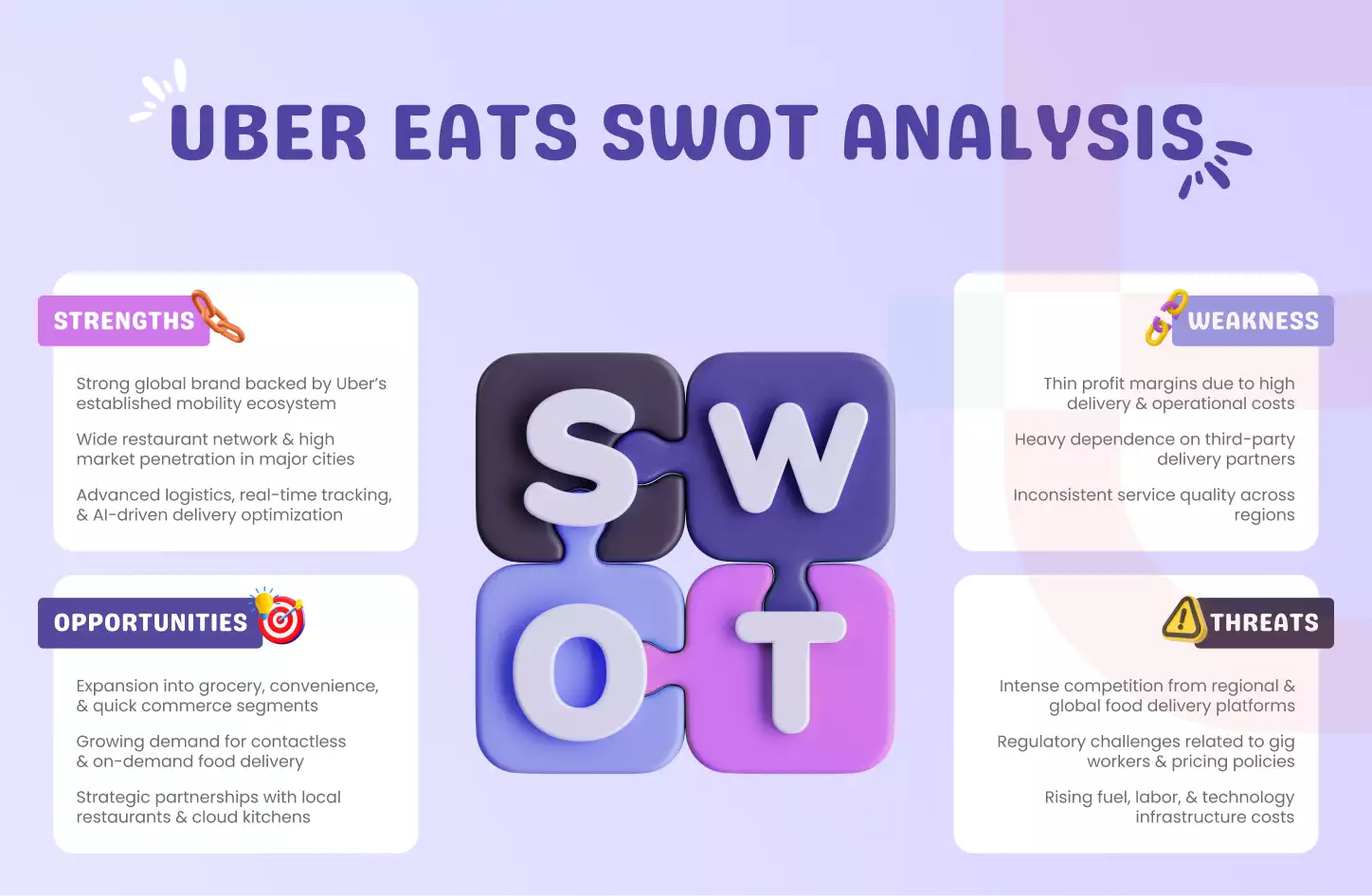
An UberEats SWOT analysis will help you explore the brand’s key strengths and the critical vulnerabilities that currently shape its global business strategy.
Strength
- The core strength of UberEats is that it’s the subsidiary of a well-recognized brand, Uber. This builds trust & credibility in Uber brands among customers and helps drive user adoption of the UberEats platform.
- Backed by Uber Technologies Inc.’s infrastructure, UberEats benefits from advanced mapping, routing, and real-time tracking technology, improving delivery efficiency & reliability.
- Another significant advantage of UberEats is that it generates diverse revenue streams, including delivery fees, restaurant commissions, subscription programs, and more, which help maintain financial stability.
- UberEats also uses data-driven insights to predict demand trends, improve delivery efficiency, and offer a personalized experience to its end customers.
Weakness
- As UberEats relies on its delivery partners, who operate as independent contractors, this dependency can lead to inconsistent service levels, as factors such as driver availability and external conditions can affect delivery times and overall service quality.
- The online food delivery market is highly competitive, with major players including DoorDash, Grubhub, and Just Eat Takeaway.com significantly impacting UberEats’ market share and growth.
- We all know that the food delivery business involves significant expenses, including marketing, technology, and incentives for delivery drivers. These high operational costs impact UberEats profitability, especially in a highly competitive food delivery market.
Opportunity
- One of the most prominent opportunities for UberEats is investing in and researching the development of autonomous delivery drones or robots, reducing reliance on humans and potentially lowering costs in the long run.
- With Uber’s sustainability initiatives, they have already begun exploring eco-friendly packaging options and incentives for green transportation methods, which could appeal to environmentally conscious customers and help differentiate UberEats in the marketplace.
- Enhanced technological features by investing in high-quality technologies to improve user experience by involving functionalities like more personalized recommendations, virtual cooking classes, augmented reality, and more.
Threat
- As the governments have imposed stricter regulations on gig economy platforms, UberEats may face challenges related to labor laws, tax regulations, and worker rights, particularly concerning its delivery partners who operate as independent contractors.
- As the food delivery market is saturated with numerous players, each is vying for market share. Intense competition increases pressure on UberEats to continually innovate and offer competitive pricing, which can strain its profitability.
- With the increasing use of advanced features and technologies, there is a higher risk of cybersecurity threats, including data breaches, which can damage its reputation and result in legal and financial consequences.
How UberEats Make Money? Its Revenue Model Breakdown
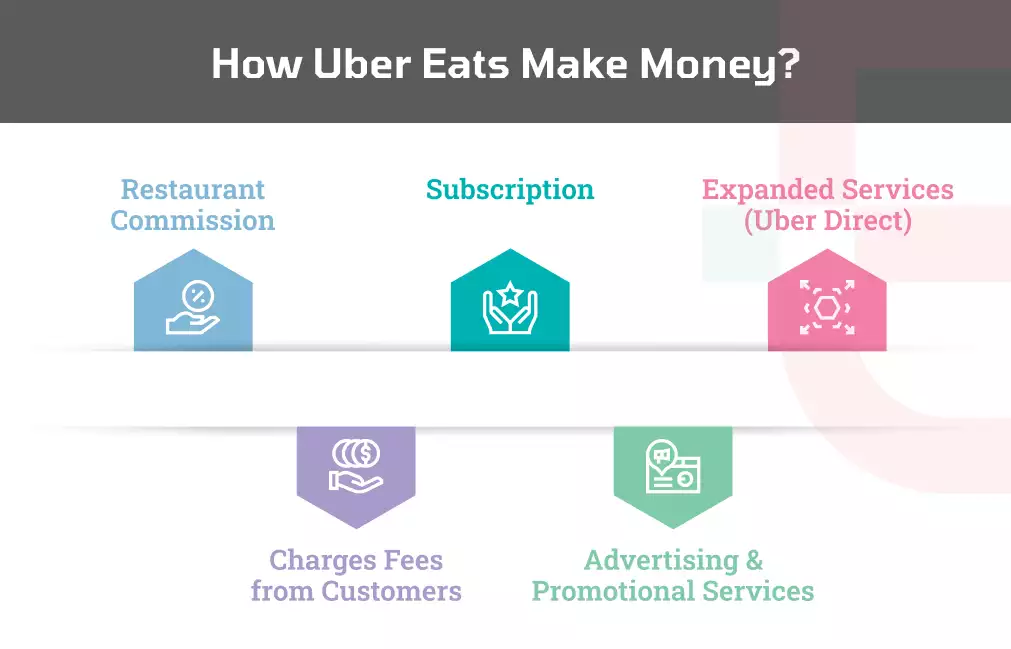
The UberEats revenue model is built on multiple revenue streams that drive profitability while also ensuring consistent services to its extensive customer base. Below are some steady ways the company can increase profits.
Restaurant Commission
One of UberEats’ primary revenue sources is its restaurant commission, which generally ranges from 15% to 30%. Also, it varies by plan and service type, which includes:
| Restaurant Commission Based on Plan & Service Type | ||
| Plan | ||
| Lite | ~ 15% | For basic listing & search result visibility |
| Plus | ~ 25% | Get an app with increased visibility, feature placement, and Uber One member benefits |
| Premium | ~ 30% | For maximum exposure, enhanced marketing, and top placement in search |
| Based on Service Type | ||
| Delivery & Pickup | Ranges between 6% to 15% | Lower fees when the restaurant handles deliveries or customers pick up, as Uber’s logistics costs are lower. |
Charges Fees from Customers
The company charges varying fees to its end customers per order, allowing the platform to cover logistics and operational costs while maximizing customer profit.
Delivery Fees:
- Fixed fees, which a customer pays for the package they receive.
- Dynamic delivery fees: During periods of high demand, Uber’s algorithm increases delivery fees to balance supply and demand and monetize peak usage.
- Also, the company imposes long-range fees when the deliveries exceed a certain distance threshold to compensate for the parcel and to cover additional fuel or time costs.
Service Fees:
Aside from delivery charges, which range from 5% to 15%, the company also charges a separate service fee to the customer, calculated based on the total order price.
Small Order Fees:
The company also charges a fee for small orders. That is, if a customer’s order is below a certain subtotal, then they have to pay a fixed fee.
Driver Benefit Fees:
In California, the company also offers a driver benefit fee, which may include a healthcare stipend and minimum earnings.
Subscription
Uber One, Uber’s subscription program, is one of the reliable recurring revenue streams that build on customer loyalty.
By paying a fixed monthly or annual fee for the Uber One membership, you will receive perks such as free deliveries and discounts, which significantly boost the platform’s overall gross transaction volume.
Advertising & Promotional Services
One of the company’s high-margin revenue streams is its contribution to advertising and promotional services.
Sponsored Listing:
Restaurants pay approximately 10% to 12% to UberEats to appear in prominent locations, such as the top of search results or dedicated ad carousels.
Marketing Partnerships:
The company earns around 10-12% commission through marketing partnerships, promotional packages, or negotiating special contracts with large chains like McDonald’s for exclusive, system-wide promotions or shared marketing campaigns, which further boost revenue.
Other Promotions:
UberEats also offers deals like BOGO (Buy One Get One Free) to attract customers, which restaurants pay for.
Expanded Services (Uber Direct)
Beyond food ordering and delivery, UberEats has expanded its offerings to include groceries, alcohol, and convenience, opening new opportunities to generate income.
Retail & grocery delivery:
Uber takes 15% to 30% of revenue from other services, including grocery stores, convenience stores, pharmacies, and liquor stores.
Uber Direct:
One factor that strongly reflects UberEats’ income is its Uber Direct concept. This service allows any business, including those not listed on the app, to use the Uber courier network for last-mile logistics from their own website or platform.
Here, the charges are a custom delivery fee paid by the business, and UberEats takes its substantial cut for providing courier fulfillment.
Launch Your Own Food Delivery App Like UberEats Integrated With Multiple Revenue Channels!
The Future Landscape for UberEats, Beyond the Roads
Robot Delivery
Robot delivery is becoming the new addition to the UberEats network. They partner with companies like Starship Technologies and use robots to handle last-mile food delivery in selected cities, offering three key benefits.
Fresher food for your customers
Fewer stops during peak hours
Fewer crowds at the counter
Autonomous Vehicles & Drone Deliveries
Drone Deliveries:
UberEats aims to build the world’s most flexible, multimodal delivery network, expanding beyond cars, bikes, and couriers to sidewalk robots and autonomous aerial delivery. This shift is strongly supported by AI in food delivery apps, which enables route optimization, real-time decision-making, and automated dispatching.
The firm partnered with Flytrex in late September 2025, one of the only four drone delivery providers authorized by the FAA for Beyond Visual Line of Sight (BVLOS) operations, bringing technology and operational expertise to Uber, enabling its customers to receive orders in minutes while reducing congestion and emissions.
Autonomous Deliveries:
It’s been an immersive experience to learn that Waymo, a well-known driverless car company, has also been providing food deliveries through a partnership with UberEats since April 2024.
Sustainability Initiatives
“Uber strives to be a zero-emission and low-packaging-waste platform by 2040.”
In 2020, Uber committed to helping merchants and food vendors shift to sustainable packaging by 2030, accepting recyclable, compostable, and reusable packaging.
How Can Elluminati Help You Build an App Like UberEats?
UberEats has transformed the way we think about food delivery. By building an ecosystem of restaurant vendors and delivery drivers, the UberEats business model has perfected its operations, from online food ordering and delivery to expanding its services worldwide.
Entrepreneurs like you planning to enter the on-demand delivery market should consider Elluminati your ideal tech partner. We help you launch delivery apps with built-in monetization benefits. Our UberEats clone comes with flexible revenue models and helps capture profitable opportunities as the market scales.
FAQs:
The UberEats business model operates on a three-sided platform that connects food lovers, delivery providers, and restaurants through its mobile app. Customers use the platform to order from a variety of options; restaurants prepare the meals or place orders, while delivery providers fulfill them to earn extra income.
The core USPs of UberEats include
- Recognizable brand trust
- No minimum order limits
- Convenient & user-friendly platform
- Massive global reach
- Fast & reliable delivery network
By partnering with UberEats, restaurants can reach a large customer base through its platform. Also, its global reach helps restaurants easily enter a competitive market and expand their sales without requiring a hefty investment.
The UberEats revenue models primarily generate income from
- Commission on orders
- Delivery & services fees
- In-app advertising
- Uber One subscription plans
- Sponsored listings
UberEats charges restaurants approximately 15% to 30% commission, depending on their chosen plan, which can significantly reduce restaurant profit margins but, on the other hand, provides them with access to a large customer base and a vast delivery network.
Below are the core factors that contributed greatly to making UberEats successful:
- User-Centric platform design
- Ecosystem synergy
- Data-driven decision-making
- Adaptive scaling strategy
- Loyalty & subscription innovation
The future of the UberEats business model seems very promising, as it is going to focus on:
- Autonomous & drone deliveries.
- Diversified its services from food to groceries, alcohol, etc.
- Adopt a sustainable approach to fulfill its initiatives.