Key Takeaways (or TL;DR)
- Originally founded in Kuwait, Talabat is the leading delivery platform that evolved from a food delivery service into a multi-category tech giant.
- The Talabat business model functions on a hyperlocal approach that connects customers, restaurants, and delivery partners across the MENA region.
- The company follows a simple workflow: customers browse restaurants or grocery stores and order the items they need. Restaurants/ grocery stores receive the orders, and once prepared, the delivery partner delivers them to customers’ doorsteps.
- The Talabat revenue model primarily includes commissions, delivery fees, in-app advertising, subscriptions, and service fees.
- Talabat’s future strategy centered on expanding its Grocery Mart operations, scaling its pro subscriptions, among others.
From a Kuwait-based startup to becoming a leading player, Talabat has refined the food delivery market of the Middle East and North Africa (MENA) region. The Talabat business model operates as an on-demand delivery platform that connects customers with a wide network of restaurants, cafes, and retailers to order their required items via the app or website.
Whether you are a startup founder exploring the initial stage of entering the multi-delivery market or an established entrepreneur looking to expand services from food to multiple categories, understanding Talabat’s strategies is essential!
The company has started with a regional focus and expanded its services to the surrounding area. If you want to learn more about how Talabat works, its diverse revenue streams, and its future plans, read this article!
What is Talabat?
Talabat is a leading on-demand delivery platform that offers customers a convenient, personalized, and simple way to order food, groceries, and other products from a wide range of restaurants and stores through its app or website.
About Talabat: Insights Into How A Startup Became a Leading Food Delivery Giant
Initially started as an online food ordering company in Kuwait, it now has a presence across 8 key markets, including the UAE, Kuwait, Qatar, Bahrain, Egypt, Oman, Jordan, and Iraq.
Company Overview
Founded in: 2004
Founder: Abdulaziz Al Loughani
Services: Food delivery, grocery delivery, pharmacy delivery, and more
Parent Company: Delivery Hero
Operating In: Kuwait, Bahrain, UAE, Oman, Qatar, Jordan, Egypt, and Iraq
Revenue: Talabat’s Q4 2025 saw 21% GMV and 26% revenue growth.
In this evolving on-demand economy, where many platforms struggle to survive, Talabat is one of MENA’s on-demand delivery app giants, with a wide network of restaurants and retailers from which customers can easily place orders.
Currently operating under its parent company, Delivery Hero, a German-based multinational online food delivery company, Talabat serves over 6 million monthly active users, has a vast network of 65,000+ restaurant and retail partners, and a fleet of over 119,000 delivery partners.
Success Timeline:
- 2004: Founded in Kuwait to make ordering food simple and easy.
- 2012: The company expanded its operations by entering the UAE, Bahrain, and Oman markets.
- 2015: Delivery Hero, a German multinational online food delivery company, acquired Talabat.
- 2017: The company introduced its delivery services into the Jordanian and Egyptian markets.
- 2019: Talabat acquired Zomato’s food delivery business in the UAE.
- 2020: Rebranded from “Otlob” to “Talabat” in Egypt. Also, the company launched its Talabat Mart (tMart) to enter the 30-minute grocery delivery space.
- 2021: Expanded its entry into the Iraqi market.
- 2022: The company launched its Deferred Payment service and the Talabat Pro Subscription program
- 2023: The company also launched its main technology headquarters in Dubai.
- 2024: Talabat listed on the Dubai Financial Market (DFM) by raising $2 billion, making it the largest technology IPO in MENA history and valuing the company at over $10 billion.
- 2025-: Talabatacquired Instashop for $32 million. Currently, it has reached over 6 million monthly active customers and 65,000+ restaurant partners.
Understanding the Talabat Business Model
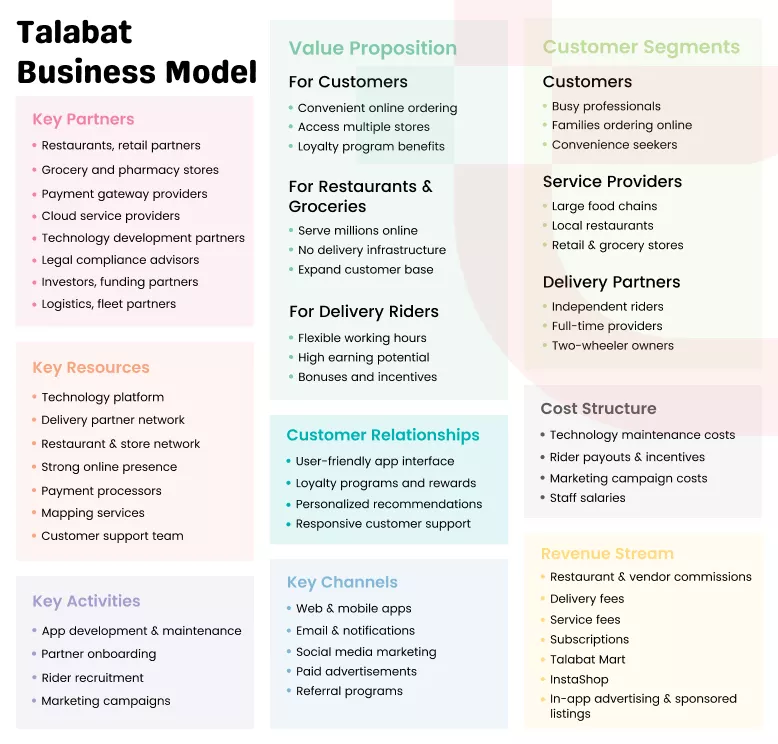
The Talabat business model operates as a multi-sided marketplace that connects customers with nearby restaurants and stores through a mobile application. Here is a detailed glimpse of key aspects of the model.
Key Activities
- Building and maintaining the web and mobile applications.
- Expanding the provider network by onboarding new restaurants and stores.
- Recruiting new riders with a proper authentication process.
- Conducting marketing campaigns to grow order volume and enhance the customer base.
Key Resources
- Technology platform to provide online ordering and delivery services.
- A strong network of delivery partners to deliver the ordered items on time.
- A network of local restaurants and stores offers different kinds of items.
- Powerful online presence in the market to build trust among customers.
- Reliable payment processors to enable secure online transactions.
- Mapping services like Google Maps can provide optimized routes to delivery partners, enabling faster deliveries.
Value Proposition
For Customers
- Provides convenience to order meals, groceries, and other essential items from the comfort of their space.
- They get access to local restaurants, supermarkets, retail stores, pharmacies, and more from a single application.
- Loyalty programs make every order affordable for customers.
For Restaurants & Grocery Partners
- They can serve millions of customers without having their own digital platform.
- As Talabat maintains delivery operations, they do not have to worry about delivery infrastructure.
For Delivery Partners:
- Flexible working hours allow them to operate according to their preferred time.
- Talabat’s large user base helps delivery partners earn more.
- Performance bonuses and incentives help delivery partners earn extra income.
Customer Segments
Customers:
- Individuals who prefer ordering meals and other essentials from applications rather than traveling physically to restaurants or stores.
- Professionals who find it hard to prepare meals or travel to markets due to busy work schedules.
- Families who want to order meals or shop for groceries online.
Restaurants/Retailers:
- Short- or medium-scale restaurants can increase their sales by joining the larger community.
- It’s an ideal solution for stores suffering from staffing shortages to fulfill their orders.
- Local restaurants and stores that want to serve online without investing in technology or delivery infrastructure.
- Easy business expansion across multiple regions.
Delivery Partners:
- An independent delivery partner who wants to work flexibly.
- Delivery partners who want to generate additional income.
Key Channels
- Web and mobile applications to allow online ordering.
- Emails and push notifications that keep customers aware of exclusive discounts and offers.
- Digital marketing campaigns, including SEO (Search Engine Optimization), SMM (Social Media Marketing), and paid ads, are being used to expand its business reach.
- Referral programs to grow the customer base.
Cost Structure
- Technology development and maintenance costs.
- Payouts and incentives for delivery partners.
- Expenditure for conducting marketing campaigns.
- Salaries of operational and support teams.
Key Partners
- Reliable technology provider to build and maintain the digital platform.
- Businesses like local restaurants, supermarkets, and retail chains need to enable online delivery.
- Payment gateway providers for secure online transactions within the app.
- Cloud service providers need to ensure future scalability with ease.
- Legal advisors help ensure compliance with local rules and regulations.
- Investors to provide funding for scaling operations and technological enhancements.
- Mapping and navigation partners like Google Maps and Mapbox for smart route optimization.
- Logistics and fleet operators to conduct delivery operations.
Customer Relationships
- Loyalty programs and rewards encourage customers to use the app frequently.
- Strong customer support ensures faster query resolution, thereby enhancing the overall user experience.
- Personalized product suggestions enhance the customer experience.
Want to Build an App Like Talabat? Let Our Experts Guide You to a Scalable Platform Designed For Long-Term Growth
How Talabat Works? – The Step-by-Step Order Flow
Understanding how Talabat works at an operational level is essential for entrepreneurs who want to build a similar platform. The workflow given below is not just a user flow, but a series of interconnected technical and commercial decisions.
Step 1: Customer Browses & Places an Order
- Customers open the app or website and enter their delivery location.
- Talabat’s app algorithm shows nearby restaurants and grocery stores ranked by relevance, ratings, estimated delivery time, and sponsored placement.
- The customer selects items and adds them to the cart, then applies a promo code or a Talabat Pro benefit and proceeds to checkout.
- Payment can be made via card, digital wallet, connected payment gateway, or cash on delivery.
Step 2: Restaurant Receives & Accepts
- The restaurant receives a real-time notification of a customer order through their Talabat partner dashboard.
- The restaurant confirms the order, and the estimated meal preparation time is displayed immediately on the customer’s live tracking screen.
Step 3: Assign Order to Delivery Partner
- Talabat’s proprietary dispatch system identifies the nearest available delivery partner based on GPS position, current workload, and calculated pickup time.
- The delivery partner receives the notification with the restaurant’s address, location, and order details.
- The delivery partner accepts the request and navigates to the pickup location.
Step 4: Pickup, Delivery & Live Tracking
- The delivery partner collects the order from the restaurant and navigates to the customer’s location.
- The customer can track the delivery progress in real time using the built-in navigation.
- Also, push notifications are sent at key stages: when the order is confirmed, when it’s being prepared at the restaurant, when it’s being picked up, when it’s on the way, and when it’s delivered.
Step 5: Payment Settlement & Rating
- If the payment method was online, the payment was already collected by the Talabat platform at checkout.
- The platform deducts its commission and settles the net amount to the restaurant on a weekly or monthly payment cycle.
- The customer is asked to rate both food quality and the delivery experience, and that data flows directly into the ranking algorithms that determine which restaurant and delivery partner gain or lose visibility.
How Does Talabat Make Money?
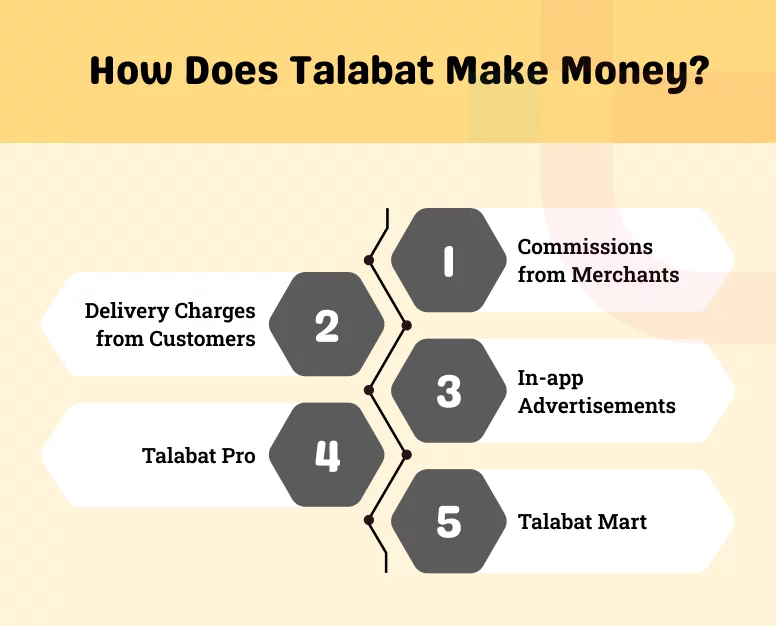
The Talabat revenue model generates income from multiple sources like commissions, subscriptions, and more. Let’s explore how Talabat makes money.
Commissions from Restaurants and Stores
This is the company’s primary source of revenue. Every restaurant or grocery partner is typically charged a commission of 15% to 30% on each order received through the platform.
The commissions are not fixed. It varies by order type, product category, and location. Moreover, if any restaurants or stores use Talabat’s delivery fleet, they must also pay a commission.
Delivery Charges from Customers
Talabat has no minimum order delivery requirement, so orders below the minimum can be placed without issue. However, the delivery charges can fluctuate based on the distance, order size, and demand.
In-App Advertising and Featured Listings
Most restaurants and other stores adopt a restaurant affiliate marketing approach, showcasing their app promotions on other platforms to expand their customer base.
Talabat charges a fee for those who want to appear at the top of search results and in banner ads in the app. This helps service providers enhance their visibility while creating an additional income source for Talabat.
Talabat Pro
Talabat Pro, a premium subscription program by Talabat, where the customers are required to pay as low as AED 19/month to enjoy unlimited free delivery from thousands of top-rated restaurants, Talabat Mart, and other specialty stores.
https://www.talabat.com/uae/campaign/pro
Moreover, in addition to these, the customer also gets a 2-week free trial, and they can cancel the plan anytime up to 24 hours before its renewal.
Talabat Mart
Instead of third-party stores and customers, Talabat operates its own dark stores across the regions. Here, the company earns direct retail margins while also collecting fees and service charges on every transaction.
What Future Does Talabat Hold?
Expand Talabat Grocery Mart
Supported by strong 2025 results, with GMV and revenue growth significantly increased and EBITDA hitting $615M, mainly driven by groceries and subscription services, the company plans to make over $100M in strategic investments for 2026.
The company has a main focus on optimizing its network of dark stores to ensure the availability of essential products. Also, Talabat is planning to integrate its technology and localized vendor network to enhance speed and offer a greater variety to customers.
To Become an “Everyday App”
With the growing popularity of super apps, the company is also planning to position its food delivery app as an everyday app in the MENA region.
Talabat aims to transition from a mere food delivery platform to one that people use daily. And so it is expanding its offerings to include groceries, pharmacies, and other services.
Expanding into Non-GCC Market
After building a strong presence in Kuwait and the UAE, the company plans to expand its operations into non-GCC markets, including Jordan and Iraq.
In this market, demand for online delivery solutions is growing extensively, which will likely help the company to strengthen its market position with ease.
Scaling Talabat Pro Subscription Across All 8 Markets
Talabat Pro is no longer just a “free delivery” perk for customers; it’s one of the core strategies that keep the company financially stable. By successfully launching its subscription program in Egypt and Iraq in 2025, the company has successfully introduced its plan across 8 markets, which will receive incremental investments to enhance value for both customers and vendors.
Moreover, for 2026, they plan to expand their multi-vertical subscriber base by enhancing the value proposition for Talabat Pro and scaling Talabat Mart, their grocery-integrated vertical.
How Elluminati Can Help You Build an App Like Talabat?
From a food delivery startup to a leading on-demand delivery platform, the Talabat business model is evolving its operations to become the everyday app for the MENA region. This transition at the company has inspired many entrepreneurs to enter the multi-delivery market.
However, entering a competitive market requires strategic and technical support, and that’s where Elluminati comes in. We have a team of professional developers who understand your pain points from the outset to create a Talabat clone that aligns with your target market requirements, helps you expand your business, and keeps you standing competitive with confidence.
FAQs
The Talabat business model primarily operates as a hyperlocal platform, connecting customers with vendors and delivery partners via a mobile application.
The Talabat revenue model generates income through five different channels:
- Commissions from restaurants and grocery vendors
- Delivery fees from customers
- In-app advertising and featured listings
- Talabat Pro subscription
Talabat charges restaurants approximately 15%-30% commission. However, the exact rate depends on the partnership type, order volume, restaurant location, and product category.
Talabat’s platform algorithm identifies the nearby delivery partner and sends them a notification. The rider receives a notification in the app and accepts the request; after that, the rider is assigned to complete the job.
Talabat Pro is a subscription plan where customers pay a recurring fee on a monthly or annual basis to avail of benefits such as free or fast delivery, exclusive discounts, and priority support. As subscribers pay the recurring amount, it helps Talabat generate predictable revenue.
Talabat Mart is Talabat’s grocery and convenience delivery vertical, operating from dark stores and offering targeted delivery times of under 30 minutes.
Talabat’s primary competitors include Deliveroo, Noon Food, and Careem.