Key Takeaways (or TL;DR)
- Demand for online vegetable delivery apps is rising due to increasing demand for fresh produce, low inventory needs, and opportunities.
- The most common types of vegetable delivery app business models include the inventory-based model, multi-vendor marketplace, hyperlocal delivery model, and farm-to-consumer model.
- To start an online vegetable delivery business, you should perform detailed market research, partner with local vendors, choose the appropriate business model, build a vegetable delivery app, and market it.
- The cost to start an online vegetable delivery app usually ranges from $10,000 to $300,000+, depending on factors like platform type, app complexity, and number of features.
- The vegetable delivery app revenue streams involve multiple sources like order commissions, delivery fees, vendor subscriptions, featured listings, in-app advertising, and premium membership plans.
- In the future, vegetable delivery apps can evolve with technological enhancements through AI-based demand forecasting, immersive shopping experiences, quick commerce deliveries, and the adoption of sustainable solutions like an electric fleet for delivery.
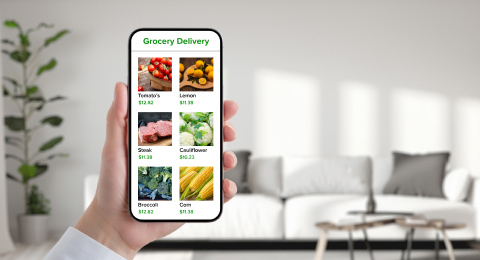
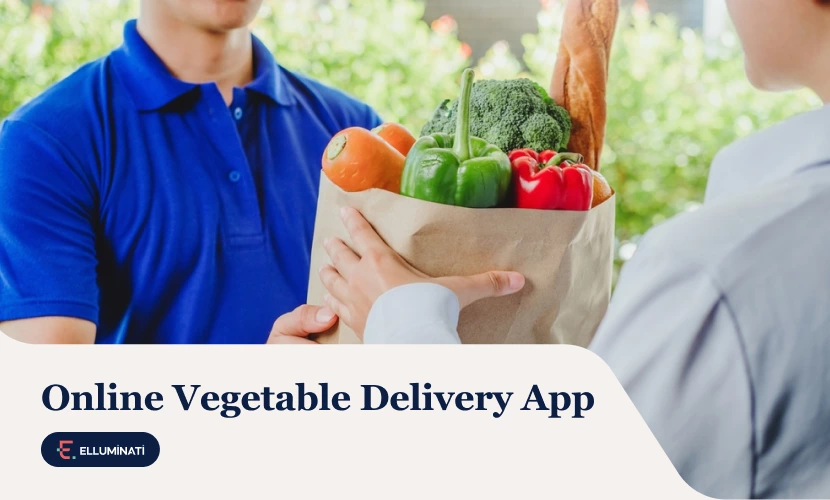
An online vegetable delivery app allows customers to order fresh veggies from nearby local stores, farmers, and vendors and get them delivered to their doorsteps.
With features like real-time order tracking and multiple payment options, these apps make the entire buying process simple and convenient. That’s the reason why they have gained immense popularity in urban and semi-urban markets.
If you are planning to enter this rapidly growing market, this article serves as a perfect guide to help you get started. You will get detailed insights about how to start an online vegetable delivery app, its business model types, revenue strategies, and future trends, so you can launch your business confidently.
Market Overview of Online Vegetable Delivery
Today, the grocery delivery market is growing exponentially as consumers prefer convenience and use more smartphones.
According to Business Research Company, the online grocery market size is expected to reach $1721.3 billion by 2030 at a CAGR of 21.3%. And in this, fresh produce, which includes vegetables and fruits, is considered to be the major growth driver.
This highlights a good opportunity for businesses aiming to start an online vegetable delivery business. Here is a quick look at the current scenario of the vegetable delivery market.
- As per the survey by Precedence Research, the global fresh vegetables market is predicted to increase to around US$957.38 billion by 2034, in which the online segment is expected to expand at a CAGR of 4.7%.
- Also, according to Business Research Company, the Asia Pacific is the largest region in the online grocery market, while North America is the fastest-growing region.
- According to Statista, the average revenue per user in the overall grocery delivery market, including vegetable delivery, is anticipated to grow to US$569.57 in 2026.
- As per the research by Capital One Shopping, 61% of US people shop for groceries online, which includes vegetables, fruits, and daily household essentials.
These market insights highlight how vegetable delivery apps are becoming an integral part of consumers’ daily needs.
Why Start an Online Vegetable Delivery Business?
Today, with the increasing demand for convenience and smartphone penetration, more people are switching to vegetable delivery apps instead of visiting markets physically. This makes it a core reason to start an online vegetable delivery app. Besides, there are several other reasons that tell businesses why they should invest in it.
Growing Demand for Fresh Produce Delivery
Customers are prioritizing their health more, and they are opting for fresh and organic veggies over processed ones. Most online delivery platforms offer same-day delivery, which ensures the freshness of the ordered veggies.
This rising demand becomes a good opportunity for businesses to build platforms for fresh produce delivery by bringing together vegetable suppliers and consumers on one platform.
Low Inventory Startup Options
To sell vegetables offline, businesses would require physical retail stores and an extensive on-site staff, which would increase operational costs. Moreover, it would also require larger inventories for stock preservation to ensure enough veggies are available for walk-in customers.
However, setting up inventories becomes expensive initially, especially for startups. But on-demand vegetable delivery businesses can collaborate with local farmers and fresh produce suppliers for vegetable supply. This eliminates the need for having larger inventories and reduces operational costs.
High Repeat Purchase Behavior
Unlike electronics and clothing, which customers buy occasionally, vegetables have regular demand. That’s why they need to be replenished again because customers are going to purchase them frequently every week or sometimes multiple times in a week.
The frequent demand makes customers repeat purchases, which ultimately helps businesses maintain order consistency.
Opportunity in Hyperlocal Markets
Physical stores limit businesses’ reach to specific operational areas and do not allow them to serve those living in nearby areas.
Online delivery platforms, on the other hand, work with a hyperlocal approach, which allows businesses to take orders from customers residing in neighborhoods and partner with local farmers, nearby stores, and wholesale markets. This approach helps businesses reach more customers.
Common Types of Vegetable Delivery App Business Models
Before you start planning to build a delivery platform, it becomes necessary to choose the type of business model you want to operate in. A business model is usually a strategic roadmap that describes how your digital solution will operate and generate revenue.
Every model operates uniquely depending on how they manage inventory, vendor relations, and logistics. Below are listed the most common types of models.
Inventory-Based Model
In this approach, businesses directly purchase veggies from farmers and wholesale markets and store them in their own warehouses or dark stores. Whenever a customer places an order, businesses pack the requested items from their inventory and deliver the order.
Pros:
As businesses handle storage and delivery operations, they are able to ensure higher vegetable quality and earn higher margins.
Cons:
It requires a huge investment in storage facilities.
Multi-Vendor Marketplace Model
This is one of the most popular business approaches. In this model, businesses connect customers with multiple available vegetable vendors through a digital platform. Vendors list their veggies on the app, and customers select and purchase their desired products.
Pros:
- Businesses only have to handle delivery operations as stocks are managed by the vendors themselves.
Cons:
- As vendors directly deliver the veggies, businesses cannot guarantee the product quality.
Hyperlocal Delivery Model
This on-demand business model enables businesses to serve a specific geographical area by connecting customers with nearby available vegetable vendors. The customer enters their location, and the platform finds and showcases the nearest supplier.
Pros:
- The hyperlocal delivery ensures faster delivery since businesses deliver veggies from stores that are nearest to the customers.
Cons:
- The success of this approach depends entirely on the availability of specific vendors and veggies.
Farm-to-Consumer Model
In this business model, businesses connect local farmers directly with customers through a mobile application. Farmers list their produce on the platform, and customers select the items according to their needs.
Pros:
- By sourcing veggies directly from farmers, businesses can deliver quality products that help them build a reliable brand image among customers.
Cons:
- It demands building a strong network of local farmers to ensure consistent quality and availability.
How to Start an Online Vegetable Delivery App Business: A Step-by-Step
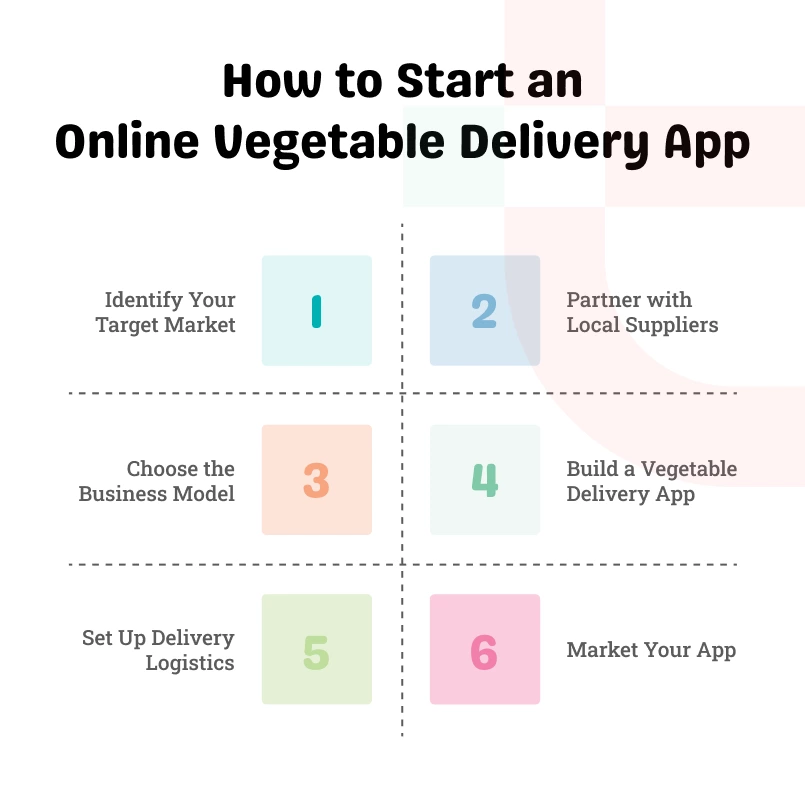
Starting a grocery delivery business, whether for vegetables or other household goods, requires careful planning and consideration, from choosing your targeted market and selecting the business approach to building an app and marketing it. Here is a complete 6-step guide on how to start an online vegetable delivery app.
Step 1: Identify Your Target Market
Before you start planning for app development, it is essential to first identify who your target audience would be. Will you target
- Residential areas, which are the largest customer segment, have a demand for fresh veggies every week.
- Restaurants that need to order vegetables in bulk every day to serve their customers.
- Corporate offices that have to order fresh veggies either for their cafeterias or employee meal services.
By choosing your customers early, you can plan for product types, serving locations, and revenue strategies effectively.
Step 2: Partner with Local Vendors & Farmers
Once you identify your target customers and location, the next thing that you need to do is to find and collaborate with local and reliable farmers, vegetable vendors, supermarkets, and wholesalers.
Strong partnerships allow you to maintain service quality and availability always, which ultimately helps in building long-term relationships with customers.
Step 3: Choose the Right Business Model
This is an important stage of the entire process. The model choice decides how your business will operate and generate revenue. You should select the model based on your goals and preferences.
For instance, choose an inventory-based approach if you have your own warehouses for storage, or you can opt for a multi-vendor solution if you want to offer delivery services without undergoing the hassle of managing stocks.
Step 4: Build Your Online Vegetable Delivery App
A web or mobile application is the heart of an online vegetable delivery business. Instead of loading your app with several features, make sure to create a user-intuitive platform with essential features like an easily navigable interface, secure payment processors, and real-time order tracking.
An easy-to-use application is far better than one that is difficult and confusing to use.
Step 5: Set Up Delivery & Logistics
The success of the on-demand vegetable business depends on the efficiency of delivery operations to a greater extent.
That’s why you build a strong delivery and logistics network by partnering with reliable delivery providers (drivers) and third-party logistics providers. Reliable delivery partners will help you fulfill orders on time, which will enhance customer experiences.
Step 6: Launch Marketing Campaigns
Once you have set up your online delivery business, the final step involves marketing it through different channels. In today’s era, digital marketing methods like SEO (Search Engine Optimization), social media campaigns, and paid ads help in boosting your brand visibility more effectively.
Start Your Online Vegetable Delivery Business with Elluminati’s Expert Guidance and Market-Ready Solutions
Must-Have Features of an Online Vegetable Delivery App
Features play an important role in the success of your vegetable delivery platform. That’s why it becomes crucial to understand the essential grocery app features.. Here are some core features you should include.
Customer App
- Real-time order tracking: Customers can track order status in real time through the map integrated in the app.
- Multiple payment options: The app offers flexibility to customers to make payments according to their preferences.
- Order scheduling: Customers can schedule vegetable delivery at their preferred time and date, offering ultimate convenience.
- Ratings and reviews: Users can rate their experience with specific
Vendor Panel
- Product catalog management: Vendors can add or remove products according to their needs.
- Inventory management: Vegetable vendors can track inventory in real time to avoid overstock or understock situations.
- Order acceptance: The platform gives authority to vendors to accept or reject the order request based on their availability.
- Multi-Tax System: Vendors get the flexibility for tax application, that is, they can either apply tax on each item or on the overall order value.
Admin Panel Features
- Vendor management: Admin can easily manage multiple vendors from a single dashboard efficiently.
- Map View: Integrated Google Maps makes it easy for admins to know the real-time location of vendors, customers, and delivery partners.
- Add Multiple Countries: Businesses can easily expand their services into different countries by adding multiple countries.
- Analytics dashboard: Businesses can have a detailed eye on earnings, sales, and other operations from a single dashboard.
Delivery Partner App
- Route optimization: The app is integrated with Google Maps, which allows delivery partners to track customers’ locations and provide faster delivery by route optimization.
- Accept/Reject Request: Delivery partners can accept or reject the delivery request based on their availability.
- Order notifications: The delivery providers receive the request immediately after a nearby customer places the order.
- Delivery status updates: Delivery partners can set different updates in real time, like “Picked Up” and “Delivered” as the order proceeds, to give updates to customers.
Technology Stack for Online Vegetable Delivery App Development
A technology stack refers to the set of programming languages, databases, APIs, and frameworks that are essential to build and run your application. The tech stack choice decides how your app will function and handle deliveries. The following are the important technologies you should include in your delivery platform.
Frontend Technologies
As the name implies, these technologies are used to build the front part of the application, which is used by the customers to interact while browsing veggies, placing orders, and tracking deliveries.
The most popular frontend technology for delivery applications is Angular. This framework helps programmers create applications quickly with higher efficiency.
Backend Frameworks
These frameworks are used to perform server-side operations like order processing, handling payments, managing users, assigning delivery partners, and storing product information. Node.js is one of the most common backend technologies used.
Cloud Infrastructure
As more users use your app, it becomes challenging for the platform to handle numerous queries, especially during peak times.
Cloud infrastructure ensures effective scaling by storing large amounts of data and handling increased traffic effectively without needing any physical data centers. Amazon Web Services (AWS), Microsoft Azure, and Google Cloud are used for on-demand delivery applications.
APIs & Integrations
Vegetable delivery apps require connecting with several external services like Google Maps, payment processors like Stripe, and push notification systems to ensure smooth operations. Integrating third-party services proves to be a more time-efficient and affordable way than building each functionality from scratch.
How Much Does it Cost to Build an Online Vegetable Delivery App?
The development cost for vegetable delivery apps usually ranges from $10,000 to $300,000+, depending on numerous factors like the number and type of features, platform type (Android or iOS), and app complexity.
For instance, an app with basic features like a user app, payment processors can cost around $10,000 to $40,000. At the same time, an advanced app with AI features can cost between $150,000 and $300,000+.
|
App Type |
Approximate Cost Range |
Features |
|
Basic |
$10,000 – $40,000 |
User registration/login, product listing, basic search & filters, shopping cart, secure payment gateway, order placement |
|
Mid-Level |
$40,000 – $150,000 |
Real-time order tracking, push notifications, delivery management, ratings and review system, multiple payment options, analytics dashboard |
|
Advanced |
$150,000 – $300,000+ |
AI-based demand forecasting, personalized recommendations, advanced analytics, route optimization, multi-lingual support, and add multiple countries |
A Quick Look into the Online Vegetable Delivery App Revenue Strategies
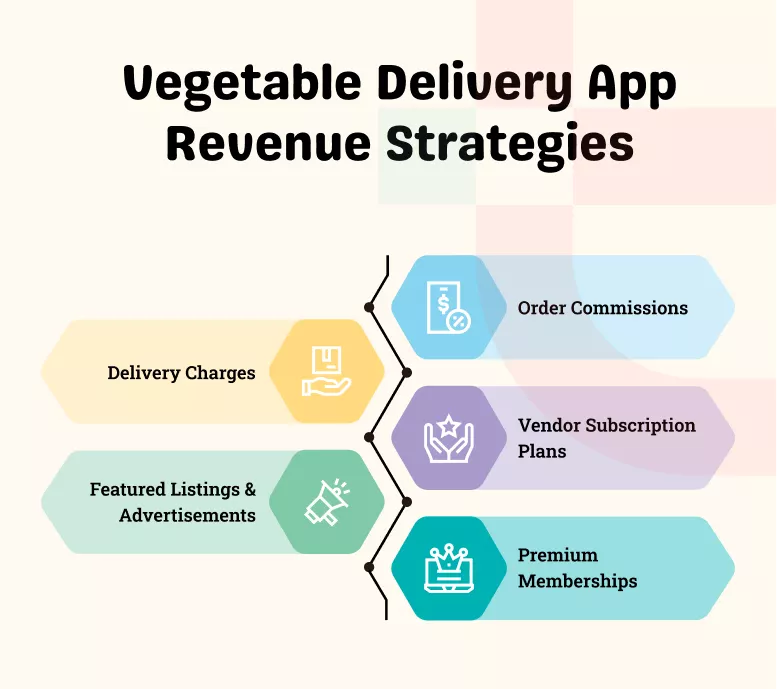
The vegetable delivery app generates income from multiple sources. Let’s have a detailed understanding of the vegetable delivery app’s revenue strategies.
Order Commissions
This is the primary revenue source of the on-demand vegetable delivery business. The platform charges a small percentage of commission to vendors for each order received through the platform. This strategy helps businesses earn from every order received.
Delivery Charges
Customers are charged a small delivery fee by the platform to receive ordered items at their doorsteps. However, these fees are not fixed. They vary depending on distance and order type. Delivery fees allow businesses to cover logistics and transportation expenses.
Vendor Subscription Plans
Many applications offer subscription plans for vendors where they pay a considerable amount on a monthly or annual basis to get access to benefits like advanced analytics tools or list a larger number of products.
Featured Listings and In-App Advertising
Many vendors are ready to pay a premium price to businesses to appear at the top of search results or promote their products through in-app advertising. This allows businesses to generate additional income opportunities besides earning from deliveries.
Premium Membership Plans for Customers
In this revenue model, customers pay a set recurring amount on a monthly or annual basis to the platform to get exclusive benefits like free delivery, prioritized service, and special discounts. This strategy helps businesses create stable income opportunities.
Launch Your Online Vegetable Delivery App Quickly and Affordably with Elluminati’s Proven Solutions and Strategies
Challenges Faced by the Vegetable Delivery Business
Although the online vegetable delivery business serves numerous benefits like access to a higher user base, it also poses different challenges for quality control, logistics, and customer experience. Here are some potential hurdles that businesses might have to face.
Managing Fresh Inventory
Vegetables have an extremely short shelf life. So, maintaining freshness on delivery is a major roadblock you might face. You can overcome this challenge by continuously tracking the inventory and sourcing veggies in small batches. This will help you ensure fresh inventory and also prevent product spoilage.
Delivery Logistics
Delivering veggies on time is very crucial to maintain their freshness. However, managing multiple orders simultaneously and assigning delivery partners can become difficult, especially during peak hours. In such scenarios, having a centralized delivery management system becomes very helpful, which automatically assigns a nearby delivery partner through smart matching.
Vendor Coordination
Many vegetable delivery apps have multiple vendors, like farmers, wholesalers, and local suppliers. So, sometimes it can become difficult to coordinate with multiple vendors simultaneously and ensure that the required products are available.
To avoid such a situation, you should have a centralized system where vendors update the stocks, and you can track them in real time.
Quality Maintenance
While ordering online, customers expect to receive fresh and good-quality veggies. However, ensuring quality consistency becomes challenging when you deliver vegetables from different vendors. So it is always better to perform timely quality checks and also build partnerships with trusted vendors.
Popular Online Vegetable Delivery Apps
Now let’s have a look at some of the popular online vegetable delivery apps.
Instacart
It is a well-known online grocery delivery platform in North America that offers same-day delivery and curbside pickups. The Instacart business model works as a three-sided marketplace that allows customers to order groceries and fresh vegetables from nearby stores through a digital platform.
The company’s partnerships with major retailers like Costco, Kroger, and Safeway help the platform ensure fast and same-day deliveries, which have allowed it to dominate the market.
Walmart Grocery
This famous delivery app uses Walmart’s extensive retail network to deliver groceries and fresh vegetables online. It follows a straightforward working approach where customers place orders by choosing a particular local store and desired items from the mobile app, and stores deliver the order with the help of assigned delivery partners.
Besides home delivery, customers also get the option to pick up their orders from nearby Walmart stores. The platform is widely popular for its affordable pricing and good quality and freshness of veggies.
Amazon Fresh
This is a grocery delivery platform that allows customers to order vegetables and groceries from local stores directly through their Amazon accounts.
Amazon Fresh is deeply connected with Amazon’s Prime membership programs, where customers receive the benefits of free delivery for a certain order value, encouraging frequent purchases.
Shipt
It is a same-day grocery delivery service that is known for delivering a personalized experience to its shoppers in a unique way. Customers order vegetables through the app, and a “Shipt Shopper” (the platform’s personal shopper assistant) picks and packs items from nearby retail stores and delivers them to the customer’s location.
The Shipt Shopper also often communicates with customers in real-time for item suggestions or substitutions. It basically works on a subscription model where customers pay a set recurring fee to access customized services.
FreshDirect
It is a prominent grocery and vegetable delivery service operating specifically in metropolitan areas of New York City and the East Coast regions. The platform is widely known for delivering high-quality fresh produce, prepared meals, and other household essentials.
The FreshDirect business model works on an inventory-based approach where customers order vegetables and the platform delivers items directly from its warehouse to customers’ locations. Its strong focus on quality has helped the company build long-term relations with its customers.
|
Popular App |
Business Model |
Delivery Approach |
Main Strength |
|
Instacart |
Multi-vendor marketplace connecting customers with nearby grocery stores |
Orders are picked from partner stores and delivered by Instacart delivery partners |
A large retailer network helps in fast delivery |
|
Amazon Fresh |
Integrated grocery delivery service within the Amazon ecosystem |
Groceries are delivered through Amazon’s logistics network |
Integration with Amazon Prime builds trust among customers |
|
Walmart Grocery |
Retailer-based model using Walmart’s own store network |
Orders are fulfilled from nearby Walmart stores and delivered by partners |
Affordable pricing with extensive store coverage |
|
Shipt |
Subscription-based marketplace with personal shoppers |
“Shipt Shoppers” pick items from local stores and deliver them to customers |
Delivers a highly personalized shopping experience |
|
FreshDirect |
Inventory-based model with centralized warehouses |
Orders are fulfilled from the company’s warehouses and delivered directly |
Strong focus on product quality and freshness |
Future Trends in Online Vegetable Delivery Apps
In the future, the online vegetable delivery apps are expected to focus on advancing with new technologies. The key emerging trends involve immersive shopping, quick deliveries, demand forecasting, and sustainability through an eco-friendly delivery fleet and packaging. Let’s have a detailed look at each future trend.
AI-Based Demand Forecasting
Since vegetables have a limited shelf life, it becomes essential for businesses to stock the right quantity of items to prevent wastage and spoilage. For this, artificial intelligence will be very helpful.
Businesses will be able to predict customer demand with the help of AI-powered data analytics tools and stock items accordingly. This will also allow businesses to ensure product availability during peak times.
Immersive Shopping via Augmented Reality (AR)
By delivering immersive shopping experiences, Augmented Reality (AR) technology helps businesses assure product quality and freshness to customers virtually.
Customers can have detailed 3D visuals of each product through their mobile phones. This will allow businesses to deliver real-life-like shopping experiences to customers while building trustworthy relationships.
Quick Commerce Deliveries
Quick Commerce is a major trend going on in the on-demand delivery industry. Also, customers today want their groceries and vegetables to be delivered quickly within a few minutes. That’s why more businesses are adopting a hyperlocal strategy by partnering with nearby local vendors and farmers to provide instant delivery.
Sustainability
Concerns for environmental sustainability are rising among both businesses and customers. For this, businesses are making efforts to reduce their carbon footprint by using eco-friendly packaging and encouraging delivery partners to use electric vehicles.
This strategy also helps businesses improve brand reputation among environmentally conscious customers.
How Elluminati Can Help You Build a Vegetable Delivery App
The online vegetable delivery market is growing rapidly, with customers preferring more convenience. By identifying the target market, choosing the right business model, and opting for the right technologies, businesses can easily launch a scalable and user-intuitive online vegetable delivery app.
If you are planning to build a digital platform for launching your on-demand delivery business, then Elluminati becomes your reliable technology partner. With 14+ years of experience in building on-demand solutions, our grocery app development company has gained expertise in understanding the market needs. With features like search filters, multiple payment options, e-wallet integration, and multilingual support, our apps allow businesses to launch and scale their vegetable delivery businesses easily.
FAQs
To start an online vegetable delivery app, you need to follow a step-by-step approach, which involves:
Step 1: Identify your customers
Step 2: Partner with local vendors and farmers
Step 3: Choose the right business model
Step 4: Build the delivery platform
Step 5: Set delivery and logistics
Step 6: Promote your services
The most common types of vegetable delivery app business models include:
- Inventory-based model
- Multi-vendor marketplace model
- Hyperlocal delivery model
- Farmer-to-consumer model
The online vegetable delivery app revenue strategies involve:
- Order commissions
- Delivery charges
- Vendor subscription plans
- In-app advertising and featured listings
- Premium membership plans for customers
Businesses can embed several features in the app according to their needs and goals. The most common features include order scheduling, search filters, multiple payment options, social sharing, and marking favorite stores for future purchases.
The app development cost usually ranges between $10,000 to $30,000+, depending on different factors like app complexity, number and type of features, platform choice (Android or iOS), and more.
Online vegetable delivery businesses have to face several operational hurdles, which include managing and maintaining fresh inventory, handling vendor coordination, and delivery logistics.
The emerging trends in the online vegetable delivery app industry include demand prediction, immersive shopping with AR, ultra-fast deliveries, and adopting sustainable delivery solutions like eco-friendly packaging and an electric delivery fleet.