Key Takeaways (or TL;DR)
- The online electric taxi market is growing rapidly due to increasing fuel costs and environmental concerns.
- An online EV taxi booking business offers several key benefits, like environmental sustainability, lower operating costs, and a competitive edge.
- Launching an electric taxi venture requires strategic planning involving market research, business model selection, EV choice, app development, and an easily accessible charging infrastructure.
- Government incentives like tax credits, rebates, and green mobility programs significantly reduce upfront costs.
- Smart charging infrastructure planning and management ensure your EVs remain operational and complete more rides.
- The overall cost to start an online electric taxi booking business ranges between $50,000 and $300,000+, influenced by numerous factors like fleet size, app development costs, charging infrastructure, and more.
- Partnering with Elluminati helps you launch your E-taxi app faster without breaking the bank.
Today, the rising fuel costs and environmental concerns are making gasoline-fueled vehicles costly for ride-hailing businesses. As a result, a greater number of businesses are opting for green mobility solutions.
EV-based taxi services combine eco-friendly transportation with digital convenience. However, the success of the business depends on strategic planning, choice of business model, mobile app, charging infrastructure, and more.
This article will take you through the complete process of how to start an EV taxi business online successfully, along with the key market trends, an overall cost estimate, and everything else that you need to start a successful electric taxi venture.
Latest Market Trends of Online EV Taxi Booking Business
The growing environmental awareness and continuously rising fuel costs have led to a significant growth in the global EV taxi market. This has opened great opportunities for businesses to start their next venture.
- The global electric vehicle taxi business is expected to grow from USD 27.5 billion in 2026 to USD 90 billion in 2035 at a CAGR of 14.1%.
- Further, according to Mordor Intelligence in 2025, the Asia Pacific has become the largest EV taxi market, with North America being the fastest-growing market.
- Also, the Philippines, Saudi Arabia, Brazil, and the UAE are the emerging countries for electric taxi business growth.
- According to Statista, EV market unit sales are expected to be 17.07 million vehicles in 2028.
These market insights are a testament to the huge potential for businesses in the electric taxi market.
How to Start an EV Taxi Booking Business Online: A Step-by-Step Guide
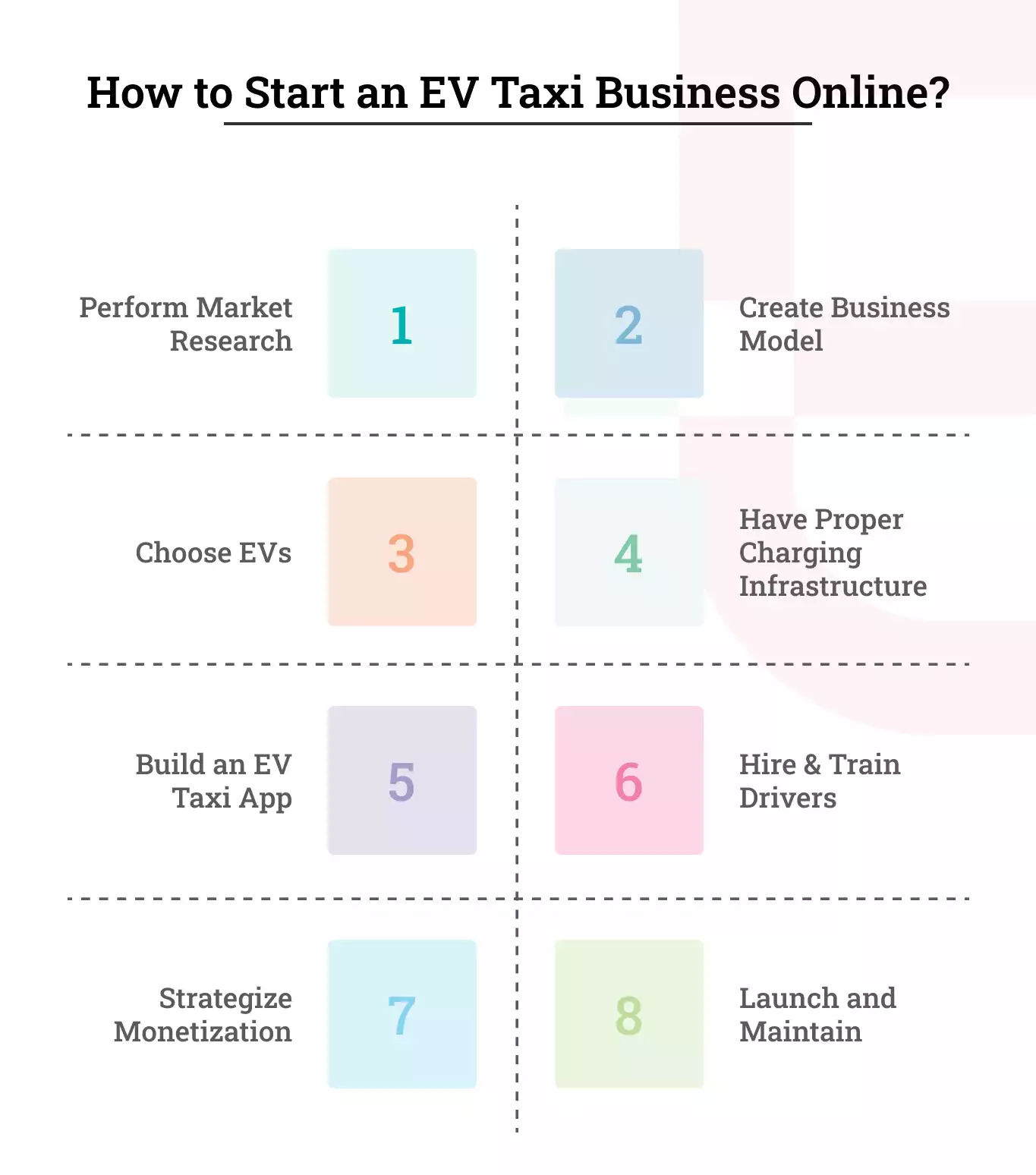
To launch an online electric taxi business, you need to plan strategically with the right choice of business models and vehicles. We have listed here the key steps involved in starting the business.
Step 1: Perform Detailed Market Research
Start by performing detailed market research of the electric taxi business. This includes:
- Determining how many people would opt for electric taxis in the area you desire to operate.
- Conducting detailed analytics of your competitors and existing EV service platforms to know where they are exceeding and where they are falling back.
- Understanding local regulations
- Knowing the availability of charging infrastructure in the desired area.
A thorough market evaluation will help you identify the potential risks early and align your business with the customer needs.
Step 2: Create the Appropriate Business Model
After researching the market, the next step involves choosing the appropriate business model. The model choice will greatly impact your business operations and overall revenue.
So, select the model aligning with your budget, operational capacity, market demand, target customers, EV performance, charging infrastructure, local regulations, and revenue streams. You can run your own fleet, partner with independent drivers, or even offer franchisee opportunities.
Here is a detailed look at different business models for your zero-emission taxi business.
| Business Model | How it Works | Who is it for? | Pros | Cons |
| Fleet Ownership | You run your own EVs | Enterprises | Complete control over operations and a higher margin | Needs high upfront vehicle and infrastructure investment |
| Driver-Owned Model | Partner with independent drivers who have their own EVs | Startups and aggregators | Low capital investment | Limited control over vehicle quality and service consistency |
| Franchise Model | Local franchise partners operate EV fleets under your brand and technology | Businesses aiming for multi-city expansion | Faster scaling, local market expertise | Revenue sharing, dependency on partner performance |
Step 3: Choose the Right EVs
The effective operation of the electric mobility business depends on the efficiency of its vehicles.
While choosing electric vehicles, make sure to consider factors like driving range, passenger comfort, battery life, and maintenance costs. The well-chosen EVs will help you deliver premium service quality and enhance customer experiences.
Generally, green ride-hailing businesses use electric sedans for city commutes, while electric SUVs are used for airport and premium ride services.
Step 4: Ensure Proper Charging Infrastructure
For on-time service fulfillment, electric vehicles need easy access to charging facilities. Traditional vehicles can be fueled in minutes at any gas station. But electric vehicles usually take around 30 minutes to several hours to charge, depending on the battery capacity and charger type.
Without proper access, drivers have to waste time looking for charging facilities, especially when they are scarce or located far from routes. This leads to unwanted higher operating costs and lower earnings.
Partner with public or private charging facilities available in your desired city. You can even create your own charging infrastructure in crowded places for fast and reliable access.
Step 5: Build or Opt for a Ready-Made EV Taxi App
The app plays a central role in managing E-taxi business operations. You can either build the EV taxi booking app from scratch or opt for a white-label taxi script.
Whatever option you may choose, make sure that your app is embedded with EV-specific features and functionalities like battery monitoring, charging station locator, route optimization, along with basic functions like taxi booking/scheduling, GPS tracking, and fleet monitoring.
Step 6: Onboard and Train Drivers
Not all your hired drivers will be well-versed in using the EVs or taxi applications.
Without proper training, drivers may drain batteries faster by improper driving or choose the wrong time for charging. Also, they may face difficulty in accepting or managing the ride bookings through the app.
So, train your drivers on operating the electric vehicles, managing charging, and using the driver app. Well-trained drivers ensure efficient operations, higher customer satisfaction, and higher profits.
Step 7: Create a Strong Monetization Plan
Generating profitable revenue is the ultimate goal for businesses. That’s why you should make sure to define all the possible revenue streams for your business beforehand.
This will include setting commissions on each ride for drivers and fleet owners, pricing during peak hours, and in-app advertising. You can even offer subscriptions for corporates and hotels. A strong monetization strategy will ensure long-term profitability for your taxi business.
Step 8: Launch, Monitor, and Optimize
After launching your on-demand EV business, regular monitoring is essential. Keep tracking ride demands, driver performance, customer feedback, and charging efficiency. This will enable you to improve your service and enhance customer experience.
Expert Tips
- Electric taxis reduce operating costs by 40-60% due to lower electricity costs and minimal maintenance.
- Corporate contracts and subscription models deliver 2-3X higher lifetime value compared to on-demand rides.
- Long-term profitability comes from operational discipline, not from rapid expansion.
Start your profitable EV taxi journey with Elluminati’s expert guidance and affordable app solutions.
Why Start an EV Taxi Booking Business?
Shifting from conventional vehicles to electric vehicles brings several benefits for businesses. Let’s look at the key benefits.
Lower Regulatory Risk
A large number of cities and states, like New York and Colorado, have started imposing emission-related restrictions on vehicles. Unlike conventional vehicles, EVs run on electricity backed by rechargeable batteries, releasing zero carbon emissions. This allows businesses to operate smoothly without facing any environmental compliance hurdles.
Long-Term Affordability
EVs run on electricity, which offers lower operating costs compared to petrol or gas. Moreover, electric vehicles have fewer moving parts compared to fuel-based vehicles, which reduces the frequency of maintenance costs. Low maintenance expenses make it easier for businesses to achieve better profit margins.
Government Subsidies and Incentives
To promote more usage of green mobility solutions, governments worldwide are offering various subsidies and incentives like purchase and operation rebates, tax exemptions, and EV charging support. These incentives help taxi businesses to cover initial setup costs in the early stages.
Competitive Advantage
Many countries have started taking measures to phase out combustion engine vehicles. In such scenarios, switching to EVs becomes the smart move for businesses.
Moreover, green ride-hailing solutions attract environmentally conscious customers and build long-term loyalty, serving as the biggest advantage in the competitive landscape.
Top 5 Industry Players in the On-Demand EV Taxi Business
Now let’s have a look at the leading taxi businesses that have marked a successful position in the green transportation market.
Uber Green
Uber Green was launched as a part of Uber’s global commitment to become a zero-emission mobility platform by 2040. It allows riders to choose between electric and hybrid vehicles.
Lyft Green
With its goal to become 100% electric by 2030, Lyft introduced Green mode in the app to allow customers to book electric taxis. This electric ride-hailing platform connects riders with nearby electric vehicles instantly while allowing drivers to reduce fuel costs and achieve more profits with ease.
Didi Chuxing
Chinese ride-hailing network Didi Chuxing, which is considered to be one of the world’s largest on-demand taxi networks, launched an electric vehicle option with an aim to support China’s push towards eco-friendly mobility and also to acquire a competitive edge in the mobility market.
Ola Electric
The leading giant in India’s ride-hailing market, Ola, introduced an electric taxi option to comply with the government’s sustainability goals and to improve the operational efficiency of drivers.
BluSmart
It was launched as a fully electric hailing company in 2019. The main goal of BluSmart was to provide a zero-emission transportation alternative to tackle the growing environmental issues with ease.
How will your E-Taxi Booking Business Generate Revenue?
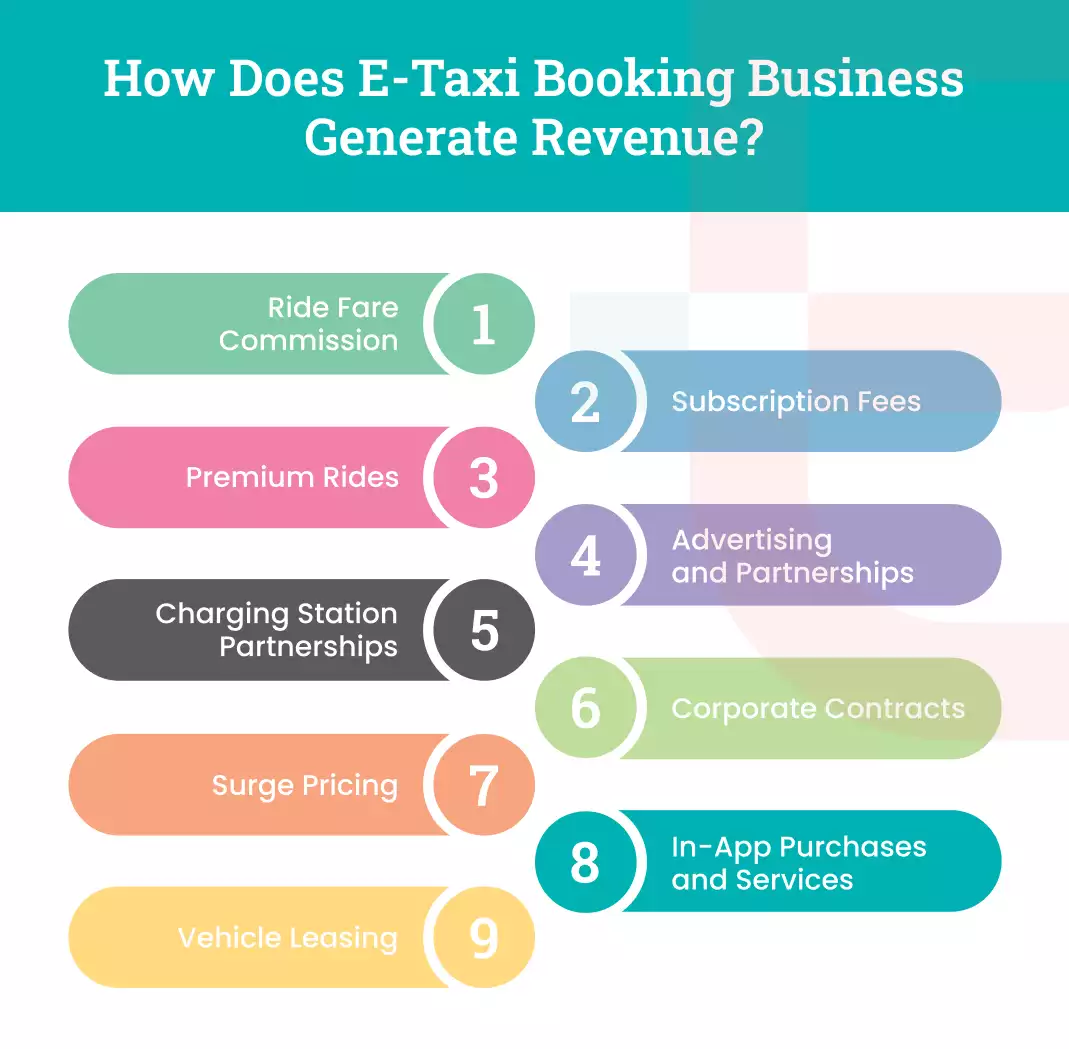
When planning to start an online EV taxi booking business, having a key understanding of how your business will generate revenue is important. Here are the different revenue models that work well for any E-taxi business.
Ride Fare Commission
This is the most common revenue generation practice followed by sustainable mobility businesses. Every time a passenger completes a ride, the taxi booking platform deducts a percentage of the fare before paying the drivers.
Subscription Fees
Instead of charging commission per ride, drivers pay a set recurring fee on an annual or monthly basis to access the platform, ride requests, and charging infrastructure.
Premium Rides
Many customers are willing to pay an extra amount for VIP travel experiences and luxury EVs. You can take advantage of this by charging higher for premium services, creating higher profit margins compared to economy rides.
Advertising and Partnerships
As the user base of your E-taxi app increases, it becomes a valuable digital asset for third-party businesses. You can allow EV brands, charging stations, maintenance services, insurance providers, and more to promote their offerings through in-app banner advertising. This creates an extra income source for taxi businesses by charging for ads per click or for a fixed duration.
Charging Station Partnerships
Smooth operation of electric taxis relies heavily on easy charging access. Frequent charging costs can significantly increase the operational expenses, especially when you have your own electric vehicles.
To balance this, you can partner with local charging station providers. These partnerships allow drivers to charge vehicles at lower costs, which ultimately helps businesses reduce operational costs.
Corporate Contracts
Many companies need reliable and eco-friendly cab services for their employees, guests, or events every year. That’s why instead of booking or scheduling each ride, they would partner with trusted electric taxi booking services.
Corporate contracts are usually created on fixed pricing or monthly billing terms, creating a steady revenue opportunity for electric ride-hailing businesses.
Surge Pricing
During peak hours, festivals, events, or bad weather, customer demand often exceeds the supply of drivers. And these are the times when customers are ready to even pay extra for the rides. During this, electric mobility businesses increase the fares. This allows both drivers and businesses to earn a good profit share.
In-App Purchases & Services
Some passengers will be ready to pay an extra amount for convenient and personalized ride experiences, such as faster booking or pickup, preferred driver, in-car Wifi or entertainment library, and more. This allows businesses to charge extra for custom services to the total fare.
Vehicle Leasing
Sometimes drivers want to partner with electric taxi businesses, but they cannot afford to purchase EVs. In such scenarios, businesses rent vehicles to drivers or franchise partners in exchange for a monthly or annual lease fee.
Cost to Start an Online EV Taxi Booking Business
The overall cost to start an electric taxi business depends on numerous factors like fleet size, app development type, local regulations, infrastructure cost, and so on. Here’s the complete breakdown of major costs involved.
| Factors Influencing the Cost | What’s Included | Estimated Cost | On What Does it Depend |
| Electric Vehicle (EV) Cost | Vehicle purchase, battery, basic accessories | $30,000 – $80,000+ per vehicle | EV model, battery capacity, and driving range |
| Taxi App Development | Ride booking, GPS tracking, digital payments, battery status display, charging station locator, battery-based route optimization, analytics dashboard, and AI-powered demand prediction | $10,000 – $100,000+ | Development timeline and number of features to be added to the app |
| Licensing & Permits | Business registration, local transportation permits, and taxi medallions | Varies by city or state | Local regulations |
| Charging Infrastructure | Own chargers (Level 2 / DC fast chargers), installation, maintenance, partnerships with public chargers | $1,000 – $5,000+ per station | Number of chargers, charger type, installation cost |
| Operations | Driver recruitment, training, salaries, commissions | Varies by fleet size | Number of drivers and route coverage |
| Marketing | Digital ads, SEO, social media campaigns | $5,000 – $20,000 | Marketing channels and targeted market |
Build Your EV Taxi App Effectively and Affordably with a Team that Understands Real Ride-Hailing Operations.
Legal and Regulatory Compliance for Starting an Online Electric Taxi Booking Business
To start an online EV taxi booking business successfully, adhering to standard legal, transportation, and digital regulations is paramount. So, below is the breakdown of key legal and regulatory norms you need to follow before launching your business.
Business Registration and Transportation Licensing
Before operating your green mobility business, it is mandatory for it to get legally registered and authorized for transportation services.
- Your company should be registered as a legal entity, like an LLC or a private limited company, to open bank accounts and partner with drivers, charging providers, and EV services.
- To connect drivers and passengers through a digital platform, you must obtain a TNC (Transportation Network Company) or aggregator license from the relevant state authority.
- Many cities require local city permits or medallions to operate electric vehicles commercially. These requirements may vary by location. So, check your local transport authority rules.
- Besides personal auto insurance, you must have commercial livery or TNC insurance to cover vehicle damage, passenger injury, driver liability, and any third party involved in accidents during active ride periods.
EV-Specific Regulations
Electric vehicles and their charging operations have specific mandates that need to be followed by eco-friendly ride-hailing businesses.
- Many regions, like California, have issued zero-emission transportation mandates. Under these rules, businesses have to operate a completely electric fleet and meet emission reduction targets. Adherence to such mandates allows businesses to receive incentives and tax benefits from the government.
- In case of installing your own private charging station, it is necessary to comply with local safety and installation standards. This mainly includes IEC standards for EV chargers, ISO safety guidelines, local fire safety rules (NFPA 70), and the use of UL-certified charging equipment.
- Charging large fleets would require faster DC charging, which would need coordination with local electricity utilities. This will help you manage energy usage and prevent higher electricity bills.
Data Security and Digital Platform Rules
Since your electric taxi booking business will operate digitally, it will be required to comply with digital platform and data privacy norms:
- As your E-taxi app will store sensitive data like user location and payment details, adherence to regulations like GDPR or CCPA will safeguard your data from cyber threats.
- Your electric taxi booking mobile app must follow Google Play and Apple App Store policies related to user content, payments, and subscriptions, as listed on them.
Driver & Vehicle Regulations
Not just your business but your hired drivers and EVs must also comply with certain legal regulations to ensure passenger safety.
- Drivers should have a driving license, background verification, medical certifications, and any other ride-hailing certifications required by local authorities.
- Your electric vehicles must pass through regular mechanical inspections, which include battery health checks and taximeter accuracy. Besides, they should also meet certain safety regulations for fleet adoption, which vary by state.
Government Incentives for EV Taxi Booking Business
Starting an E-taxi business becomes much more affordable with government-backed incentives. Here’s a detailed overview of the different incentives available at both the federal and state levels.
Charging Infrastructure Tax Credit
Governments offer a federal tax credit to businesses to install charging stations for their fleet. This includes expenses related to charging equipment, hardware upgrades, and installation costs. These credits help in reducing the overall cost of building charging infrastructure for the electric fleet.
For instance, in Delaware, you receive a rebate of up to $2,500 per port for the purchase and installation of Level 2 EV charging stations. And New Jersey provides grants of up to $4,000 for the purchase and maintenance of Level 2 chargers.
EV Purchase Rebates
Many states, like Illinois, Florida, and California in the US, offer direct financial incentives to purchase EVs for commercial purposes, for example, for ride-hailing services. These rebates help businesses reduce the overall upfront costs required for electric fleet acquisition.
Green Mobility Support
To promote eco-friendly transportation, numerous states and cities across the world provide regulatory support to ride-hailing businesses. This mainly includes faster permit approvals and lower license or registration fees for businesses. The major states providing green mobility support in the US include New York, Colorado, California, and Washington.
NEVI Program Funding
The National Electric Vehicle Infrastructure (NEVI) program is focused on supporting the expansion of charging infrastructure across highways and urban areas. The funding covers 80% of the total cost of the charging infrastructure. While funding is issued to charging providers, taxi businesses benefit from having easy access to charging stations for long-distance rides.
Charging Infrastructure Planning for Electric Taxi Business
A well-planned charging infrastructure is essential for running your e-taxi business without operational headaches. Here are the key aspects that ensure smooth charging for your electric taxi fleet.
1. Analyze How Drivers Prefer Charging
Before you start planning for the charging setup, you need to take a moment to understand when and how often drivers prefer charging vehicles. Some would charge between rides, others charge when there are fewer ride requests, and a few would charge after completing long rides.
By having a detailed analysis of busy hours, quieter periods, and common charging stations, you can easily plan the charging access without disrupting the operations.
2. Partner with Existing Charging Stations
It’s not possible to have your own charging stations everywhere in the city. If drivers have to rely completely on their own chargers, they may waste time waiting in queues or travel far just to charge their vehicles. This will lead to fewer ride completions. So it will be better to use public charging stations or partner networks available in the city.
3. Choose the Right Charging Solutions
All EV chargers are not the same. They vary in terms of charging capacity and speed.
- Level 1 chargers are very slow with a 120V household outlet, which is why they are best suited for overnight charging.
- Level 2 chargers use a 240V outlet for faster charging. They become perfect for drivers operating on city routes.
- Rapid DC (Direct Current) chargers are the fastest chargers, which can be used in congested areas where every second counts.
Using the combination of these chargers will provide high-end flexibility to the drivers to charge according to their convenience.
4. Maintain the Charging Infrastructure
Once your charging infrastructure is in place, it’s necessary to maintain it regularly for smooth operations. Perform regular checks for charger performance, usage, and downtime, and schedule repairs in case you find any issues. This will ensure smooth operations for your electric fleet.
Common Challenges to Start an Online EV Taxi Booking Business
While the market of green ride-hailing businesses holds a huge potential for success, there are several challenges that you may face when launching your business.
High Capital & Costs
Setting up your electric fleet, charging infrastructure, and ride-hailing operations will require significant initial investment.
Charging Infrastructure
EVs need reliable charging access. However, charging stations are not currently as widespread as traditional fuel stations. This limitation can easily disrupt the fleet availability and ride operations.
Range Anxiety
The drivers may constantly worry about the battery running out before reaching the destination, which can easily impact their operational efficiency and customer satisfaction.
Charging Time
Even the fastest DC chargers take longer to charge EVs, resulting in costly downtime for businesses.
Battery Concerns
EV batteries degrade over time due to internal chemical changes from factors like heat, calendar aging, and charge/discharge cycles. This will reduce the vehicle’s operating range and increase maintenance costs.
Driver Adoption
Not all drivers are familiar or comfortable with EVs. Moreover, some might even be concerned about battery life and charging infrastructure. That’s why they might be hesitant to adopt EVs.
Regulatory Hurdles
Rules and regulations for electric vehicles vary from country to country and city to city. Some regions might have complex licensing processes and limited EV support policies, which can increase paperwork and slow down business setup.
How Does Elluminati Help You Start an EV Taxi Booking Business Online?
Starting an online EV taxi business requires more than simply having electric vehicles. Success largely depends on having a high-performing app without overspending on technology. However, most businesses, especially startups, struggle with how to start an EV taxi booking business online with the right technologies affordably.
Elluminati simplifies this journey by providing high-end taxi app solutions without breaking the bank. From consultation and planning to developing an advanced EV taxi platform, our taxi app development company ensures businesses can operate profitably from day one.
FAQs
An electric taxi business can become profitable with careful planning, the right business model, a high-performing app, smart pricing strategies, efficient charging management, and multiple revenue streams.
The cost to start an online electric taxi business ranges between $50,000 and $300,000 or more, depending on different factors like fleet size, app development approach, charging infrastructure, operational and marketing costs, and fleet management.
You can either lease EVs or partner with fleet owners and launch your electric taxi venture, depending on the business model you choose.
The EV taxi booking app includes features like ride booking, battery status monitoring, charging station integration, route optimization, secure payments, and GPS tracking.
The main difference lies in the operating costs. The electric taxis rely on electricity rather than fuel, which lowers operational costs. Besides, EVs involve a battery, motor, and associated electronics, which require minimal maintenance.