Key Takeaways (or TL;DR)
- OpenTable simplifies restaurant reservations through a fast, digital booking system.
- The OpenTable business model follows an aggregator approach by connecting diners with restaurants through an app.
- Customers can search restaurants, check availability, and reserve tables in real time.
- Restaurants benefit from better table management and reduced booking conflicts.
- The OpenTable revenue model is based on multiple streams, such as subscription fees, service fees, referral fees, and advertising charges.
In today’s digital era, restaurant reservations have evolved from manual phone-based systems to online platforms. And in this changing landscape, OpenTable has emerged as a leading solution. It helps diners find a restaurant and reserve a table based on availability, while it makes it easy for restaurants to manage bookings and operations.
By simplifying reservations and their management, the platform is creating value for both customers and service providers. That’s why understanding the OpenTable business model becomes important for businesses considering implementing a similar technology-driven platform.
This article will give you a detailed glimpse of how OpenTable works, its business model, and revenue streams.
What is OpenTable?
OpenTable allows people to reserve a restaurant table in advance through an online booking system. It has surely changed the way restaurant managers manage their bookings. It was launched in 1998 by Chuck Templeton, Sid Gorham, and Eric Moe in California.
The idea came from Templeton’s personal experience, where his wife spent nearly 3 hours booking a restaurant by making several phone calls and voicemails. This frustration underscored the need for a digital solution to streamline restaurant bookings.
Initially, OpenTable was launched as easyeats.com, Inc. But it was rebranded as OpenTable in 1999 after witnessing a rapid rise in its adoption. Today, the company operates in over 80 countries with a network of over 60,000 restaurants worldwide. The US, Canada, Japan, Mexico, Germany, and the UK are the key markets of its operations.
OpenTable - Facts, Funding, and Growth Timeline
Brand Name: OpenTable Inc.
Founder: Chuck Templeton
Founded in: July 1998
Headquarters: San Francisco, California, USA
Services: Table reservation
Area Served: Worldwide
Parent Company: Booking Holdings
Stock Symbol: BKNG on NASDAQ
Total Funding: $48 Million
Listed Restaurants: 60,000
Funding Insights of OpenTable
|
Year |
Investors |
Funding Amount |
|
May, 1999 |
Venture Frogs, Draper Richards, Kaplan Foundation |
$2 million |
|
Jan, 2000 |
Benchmark, Impact Venture Partner |
$10 million |
|
Oct, 2000 |
Impact Venture Partners, Benchmark, Integral Capital |
$36 million |
Source: Crunchbase
A Look into OpenTable’s Success Timeline
- 1998: Was launched as easyeats.com by Templeton in California, US
- 1999: Was rebranded as “OpenTable” because of its rapid adoption
- 2001: Expanded its operations to 50 new US cities, even though it was not profitable yet.
- 2005: European Hotel reservation website acquired for $133 million in cash.
- 2009: The company went public and launched its first IPO on the NASDAQ stock exchange under the symbol OPEN
- 2010: Acquired the UK’s restaurant reservation venture, Toptable
- 2021: Launched “Experiences” on its platform to allow restaurants to offer prepaid events like tasting menus and wine pairings.
- 2024: It partnered with Visa to launch its Visa Dining Collection program, in which the eligible cardholders were offered access to primetime reservations and events at select restaurants.
- 2025: Introduced AI-powered features like AI Concierge to resolve common diner queries related to menus, dietary, and seating instantly.
How OpenTable Works?
OpenTable operates as a two-sided platform that connects diners with restaurants through a booking system. Let’s see in detail how OpenTable works.
For Diners:
- Users initially search for restaurants based on location, budget, and cuisine type.
- After choosing the restaurant, they can select their preferred time and table and confirm the booking by paying digitally.
- The platform confirms the booking instantly, and users can either modify or cancel the reservation anytime through the app.
- After dining, users receive special reward points which they can redeem for exclusive discounts in future bookings.
For Restaurants:
- Restaurants initially register on the app by uploading photos, menus, and table layouts.
- The platform provides a live floor plan, which allows restaurants to manage bookings, move tables, and even handle walk-ins.
- The app allows restaurants to monitor table status and guest spending by integrating with modern POS (Point-of-Sale) systems like Lightspeed.
- Detailed insights about guest history help restaurants identify customers’ special occasions and seating preferences, which ultimately help them deliver personalized experiences.
A Dive into the OpenTable Business Model
Now, let’s understand the key components of its business model.
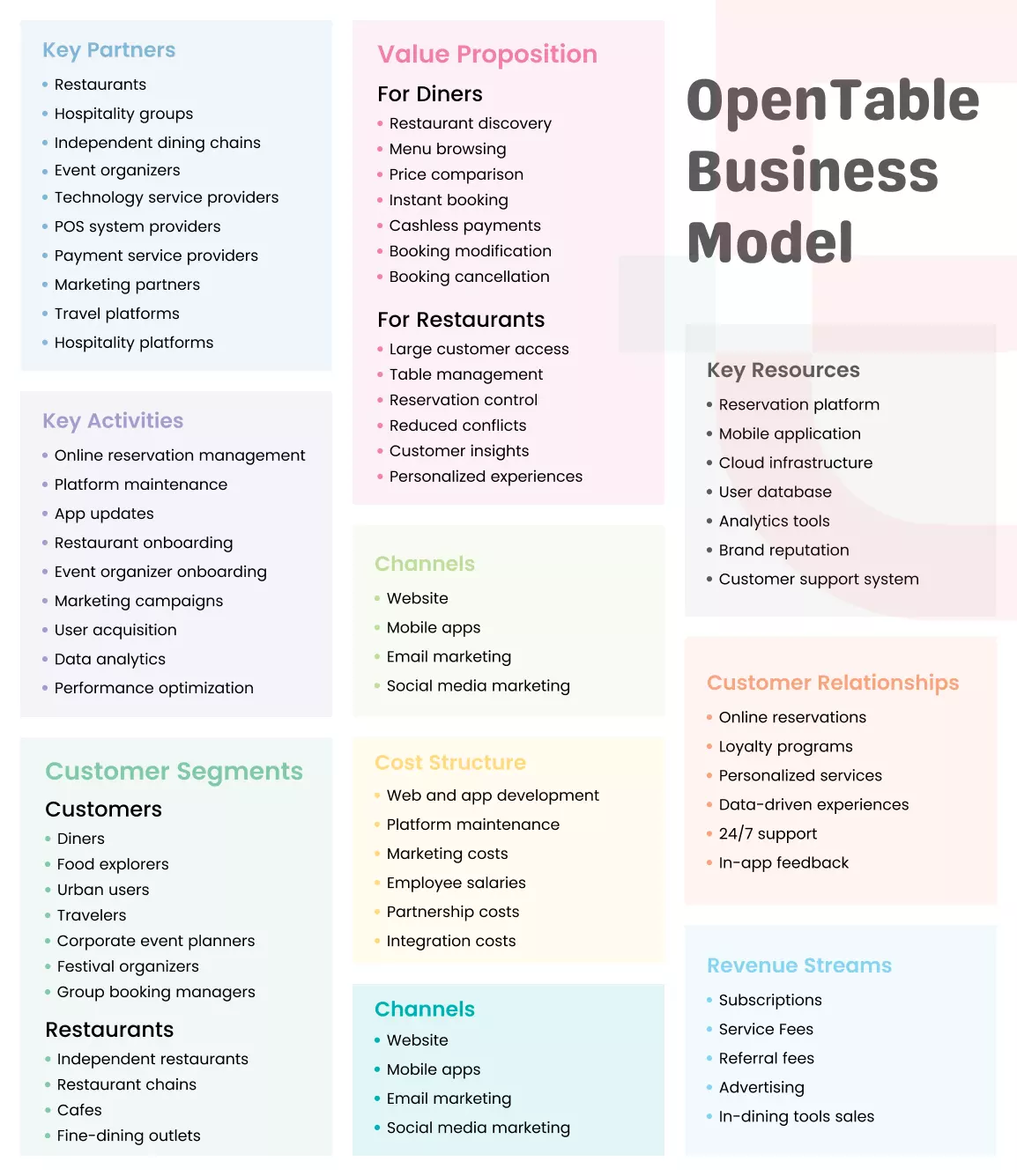
Key Partners
OpenTable partners with multiple stakeholders to operate effectively.
- Restaurants, hospitality groups, and independent dining chains are allowing online table reservations.
- Event organizers who require the platform to manage bookings during special events.
- Technology service providers for app development and maintenance.
- POS system providers for better integration
- Payment service providers enable secure online transactions.
- Marketing partners to promote restaurant services and their offerings.
- Travel and Hospitality platforms to reach potential diners in hotels, airlines, and tourism apps.
Key Activities
The core operations performed by the platform for smooth running include:
- Managing online reservations effectively to ensure table availability.
- Maintaining the booking platform and app for a smooth user experience.
- Extending the network by onboarding new restaurants and event organizers.
- Conducting online and offline marketing campaigns to increase the user base.
- Using data analytics to improve app performance.
Value Proposition
The platform provides a convenient way to reserve tables for diners, while for restaurants, it becomes a way to enhance their customer base and also manage bookings.
For Diners
- Allows for the discovery of different restaurants across cities quickly, along with their menus and price ranges.
- Instant booking confirmation makes restaurant reservations convenient and hassle-free.
- In-app payment systems enable cashless payments.
- The app provides complete flexibility by allowing you to modify or cancel a booking at any time.
For Restaurants
- Provides access to a large customer base.
- The management system helps restaurants manage tables efficiently and reduce reservation conflicts.
- In-app data analytics allow for understanding customer behavior and delivering personalized experiences.
Key Resources
The platform requires several key resources for efficient functioning.
- A restaurant reservation system and mobile app to allow online table bookings.
- Cloud infrastructure for data hosting.
- User data and analytics tools to gain performance-based insights.
- Strong brand reputation to build user trust.
- A customer support system to solve user queries and disputes instantly.
Customer Segments
Customers:
- Diners, food explorers, and travellers use the platform to search for restaurants, menus, and book tables based on real-time availability.
- Event planners organizing events for corporations and special occasions can use the platform for group bookings in desired restaurants.
Restaurants:
OpenTable helps restaurants manage bookings efficiently, attract more customers through promotions, and ensure proper utilization of tables.
Customer Relationships
OpenTable builds long-term relations with its customers.
- Makes restaurant reservations convenient and quick through a booking platform.
- Loyalty programs encourage diners to use the platform again.
- Data analytics help deliver a better dining experience.
- 24/7 customer support enables instant help whenever users need it.
- An in-app feedback system helps improve service quality.
Channels
The restaurant reservation system reaches its users through different channels.
- Website and mobile apps to acquire online users.
- Email marketing for special offers and timely reminders.
- Online ads help in increasing platform awareness and acquiring more users.
- Digital marketing strategies like SEO and social media marketing help boost online presence.
Cost Structure
OpenTable incurs several operational costs that involve:
- Web and app development and maintenance
- Server and hosting costs are needed to handle data effectively.
- Marketing and promotions to attract more users.
- Employee salaries and operational costs.
- Costs of different partnerships and integrations.
- Transaction fees during payment processing
Streamline Restaurant Bookings and Operations with Elluminati’s Proven OpenTable Clone
OpenTable Revenue Model: How Does It Make Money?
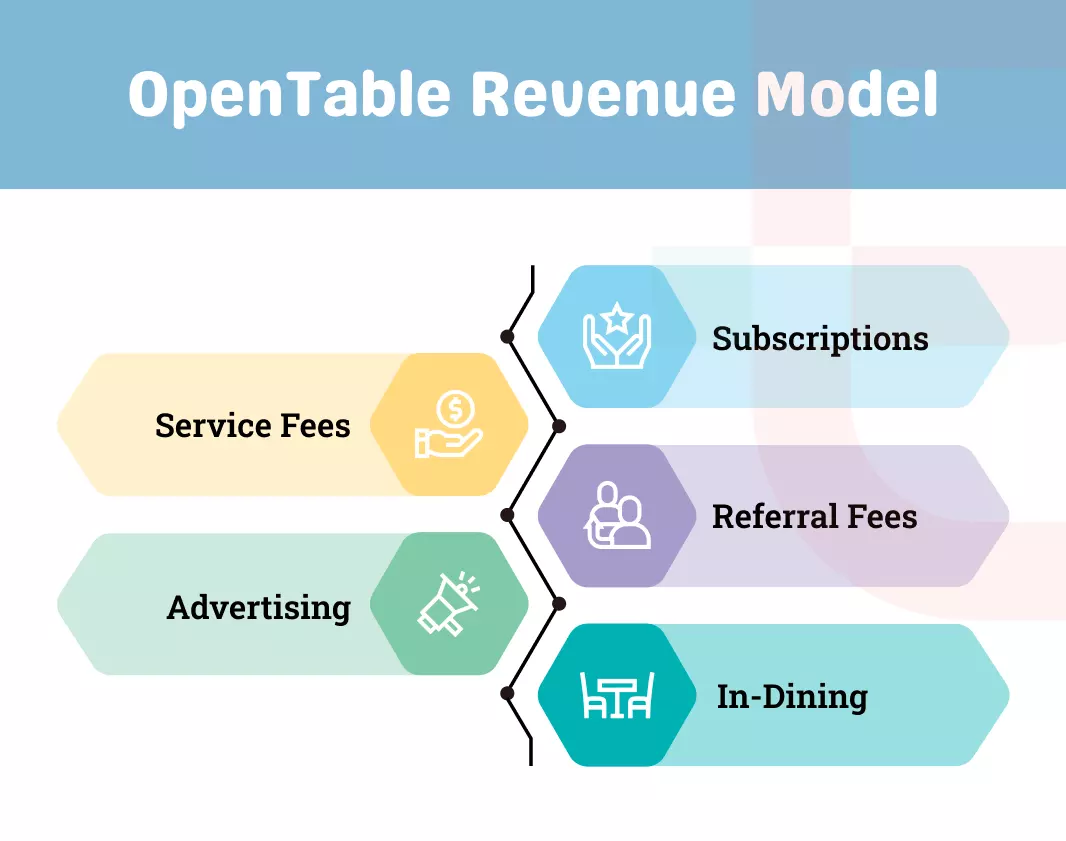
OpenTable generates revenue through multiple streams like subscriptions, advertising, and referral fees. Let’s have detailed insights into how OpenTable makes money.
Subscription
It is considered to be the main revenue source of OpenTable. In this, restaurants pay a fixed monthly or annual fee to use their services. The company basically offers three plans: Basic ($149/month), Core ($299/month), and Pro ($499/month). Each plan offers different features and benefits, and restaurants choose the plan based on their needs.
Booking & Service Fees
The platform charges a small percentage of service fee for every reservation made through the platform. The service fees vary depending on whether the reservation is made directly from OpenTable or from its partner channels. This allows the platform to earn from every booking confirmed for the restaurant.
Referral Fees
OpenTable earns money by directing users to third-party service apps. This includes food delivery apps, hotel websites, and event booking platforms. When a user books any service through these links, OpenTable earns a small commission from the businesses.
Advertising
OpenTable allows restaurants to promote their services through paid advertising options. In-app advertising allows the restaurants to appear in premium, featured, or promoted spots, allowing them to extend their reach. In return, OpenTable charges a fixed amount.
In-Dining
The platform also generates revenue by offering in-dining tools to restaurants. These tools include features like guest management, data analytics, and customer engagement, which are helpful to restaurants to enhance customer experiences and streamline operations. That’s why they are ready to pay even extra for such premium solutions.
How Elluminati Helps You Build a Restaurant Reservation Platform Like OpenTable?
The OpenTable business model demonstrates how technology can simplify restaurant reservations while creating a strong business opportunity. A well-designed reservation platform can benefit both diners and restaurants by improving accessibility and operational efficiency.
If you are an entrepreneur considering building an app similar to OpenTable, choose Elluminati as your food delivery app development company. We hold 14+ years of experience in building restaurant and on-demand solutions. By using modern technologies, we help businesses streamline everyday operations like online ordering, reservations, payments, and restaurant management, leading to a more efficient and scalable dining platform.
FAQs
OpenTable allows diners to search restaurants and book tables instantly through an app. Restaurants use the application to manage reservations efficiently.
The OpenTable revenue model is based on multiple streams, including subscriptions, service fees, referral fees, advertising, and in-dining tools.
OpenTable operates globally, serving restaurants and diners across multiple countries, including the United States, Canada, the UK, Australia, and many other international markets.
OpenTable allows diners to reserve restaurant tables. And for restaurants, it allows a complete solution for reservation management, POS integrations, guest insights, and marketing tools.