Key Takeaways (or TL;DR)
- The market for taxi booking apps in Southeast Asia is expanding rapidly, driven by increasing urbanization and smartphone adoption.
- Leading taxi apps in Southeast Asia include Grab, Gojek, Xanh SM, ComfortDelGro, Blue Bird Group, Bolt, InDrive, Maxim, Tada Mobility, and Mai Linh Group.
- The future of ride-hailing apps in Southeast Asia includes higher EV adoption, AI-powered optimization, super app integration, and regulatory formalization.
- The SEA ride-hailing market offers significant growth opportunities for businesses in untapped tier II and tier III cities, EV incentives, airport transfers, and corporate mobility solutions.
Taxi apps in Southeast Asia are transforming the region’s mobility landscape, with millions of commuters across SEA relying heavily on app-based solutions for more convenient daily travel.
This article explores the top 10 taxi apps in Southeast Asia, along with the growth opportunities and future outlook of the market. For entrepreneurs and startups considering starting a taxi business in SEA, these insights will help you better understand the market.
Why Investing in Taxi Apps in Southeast Asia Is a Smart Business Opportunity
Southeast Asia’s ride-hailing market has experienced rapid growth in the past few years. According to Mordor Intelligence, the taxi app market in Southeast Asia (ASEAN regions) is anticipated to reach USD 37.15 billion at a 7.26% CAGR from 2026 to 2031.
Countries such as Indonesia, Vietnam, Thailand, Malaysia, and the Philippines are seeing strong adoption of digital mobility solutions. Factors like increasing urbanization and smartphone penetration are major contributors to this growth.
Besides, there are several other reasons why investing in ride-hailing apps in Southeast Asia can be a smart choice for businesses, including;
Rapid Urbanization and Mobility Demand
Currently, the total population of SEA is approximately 704,755,165, with Indonesia, Thailand, and Vietnam among the most populous countries. The growing population intensifies traffic congestion.
Moreover, public transportation systems are insufficient to meet the growing demand for mobility. This makes taxi apps the most convenient daily mobility solution.
Untapped Secondary Cities
Secondary cities in SEA, such as Bandung in Indonesia, Cebu in the Philippines, and parts of Jakarta and Manila, lack adequate public transportation. In such scenarios, ride-hailing apps help people fulfill their commuting needs.
That’s why launching a ride-hailing business in secondary cities becomes more advantageous for entrepreneurs. It makes market dominance much easier compared to the metro areas, where competition is intense.
Tourism-Driven Ride Demand
Southeast Asia is a premier tourist destination, with Singapore, Vietnam, Malaysia, Indonesia, and Thailand being the major countries.
And tourists prefer ride-hailing apps over local taxis because of booking convenience, transparent pricing, cashless payments, multilingual support, and the apps’ safety measures.
For businesses, launching in tourist areas creates recurring earning opportunities through airport pickups and drop-offs, local tours, and hotel transfers.
Smartphone & Digital Payment Penetration
The growing adoption of smartphones and internet connectivity has made taxi apps more accessible. In addition, the cashless payment options, digital wallets, and QR-based payment systems allow people to pay according to their preferences.
Digital readiness makes the adoption of ride-hailing apps easy and fast, which becomes a greater advantage for businesses.
Regional Investment & Unicorn Ecosystem
Grab and Gojek are among the most prominent ride-hailing apps in SEA. Since their launch, these apps have attracted billions of dollars in investment. The huge funding is a testament to investors’ confidence in the region’s growth potential in the ride-hailing market.
These platforms initially launched as ride-hailing apps before evolving into comprehensive multi-service ecosystems. The success of these unicorn ecosystems highlights that people are already aware of the mobility apps, making market entry much easier for new businesses.
Top 10 Taxi Apps in Southeast Asia
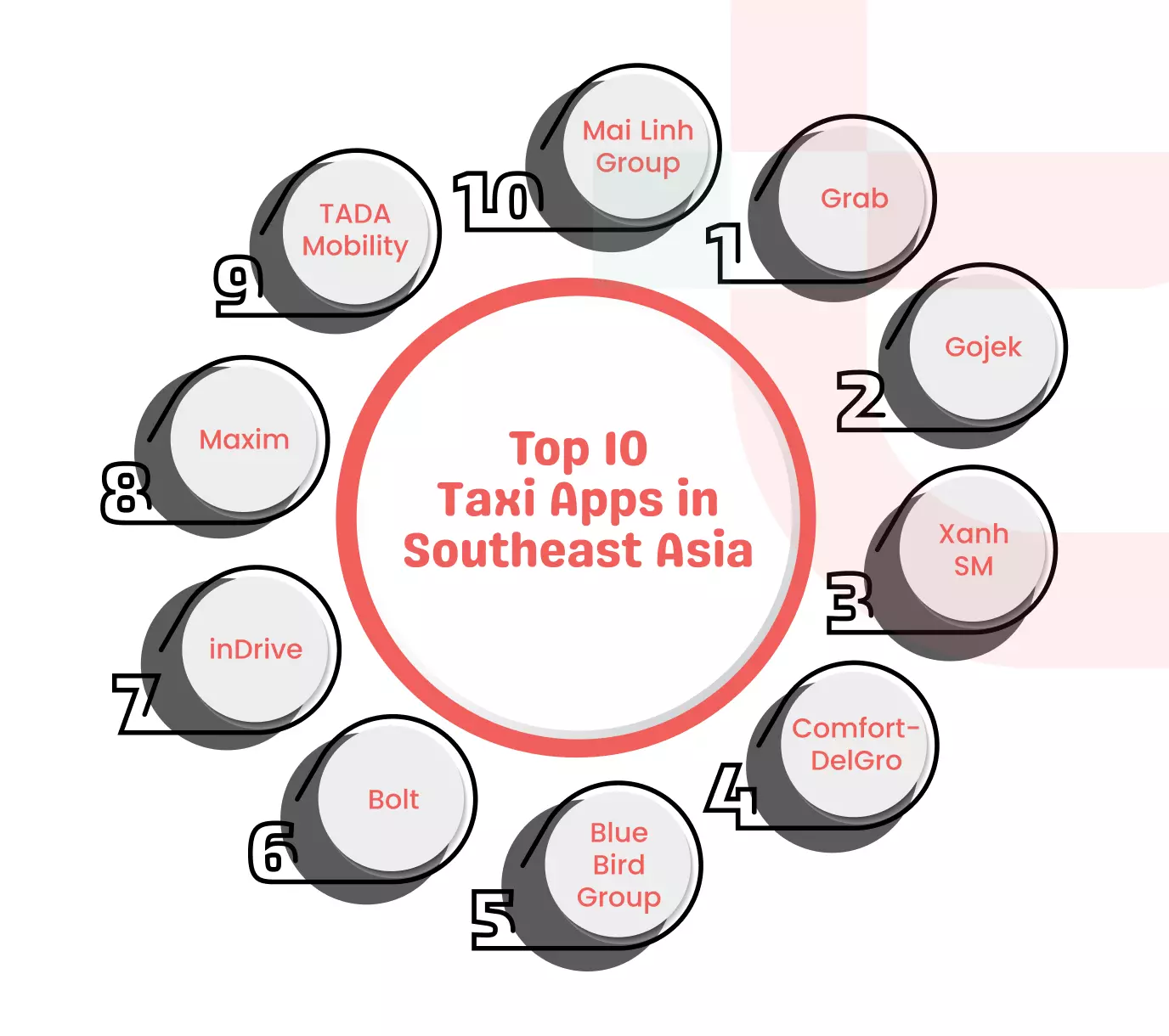
Here is the breakdown of the best taxi apps in Southeast Asia.
1. Grab
Grab is one of the top super apps in Southeast Asia, including ride-hailing as a key service. It was initially launched as a taxi booking app and later became a multi-service platform due to high adoption.
Today, it operates in 8 countries and over 500 cities across SEA, including Singapore, Cambodia, Indonesia, Malaysia, Myanmar, the Philippines, Thailand, and Vietnam. It stands out through its super app ecosystem, enabling users to access ride-hailing, delivery, and financial services from a single platform.
The company is also actively investing in EV and autonomous mobility through strategic partnerships. It recently partnered with Momenta to deploy autonomous driving technology in the region and began testing autonomous vehicles in Singapore.
Studying the Grab business model can help businesses plan strategically to enter the SEA market effectively.
2. GoTo Group (Gojek)
GoTo Group is the parent company of Gojek, one of Indonesia’s leading multi-service platforms, with ride-hailing as its core service.
Gojek is expected to hold around 43% of the market share in Indonesia’s ride-hailing market. In 2019, the company achieved decacorn status with a valuation of over $10 billion.
Currently, it has been focusing strongly on its EV taxi operations. For this, it partnered with Green SM, an EV taxi operator, and launched electric cab booking options in its app. It also exited Vietnam to focus on its core operations in Singapore and Indonesia.
3. Xanh SM (Green SM)
Popularly known as Green SM, Xanh SM is Vietnam’s premium electric ride-hailing and delivery app. It uses 100% VinFast EVs to ensure completely eco-friendly mobility solutions.
It recently expanded its reach by partnering with Gojek, allowing booking Xanh SM rides through its app. It also strategically partnered with the Vietnam Business Association in Laos (AVILA) to expand its operations in Laos.
4. ComfortDelGro
It is a multi-modal transport operator working mainly in Singapore and Malaysia. The company is operating in 13 countries in SEA with a network of 54,000 vehicles. In 2025, ComfortDelGro made a record as its revenue grew to S$5.06 billion, highlighting a 13% increase compared to the previous year.
The company further strengthened its UK presence by acquiring Addison Lee, the country’s largest premium point-to-point operator. Furthermore, in 2025, it partnered with Pony AI, a Chinese autonomous vehicle technology company, to pilot its AV taxi services in Singapore.
5. Blue Bird Group
Blue Bird Group is Indonesia’s most established taxi brand, having digitized its operations through a dedicated mobile app. It allows passengers to book taxi rides conveniently through a digital platform.
It operates in several Indonesian cities, with Jakarta, Bali, and Surabaya being the major areas. Besides standard taxi services, the Blue Bird Group also offers charter bus services, executive taxis, logistics, rental cars, and more.
Want to Launch Your Ride-Hailing Business in Southeast Asia Successfully? Partner with Elluminati for Technology and Expertise
6. Bolt
It is an Estonian mobility platform operating in Thailand, Malaysia, and other regions of Southeast Asia. Beyond ride-hailing, Bolt also offers food delivery and corporate transport services.
With a strong presence in more than 600 cities worldwide, Bolt is strategically planning to expand its services in Vietnam.
Besides, it is also investing heavily to expand its mobility ecosystem through technology innovation. It recently partnered with Stellantis to deploy driverless mobility solutions in Europe.
7. InDrive
InDrive is a global ride-hailing and delivery platform operating in around 48 countries and 1,065 cities worldwide, including Southeast Asia: Indonesia, Malaysia, Laos, the Philippines, and Thailand.
It operates on a negotiable pricing model in which customers propose a fare, and providers can accept, reject, or counteroffer.
The InDrive business model has helped it gain huge success in the market. Currently, it is planning to launch autonomous mobility services for which it signed an MOU with Ai Driver (an autonomous mobility company in Saudi Arabia) and the national official dealer of WeRide.
8. Maxim
It is an international and self-funded taxi app operating in over 1,000 cities across 18+ countries, which includes SEA’s Thailand, Philippines, Vietnam, Cambodia, Laos, Malaysia, and Indonesia.
It is highly popular for its affordable pricing on cars, bikes, and autos. Besides ride-hailing, Maxim offers other services like courier delivery, food delivery, and cleaning services.
9. TADA Mobility
TADA Mobility is known for its driver-first approach, where the platform charges no commission. It connects riders with nearby drivers through a digital platform without charging any commission fees.
It operates across Singapore, Cambodia, Vietnam, Thailand, and Hong Kong. The app strongly focuses on ensuring transparency and reliability for both drivers and riders.
10. Mai Linh Group
As Vietnam’s largest premier taxi operator, Mai Linh Group is recognized for its green cab fleet. Besides taxi services, it includes services like car rentals and e-buses.
Currently, the company is planning to step into the EV market, increase green mobility adoption rates, and create a comprehensive repair chain for electric vehicles. For this, it has partnered with Green and Smart Mobility.
|
App |
Strengths |
Weaknesses |
|
Grab |
Super app ecosystem and expanding its services to EV and autonomous mobility |
Multiple service offerings can make it challenging to manage operations |
|
Gojek (GoTo Group) |
Multi-service offerings with a strong focus on EV operations |
Geographic reach becomes limited to Singapore and Indonesia |
|
Xanh SM (Green SM) |
Complete focus on electric fleet |
Limited geographic presence, mainly centered in Vietnam |
|
ComfortDelGro |
Large fleet network |
More traditional transport operators compared to digital apps |
|
Blue Bird Group |
Establishes taxi brand in Indonesia with diverse service offerings |
Only operates in Indonesia |
|
Bolt |
Global ride-hailing platform active in different cities worldwide |
Limited penetration in SEA compared to other regional leaders |
|
InDrive |
Unique negotiable pricing model |
Fare negotiation can cause inconsistent pricing |
|
Maxim |
Premium services with affordable pricing |
Lower prices can affect premium service perception |
|
TADA Mobility |
Zero commission model |
Operates in fewer countries compared to its larger competitors |
|
Mai Linh Group |
Popular taxi operator in Vietnam with a green fleet |
Only focused on Vietnam |
Future Outlook for Taxi Apps in Southeast Asia
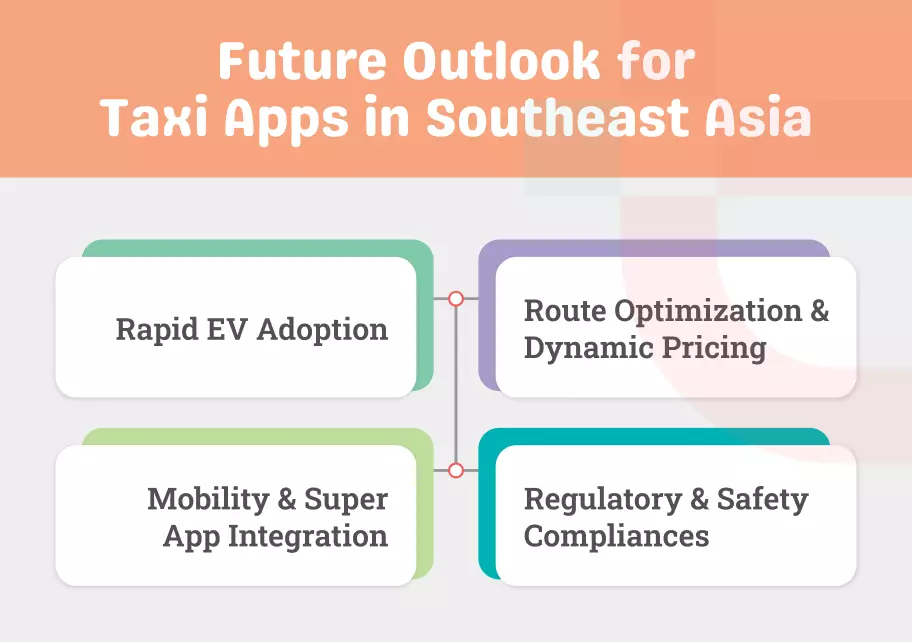
Here is a brief overview of what the future holds for taxi booking apps in Southeast Asia.
Rapid EV Adoption
Governments across Southeast Asia are promoting EV adoption by offering incentives and lowering import duties. Countries like Singapore, Thailand, and Indonesia are encouraging businesses to shift towards electric mobility.
As a result, many ride-hailing businesses have begun planning to expand their EV services. For instance, Grab partnered with BYD (the world’s leading new-energy vehicle manufacturer) to gain access to a 50,000-EV fleet in SEA.
AI-Driven Route Optimization and Dynamic Pricing
The use of AI in taxi apps is expected to grow significantly in the coming years. It will be used for route optimization, smart matching, dynamic pricing, and real-time tracking, helping businesses easily enhance customer experiences and drivers’ operational efficiency.
Diversified Mobility and Super App Integration
Leading taxi apps like Grab and Gojek, initially launched as on-demand transportation solutions, transitioned into super apps as they scaled successfully.
By offering diverse mobility solutions like motorbikes and carpooling, and by integrating a super app ecosystem to offer other services, businesses can create revenue opportunities in multiple ways.
Regulatory Formalization and Safety Focus
In Southeast Asian countries like Vietnam and the Philippines, governments are introducing stricter legal frameworks for ride-hailing apps while ensuring that each app complies with safety standards.
To comply, apps are implementing safety features such as real-time location tracking and mandatory driver background checks.
Investment and Business Opportunities in Southeast Asia Taxi Market
Here is an overview of the key business opportunities in Southeast Asia’s ride-hailing market.
Untapped Tier II and Tier III City Markets
Instead of targeting the metro regions where major players like Grab and Gojek are dominating, it would be a smarter move for businesses to start from Tier II and Tier III cities.
Cities like Bandung, Surabaya, Cebu, Chiang Mai, and Da Nang have less competition, a growing middle-income population, and lower marketing costs. This makes it easy for new businesses to establish their mark in the market.
Electric Vehicle (EV) Fleet Investment Opportunity
Southeast Asian governments are continuously making attempts to promote EV adoption for environmental sustainability by offering various incentives and green policies.
Investing in electric vehicle taxi services allows businesses, particularly startups, to offset a portion of upfront costs through government incentives.
Corporate and B2B Mobility Solutions
Today, many companies are opting for organized transport solutions for their employees. For this, they partner with ride-hailing companies. By offering corporate ride packages, businesses can create a recurring and stable revenue opportunity for themselves.
Airport Transfer and Premium Shuttle Services
With numerous Southeast Asian regions being tourist spots, launching dedicated airport transfer and hotel transfer services can prove to be beneficial for businesses.
Also, opportunities lie for offering premium travel solutions, as most tourists and corporate travelers prefer having luxury travel. Tourist attractions like Singapore and Bali continue to experience high visitor traffic, creating consistent demand for ride-hailing apps in Southeast Asia.
How Elluminati can Help You Build a Taxi App?
Today, the demand for taxi apps in Southeast Asia is growing rapidly due to rising urbanization, disposable income, and smartphone usage.
This creates strong business opportunities for entrepreneurs planning to enter the region’s ride-hailing market. However, business success depends on having an app that delivers smooth performance and a seamless user experience.
That’s where Elluminati steps in. As a reliable taxi app development company, we have served 450+ mobility businesses worldwide. Our solutions include features such as real-time tracking, dynamic pricing, and multilingual support, enabling businesses to easily build and scale in a competitive market.
FAQs
Grab is one of the top taxi apps in Southeast Asia, operating in 8 countries and more than 500 cities in the region.
Indonesia has the highest ride-hailing adoption rate, with Gojek being the major player in the market.
Although the use of EV ride-hailing apps in Southeast Asia is growing, it is not fully replacing traditional taxis. Many ride-hailing businesses are adding EV services to reduce operational costs and support sustainability goals.
Yes, starting a taxi app business in Southeast Asia can be profitable, driven by the growing demand for app-based mobility. Key factors include increasing urbanization and rising disposable income.