Key Takeaways (or TL;DR)
- For taxi apps, revenue models can vary by market and business growth stage.
- Primarily, a taxi app can mint revenue through four ways: commissions per ride, subscriptions, dynamic pricing, and in-app advertisements.
- Beyond ride commissions, taxi apps can generate revenue through cancellation charges, convenience fees, corporate ride programs, enterprise contracts, and in-app wallets.
- Depending on the business structure, a taxi app can purely act as a marketplace (aggregator model), run its own vehicles (fleet-owned taxi business model), or combine both.
- The cost of building taxi apps can start from $20,000 for basic features and may go beyond $150,000 for including advanced ones.
- Depending on your business’s growth stage-startup, growing platform, or enterprise- the choice of revenue model(s) may differ.
How does a taxi app make money? There is no single best answer. The taxi app can charge a commission per ride, promote subscriptions for offering elite features, run in-app promotions, or introduce dynamic pricing during peak hours. Besides, corporate programs, cancellation fees, and in-app wallets also contribute a significant profit. How to know which model could work best for your app?
Read this article to understand different taxi app revenue models depending on the growth stage of your business. We will also understand the cost aspect involved in incorporating these revenue models into the application and the right way to figure out the best ones for your business.
Overview of Taxi Apps Revenue Models
The taxi booking market is proliferating across the globe. The size of the global ride-hailing and taxi market is projected to reach USD 432.63 billion by 2028.
Taxi apps serve as a digital aggregator between drivers and riders. For users, it is a simple interface to book a ride. Behind that simple interface, many processes run in parallel. An ideal app would monetize every successful trip, every extra service rendered, and every value-added feature the customer opted for.
In a taxi riding business, there can be multiple sources of income. However, businesses find it difficult to leverage all of them due to dynamic situations, such as changes in fuel prices, driver unavailability, and local regulations. Relying on just a single source of income can expose the business to a significant risk.
To thrive in this on-demand taxi booking market, successful platforms, like Uber and Lyft, spread the risk across multiple income channels. Taxi apps usually make profits through the following ways:
- Driver subscriptions
- In-app promotions
- Dynamic pricing
- Corporate partnerships
- Premium service offerings
- Logistics & delivery services
In the upcoming sections, we will understand how each of these taxi apps revenue models uniquely contributes to overall profitability.
Core Revenue Models of On-Demand Taxi Apps
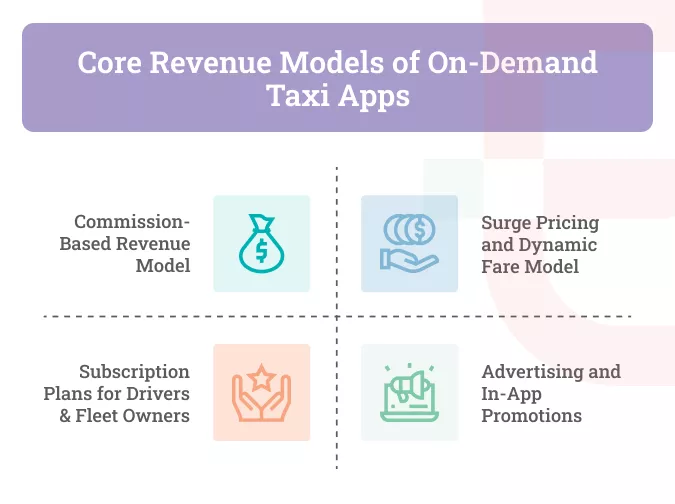
All major taxi apps revenue models are modifications and extensions of the following three core methods of monetization.
Commission-Based Revenue Model
As the name suggests, in a commission-based revenue model, taxi platforms take a percentage cut from every successful ride. As soon as the user books a ride through the app, the platform deducts a share of that fare as its revenue before paying the driver.
Usually, the standard commission rate falls in the window of 15% to 30% per ride. However, it may vary depending on the region. For example, Uber and Lyft charge 20-25% commissions per ride. However, in Kenya, regulations cap the commission at 18% for both.
Surge Pricing and Dynamic Fare Model
Surge pricing (or dynamic fares) is an excellent pricing model to make extra profit when demand outstrips supply. The number of bookings goes up during rush hours, events, or bad weather. Platforms leverage such situations and increase fares by 1.5x or 2x. As a result, more drivers feel motivated to accept the order.
According to a study, the dynamic pricing model improves demand-prediction accuracy by 12-15%. This reduces drivers’ vacant roaming times by 9.4% and increases the average number of trips per taxi by 2.6%.
However, if not carefully balanced, it can offset user experience. That’s why some regions have regulatory caps on how high prices can go during surge moments.
Subscription Plans for Drivers and Fleet Owners
New platforms require a predictable cash flow to sustain the initial phase of market penetration. That’s why many platforms offer subscription plans for drivers and fleet owners.
Instead of charging commissions on each trip, platforms charge a fixed weekly or monthly fee to access app features to receive bookings. This can be a flat fee or tier-based. For example, riders with premium access are granted perks like priority dispatch or reduced commission on peak rides.
Subscription plans allow you to reduce dependency on transactional earnings. It is also a good strategy to keep drivers happy, as they get to keep most or all of their fare revenue.
Advertising and In-App Promotions
Taxi apps can also generate revenue by running in-app ads or promoting business listings for users. For example, a restaurant or a retail shop can be sponsored to appear as a recommended stop at the destination spot. Surprisingly, Uber Ads crossed $1.5 billion in annual revenue run rate in May 2025.
As most users are already in “go somewhere” mode, these targeted ads yield better ROI than traditional ads for businesses. Many local brands, hotels, and delivery services pay taxi apps to offer discount coupons for their services on ride bookings through special offers.
How Taxi Apps Make Money Beyond Ride Commissions
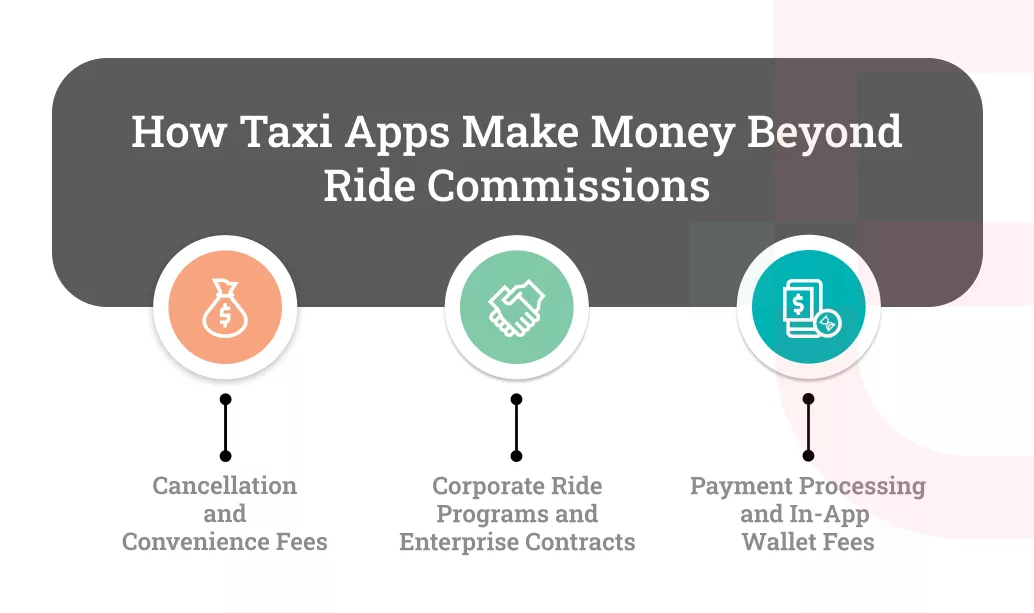
Besides commissions, taxi apps revenue models can include leverage from value-added services, transaction fees, and enterprise clients. These secondary income sources keep the business profitable even when ride margins are under pressure.
Cancellation and Convenience Fees
Users face cancellation fees when they cancel the ride after the driver has already been assigned or is close to pickup. The platform retains a small fee while the rest of the amount compensates for the driver’s lost time and fuel.
Additionally, most platforms charge platform fees, also mentioned as convenience fees. This cost covers app maintenance, customer support, and app infrastructure. This can be a fixed amount or a small percentage of the total fare.
Corporate Ride Programs and Enterprise Contracts
Popular taxi apps offer B2B ride programs. They accept corporate bookings for the transportation of employees and clients. It requires organizations to open a corporate account to book rides centrally and track expenses. They receive monthly invoices instead of paying per trip.
For taxi platforms, corporate and enterprise contracts are lucrative deals. It means recurring revenue, higher ride volumes, and long-term client retention. Taxi platforms can offer such deals to large firms, hotels, airlines, and logistics companies.
Payment Processing and In-App Wallet Fees
As digital payment systems have become the new normal for users, taxi apps with digital wallets can make a significant revenue. OLA found that 25% of bookings come from digital wallet users. The platform charges a 2-3% convenience fee per transaction. This turns into a fee-based revenue stream for taxi businesses.
Riders tend to book more frequently when wallets are pre-loaded. Pre-loaded wallets, until used, can be treated as a floating income for the taxi platform. This floating income also acts as a medium to claim business interests from banks with ease.
Design Taxi Apps With Smart Monetization, Advanced Analytics, and Global Scalability. Maximize Every Ride With Revenue
Taxi App Revenue Models Based On Business Structure
A taxi app can purely act as a marketplace, run its own vehicles, or combine both. Let’s see how the profit model can change depending on such business structures.
Aggregator Model
Most taxi apps act as a marketplace. They just connect riders with independent drivers with their own vehicles. The platform just controls bookings, pricing, payments, and customer experience. Uber and OLA are perfect examples. This model is light and allows platforms to scale rapidly across cities and countries without heavy upfront investment.
Revenue sources:
- Commissions
- Surge pricing
- Platform fees
- Payment processing charges
Benefits:
- Predictable income
- Low operating costs
- Minimal capital expenditure
Challenges:
- Low profit per ride
- Profit grows if the business scales
Fleet-owned Taxi Business Model
Platforms with big capital may decide to own or lease vehicles and employ drivers on payroll to run the business. This is called the fleet-owned taxi business model. As the platform owns everything, it keeps the full fare, excluding operational expenses. Naturally, this model yields higher profits per ride compared to an aggregator model.
Revenue Sources
- Full fare from each completed ride
- Corporate contracts and fixed routes
- Premium and airport transfer services
- Long-term vehicle rentals
Benefits
- Higher margins per ride
- Customers find it reliable
Challenges:
- Heavy upfront investment
- Recurring operational expenses
- Tight maintenance of a large fleet
Hybrid Taxi App Model
The hybrid model operates as an aggregator in some markets while running its own fleet in others. When startups enter a new market, they use their own vehicles to guarantee availability and service quality. Gradually, they open the platform to independent drivers.
Slowly, they shift more trips to the marketplace side. This reduces the capital burden while maintaining operational control where needed.
Revenue Sources
- Commission from independent drivers
- Direct fare revenue from owned fleets
- Subscription plans and enterprise clients
- Dynamic pricing and service fees
Benefits
- Stabilized income during the early growth stage
- Higher per-ride margins through fleet operations
- Scalability and flexibility through the aggregator model
Challenges:
- Heavy upfront investment
- Recurring operational expenses
- Tight maintenance of a large fleet
Cost to Build a Taxi App and Its Impact on Revenue
The cost of building a taxi app directly influences revenue potential, user experience, and long-term profitability. Here is a typical breakdown of development tiers, feature sets, timelines, and costs:
| Type | Features | Timeline (months) | Estimated cost (USD) |
|
Basic MVP |
>Login >Map integration >Ride booking >GPS tracking >Digital payment |
2 – 4 |
$20K – $40K |
|
Mid Scale |
>All Basic features >Live chat >Multiple payments >Loyalty programs >Business analytics
|
4 – 8 |
$40K – $70K |
|
Enterprise |
>All Mid-scale features >Advanced AI features >Enterprise-level data security >Multi-language support >Global scalability >Deep Integrations |
8+ |
$80K – $150K+ |
As you can see from the table, a basic taxi app with core ride-hailing features costs between $20,000 and $40,000 and takes over 2-4 months to develop. The app is designed to quickly test the market demand with essential features like user authentication, map integration, booking, and payments.
When the platform is ready to expand its revenue channels, a mid-scale app is built on the existing model. The app upgrades include more customer engagement features like live chat, support for multiple payment methods, loyalty programs, and basic analytics dashboards. This usually takes 4-8 months and costs $40,000-$70,000.
How to Choose the Right Revenue Model for Your Taxi Startup
The trick to selecting the best revenue model for your taxi app is to understand your market reality better. What works for Uber in New York may fail in a Tier-2 city or a niche commuter market.
Your decision should be guided by major factors like:
- How price-sensitive are your riders?
- How easily can you onboard and retain drivers?
- Do you need fast growth or predictable cash flow first?
Many taxi apps fail not because of poor technology, but because they optimize revenue before achieving ride density. Let’s take a look at the right approach for different stages of a ride-hailing business.
For Startups and New Founders
If you’re venturing into the taxi business for the first time, start with a commission-based revenue model because:
- Drivers only pay when they earn, reducing onboarding friction
- Revenue grows automatically as ride volume increases
- You avoid locking drivers into commitments before trust is built
Instead of trying to maximize your commissions from every ride, try to focus on supply creation. Lower commissions or capped fees will attract drivers and build liquidity. Once you receive consistent orders, launch premium ride categories or increase convenience fees to maximize revenue without shocking the ecosystem.
For Established Operators and Growing Platforms
When the taxi app business registers a constant inflow of orders, the challenge quickly shifts from growth to revenue. The business no longer finds stability in pure commissions. That’s when subscription-based models become essential to widen the monetization channel.
You can roll out fixed weekly or monthly subscription plans for drivers, corporates, and general users. Subscription plans work well for users and drivers, who frequently use the application.
For platform owners, it offers creative freedom to experiment with incentives, loyalty rewards, and targeted promotions without worrying about daily revenue swings.
For High-Demand and Volatile Regions
Some markets are unpredictable. Peak-hour demands, local festivals, rain, and strikes vary by state. So, when platform owners expand their business across multiple states, they leverage surge fees and dynamic fares to make the most out of it. In fact, according to Gitnux, 10% of all ride-hailing trips globally involve surge or dynamic pricing.
This model works best when:
- Demand regularly outpaces driver availability
- Travel patterns change by time of day or season
- Riders value availability more than price consistency
Surge pricing helps platforms achieve three things at once:
- Attract more drivers during peak periods
- Reduce long wait times for riders
- Increase per-ride revenue without adding new users
If you are running a traditional taxi business and looking for growth opportunities, you should consider investing in a taxi booking solution.
- Launch an on-demand taxi business within a few months
- Leverage a significant reduction in Google Maps cost
- Customize your app for a specific industry, like car rental, e-scooter, limousine, or logistics
- Add Uber-like features for your customers and drivers for a competitive advantage
- Control your business in multiple countries with a single admin console
- Allow drivers and customers to leverage app features from a scalable web console
Build a Revenue-Ready Taxi App With Elluminati’s Proven Development Framework. Turn Your Idea Into a Scalable, Profitable Platform
Conclusion
Understanding taxi apps revenue models is essential for building a scalable, profitable ride-hailing platform amidst tough market competition. Depending on the budget and growth stage of the company, there can be different monetization models.
Startups can start with a commission-based revenue model to create more supply. Established operators can benefit from subscription-based models while experimenting with incentives, loyalty rewards, and targeted promotions. When the platform goes global, introducing surge fees and dynamic fares increases per-ride revenue without adding new users.
However, the ideal revenue model of taxi apps could change depending on factors like market demand and business structure. This is where Elluminati adds value. With an excellent track record in developing scalable, profit-driven taxi applications for over 14 years, we help you start with the right platform, offering revenue models from day one.
Arm your business application with amazing features like in-app chat, surge pricing, multi-lingual support, multi-fare options, and more with our trusted taxi booking app development services.
FAQs
The monthly revenue capacity of a taxi app depends on ride volumes and commission rates. For example, if the app registers 10,000 monthly rides at an average fare of $5, with a commission cut of 20-25%, the platform earns roughly $37,000+ per month. With higher volumes (50,000+ rides), monthly revenue may reach $180,000+
The commission-based model remains the most consistently profitable for taxi apps. That’s because platforms take a cut (typically 10-30%) from every ride to scale income as the business grows with minimal overhead.
Yes, a taxi app can be monetized through different sources, like commissions, subscriptions, corporate contracts, etc. Surge pricing is one of the ways to access extra profits when demand outstrips supply.
Taxi owners retain net fare revenue after deducting costs, like driver payouts, fuel, and maintenance. Typical profit margins vary widely but often fall between 15-30% of gross revenue, depending on cost control.