Key Takeaways (or TL;DR)
- Monetization strategies for Uber clone must be planned before launch to ensure long-term scalability and stable revenue growth.
- Although ride commissions are the foundation, they are not enough to ensure long-term success.
- The common revenue strategies for Uber clone besides commissions include surge pricing, subscription plans, in-app advertising, corporate contracts, and cancellation fees.
- Besides core monetization strategies, you can also make money through white label partnerships, fleet management SaaS fees, multi-vertical expansion, and data monetization.
- Choosing the right monetization mix depends on market type, rider behavior, and payment preferences.
Monetization strategies for Uber clone play a crucial role in determining the long-term sustainability of a ride-hailing business. Many entrepreneurs only focus on entering the market quickly with a pre-built and tested solution. However, the real challenge lies in determining how the app will actually make money.
Although ride commissions can initially help you generate income, they are not enough to grow. This article will break down all essential strategies to generate revenue that you should implement to have profitable growth. Besides, you will also explore strategies for how you can implement each model effectively.
Why Planning for Monetization Strategies for Uber Clone Comes Before Launch
According to Fortune Business Insights, the global ride-hailing market is expected to reach $659.39 billion by 2034 at a CAGR of 18.40%. This growth is attracting more businesses to enter the market. However, entrepreneurs make two critical mistakes.
Mistake #1: Building First, Monetizing After
Most businesses only focus on app development first, thinking they will plan for revenue later. But this leads to limited earning potential and costly rework of features, which ultimately impacts the user experience. The revenue model is not something you should plan after launch. It should be designed in the app from day one.
Mistake #2: Thinking Only the Commission Model is Enough for Revenue Generation
Many taxi platforms rely on ride commissions for revenue. But businesses forget that building a clone does not mean simply replicating Uber’s core features. It actually means designing it on the platform’s business strategies.
This can be seen in the Uber business model, which operates on multiple revenue streams, such as surge pricing, corporate contracts, subscriptions, and diversified service categories.
In 2025, the company generated $52.017 billion in annual revenue with 18.28% increase year over year, supported by multiple revenue streams beyond ride commissions. So, depending solely on commissions is not sufficient in today’s dynamic market. A diversified revenue strategy helps you have stable growth.
Core Monetization Strategies for Uber Clone You Must Know
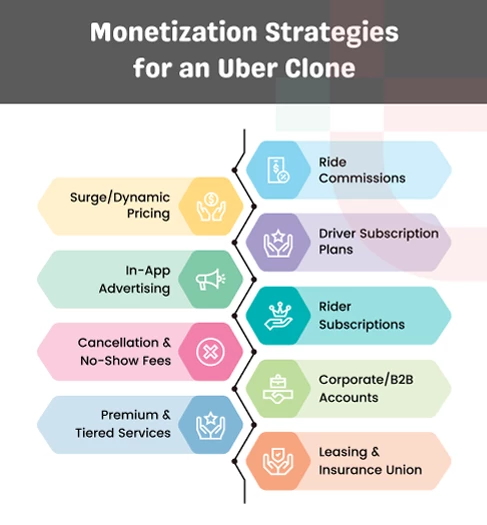
Implementing a well-structured revenue model helps you maximize earnings and scale easily in the competitive space. Below are the most common revenue strategies for an app like Uber that you should include without fail.
Commission on Rides
This model is the foundation of every ride-hailing business. You charge a set percentage share to drivers on the total fare for every booking received through the platform. The commission rates range from 15% to 25%, which you can adjust based on location, demand level, and vehicle type.
This strategy lets you earn from each ride. However, setting higher commissions can restrict new drivers from onboarding, which can negatively impact the business performance.
That’s why it would be better to set lower commissions initially to attract drivers. You can then increase the rates gradually once drivers start completing more rides.
Surge Pricing / Dynamic Pricing
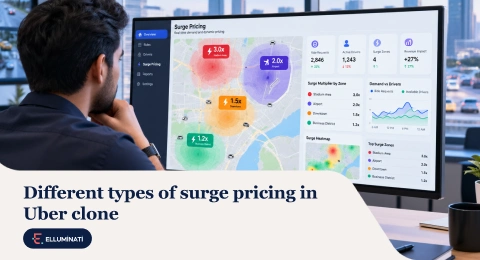
It is a dynamic pricing model where ride fares increase automatically during peak times, special events, bad weather conditions, geographic hotspots, and driver shortages. Surge pricing is calculated by applying a multiplier to the base price, which adjusts in real time based on market conditions.
Final Fare = Base Fare x Surge Multiplier
Example: A base fare of $9 with a 3x surge becomes $27, while a 1.5x surge on a $12 ride results in $18.
To execute this model, you will first have to identify the surge zones and set multipliers based on traffic and demand patterns. Also, displaying surge estimates at booking time allows you to maintain transparency with riders.
Subscription Plans for Drivers
These are the SaaS style subscription models in which drivers pay a set fee every month or annually to avail benefits like priority dispatch or lower commissions. This creates a win-win situation for both drivers and the business.
Lower commissions allow drivers to retain more of their earnings while letting you generate predictable revenue even during low-demand periods. This approach also allows you to build long-term relations with drivers and retain them for longer.
Rider Subscription and Membership Plans
This is another popular strategy for revenue generation where riders pay a set recurring amount on a monthly or annual basis to get benefits like priority services, waived surge pricing, and discounted fares.
These programs enable you to increase customer loyalty and retention in the highly competitive space while ensuring a predictable income.
Attracting riders for subscription plans can be challenging initially. So, it would be better to offer free trials in the beginning, which will become a point of traction for new riders.
In-App Advertising
Since riders spend several minutes on the platform for trip booking, you can create additional revenue through in-app banner ads.
For this, you can partner with local third-party businesses like restaurants, retail stores, and hotels to promote their services on the app. In exchange, you can earn by charging them a considerable amount.
Cancellation and No-Show Fees
These fees might seem to be small, but they create a significant impact on overall earnings. Charging riders for last-minute cancellations, no-shows, or driver wait time lets you ensure fair compensation and also discourages the misuse of the platform. You should charge cancellation fees based on the driver’s travel distance to the pickup.
Also, display all charges clearly before booking confirmation to avoid any later surprises.
Corporate/B2B Accounts
Corporate ride accounts are underutilized sources, but they tend to generate high-value and recurring revenue opportunities.
You can partner with local corporate businesses to help them fulfill and manage office travel needs for employees and clients through a centralized platform. This revenue model creates higher fares compared to usual ride fares.
Premium and Tiered Ride Services
Offering a single ride category leaves significant revenue on the table. Instead, offer multiple categories like Economy, Comfort, and XL to serve different rider segments from a single platform. Also, premium rides let you charge higher fares, ultimately increasing revenue per ride.
Driver Leasing & Insurance Partnerships
This strategy is the most overlooked yet powerful enough to grow a revenue base. You can partner with car leasing companies to offer car packages to drivers who do not own a vehicle.
Besides, you can create collaborations with insurance providers to offer commercial ride-hailing insurance directly through the platform. You earn a set commission for promoting these services in the app.
Advanced Revenue Strategies for Uber Clone
Once you implement the core monetization strategies for Uber clone, you can move forward and plan advanced strategies that many of your competitors miss out on. Let’s have a closer look at each method.
White Label Partnerships
You can form white label partnerships with local taxi operators, regional transport companies, or fleet owners to let them run the application under their own brand name. You earn a set recurring licensing fee or revenue share without having to manage drivers or rides.
Fleet Management SaaS Fees
Fleet owners find it challenging to handle multiple drivers, vehicles, and bookings efficiently.
Since the platform will be able to track drivers’ location, vehicle utilization, and earnings in real time, it becomes a SaaS like solution for fleet owners to manage their daily operations. In return, you can charge monthly fees from them to access the app.
Data Monetization
Collects valuable data related to user behavior, peak demand zones, and travel patterns.
When aggregated and handled in compliance, this data becomes helpful for logistics companies, city planners, and local businesses. You can monetize it through reports, API access, and dashboards. Although this strategy requires strict privacy adherence, it can become a valuable resource for you to generate income.
Multi-Vertical Expansion
Once you build a strong network of drivers and riders, you can expand services to delivery of food, groceries, pharmacies, and couriers. Multiple verticals help you earn even when ride demand is low.
Moreover, since each service adds its own revenue layer, like delivery fees and merchant commissions, it helps you increase overall revenue. However, there are several pros and cons of multi-service apps that you should consider before expanding.
Want to Launch a Monetization-Ready Uber Clone App? Partner with Elluminati for Expert Guidance and Solutions
How to Choose the Right Monetization Mix for Uber Clone App
Now that you have become familiar with how to make money with an Uber clone, the next step involves choosing the right monetization mix. Here are some strategies that you can adopt to make the right decision.
Understand Market Type & Demand Patterns
The condition of the target market will determine which monetization strategy will work better. An emerging market with higher ride demand but lower fare needs will require a different approach compared to the developed market with fewer but higher-value trips.
Analyzing ride frequency, peak hours, and city-level demand in the market will help you choose the right revenue model.
Analyze Customer Behavior & Price Sensitivity
Not all riders can afford premium ride fares. Understanding what riders are willing to pay will shape the pricing decision of the platform.
For instance, price-sensitive riders will opt for platforms with subscription models over those with a surge pricing model. At the same time, the high-income segment will be ready to pay a luxurious price to have a comfortable travel experience. That’s why design the pricing structures while keeping each rider type’s needs and preferences.
Evaluate Payment Preferences (Cash vs Digital)
Payment infrastructure will determine which monetization strategies for Uber like app will work better in the market.
Cash-heavy markets require commission and fee-based models, while digital-first regions will need subscription models and in-app wallets. So, always evaluate payment preferences in the market before planning the income generation method.
Balance Driver Earnings with Platform Revenue
The ride-hailing platform’s major success depends on driver satisfaction and retention. If you charge too high commissions, drivers will easily leave and move to competitors. That’s why set commissions and incentives that enhance driver loyalty.
Choose the Right Revenue Model Mix (Commission + Beyond)
Operating with a single revenue stream limits growth. So, combine two or three core strategies like commissions, subscriptions, and surge pricing in the initial phase. Then you can gradually introduce advanced strategies like white label partnerships once the platform starts growing.
Monetization Strategy for an Uber Like App Comparison: Which Should You Prioritize First?
Here is the quick overview of each monetization strategy for a Uber like app to decide which one will work best for you.
| Strategy | Setup Complexity | Time to First Revenue | Revenue Potential | Best For |
|---|---|---|---|---|
| Ride Commission | Low | Day 1 | High (base) | Startups launching an MVP |
| Surge Pricing | Low | Day 1 | High | Urban markets with high demand |
| Driver Subscriptions | Low | Week 1 | Medium-High | Markets having a large driver base |
| Rider Subscriptions | Medium | Month 1–2 | Medium-High | Platforms with a larger rider base |
| In-App Advertising | Medium | Month 2–3 | Medium | Apps with a larger user base (approx. 5000+ monthly active users) |
| Corporate Accounts | Medium | Month 1–2 | High | Cities with a large number of corporate businesses |
| Cancellation Fees | Low | Day 1 | Low-Medium | All types of platforms |
| Delivery Expansion | High | Month 3–6 | High (long-term) | Apps with surplus driver capacity |
| Premium Ride Tiers | Medium | Week 2–4 | High | Markets with riders willing to pay a premium price for comfortable rides |
| Leasing / Insurance Referral | Medium | Month 1–3 | Medium | Emerging markets where a very small number of drivers own vehicles |
Common Monetization Mistakes to Avoid with Uber Clone App
Even the best monetization strategy can underperform if implemented in the wrong way. Here are the most common monetization mistakes you should avoid with an Uber clone.
Relying Solely on Ride Commissions
Relying solely on commissions can limit revenue as the market matures. Diversifying the revenue model early allows you to operate profitably even when drivers pressure for lower commissions.
Setting Surge Pricing Too High Without Transparency
Unclear or aggressive surge pricing can frustrate riders and push them to competitors. Always clearly display surge multipliers and estimated fare details before booking is confirmed.
Ignoring the Corporate Market
Many taxi operators overlook corporate accounts and focus completely on individual riders, leading to missed high-value opportunities. But corporate clients generate higher revenue, are easy to retain, and pay on monthly or yearly invoices, which ensures predictable income for you.
Activating In-App Ads Before Hitting User Scale
Introducing in-app ads too early can harm the user experience without generating meaningful revenue from riders. That’s why it will be better to first build a larger user base and then monetize through banner ads.
Launching Delivery Without Sufficient Driver Supply
Adding a delivery segment before having a strong driver network can quickly harm your business’s service quality. Expand to delivery operations only when you have surplus capacity of drivers, even during off-peak hours.
Unlock Multiple Revenue Streams for Your Ride-Hailing Business with Elluminati’s Market-Tested Uber Clone
How Can You Maximize Revenue Potential with an Uber Clone?
Planning the right monetization strategies for Uber clone from the beginning helps your ride-hailing business grow effectively. Instead of relying on a single revenue source, combining multiple streams like commissions, surge pricing, and subscriptions, you can easily maximize profits while enabling long-term growth for the business.
At this stage, partnering with an experienced technology partner becomes very helpful. Elluminati brings in 14+ years of experience in serving 450+ global mobility businesses through its Uber clone app, which is embedded with market-tested features and flexible monetization capabilities.
Moreover, we help you implement the right revenue strategy with our expert business consultation to pave the path towards long-term profitability.
FAQs
There is no single model that works best for any ride-hailing app. You should combine multiple monetization strategies for Uber clone, like commissions, surge pricing, subscriptions, ads, and cancellation fees, to generate profitable revenue.
The commission range usually ranges between 15% and 25%, depending on factors like market conditions, average fare value, and driver supply. It is mostly recommended to initially charge lower commissions to build a driver base and then gradually adjust them as the platform grows.
Yes, you can use a subscription revenue strategy for an app like Uber for both drivers and riders. Drivers will pay a set recurring amount on a monthly or annual basis for lower commissions and priority dispatch, while riders will subscribe for perks like special discounts, priority matching, and no surge pricing.
Surge pricing automatically increases ride fares during peak times or in high-demand areas. This helps you encourage drivers to come online, helping you balance demand and supply at the same time.
The following are the best revenue strategies for an app like Uber in emerging markets:
- Ride commissions
- Surge pricing
- Subscription plans for drivers
- Rider subscriptions
- In-app advertising
- Cancellation fees
- Corporate contracts
- Premium and tiered rides
- Driver leasing and insurance
You can make money with an Uber clone through multiple streams, such as subscriptions, surge pricing, in-app banner ads, and corporate contracts, without charging higher commissions.