
Key Takeaways (or TL;DR)
- Most taxi startups fail due to poor market research, inadequate planning, and launching on mere assumptions.
- Three core reasons why online taxi businesses fail include launching in an oversaturated city, underpricing, and higher driver churn.
- Higher customer acquisition costs and low rider retention lead to lower revenue growth, which can result in business failure.
- Inefficient driver-rider matching algorithms lead to increased wait times and reduced customer satisfaction.
- Ignoring regulatory compliance and safety policies can cause legal penalties and permanent bans.
- By opting for MVP development, choosing the right city for operations, investing in scalable technology, and ensuring legal compliance, taxi startups can prevent business failure.
The ride-hailing sector has grown rapidly and reached a figure of multi-billion dollars. Platforms like Lyft, Uber, and Ola have reshaped how people are commuting around cities. The success of these companies has inspired so many entrepreneurs to launch their own online taxi businesses.
However, some taxi businesses struggle to survive in the market despite strong demand and sufficient funding. Why online taxi businesses fail involves several reasons, such as wrong region selection, not following market trends, lack of market differentiation, and more.
This article will let you explore in detail the key reasons online taxi businesses fail and what measures you should follow to prevent them.
Why Online Taxi Businesses Fail in Competitive Markets
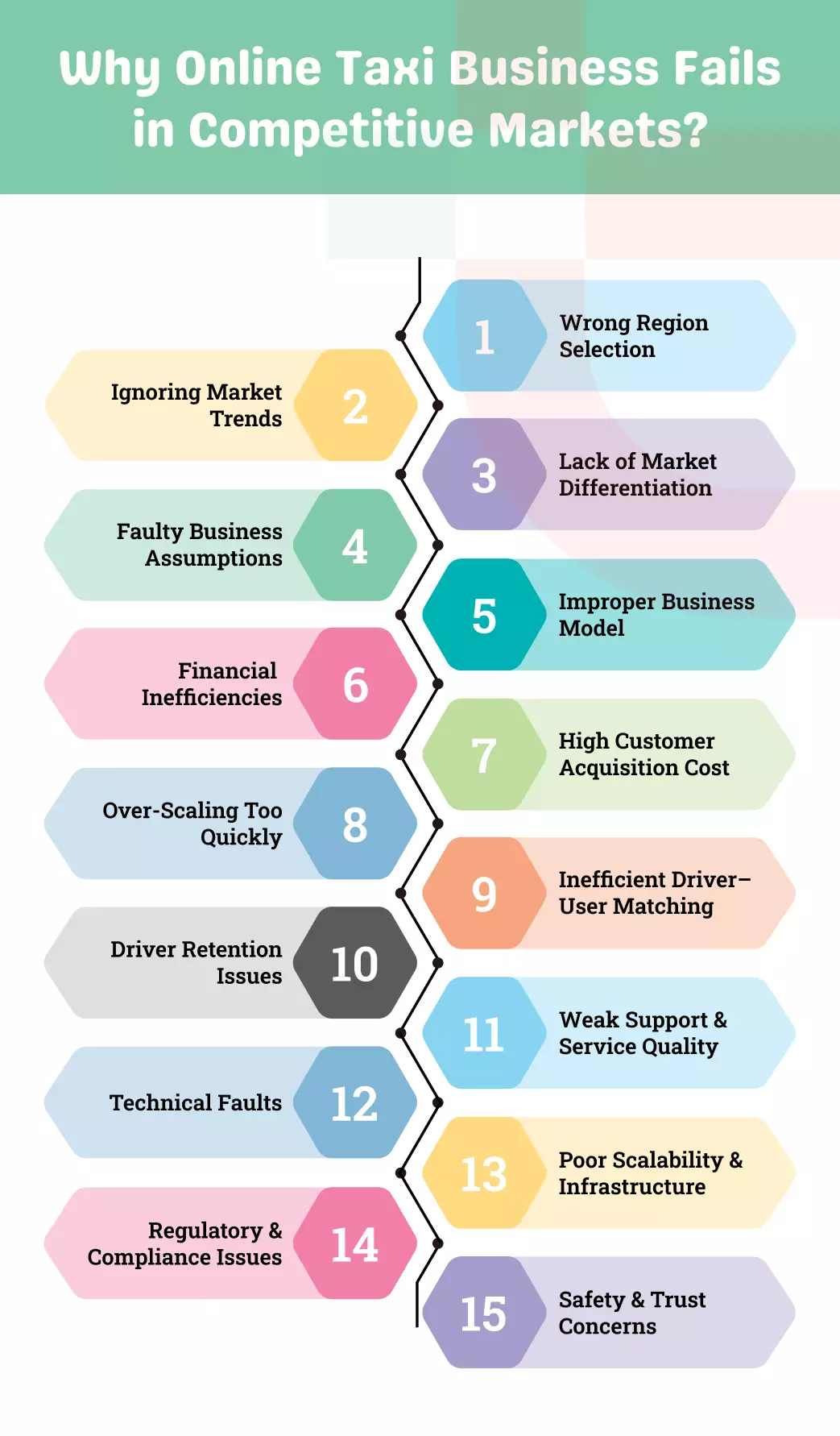
In today’s digital era, launching an online taxi business might look like a good opportunity. However, it can become challenging due to intense competition and changing customer expectations. Many startups overlook such factors, which result in business failure. Here is an overview of common reasons why online taxi businesses fail.
Wrong Region Selection
Region choice plays a critical role in business success. Many businesses start by launching in metro cities where competition is already too intense. This makes it difficult to attract customers. Moreover, launching in low-demand areas will also affect growth, as the number of rides will not help cover operational costs.
That’s why it’s essential first to understand the level of competition and service demand when choosing a region. Thorough market research will help you operate profitably.
Ignoring Market Trends
The ride-hailing market is continuously evolving with changing customer expectations and rapid technology advancements. Today’s customers expect a more convenient taxi booking experience with digital payment options, instant support, and real-time tracking.
Moreover, more businesses are shifting towards EV adoption, AI-driven operations, and multimodal integration to improve profitability and enhance customer experiences. Businesses that fail to keep up with these developments struggle to compete in the market, and so staying updated with current market trends becomes essential to remain relevant and competitive in the industry.
Lack of Market Differentiation
The taxi industry is dominated by several established players, such as Uber and Lyft, that offer similar services. These platforms are backed by large venture capital and a huge customer base. In such scenarios, if a startup enters the market without offering anything unique, it can become challenging for them to attract customers.
By adding unique value to the services, such as implementing competitive pricing strategies, improving safety features, conducting referral programs, and offering incentives to drivers, businesses can easily survive the competition.
Faulty Business Assumptions
One of the key reasons online taxi businesses fail is that they enter the market with mere assumptions about growth and user adoption. For instance, many founders assume that building a driver network is easy, or that customers will start using the platform immediately after launching.
However, building a strong user base requires considerable time and strong growth strategies for taxi businesses. Besides, overlooking local regulations and competition by assuming them to be the same everywhere also causes failure.
Therefore, instead of starting with guesswork, it would be better to carefully study the target market by understanding the local regulations, competitors, and people’s demands.
Improper Business Model
A business model is a strategic blueprint that defines how a particular company will operate and generate revenue. It differs from company to company depending on the targeted market and services offered. Without having a clear plan, businesses often struggle to operate efficiently and profitably, ultimately leading to failure.
A good example is Hailo Taxi, a British mobile app connecting passengers with licensed taxi drivers. Its business model remained successful in Europe (London and Ireland), where it partnered with traditional black taxis. But the same taxi app failed in the US even after having $100 million in funding.
It is essential for businesses to define clear strategies before starting operations.
Financial Inefficiencies
One of the reasons online taxi businesses fail is due to poor cash flow management and weak funding. Startups overspend on heavy discounts, driver incentives, underestimate operational costs, and delay building a financial strategy to reach profitability.
This is why short-term and long-term budget planning is important. Entrepreneurs should track unit economics such as commission per ride, ride-hailing fees, and platform margin cost.
High Customer Acquisition Cost (CAC)
Attracting customers at the beginning can be expensive. Companies mostly rely on referral bonuses, discounted rides, and paid advertisements, which are already costly in the early stages. However, if the cost of acquiring each customer becomes higher than the earned revenue, it can negatively impact profitability.
For instance, an Indian inter-city cab aggregator, Roder, shut down its operations due to high customer acquisition costs, low retention rate, and increased competition.
That’s why startups should focus on organic growth strategies, such as initially promoting through word-of-mouth referral programs and building partnerships with local businesses. This would help control customer acquisition costs and increase overall profitability.
Over-Scaling Too Quickly
Among the many reasons for taxi app failures, one is rapid expansion across different cities. It might look impressive on a pitch deck. Still, in practice, it can cause many issues, such as regulatory complexity, limited driver supply, stretched support teams resulting in poor service quality, and increased operational costs.
The business should first achieve profitability in any one selected region instead of scaling across multiple cities at once. Focusing on a single city is always better than shallow coverage across multiple cities and states.
Inefficient Driver- Rider Matching
The core aspect of any ride-hailing platform is to deliver a short wait time to customers. But if a system takes too long to assign drivers, it will result in long wait times and delays, ultimately impacting the overall customer experience.
Sometimes, longer wait times can lead customers to cancel bookings, which can impact driver earnings. Implementing AI-powered smart-matching algorithms can help businesses achieve faster pickups and a smoother experience, thereby boosting customer retention.
Driver Retention Issues
Drivers are the core part of your business. Without a reliable driver network, your business cannot meet demand, even with a strong marketing strategy. Driver churn is one of the biggest operational challenges, and neglecting this is the key factor why taxi startups fail.
Platforms that charge high commissions and fail to offer competitive earnings, flexible working hours, and fast payment cycles consistently lose their best drivers, resulting in business failure.
Weak Customer Support & Service Quality
Customers stay with brands that provide constant support and faster resolution of issues related to drivers, payments, and ride booking or cancellations. If customer support responses are slow or inefficient, customers can quickly lose confidence in the taxi brand.
Businesses should integrate a 24/7 chat system into the app to provide instant customer support when needed, thereby enhancing the customer experience and trust.
Technical Faults
The most important reason why taxi startups fail is faulty technology. An app that crashes during peak demand, experiences payment failures, and lacks a real-time GPS tracking system can prompt customers to abandon it.
Regular app testing and timely updates can help businesses prevent such issues and ensure smooth operations always.
Poor Scalability & Infrastructure
At the beginning of the business launch, many founders prefer basic apps that work for a few hundred users, and due to that reason, the technical infrastructure couldn’t grow as the number of rides & demand increases.
A platform that works fine at 500 daily rides may experience issues and errors when daily rides reach 1,000. Startups that build on low-cost hosting without planning to scale their business face slowdowns, website/app crashes, and data loss as their business expands.
Regulatory & Compliance Issues
Government regulations for ride-hailing operations vary by country and state. However, all taxi businesses must follow transportation rules, fulfill licensing requirements, comply with legal documents & background checks, maintain insurance, and be familiar with data privacy laws that vary by city, state, and country.
Startups that launch without fully comprehending compliance obligations face legal penalties, service bans, and forced shutdowns. That is why compliance and following regulatory laws must be a part of the launch strategy.
Safety & Trust Concerns
Safety is the major concern that affects customer decisions while choosing a ride-hailing service. Any single safety violation incident during operation can permanently damage your business’s credibility.
You can build trust by implementing passenger safety features like real-time ride tracking, SOS emergency buttons, a post-ride feedback system, and driver background checks. These measures will help you ensure a safe ride-hailing environment for passengers and also build a strong brand image.
Launch A Successful Taxi Startup with Elluminati’s Scalable Taxi App Solution Designed For Long-Term Growth
How to Avoid Taxi Business Failure?
Now that you have understood in-depth about why taxi startups fail, here is a practical roadmap to avoid these mistakes and launch a platform that is built to last.
Conduct Deep Market Research Before Launch
Before launching a taxi business, conduct thorough market research.
Ask questions like:
- Who will be your target audience?
- What are the challenges your customers face with existing ride-hailing platforms?
- What type of ride-hailing services do you plan to launch?
- What pricing strategies will you implement?
- How will you attract customers and drivers?
This will help you understand the market, target audience, and local pricing expectations.
Choose the Right City & Expansion Strategy
Start with small steps and choose the right city where you can dominate easily, rather than scaling directly to 10 cities where your platform becomes invisible.
Pick a market where,
- Daily commuting with public transport is challenging,
- Existing platforms have poor driver coverage, or
- Customer satisfaction levels are low.
Once you succeed in the chosen city, you can easily expand into other regions with similar growth strategies.
Launch with an MVP First
Minimum Viable Product (MVP) lets you test your ride-hailing app with real users without any full-scale development.
Preferring the MVP app development for your startup can reduce the risk of unwanted extra features. It also generates real performance data that makes your pitch to investors far more compelling than projections alone.
Build a Sustainable Business Model
Map out your business path to profitability first before the launch. Start by choosing the right business structure, that is, whether you want to operate as a sole proprietorship, a private limited company, or an LLP company. This choice will greatly influence the scalability and compliance requirements.
Also, at the operational level, know your cost per ride, driver commission rate, driver payout structure, and the ride volume you want to reach in a single selected city. Choose between operating your own fleet or partnering with aggregators. A well-defined business structure will help you run a scalable taxi business from day one.
Optimize Unit Economics Early
Unit Economics is a way to measure income or loss per individual ride. If unit economics are neglected, then the startup may face difficulties in the early stages. To resolve this issue, startups should focus on improving their pricing strategy and operational efficiency in line with unit economics.
Invest in Strong & Scalable Technology
A ride-hailing platform is the core aspect of your business. An app with slow performance and technical glitches can easily impact user experience. Building your app with scalable technology like cloud infrastructure allows you to perform effectively even during high demand.
Partnering with an experienced technology company can help you build a scalable app affordably.
Focus on Efficient Driver-User Matching
Use advanced technologies such as real-time traffic data, predictive demand modeling, and geolocation for tracking rides in real time, minimizing wait times & ride cancellations. By implementing these strategies, you can maximize the earnings per ride.
A well-functioning driver-user matching algorithm is a competitive advantage because shorter wait times will make customers use your app more frequently, thereby increasing retention.
Improve Driver Retention Strategy
Consider your driver network as a strategic asset of your brand. You must provide transparent earnings for drivers and create performance incentive programs that reward loyal partners.
Conduct regular driver surveys to gather feedback and suggestions. Have dedicated driver support lines and in-app tools that help and track their earnings per ride. Satisfied drivers deliver better service, creating a positive customer experience.
Ensure Legal & Regulatory Compliance
Before starting your business directly, it is mandatory to consult with a local legal advisor who specializes in transportation regulations and acts. Plan a compliance flow from driver licensing and legal background checks to insurance policies and data privacy policies.
Adhering to local regulations is better than incurring legal penalties because many cities are more willing to work with cooperative ride-hailing brands.
Prioritize Safety & Trust
Building safety feature tools into the core product is no longer optional for your platform; it’s mandatory. Features like real-time ride sharing with friends and families, an SOS button, OTP verification, two-way rating systems, and 24/7 support lines are the bare minimum expectations from your customers.
Incorporate safety features and maintain transparency about driver vetting. Additionally, enhance your incident response procedure and community guidelines that build trust.
Scale Gradually Using Data-Driven Decisions
Before any serious launch, every scaling decision should be backed by data-driven insights, not by ambition and business motivation. Entering a new city means you need to confirm your unit economics in the existing market and your support infrastructure.
Gradual and well-prepared expansion planning beats the uncertainty and loss. It is essential to grow deliberately to survive long enough to become an established brand.
Start Your Taxi Business Successfully with Elluminati’s Strategic Guidance and Proven Technology Solutions
How Elluminati Can Help You Build Your On-Demand Taxi App?
Launching a taxi business online requires more than just capital; it demands well-structured planning. Understanding the key reasons behind why taxi businesses fail is crucial for entrepreneurs who want to build a sustainable ride-hailing platform. Common challenges such as weak technology infrastructure, poor scalability, and the absence of advanced functionality often lead to operational inefficiencies and erode customers’ trust.
For entrepreneurs like you who have already decided to step into the on-demand taxi industry and are looking for support to turn it into a successful project, Elluminati is your reliable technology partner. As a leading taxi app development company, we help you design a robust taxi solution for your business that drives long-term sustainable growth while enabling your customers to experience a seamless reservation experience.
FAQs
Common reasons why online taxi businesses fail are:
- Poor market research
- Technical flaws
- Uncertain customer acquisition costs (CAC)
- Insufficient funds
- Rushing to scale the business
- Fragile infrastructure
Funding can solve the extended runways, but not the improper business model and poor product. High customer acquisition costs (CAC) can lead to a decrease in retention. Additionally, failing to meet legal requirements can result in permanent shutdowns.
The most common reasons for taxi app failures are technology flaws, a poor driver-rider matching algorithm that causes wait times for customers, app crashes during peak demand hours, insecure payment methods, and a platform that does not scale.
- Start with a deep market study and make a strategy according to real data insights & ground research.
- Launch only in a single selected region using an MVP that understands your business requirements.
- Map out a plan to follow the legal documentation process.
- Partner with an experienced app development company.