
Key Takeaways (TL;DR)
- RPA is rapidly transforming how you streamline operations with bots and low-code platforms, while also enhancing your profits & revenues.
- Robotic process automation is a technology that uses software robots to automate repetitive, rule-based tasks previously performed manually.
- These robots can work with existing systems and follow rules to automate the tasks previously performed manually.
- From healthcare and finance to manufacturing and automotive, this automation powers digital transformation by enhancing compliance, reducing manual workload, and cutting costs.
- To successfully implement RPA in your business, you need a strategic process that spans from assessing a clear opportunity to selecting the right RPA service providers and monitoring their performance to drive change.
- Along with the compelling benefits of adopting RPA, business owners often face common challenges such as data security, implementation costs, and resistance to change.
In this fast-paced world, running a business often means dealing with repetitive tasks that take more time and have a strategic value. From processing invoices to updating records, these manual activities slow down growth and increase the risk of errors. This is where robotic process automation comes into play.
By automating rule-based processes, RPA allows your team to focus on decision-making and innovation rather than routine execution. It works alongside your existing systems without disruption, helping you maintain operational control while improving consistency & control throughout operations.
If you are exploring smarter ways to scale operations, reduce operational costs, and improve productivity, understanding this automation technology is the key! This guide helps you dive into what RPA is and how to implement it effectively across your business.
What is Robotic Process Automation? Why Every Business Needs It
Robotic Process Automation is a technology that uses software robots, or bots, to automate repetitive, rule-based tasks that humans typically perform. These robots handle routine tasks like data entry, transaction processing, data validation, and report generation across multiple applications.
For your business, RPA is not just a tool for efficiency but a strategic operation that enables operational efficiency. It allows you to streamline processes, reduce dependency on repetitive tasks, and maintain consistency at scale. By automating high-volume tasks, you can improve service delivery while reallocating human resources to higher-value, decision-driven work.
The growing business demands for speed, accuracy, and cost optimization are driving widespread RPA adoption. The global robotic process automation market was estimated at USD 30.85 Bn by 2030, reflecting the increasing view of RPA as a core component of their digital transformation strategy.
Aside from this automation that streamlines business processes, several questions always pop up in business leaders’ minds, like
- Will this automation technology improve accuracy and compliance across critical processes?
- Does RPA actually reduce operational costs without disrupting existing systems?
- How promptly can it deliver measurable ROI, and more?
Here are some points that showcase its impact on overall business operations.
- Streamlines high-volume & repetitive tasks
- Followed a rule-based process with minimal exceptions
- Depending on structured data inputs & outputs
- Focused on accuracy, compliance, and speed
Moreover, these allow you to deploy, manage, and scale automation initiatives securely and efficiently.
Unlike automation, which is not a new concept, Robotic Process Automation offers a fundamentally different approach to traditional methods. This makes it best suited to today’s business environments.
| Robotic Process Automation (RPA) vs. Traditional Automation Approach | ||
|---|---|---|
| Aspects | Robotic Process Automation (RPA) | Traditional Automation Approach |
| Integration | It works across multiple applications without performing deep coding. | It requires backend access, coding, and a proper infrastructure to integrate it with the legacy system |
| Flexibility | Easily adaptable to changing business processes and interfaces | Best suited for stable, well-defined, and unchanging processes. |
| Deployment Speed | Quick to deploy with low-code or no-code tools. | A longer implementation process, as well as the need to develop expertise. |
| Scalability | Bots can easily adapt to market changes, helping you grow your business seamlessly. | Scaling is a long process that requires redesigning or upgrading the overall infrastructure. |
How Does RPA Automation Work? Explore Its Key Components
Implementing RPA in your organization doesn’t have to be complicated. When approached methodically, it enables you to streamline operations, reduce manual efforts & improve efficiency.
Below is the simplified overview of how RPA automation works, followed by the core components that make it more effective.
- Process Identification: Start by identifying repetitive, rules-based tasks that require minimal human intervention. These processes are typically high-volume and time-consuming, making them ideal candidates for automation.
- Bots Design & Development: Use advanced RPA tools to give a bot an exact shape & size you want! This information includes entering data, validating information & following predefined rules.
- Testing & Integration: Once the bot is created, it undergoes rigorous testing to ensure accuracy, reliability & compatibility with existing systems.
- Deploy the Bots: After successful testing & quality assurance, the bots are deployed on the chosen platform & begin operating in a production environment.
- Continuous Monitor & Optimization: Your business requirements evolve, and so must your bots. Continuous monitoring, performance evaluation, and optimization are essential to ensure bots remain aligned with operational goals and deliver sustained value.
To fully realize the value of RPA, you must also leverage the essential components that power bot development, management, and performance measurement.
Key Components of RPA:
- Bot Creator: These are the tools or platforms used to design and build bots. It enables your business to define workflows, configure rules & automate tasks with minimal coding.
- Bot Controller: Once the bot has been created, you need a way to manage it, and this is where the controller comes in. It allows you to schedule tasks, monitor performance, and even assign the tasks to the right bots.
- Analytics & Reporting: RPA platforms provide dashboards and reports that offer visibility into bot performance and operational impact. You can track time and cost savings, identify process bottlenecks, and uncover additional automation opportunities.
Explore the Significant Types of RPA with Examples
Understanding the different types of RPA automation helps you select the right approach based on your operational needs.
Attended RPA
Attended RPA bots are designed to work alongside human users, providing real-time assistance for interactive business processes, such as customer service and IT helpdesk operations. For example, bots fetch customer data for representatives during a call or fill out forms based on customer input.
Unattended RPA
This type of RPA operates without human intervention. It runs independently based on pre-programmed triggers, data inputs & schedules. The most commonly applied back-office processes include data entry, IT processes, and application integrations.
Hybrid RPA
Hybrid RPA combines both attended & unattended automation. It collaborates with humans to perform processes at different levels. These bots leverage the strengths of both attended and unattended bots, providing a flexible, full-spectrum automation solution that optimizes front- and back-office functions.
Discover the Benefits of RPA Automation to Drive Business Innovation

Adopting RPA improves speed, accuracy, and scalability across functions, allowing your teams to focus on strategic initiatives. This shift not only reduces costs but also accelerates digital transformation, enhances customer experience, and strengthens your competitive position in the market.
Improved Customer Experience
Delivering better-quality services enhances interactions and improves brand loyalty, and this is where intelligent robots come into play. This automated process offers many advantages to your customers.
For instance, these bots work alongside your employees and provide around-the-clock service, delivering prompt customer responses.
Increase Speed & Efficiency
RPA bots work non-stop! It drastically cut processing time. Tasks that previously took a day are now completed in hours, whether it’s identifying defects or removing them, staying on top of real-time tasks, or having bots keep the wheels turning without compromising quality.
Productivity & Digital Transformation
Robotic Process Automation (RPA) plays a significant role in accelerating your digital transformation efforts. It delivers productivity gains through speed, reliability, and precision, enabling your employees’ time to be spent on strategic & higher-value activities.
Minimize Time to Market
RPA automation can be implemented quickly without complex coding or major changes to existing systems. This allows you to automate processes faster & streamline operations, enabling you to respond promptly to changing market demands while staying at the forefront to fulfill customer demand.
Eliminates Human Error
No matter how skilled a person is in their role, human error & fatigue are always challenges for your business. However, RPA comes into play here! Bots can’t get tired; consistency & accuracy are their superpowers. It performs tasks accurately, eliminating the risk of errors while enhancing operational efficiency.
Enhanced Security
For every business, security is the primary concern, and RPA technologies help address it through their advanced capabilities. People out there are using RPA to strengthen IT security by deploying automations that protect sensitive data and eliminate the risks of human error.
It also enables high-volume business processes to be more elastic, able to handle any workload, planned or unplanned, in real-time whenever required.
Cost Savings
Implementing this automation technology can lead to substantial cost reductions for your business. By automating routine tasks, you can minimize manual processes and reduce human errors, which can be costly either way. Over time, these savings can be significant, allowing you to allocate resources to more critical areas.
Accelerate Your Operational Efficiency by Automating Complex Tasks with Elluminati’s Scalable AI Solutions.
Understanding the Practical Applications of Robotic Process Automation (RPA) Across Industries
Robotic Process Automation delivers tangible value across industries by addressing high-volume, manual processes that slow operations and increase risk.
Healthcare
The healthcare industry handles immense administrative tasks alongside patient care. Key tasks such as insurance eligibility verification and claim submission are rule-based and manual, consuming significant staff time. These slow processes often lead to high denial rates, delayed payments, and increased operational costs.
By implementing RPA in healthcare, specialized accelerators for Revenue Cycle Management (RCM) can be developed. Bots gather data from Electronic Health Records (EHRs), verify eligibility across multiple patients, and submit claims automatically. This results in improving manual and duplicative processes, freeing up healthcare professionals to care for patients.
Financial Services
Financial services processes are prime candidates for the accuracy, security, and compliance gains that RPA automation delivers. Tasks to automate with RPA include customer onboarding, where it can speed up the collection and verification of customer information, reduce processing time, & improve the customer experience.
It also supports loan processing and handles entry and document checks for credit assessments, enabling faster, more accurate decisions. One of the good-to-go examples of this is Deutsche Bank, which implemented thousands of bots to automate processes like trade settlement & regulatory reporting, enhancing speed and the customer experience while also reducing the risk of non-compliance.
Manufacturing
The manufacturing industry is among the earliest adopters of automation. It faces several uncertainties & challenges, including shortages, time constraints, risks of human error, and the need to render higher-quality outputs. To survive these, manufacturers need a solid automation strategy that increases productivity, drives revenue growth, and enhances the customer experience, and this is where RPA automation fits well.
It plays a vital role in maintaining real-time, accurate inventory visibility. By utilizing Optical Character Recognition (OCR), the bots can read delivery notes, automatically update stock levels, and more. This helps maintain compliance and sustainability and saves you from unexpected risks.
Supply Chain & Logistics
Logistics operations rely on precise coordination across fleets, warehouses, customs, and delivery networks. Manual execution in these areas often slows operations and introduces costly errors; in such cases, RPA technology is vital. It centralizes and standardizes all tracking and documentation workflows.
Also, the bots monitor carrier portals, retrieve status updates, and automatically enter that data into the central logistics management systems, notifying businesses of the expected delivery time.
Human Resources
In the human resources industry, different departments and professionals are responsible for handling time-consuming, repetitive tasks such as onboarding, payroll, compliance, and employee data management. These tasks, when done manually, can lead to errors and delays, affecting employee satisfaction and operational efficiency.
RPA streamlines the employee lifecycle, from onboarding & offboarding to payroll and benefits administration and employee data management. This ensures accurate data flow, faster processing, and improved compliance while allowing HR teams to focus on strategic workforce planning.
Customer Care
Among the industries that benefit from RPA, customer care is no exception. The manual customer service process is very time-consuming and requires retrieving data from multiple systems, including the CRM and the order management system, to resolve simple queries. This process increases the time and leaves customers frustrated by having to repeat information.
Here, the bots consolidate customer information into a single screen during a call or chat. Bots can automatically fetch order status, payment history, and system logs in real time, reducing the need for agents to switch applications.
If you are planning to enhance your customer service, embracing an AI-powered chatbot will help you build tailored bots that deliver prompt responses to your customers.
Robotic Process Automation Implementation Roadmap
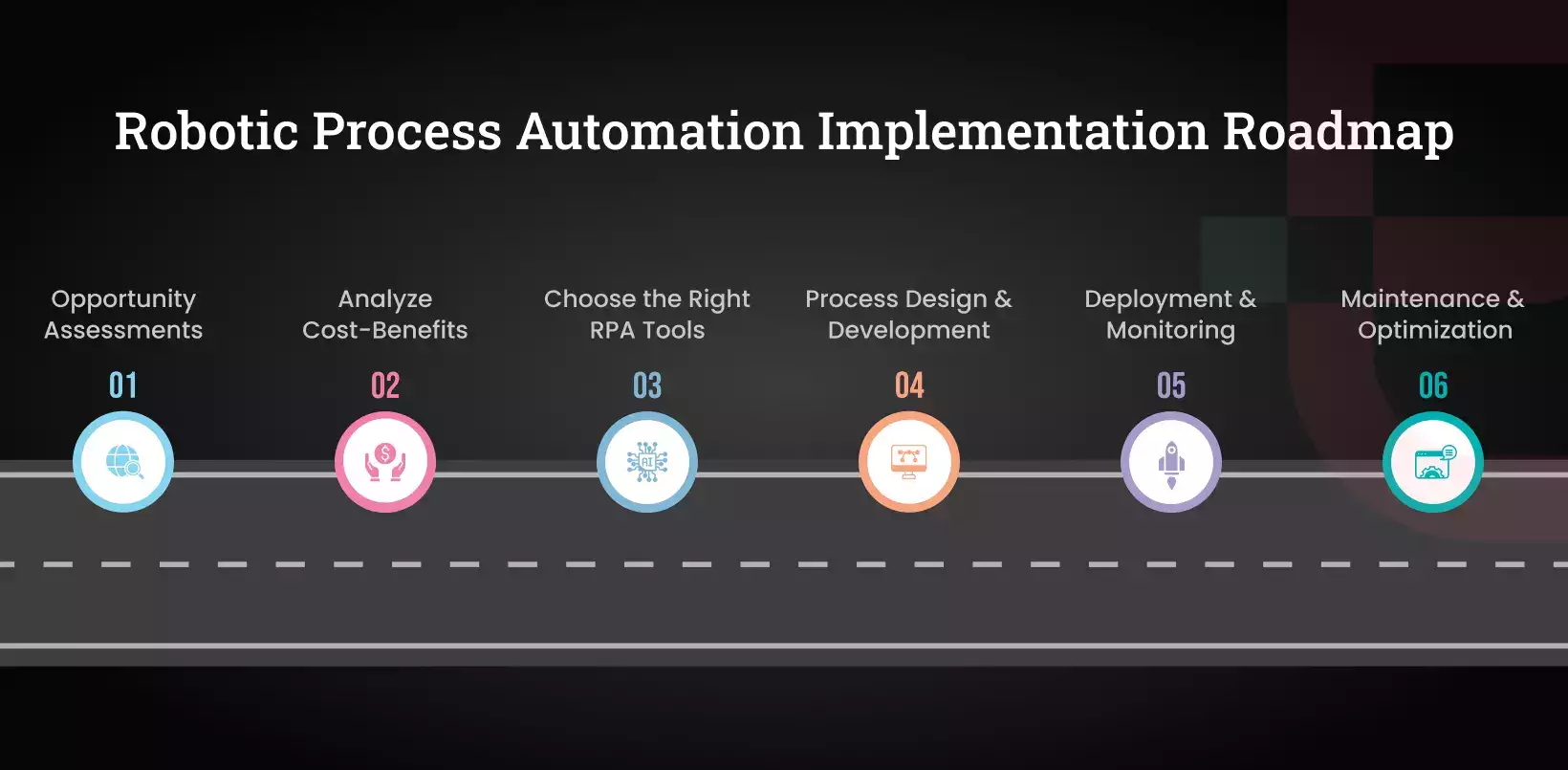
A successful RPA implementation requires a structured and strategic approach rather than ad hoc automation. This roadmap helps you identify the right processes, evaluate costs and benefits, select appropriate tools, and scale automation responsibly.
By following a phased implementation model, you can minimize risks, maximize ROI, and ensure your automation initiatives align with broader business objectives.
Step 1: Opportunity Assessments
Before jumping into implementing RPA automation in your business, first ask yourself, “What exactly are you trying to solve with RPA?” It might be related to minimizing manual errors or to concerns about processing speed.
You are required to consider the following key aspects to define a crystal-clear goal for implementing it:
- First & foremost, define the high-potential processes. Look for specific aspects you want to automate or where you can easily apply a rule-based approach. For example, data entry, report generation, and invoice processing.
- Assess whether the process can be automated successfully with RPA, accounting for technical complexity, data quality, and potential exceptions.
- Project the potential ROI. This will help you prioritize automation initiatives by calculating expected cost savings, increased productivity, and improved efficiency.
Rushing this step is one of the biggest mistakes businesses make, increasing the risk of automating the wrong business processes, which won’t deliver profit when optimized. After all, a lack of goal clarity results in wasted time and money.
Step 2: Analyze Cost-Benefits
For every process you plan to automate, build a specific business case. This involves comparing the expected benefits against the implementation & ongoing maintenance costs.
Direct Benefits:
- Reducing manual work
- Faster process turnaround
- Fewer human errors
Weigh these benefits against the initial implementation costs, such as software licenses, training, and system integration.
Indirect Benefits:
- Enhancing customer satisfaction
- Scalability
- Data-driven decision-making
These insights will help you gain a clearer idea of which technologies to use for a specific case.
Step 3: Choose the Right RPA Tools
Choosing the right tools is pivotal because it directly impacts the success and speed of your automation journey!
Also, several factors may impact your decision when selecting tools, including their compatibility with existing systems, ease of use, scalability, and cost-effectiveness.
If it’s your first time working with automation tools & platforms, it is recommended to consult with an AI expert before making your tool investment decision.
Step 4: Create an Implementation Plan
Now is the perfect time to create a detailed implementation plan! This plan should include questions like
- What tasks will be automated?
- Who will oversee the projects?
- What budget and team will be required?
- What’s the timeline for the entire implementation process, and more
Aside from this, one crucial decision is what roles & responsibilities are needed. So, establishing a Center of Excellence (CoE) is the best option, as it ensures your automated processes maintain best practices and deliver value to your organization.
Step 5: Process Design & Development
Once you have outlined a detailed implementation plan, this is the perfect time to bring your RPA vision to reality. Collaborate closely with the company to map out the processes and build the bots:
- Prepare a detailed blueprint of all required information, including steps, decision points, and potential exceptions.
- Proceed with the bot development process, where RPA developers carefully configure software robots to perform tasks within existing systems, following the blueprint framed.
- Don’t forget to test your RPA automation solution thoroughly. Test it in a staging environment to identify and address any issues before the deployment.
Step 6: Deployment & Monitoring
Now the bot is ready to work! Release your bot into its planned performance area and monitor it, making tweaks where necessary for continuous improvement, which requires careful planning, including.
- Consider rolling out this automation process in phases, starting with a small-scale pilot before expanding it.
- Provide comprehensive training for your employees who use RPA tools.
- Establish robust metrics to measure the success of your RPA implementation.
Step 7: Maintenance & Optimization
Robotic Process Automation (RPA) is an ongoing journey and not a one-time investment! Therefore, to keep pace with the evolving requirements, you have to keep your bots updated regularly by following these ways:
- Update bots as per evolving requirements & new technologies.
- Establish a governance model for regular reviews and updates to management processes, as well as ongoing maintenance.
- Determine & implement the additional processes suitable for automation and scale them as per your business needs.
Looking to Automate Your Operations? Share Your Requirements & Get a Tailored Automation Solution from Our Experts
What are the Challenges for Adopting RPA to Automate Business Operations?
While the benefits of adopting RPA are clear, businesses are also facing several significant challenges in implementing it.
Cost of Implementation
Integrating intelligent automation bots into businesses can be expensive, particularly for small & medium-sized businesses, as it entails infrastructure costs, ongoing maintenance, training programs, etc.
Solution
- Start with high-impact, high-ROI processes to justify initial investments.
- Scale automation incrementally instead of automating multiple processes at once.
- Opt for cloud-based or low-code RPA platforms to reduce upfront infrastructure costs.
Lack of Infrastructure
Without the proper infrastructure to support RPA deployment, you cannot achieve the results you seek. For instance, if you are working on an outdated system where integrating an AI solution or an RPA tool is an inflexible, resource-intensive process.
Solution
- Conduct a comprehensive assessment of your current tech stack.
- Opt for advanced automation bot tools with robust integration capabilities.
- Collaborate with an AI development firm to work on your tailored automation requirements.
Security Concerns
Since robots perform specific internal tasks, they typically have access to a company’s sensitive data, making security a critical concern. If access to data & validation of bots are not managed properly, it will lead to vulnerabilities in the system and increase the likelihood of data leaks.
Solution
- Use encryption to enforce security.
- Assign a unique identifier to each robot.
- Limit data access to authorized users.
Scalability Issues
As your business grows, you are required to automate more processes, which is where scalability issues can creep in. A bot that handles smaller tasks can’t keep up with the increased workload, but it can make a major impact on overall business efficiency.
Solution
- Adopt a modular process design to scale only the required process components.
- Manage load balancing by distributing tasks across several machines, preventing it from becoming overloaded and improving overall performance.
- Use data mining to optimize your processes before automation, thereby facilitating future scaling.
Lack of Skilled Professionals
As projected, demand for AI in RPA will increase at a 33% CAGR from 2024 to 2029, making business owners more eager to invest in these automation tools. This impacts the demand for professionals skilled in RPA & process automation, but the supply is limited.
Finding professionals with expertise in automation and process optimization remains a challenge.
Solution
- Invest in structured employee training and RPA certification programs.
- Upskill existing teams to work effectively alongside automation tools.
- Collaborate with trusted AI service providers to access specialized expertise.
Resistance to Change
Another significant reason behind the delay in adopting automation robots in business is resistance to change. Your team might be hesitant to embrace new technologies because they fear losing their jobs.
Solution
- Establish a clear communication channel and let the team know about RPA’s benefits & its impacts on enhancing their roles & responsibilities.
- Involve employees in the automation process and value their expertise.
- Providing training & upskilling opportunities.
Continuous Maintenance
To keep your robot system running smoothly with minimal intervention, you need to maintain the bots, especially as systems evolve regularly. If updates or maintenance are not followed regularly, it can lead to hidden costs and operational disruptions.
Solution
- Build a modular, reusable bot that can be easily updated or modified without requiring changes to the entire system.
- Implement an automated testing process to ensure bots continue to function properly after system updates.
- Use version control to track changes to your bots and ensure all processes are thoroughly documented.
How Can Elluminati Help You Implement RPA in Your Business
Robotic process automation is helping businesses streamline repetitive tasks, improve accuracy, and create more efficient workflows across operations. Today, businesses are increasingly moving towards intelligent automation to stay competitive, minimize manual efforts, and support scalable operations.
While RPA focuses on rule-based automation, its true impact grows when combined with intelligent systems that can learn, analyze & adapt. This is where Elluminati supports businesses by building tailored AI-driven solutions that enhance process automation beyond basic task execution.
With our expertise in AI development services, we help you design and implement smart automation solutions aligned with your operational goals. Whether you are exploring automation for the first time or looking to advance your digital transformation journey, we will help you make your first move with confidence in this competitive market.
FAQs
Robotic process automation (RPA), also known as software robotics, is a specific form of business process automation that uses advanced technologies to automate repetitive as well as rule-based tasks that human workers perform.
The implementation cost of RPA ranges from $20,000 to $500,000. This vast cost difference is influenced by factors such as the number of bots, automated processes, project complexity, location, and other customized needs. To obtain an accurate quote, we recommend you connect with our sales executive team at sales@elluminatiinc.com.
Robotic process automation addresses universal operational challenges across industries by following these ways:
- Data migration & entry
- Report generation
- Automating repetitive tasks
- Performing rule-based tasks, among others
Here are the best practices for implementing RPA automation in your business:
- Opt for a high-volume, rule-based process with robust ROI potential.
- Modularizing the workflows into components.
- Gather detailed error information for troubleshooting.
- Preparing proper outcome documentation is a must.
- Utilize consistent naming conventions.
- Introduce robust exception handling.
The primary focus of RPA technology is integrating with AI & ML algorithms to create an intelligent automation solution capable of handling more complex, cognitive tasks. Below are some of the key innovations that it brings, including
- Process mining integration
- Hyper Automation
- Self-Healing Bots
- Integration with Generative AI (Gen AI)
Yes. Robotic Process Automation (RPA) follows strict security protocols. You can strengthen your business security by deploying automated controls to protect sensitive data and mitigate risks from human error.