Key Takeaways (TL;DR)
- NLP enables machines to understand human language and turn unstructured text and speech into actionable business insights.
- Modern enterprises use NLP to automate support, analyze sentiment, improve search, process documents, and generate content at scale.
- NLP delivers measurable benefits such as improved operational efficiency, faster decision-making, and better customer experience.
- Core NLP techniques like tokenization, entity recognition, classification, and summarization power most real-world applications.
- Successful NLP implementation starts with a clear business problem, not technology-first adoption.
- Common adoption challenges include data inconsistency, domain complexity, bias, integration hurdles, and compliance risks.
- The future of NLP lies in autonomous agents, multimodal systems, real-time intelligence, and hyper-personalized experiences.
If you run a business where real-time text-to-speech conversion or vice versa impacts the bottom line, NLP is your key to success. NLP is the core technology behind many voice recognition AI tools that businesses use today. However, to use its potential to enhance the workflow, there has to be a systematic approach. A major wrong decision during integration can cost you thousands of dollars on rework, even for a basic NLP model.
In this article, we have touched upon every important aspect of NLP implementation to help you quickly decide if you are ready for it yet. The article starts with a basic understanding of NLP, followed by exploring its use cases, benefits, key components, and technologies involved. You will also learn how to overcome critical challenges during implementation and how to get started in the right direction.
What is Natural Language Processing (NLP), and How Does it Work?
Natural Language Processing is a branch of AI, powered by computer science & linguistics, that helps computers understand, interpret, and generate human language (text/speech). It enables machines to process vast amounts of data, power chatbots (like Siri/Alexa), translate languages, analyze sentiment, and automate tasks.
Usually, software tools process commands as per the structured data, like numbers or predefined commands. When it comes to understanding human language and sentiment, structured data is no longer helpful.
For example, let’s consider a simple voice instruction: “Book a cheap flight to London next Friday.”
For a generic software tool, this is just a string of words. However, an NLP system understands the meaning by its:
- Intent: Booking a flight
- Entities: Destination (London), date (next Friday), price preference (cheap)
It can convert the unstructured language humans speak into structured data for machines to understand and process.
How Does Natural Language Processing Work?
The technology works in a structured process as described below.
- Input is captured: NLP first captures raw input (text/speech) from different sources. The source can be typed message, email content, chatbot query, or spoken words.
- Input is converted to tokens: The input is divided into smaller units called tokens.
- Grammatical structure is analyzed: Each token is examined to understand its grammatical role, such as subject, verb, or object. This is important for the model to achieve contextual clarity.
- Intent and sentiment are identified: The model detects the intent of each phrase (group of words) and the sentiment of the user, such as expressing frustration or seeking information.
- Response or action is generated: Based on the analysis, NLP either generates a relevant response or triggers a workflow.
Real-time NLP Applications for Businesses
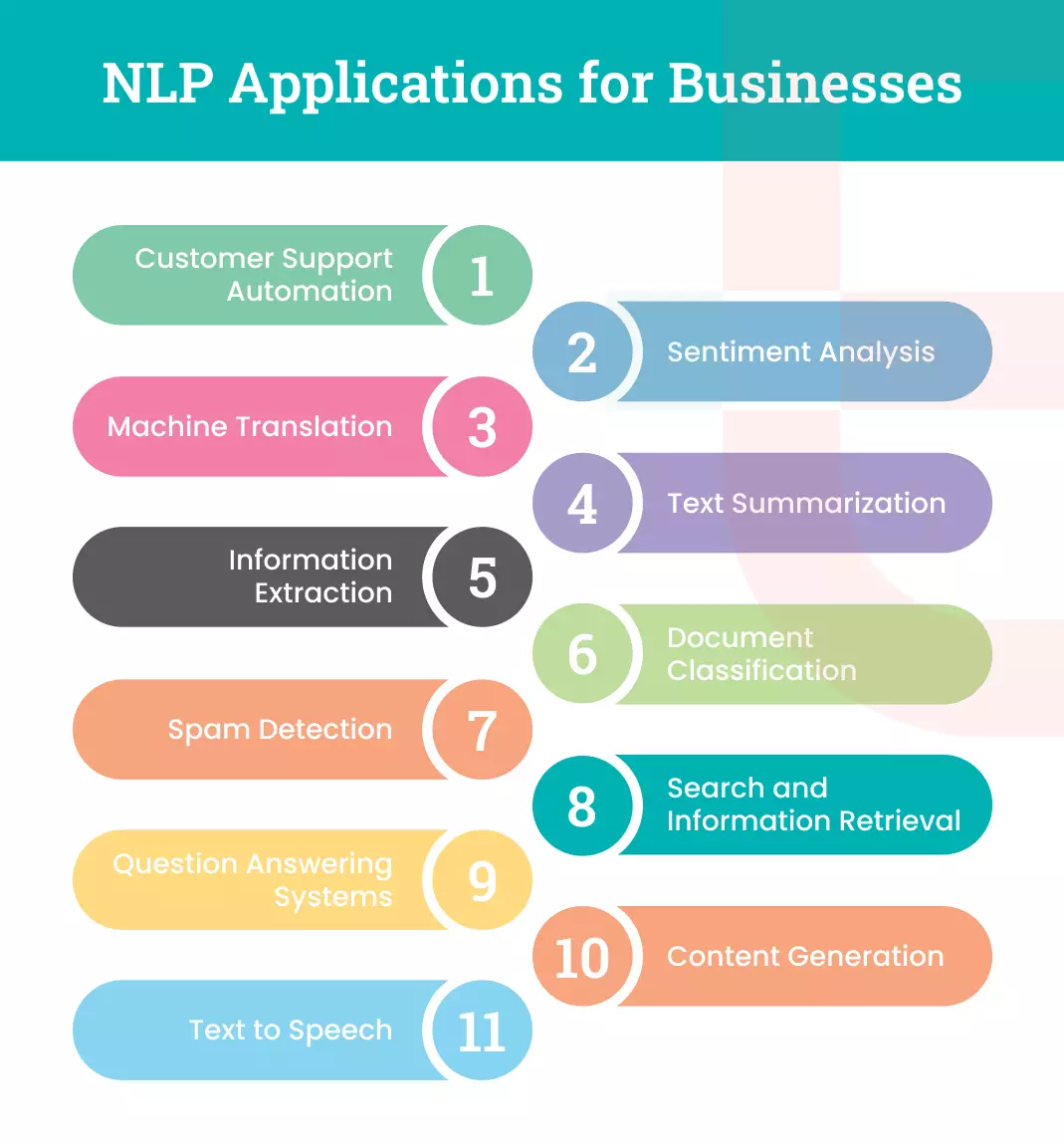
For curious entrepreneurs, understanding NLP applications is important for business clarity. It gives a clear idea of how to use this wonderful technology to save operational costs and improve customer experience immediately. Let’s take a look at some popular use cases below.
Customer Support Automation
- NLP empowers chatbots and AI personal assistants to understand and respond to customer queries as humanly as possible.
- SaaS support bots answering pricing or feature questions are the perfect example.
- This feature is useful in industries where response time directly impacts customer satisfaction.
- NLP works along with other technologies like entity recognition and dialogue.
Sentiment Analysis
- NLP can catch the emotional tone (positive, negative, or neutral) of a sentence to help businesses understand their customers.
- It’s highly useful to measure feedback through hundreds of customer reviews and support tickets in just minutes.
- This feature finds its application in reputation management, crisis detection, and brand monitoring.
Machine Translation
- NLP technology not only understands human sentiments but also translates them into suitable machine languages.
- Instead of word-by-word translation, it does contextual translation so that the intent remains preserved during multiple machine translations.
- It takes the help of additional technologies like neural machine translation and contextual language modeling to do the job.
Text Summarization
- Besides speech, NLP technology can summarize texts without losing the core message and insights.
- The feature is useful for summarizing lengthy reports, preparing transcripts, generating insights from multiple articles, and understanding legal documents.
- Employees or divisions in an organization that deal with a high volume of information daily benefit the most.
Information Extraction
- NLP can automatically identify and extract specific data points from unstructured text.
- Data points can be invoice numbers and totals from bills or patient details from medical records.
- Extracted data points are often paired with OCR and data validation systems to make them more structured for machines to understand.
Document Classification
- NLP categorizes documents into groups based on content to help with quick retrieval and repurpose as and when needed.
- This feature saves the management a lot of time on categorizing invoices, support tickets, resumes, legal files, emails, or insurance claims.
- For enterprises managing large document repositories or customer support operations, NLP helps by directly integrating into their workflow.
Spam Detection
- Natural language processing has an anomaly detection feature. When integrated with your organization’s cybersecurity, it can detect unwanted, harmful, or irrelevant messages.
- It can empower your threat intelligence system to automatically filter phishing emails, block promotional spam, and detect fake reviews online.
- It can also be used in internal communication tools to detect any malicious messages that often lead to data breaches in the organization.
Search and Information Retrieval
- Traditional search bots only fetch results for keywords provided. However, natural language processing adds intelligence to the search system to generate results based on user intent.
- This feature is also useful to find the right document from the internal knowledge bases.
- For e-commerce platforms, this is a scope for customer engagement by providing relevant suggestions even against vague queries.
Question Answering Systems
- Enterprise Q&A bots powered by natural language processing can understand customer queries and return precise answers from structured databases.
- Such AI chatbots are also useful for enterprise knowledge management to explain HR or IT policies as and when required by employees.
- Businesses dealing with legal, medical, or financial guidance can add NLP to their search indexes for thoughtful audience engagement.
Content Generation
- The power of NLP technology is not limited to speech/text translation. It can also perform as a generative AI to create human-like text for different purposes.
- It can add critical thinking to LLMs to create personalized content for different customer segments.
- Startups operating with lean resources benefit from this feature as it works by fully understanding brand guidelines and data analytics.
Text to Speech
- Natural language processing converts written text into natural-sounding spoken audio. So, the application is useful for voice-based interaction and accessibility.
- The text-to-speech feature finds its application in automated announcements and navigation systems.
- Businesses looking for multilingual voice outputs for global audiences and brand-specific voice personas can also use NLP to reduce operational costs.
Looking To Integrate NLP Into Your Workflows? Build Intelligent AI Solutions With Elluminati’s Custom NLP Development Services.
Benefits of NLP for Modern Enterprises
Let’s look at the immediate and the long-term benefits of properly utilizing NLP to its full potential in business workflows.
Improved Operational Efficiency
When teams spend critical working hours on repetitive language-based tasks, core operations slow down. Tasks like responding to common queries, reviewing documents, and routing tickets are easily handled by NLP.
For example, it can empower chatbots to help customers track orders live without any human assistance. Such automated processes improve the overall operational efficiency.
Faster Decision-making From Unstructured Data
It’s a tiresome and labor-intensive process to find critical insights buried in unstructured data like customer feedback or support tickets. NLP can easily analyze them in large volumes and generate insights within minutes.
It significantly helps leaders to make quick data-backed calls instead of relying on past trends or intuition. Support teams looking for a summary of customer feedback to make product improvements can benefit likewise.
Enhanced Customer Experience
Customers expect instant and personalized responses. Natural language processing provides that and maintains consistency across all channels. For instance, NLP can empower AI virtual assistants to handle queries and escalate complex cases to human agents for immediate assistance.
This not only improves customer satisfaction but also ensures a consistent brand experience across all touchpoints.
Reduced Manual Workload
Engaging in repetitive, low-value tasks, like data entry or document review, distracts teams from strategic work. Natural language processing can automate such tasks, removing the need for constant manual intervention.
For instance, an insurance company can extract policy details from claim documents without manual data entry. Such powerful automations speed up the workflow and reduce the cases of workplace burnout.
More Accurate Automated Processes
When the automation involves processing unstructured data from different languages, rule-based models fail. NLP is prone to inconsistent wording and multi-lingual errors. It can well understand context, intent, and variations in other languages.
A finance team can count on the NLP model to classify expense descriptions accurately despite inconsistent wording. That means higher accuracy and fewer processing errors.
Stronger Compliance and Risk Detection
The risk of regulatory and policy violations increases in the absence of a strong data monitoring system. NLP can automate the process. Large datasets can be scanned in minutes to detect risky languages, non-compliance patterns, or any scope of policy violations in real time.
Early detection provides ample time for the management to reduce legal exposure and align everything as per regulatory compliance.
Key NLP Techniques Powering These Applications
Understanding NLP examples and use cases is not sufficient to acknowledge its scope of work in your workflow. The real clarity comes from understanding its core techniques and learning how to make them work for your business.
Tokenization
Tokenization is a process where NLP breaks down unstructured input (text/speech) into words or phrases for machines. Through tokenization, it analyzes the meaning and intent of the sentence.
When a customer types, “I need a refund for my last order,” tokenization splits the sentence into eight words. Key terms like “refund” and “order” are processed further for initiating meaningful instructions for machines.
Named Entity Recognition (NER)
All tokens generated out of an unstructured input are analyzed to understand the class of object they belong to. This process is called Named Entity Recognition (NER).
If the sentence is “Ship the MacBook Pro to Bangalore by 15th July,” NLP identifies generated tokens as product, location, and date at the NER stage.
This precise and actionable data sets the base for sentiment analysis and other processes down the line.
Sentiment Analysis
Sentiment analysis is the process by which Natural Language Processing identifies whether a sentence carries a positive, negative, or neutral tone. It also helps the model catch more nuanced emotions like frustration or urgency.
This technique is highly appreciated in AI chatbots for flagging and escalating queries with negative emotions to human agents for prompt resolutions.
NLP-based Classification
NLP can assign texts to pre-defined categories based on their intent or patterns. For instance, an email saying, “I want to cancel my subscription,” is automatically classified as a churn-risk request.
By using this technique, AI bots become more sensitive to tasks like spam filtering, support ticket routing, intent detection, and topic tagging.
Text Summarization
Text summarization condenses a long string of content into shorter versions without losing context or intent. A 30-page market research report can be summarized into key insights for the team to save time.
In every organization, there are teams that are constantly engaged in researching vast amounts of information. For them, this feature offers reduced cognitive overload and helps in quicker decision-making.
Machine Translation
NLP automatically translates text from one language to another without compromising the core meaning and context. This saves businesses the high translation costs involved in translating conversations in real time for users across multiple countries.
For instance, e-commerce brands, through this feature, can translate product descriptions to appear in native languages for visitors. This helps in faster market expansion.
Speech to Text & Vice Versa
NLP can convert speech to text and vice versa for more natural human-machine interactions. For example, in a call center, natural language processing can transcribe customer calls and automated voice responses through IVR. This feature not only quickens voice-driven workflows but also aids in better call analytics.
How Businesses Can Implement NLP Effectively
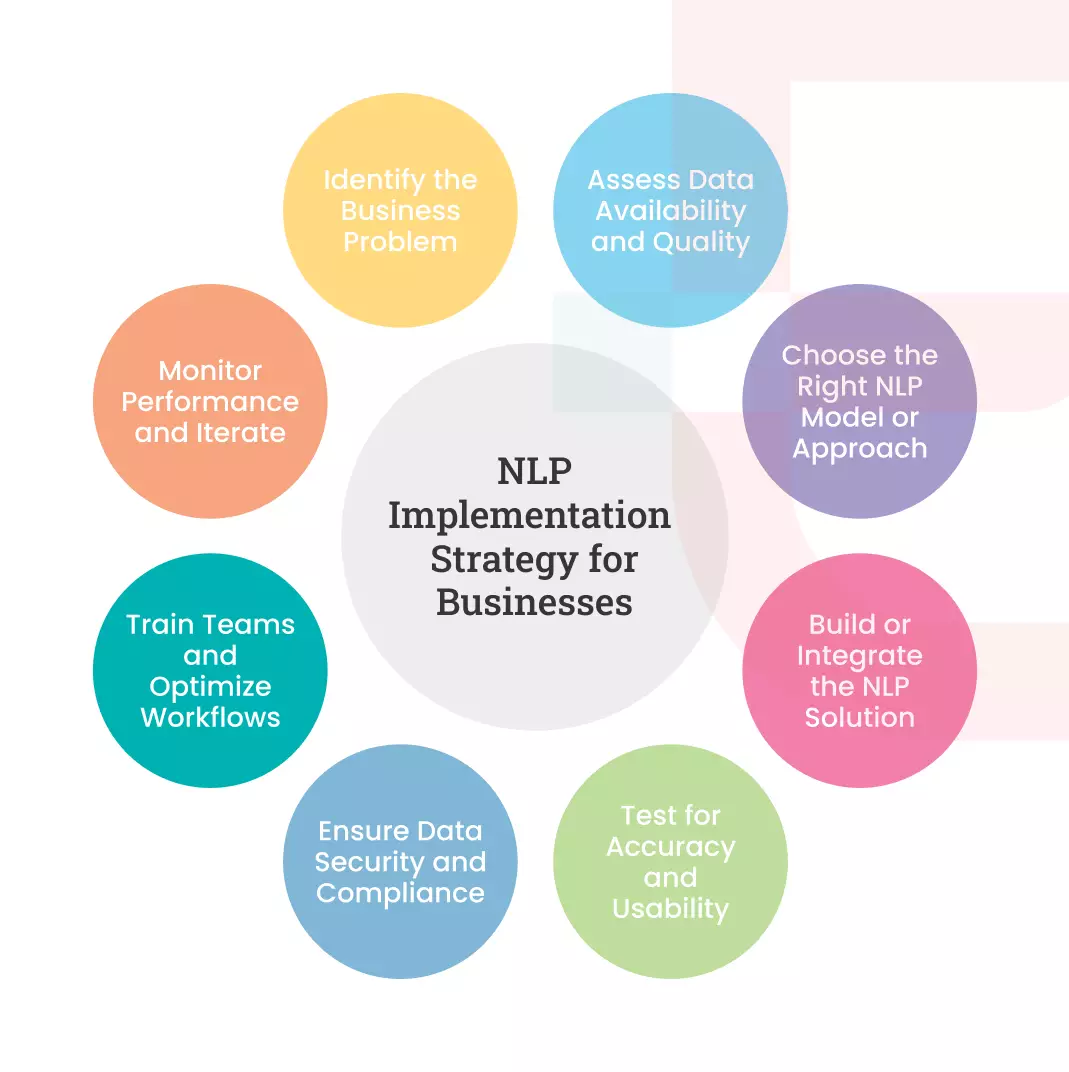
Implementing NLP successfully means solving critical business problems in the right way. Let’s understand the correct way to implement natural language processing for a strategic business advantage.
Identify the Business Problem
First, identify the operational bottleneck or business outcome to be improved through NLP.
For example, instead of just hoping for an AI chatbot to streamline your customer support, be specific about how you want it to benefit your business. It could be reducing support ticket resolution time for common billing queries or automating document processing.
Assess Data Availability and Quality
NLP models learn patterns from data. So, evaluate the input before processing it through the model. Primarily, check for consistency, completeness, and labeling quality.
Let’s say the customer support team wants to train an intent classification model through natural language processing. Before feeding the data into the model, the team should audit its historical chat logs to remove duplicates, outdated responses, and irrelevant messages.
Choose the Right NLP Model or Approach
There are different types of NLP models available, such as:
- Pre-trained models
- Fine-tuned models
- Custom-built models
Below is a quick comparison table to understand their need for a business workflow.
A Quick Comparison of Different NLP Models |
|||
|---|---|---|---|
|
Pre-trained |
Fine-tuned |
Custom-built |
|
|
Model Training |
Trained on diverse datasets to identify the general language pattern |
Pre-trained models further trained on a smaller, specific, labeled dataset |
Trained entirely from scratch on proprietary or specific datasets |
|
Data Requirements |
Data is already embedded |
Requires a small to moderate amount of high-quality data training |
Requires a significant amount of relevant data training |
|
Time to Deployment |
Instant |
Initial training takes days to weeks |
Initial training can take months or longer |
|
Scope of Customization |
Limited |
Moderate |
Maximum |
|
Use Cases |
Sentiment analysis, general translation, basic text classification, and initial prototyping. |
Chatbots, domain-specific Q&A (e.g., medical or legal text analysis), and text summarization. |
Novel architectures, academic research, highly sensitive data scenarios (privacy concerns), and unique data types (e.g., time-series data). |
Build or Integrate the NLP Solution
This step is more or less linked to the last step. The speed of deployment depends on your build-vs-buy decision. If the requirement is for basic automations like sentiment analysis or general translation, third-party pre-trained NLP APIs will work just fine.
However, custom-built models are advisable if they are to solve unique problems, specific to your domain or organization. This will increase cost and time to value as compared to third-party APIs.
Test for Accuracy and Usability
Most enterprises focus on the technical accuracy of NLP models and largely ignore how users interact with the system. This is a critical mistake, as NLP systems can fail if they misunderstand intent or confuse users. So, models should periodically undergo rigorous user testing.
For instance, a chatbot should be tested against informal language, typos, and slang to see how well it responds to real conversations.
Ensure Data Security and Compliance
The global average cost of a data breach is $4.40 million, as per a new global research from IBM. As NLP systems process a large dataset, including sensitive user data and financial information, there is a strong need for data anonymization.
There are a number of ways to protect data, including:
- Data encryption
- Access restrictions
- Use for firewalls
- Deploying endpoint protection
It is also important to automatically back up data and store it in a secure cloud to minimize damage and downtime.
Train Teams and Optimize Workflows
NLP brings automations, but still requires human intervention to handle exceptions. Like all tools, this technology comes with its fair share of challenges and limitations. So, the team from the department for which NLP is being used should be trained well on how to handle exceptions or escalations.
Monitor Performance and Iterate
An NLP system should be trained continuously as language, products, and customer behavior change. Each time after a new upgrade, monitor its performance metrics to see if it delivers with the same accuracy. If not, retrain the model and fix the anomalies until perfection.
Challenges in Adopting NLP & How to Overcome Them
NLP promises speed, scale, and intelligence, but its practical implementation is full of challenges for beginners. Let’s learn about some common challenges and the right way to overcome them for a smooth NLP automation.
Data Quality and Inconsistency
NLP models thrive when data is clean, structured, and free of any anomalies before processing. If the input data is messy, the model accuracy shifts from the ideal performance curve.
Solutions:
- Clean and normalize data before processing it through the model.
- Check for redundancy and outdated entries to ensure model accuracy.
- Standardize formats and language outputs to maintain consistency in output.
Domain-specific Language Complexity
Without proper training, general NLP models struggle to understand industry-specific jargon and abbreviations. This is very common in industries like healthcare, finance, and legal. For example, without fine-tuning, the model can misinterpret contract clauses because it failed to understand legal phrasing or risk language.
Solutions:
- Train models to the industry-specific standard using relevant documents.
- Involve subject matter experts during each cycle of training and validation.
Model Bias and Fairness Issues
NLP models learn patterns from historical data. Sometimes, the data may contain social, cultural, or operational biases. If they are not removed, models may produce biased results. A recruitment screening tool, unintentionally favoring certain profiles, can be a perfect example.
Solution:
- Train the model on a diverse dataset.
- Periodically audit model outputs for bias.
- Use fairness metrics to filter out bias from input.
- Add human review checkpoints to the workflow.
Integration Challenges with Existing Systems
Integrating AI into the existing legacy system is a big challenge for most organizations. Old legacy systems lack APIs or the required data structures for the NLP to process unstructured data easily. Integrating NLP into such environments often disrupts workflows and slows adoption.
Solutions:
- Introduce middleware to connect legacy systems with NLPs without friction.
- Start with isolated workflows. If the integration is smooth, scale the model for the entire workflow.
- Adopt microservices or event-driven architectures.
High Computational and Development Costs
Advanced NLP models require significant computing power. Consistently training and maintaining these models requires skilled talent. This makes custom NLP development expensive for small and mid-tier companies.
Solution:
- Organizations with a low budget should use pre-trained or fine-tuned models at the beginning.
- Cloud-based platforms providing AI as a Service (AIaaS) can also reduce the operational costs as they charge per usage.
- Scale infrastructure only after ROI is proven.
Privacy and Compliance Concerns
NLP systems often process sensitive information. It can be customer personal information, company financial records, or medical notes. If the data falls into the wrong hands, businesses may face legal penalties and reputational damage.
Solution:
- Consider encrypting data at every stage of processing.
- Anonymize or mask sensitive fields with restrictive access for a few individuals.
- Periodically audit the system through a third-party vendor to ensure compliance with regulations like GDPR or HIPAA.
Lack of In-house Technical Expertise
You may add third-party cloud NLP models to your workflow, but their performance reliability depends on in-house experts. Most organizations lack high-salaried positions like data scientists, engineers, and AI architects. This skill gap leads to stalled projects or poor implementation.
Solution:
- Partner with experienced AI and NLP solution providers.
- Use managed NLP platforms with built-in support.
- Upskill internal teams gradually through training.
Future of NLP and Emerging Innovations
The future of NLP will witness a paradigm shift from assisting workflows to driving decisions. Let’s take a look at the emerging innovations in NLP that are going to make the technology a major operating layer for businesses in the future.
Advancements in Large Language Models (LLMs)
- LLMs are soon going to step up from content generation to structured reasoning and decision validation.
- As LLMs will upgrade for deep contextual memory, NLPs can remember preferences for past actions and advise for better modifications.
- Enterprises will use LLMs as cognitive layers for strategy analysis, contract review, and financial forecasting.
Multimodal NLP Systems
- Future NLP systems will simultaneously interpret text, voice, images, documents, and video instead of treating them as separate entities.
- They will understand what customers show, upload, or point to, pushing the boundaries of advanced intent detection.
- Customer interactions across different channels can be merged into a single conversational and analytical context.
- This will shift the capacity of industries to serve better. For instance, medical professionals can analyze reports with images and notes together. E-commerce platforms will allow customers to search using speech and photos combined.
Real-time Conversational AI
- NLP models will have near-zero latency interactions. That means responses will feel instantaneous without any mechanical pause that users associate with AI systems today.
- Real-time NLP will adapt responses based on tone, hesitation, frustration, or urgency detected mid-conversation.
- Conversations will be adjusted on the fly by the system as user intent changes to sound more human and less robotic.
- This will dramatically reduce handle time in call centers, leading to improved customer engagement.
Autonomous AI agents
- Instead of just following orders, AI agents will have the capacity to independently execute tasks like scheduling, reporting, and system updates.
- Special NLP agents will communicate with each other to handle complex tasks on their own without human intervention.
- Enterprises can extensively use different types of AI agents for internal process automation to reduce human dependency in the future.
Hyper-personalized User Experiences
- Future NLP systems can quickly adapt to language, tone, and intent at an individual level.
- They will be programmed to automatically and continuously learn from every interaction to improve responses instantly.
- This will help support interactions and marketing messages that feel more human and personal for the readers.
Low-code and No-code NLP Development
- Future NLPs will be super user-friendly to deploy and manage, even for users with no coding knowledge.
- Non-technical teams can design NLP logics just using prompts and reference examples, through open-source coding platforms.
- Deployment will take just a few days instead of months to help businesses expand NLP applications to more dimensions of their workflow.
Industry-specific Pretrained Models
- Future NLP models will have a wider scope of industry-specific customization.
- They will require minimal fine-tuning to perform in a complex workflow of industries like healthcare, finance, and logistics.
- NLP automations will be smarter as models will automatically adapt to native compliance rules and reporting standards with some basic training.
Smoothly Integrate NLP into Your Applications With Elluminati
Are you looking for NLP-powered AI tools to transform your business? Partner with Elluminati.
We have been helping organizations explore new opportunities in their business domain with our custom AI development services for more than a decade. We can help you leverage Natural Language Processing to create intelligent solutions to solve your present and future challenges with ease.
We can design NLP solutions to track customer sentiment, streamline data processing, convert spoken language into text, sort data into predefined categories, and more. Our handpicked developers work 2X faster, and the team delivers before time without odd surprises.
Experience a smooth NLP development process. Let Elluminati design and deploy NLP-powered systems built for your data and domain.
FAQs
Natural Language Processing (NLP) is a branch of artificial intelligence that enables machines to understand, interpret, and respond to human language in a meaningful way.
The most common NLP applications focus on automation and insight extraction, such as:
Chatbots and virtual assistants: handle customer queries instantly
- Sentiment analysis: tracks customer emotions across reviews and social media
- Document classification: sorts invoices, contracts, and tickets automatically
- Information extraction: pulls names, dates, and amounts from documents
The cost of building a custom NLP solution can vary anywhere from $10,000 for a basic implementation to over $300,000 for complex, enterprise-grade systems. The cost for the same model also varies depending on your data requirements and preferred development approach.
Industries with heavy language data, like a bank dealing with thousands of customer queries per hour, benefit the most from NLP. Where there is a need to process a lot of data in a short span of time to retain customer engagement, NLP offers the best ROI.
A basic, pre-trained NLP takes a few weeks to implement by using pre-built APIs. More advanced or custom solutions take three to six months. Enterprise-grade NLP models may take longer due to integration, testing, and compliance checks.