Key Takeaways (or TL;DR):
- AI in transportation is transforming mobility through automation, safety improvements, and system-wide efficiency.
- Effective applications of AI are autonomous vehicles, traffic management by predicting congestion, predictive maintenance, smart parking systems, and driver behavior analysis.
- AI improves the booking experience for riders through solutions like chatbots, flight delay predictions, and personalized services.
- Businesses adopting AI face challenges such as integration difficulties, high implementation costs, data security concerns, and regulatory limitations.
- The future is about advanced safety mechanisms, smart city integration, and AI-driven infrastructure.
Over the past few decades, artificial intelligence has made transportation easier by reshaping planning, operating, and optimizing mobility systems. From self-driving vehicles to real-time traffic predictions, improving safety, efficiency, and sustainability, AI in transportation has transformed the landscape.
Nowadays, AI is no longer an optional concept, but it’s a necessity for businesses, being an active driver of change, aiming to accelerate growth and automation.
To explore the AI revolution in the mobility sector further, all the essential details are covered in this article. Here, we will explore it through its use cases, key benefits of AI in transportation, and the challenges that businesses encounter when adopting AI in their existing systems.
AI’s Impact in the Transportation Industry
AI in transportation refers to the use of advanced algorithms and technologies like machine learning, computer vision, data analytics, NLP, and more to make the mobility solutions smarter, safer, and more efficient. It includes applications like autonomous vehicles, traffic management, predictive fleet maintenance, sustainability, and efficiency.
Now, let’s have a quick look at how AI is accelerating the transportation industry:
- The global AI in transportation market is projected to grow to $34.83 billion by 2034, driven by the rapid adoption of advanced technologies by businesses to enhance mobility services worldwide.
- It helps mobility-as-a-service providers deliver personalized, cost-effective services, resulting in an enhanced customer experience and increased retention.
- It also plays a vital role in managing electric vehicles by optimizing charging networks, balancing power demand, and enabling intelligent energy use.
Besides these driving factors behind the rise in AI demand, there are several key benefits of AI in transportation, as well as notable use cases. So, let’s check it out:
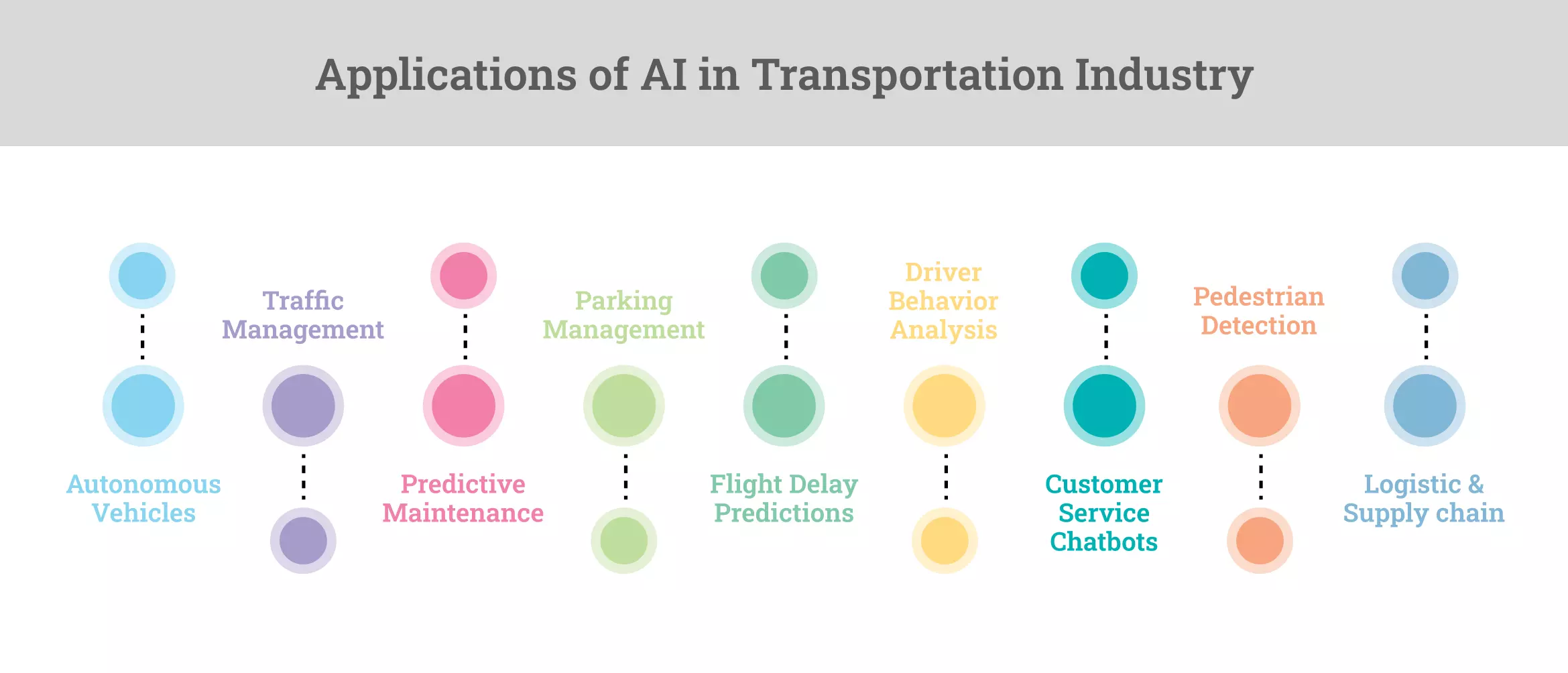
9 Effective Applications of AI in Transportation Industry
AI is not just about fancy automation. It’s about leveraging the benefits where legacy systems and older software fall short. Let’s look at interesting applications of AI in the transportation industry.
1. Autonomous Vehicles
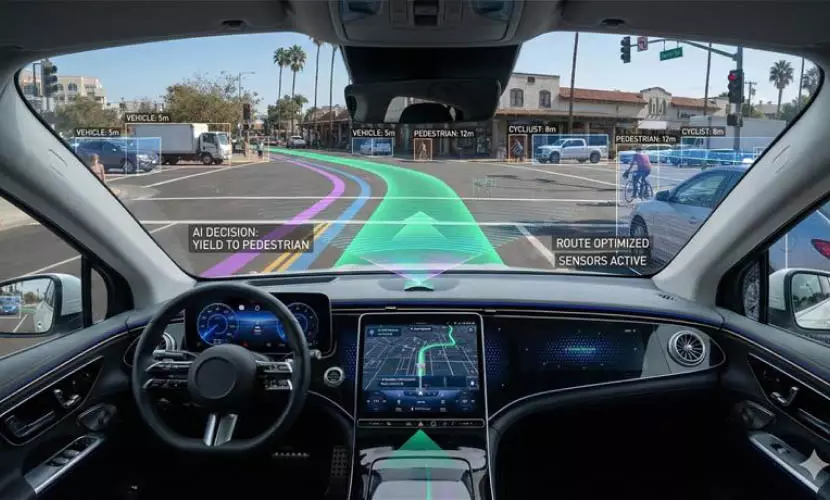
One of the most impressive applications of AI in transportation is the autonomous vehicle, also known as a driverless car. It has completely revolutionized the way we think about traveling.
Tokyo is a great example of this concept, where driverless cars are successfully operating on the road. These cars rely on AI algorithms, including cameras, sensors, and radar, to make decisions like when to accelerate, brake, and take a turn.
The global autonomous vehicle market is projected to reach USD 214.32bn by 2030, driven by rising demand for automation, road safety, and technological innovation. AI also enables these vehicles to interpret traffic signals, detect obstacles, and find routes in real-time, redefining the future of mobility.
Benefits of Autonomous Vehicles
- Reduce the chances of road accidents due to vehicles’ automated decision-making capabilities.
- It operates 24/7 without fatigue.
- It collects real-time road and traffic data to maintain smooth traffic flow and improve road planning for ongoing trips.
2. AI-Powered Real-time Traffic Management
One of the biggest hurdles that commuters have consistently faced is related to inefficient traffic management, and AI plays a crucial role in addressing this issue.
It analyzes traffic flow, vehicle speeds, and congestion levels to adjust signal timings dynamically, eliminating the excessive waiting periods, reducing fuel consumption, and reducing emissions.
In fact, traffic management empowered by AI also prioritizes emergency vehicles, ensuring enough space during critical situations. Not only that, but it also keeps drivers informed with essential information, such as traffic predictions and road blockages, improving overall customer experience and operational efficiency.
Benefits of Traffic Management
- Reduce congestion by optimizing low-traffic areas in advance, thereby eliminating delays in reaching destinations.
- Enhanced road safety by predicting the accident-prone areas in advance.
- It also detects the shortcuts, resulting in reduced fuel consumption and contributing to sustainability goals.
3. Predictive Maintenance
Predictive maintenance is a game-changing concept for fleet operators, which is one of the key applications of predictive analytics. It analyzes historical and real-time data, including engine temperature, brake wear, fuel efficiency, etc., to identify signals indicating when maintenance is required.
This process prevents businesses from incurring last-minute vehicle maintenance costs and minimizes downtime.
Moreover, predictive maintenance is particularly suitable for electric vehicle operators, as they primarily use it, as it keeps EV battery performance protected for a longer period, thereby enhancing businesses’ productivity and increasing vehicles’ life spans.
Benefits of Predictive Maintenance
- Timely vehicle maintenance results in optimal performance while also extending the vehicle’s lifespan.
- Regularly maintaining engines to deliver a smooth trip experience.
- Saves businesses from last-minute vehicle maintenance breakdowns.
4. Effective Parking Management
Finding safe parking spots in busy cities is a time, as well as fuel-consuming issue that most people are facing nowadays.
An AI-powered parking solution utilizes the available parking spaces in real-time for drivers through mobile apps or integrated devices.
Moreover, advanced AI algorithms simultaneously adapt to changes in parking spaces by considering factors like the time of day, local regulations, and more, enhancing traffic management and providing customers and drivers with an effective parking solution.
Benefits of Smart Parking
- AI-powered apps provide real-time information on parking availability, distances, and more, resulting in an enhanced user experience.
- Saves time and fuel by directing the driver to the exact parking slot.
- Enhances traffic flow while also reducing congestion near parking areas.
5. Flight Delay Predictions
We all know that people face flight delays in very frequent cases, and it costs airlines millions of dollars every year in crew expenses, fuel consumption, and scheduling inefficiencies.
Since various factors, such as technical glitches and adverse weather conditions, can cause delays, machine learning systems primarily rely on satellite imagery, radar, aircraft sensors, weather stations, and other data sources to predict delays. Additionally, businesses can update this information in real-time to reduce unnecessary waiting times and improve their planning schedules.
Benefits of Flight Delay Predictions
- It helps reduce overall operational costs by pre-indicating airlines related to delays.
- Provides customers with real-time updates on travel planning, including its landing times, eliminating frustration caused by unexpected delays.
- It helps businesses minimize congestion and disruptions by allocating staff and equipment effectively.
6. Driver Behavior Analysis
Another significant benefit of AI in transportation is the monitoring of driver behavior. Nowadays, vehicles are equipped with telematic devices to detect signs of distraction or unsafe driving patterns. This AI-powered functionality enhances road safety and ensures compliance with transportation regulations.
As fatigue is one of the leading factors behind road accidents, particularly among drivers driving vehicles over time, AI recognizes the early signs, such as frequent blinking, yawning, or head nodding, and immediately alerts them to take a break or reduce the vehicle’s speed. Governments in the UK & US are actively supporting these technologies to reduce accident rates caused by mobile phone usage while driving and other factors.
Benefits of Behavior Analysis
- Enhances safety compliance and reduces the chances of accidents.
- By identifying driver behavior, it alerts them to take a break or other precautions, thereby mitigating the risks.
- Additionally, it provides drivers with data-driven training and monitors their overall performance to deliver a safe and comfortable trip experience to customers.
7. Customer Service Chatbots
With AI, businesses are redefining the way they interact with their customers. They leverage an AI-powered chatbot solution, equipped with natural language processing capabilities, to interact with their customers. It easily understands and responds to all customers’ queries, whether they are related to car-specific features or require further assistance with reserving or canceling the ride.
Additionally, it automates repetitive tasks, such as booking services, test drives, and scheduling calls, which ultimately helps businesses improve their customer service by responding to them instantly, while also enhancing their overall service quality.
Benefits of AI-Powered Customer Service
- Provides round-the-clock assistance to customers.
- Enhances customers’ experience by offering personalized interaction and resolving their issues promptly.
- Manages all repetitive tasks, such as assisting with booking flows, thereby reducing the need for human intervention and saving time.
8. Pedestrian Detection
AI-driven pedestrian detection systems help in safety innovation for semi-autonomous and fully autonomous vehicles. These advanced algorithms, built using computer vision and deep learning technology, can identify pedestrians in real-time and react before the driver even notices, especially when operating in low-visibility conditions such as heavy rain, fog, or at night.
Benefits of Pedestrian Detection
- It helps prevent road accidents, specifically during low visibility, by detecting pedestrians in advance.
- It perfectly supports autonomous vehicles by providing safe navigation indications.
- AI-powered detection at traffic lights helps optimize the signal timing and reduces the chances of collisions.
9. AI in Logistics & Supply Chain Optimization
The success of logistics businesses mainly relies on delivery efficiency and inventory management, and all thanks to artificial intelligence capabilities to make this possible. By implementing AI’s advanced algorithms, such as machine learning and automation, businesses can streamline inventory processes, optimize data in real time, and make informed business decisions, thereby increasing overall operational efficiency.
Benefits of AI in Logistics & Supply Chain
- It helps businesses minimize their operational costs by utilizing automation tools.
- It enables businesses to predict the inventory stocks in advance using predictive analytics, resulting in improved inventory accuracy.
- Also, businesses can maintain delivery efficiency by using tools such as route optimization and real-time tracking.
Build an AI-Powered Transportation Software with Elluminati That Actually Helps You Grow!
Explore the Real-World Examples of Businesses Adopting AI in Transportation
Many taxi players are already utilizing AI features in the taxi app to attract customers and automate their operations. Some of the real examples are discussed here:
Waymo: Self-Driving Ride-Hailing
Waymo LLC, previously known as the Google self-driving car project, is an autonomous driving technology company. Currently operating as a robotaxi service in Phoenix and San Francisco, it has expanded its driverless technology for commercial trucking & logistics applications.
Unlike Tesla, Waymo uses a multi-sensor approach, combining AI with LiDAR, radar, and cameras to create detailed 360-degree 3D maps of its surroundings, enabling high reliability in fully driverless automation. Aside from Waymo, there are other prominent robotaxi service providers, including WEride, Baidu, Cruise, and Pony.ai.
Uber: Smart Ride Matching
One of the renowned names in the world of transportation, Uber, also relies on AI to enhance its overall performance efficiency. Uber leverages smart ride-matching functionality to match riders with the most suitable drivers in a matter of seconds.
This AI system considers various factors, such as traffic, weather, and demand, in real time before connecting customers with drivers, ensuring both drivers and customers have a smooth trip experience.
Tesla Autopilot: Self-Driving Cars
Tesla, Inc. is an American multinational automotive and clean energy company, headquartered in Austin, Texas. It stands at the forefront of AI-powered autonomous driving technology with a full self-driving and autopilot system.
The company utilizes deep learning and neural networks to process data from cameras, radar, and ultrasonic sensors, enabling automatic lane-keeping, adaptive cruise control, and self-parking functionality.
DHL: AI Logistics Automation
DHL is a multinational logistics company that provides services such as courier, package delivery, and express mail. By employing AI-powered warehouse robotics, the company DHL can easily automate tasks such as picking, packing, and sorting, leading to faster order fulfillment and enhanced overall operational efficiency.
Moreover, the company also leverages a predictive planning tool powered by AI to optimize its shipping logistics by forecasting demand and managing the supply chain more effectively. This results in minimizing the disruption, cost savings, while also improving delivery efficiency.
Mozee: AI-Powered Electric Shuttle Mobility
Mozee, an American company headquartered in Dallas, Texas, is known worldwide for its autonomous transportation solutions. The company uses AI technologies such as computer vision, sensor fusion, and navigation systems. These multi-passenger shuttle services operate safely and efficiently while also delivering customers with a zero-emission travel experience.
In addition, Mozee’s shuttle services adapt to market changes promptly without fixed infrastructure, offering dynamic route adjustments through a user-friendly app. This enhances service accessibility for their customers at any time, anywhere.
Challenges of AI in Transportation
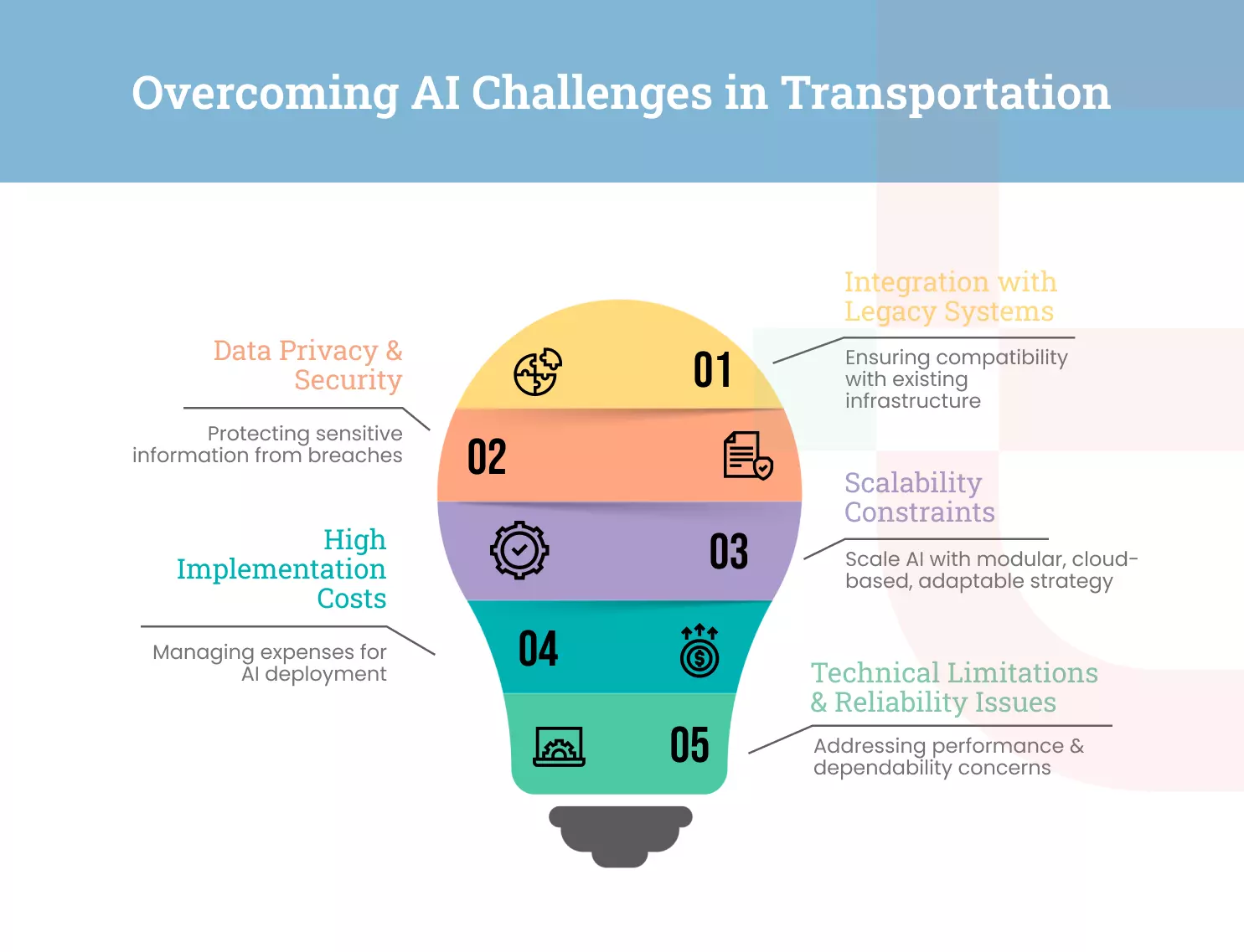
AI plays a vital role in transforming the transportation industry; however, its integration is one of the most complex tasks. Businesses are required to encounter various hurdles when implementing artificial intelligence into their mobility solutions. So, below we have shared some of the common challenges of AI in transportation.
Integration with Legacy Systems
Even in this digital era, many businesses continue to rely on outdated systems to manage their operations. When integrating AI into a legacy system, the process can be complex and time-consuming. Not only that, but it also demands significant tech investments, entire system upgrades, and more, making the transition challenging for many businesses.
Solution:
Instead of replacing everything at once, a phased modernization approach that upgrades outdated systems gradually will be a better option. Migrating to a cloud-based system simplifies AI development. Using API-based connectors and middleware makes it easier to link AI tools with existing infrastructure.
Data Privacy & Security
Ensuring strong data protection is one of the key challenges of AI in transportation. Most businesses have collected their users’ data to deliver a personalized experience in the future; however, this increases the risk if the business is unable to protect it with a robust cybersecurity system.
Solution
Implementing robust security measures such as end-to-end encryption, secure access controls, and multi-layer authentication strengthens data privacy. Using clear governance policies to ensure your customer data is handled ethically and responsibly.
Scalability Constraints
We all know that as a business evolves, it is vital to upgrade its AI systems to keep pace with those changes. If not, then the AI system will not be able to gather your required business data in real-time, impacting the overall business operations.
Solution:
The best way to overcome this roadblock is to set a strategic plan to scale the AI as the market evolves. Opt for a modular architecture, cloud computing, and elastic storage solutions, and keep testing its performance regularly to ensure it is capable of adopting changes as per your business requirements.
High Implementation Costs
Implementing advanced technologies will require significant investment from businesses, making it one of the prominent challenges of AI in transportation. This includes deploying AI systems, particularly those involving sensors, data networks, and real-time processing, which is expensive and becomes the leading factor behind the increasing costs of system upgrades.
Solution
Start with MVPs and small-scale AI pilots before investing larger amounts. Cloud-based AI reduces initial hardware costs. Modular AI components help avoid building systems from scratch, lowering integration costs.
Technical Limitations & Reliability Issues
AI doesn’t always go in the right direction. There are some situations that AI is unable to predict, such as navigating roads without markings or when temporary construction is ongoing. Thus, businesses need to train their AI models to be aware of every possible situation that may occur while on a trip or while driving.
Solution
Continuously train models using diverse, real-world datasets to enhance accuracy in unpredictable situations. Involve humans in the loop to avoid any risk of a wrong decision. Perform rigorous testing across different environments
Future Outlook of AI in Transportation—Emerging Trends of 2026 & Beyond
AI grew from a basic rule-based model into a machine learning model with independent reasoning capabilities. And it’s not the end. Every day we are discovering new AI trends that are going to impact any industry around the globe; driving automation and optimizing the operation and transportation are not behind. Here are some emerging trends in this industry that should not be missed.
Advanced Safety Mechanisms
AI plays a vital role in enhancing the safety of both drivers and customers. The advanced AI algorithms help businesses monitor drivers’ behavior in real-time, including driving patterns, and immediately alert them, thereby reducing the chances of collisions and delivering a smooth trip experience to customers and drivers.
Smart City Integration
Advancements in technology have led to significant transformations in how people navigate cities. Nowadays, self-driving cars and buses utilize cameras, sensors, and other technologies to analyze road systems, predict traffic signals, and more. It helps optimize routes and predict congestion to deliver an efficient travel experience, even in busy cities.
AI-Driven Infrastructure
As the adoption of AI increases in the transportation industry, it has also had a significant impact on the infrastructure. From roads and intersections to bridges and tunnels, everything is fully equipped with sensors that communicate with AI-driven vehicles. It provides them with accurate road details, ensures safety, and enables driverless cars to operate smoothly on the road.
Elluminati will Help You Implement AI in Your Transportation Operations
AI in transportation is redefining how mobility services operate and grow. Throughout this comprehensive blog, we have explored some of the essential use cases, potential challenges, and benefits of AI in transportation, along with emerging trends that showcase the future of AI in mobility services.
For businesses to thrive in this competitive market, they must adopt AI-powered technologies. If you are also among those who are seeking the opportunity to embrace this transformation, then collaborate with Elluminati to get comprehensive AI development services. We have an experienced team of developers who will help you maximize innovation and business performance seamlessly.
FAQs
AI plays a vital role in transforming the transportation industry, as it optimizes traffic flow, reduces congestion, and enhances fleet management. Moreover, AI in autonomous vehicles addresses safety concerns, while its data analysis also helps businesses enhance their customers’ experience.
The cost to implement AI in transportation ranges from $5,000 to $20,000. However, several factors contribute to varying costs, including the need for a custom solution, data management, integration of AI models, model testing, and other related expenses.
With AI-powered technology, businesses can easily deliver a superior customer experience, including instant responses to their queries with a chatbot, personalized trip experiences based on previous data, and real-time trip updates, resulting in improved customer satisfaction and increased retention.
There are numerous environmental benefits to adopting AI in the transportation industry; however, the most significant ones are: it reduces carbon emissions and fuel consumption through effective route optimization.