Key Takeaways (or TL;DR)
- Curb is a taxi booking platform operating in more than 65 cities in the US, playing a major role in serving on-demand rides.
- The platform stands out through its transparent and no-surcharge pricing model.
- It was launched with the aim of reducing cash dependency in taxi operations.
- It follows an aggregator-based business model that allows riders to book licensed taxis through a mobile application, without having its own fleet.
- Rather than relying solely on ride fares, the platform generates income from multiple sources, including commissions, medical transport contracts, advertising, and software licensing fees.
Curb works as a two-sided marketplace model that connects riders with nearby licensed taxi drivers. It monetizes this platform through multiple revenue streams, including commissions, advertising, corporate accounts, and more.
For businesses looking to modernize their traditional taxi operations, the Curb business model shows how a taxi-booking platform can build diverse income layers on top of a licensed-cab network.
This article will tell you in detail about how Curb works, its business model, and monetization strategies.
What is Curb?
Curb is a US-based on-demand taxi-hailing platform that allows riders to book licensed taxis and for-hire vehicles through a mobile application. It traces its roots to Amos Tamam’s 1990s taxi payment technology and his company, TaxiTronic, which later merged with Verifone, Inc. to form the company that now operates as Curb. Its primary aim was to reduce cash dependency in the industry and to make cab booking hassle-free for riders.
Curb Overview: How It Became One of the US’s Leading Taxi Platforms?
Initially, Curb was launched as “RideCharge” to provide online ground transportation services for business travelers. Later, it was rebranded as “TaxiMagic” in 2009, then as “Curb” in 2014. The company differentiates itself from its competitors with a fair and no-surprise pricing model.
Company Overview
Founded in 2007 as RideCharge
Founder: Amos Tamam
Services: On-Demand services for booking licensed taxis
Headquarters: Long Island City, New York, USA
Key People: Amos Tamam (Founder and CEO), Vishal Dhawan (CTO), Avi Itzhakov (COO)
As of 2026, Curb’s platform connects over 100,000 drivers across more than 65 cities in the US, UK, and Canada.
Now, here’s how Curb evolved from a 1990s taximeter to a national taxi-booking platform.
Success Timeline of Curb
2007
- “RideCharge” launched as a separate ground transportation booking service.
2009
- RideCharge got rebranded as “TaxiMagic”.
2014
- TaxiMagic got rebranded as “Curb”.
2015
- Verifone Transportation Systems acquired the Curb taxi app to offer an alternative solution to Uber and Lyft.
2018
- Verifone Transportation Systems was spun off from Verifone Inc., and Curb became an independent company.
2022
- Curb partnered with Uber to make taxis available for Uber users.
2025
- Curb launched Curb One, the first all-in-one driver app featuring GPS metering and Tap-to-Pay with no extra hardware required.
Funding Rounds of Curb
Curb has raised around $10.7 million in funding in 3 rounds, with SAP Concur as one of the lead investors.
| Funding Date | Funding Type | Amount Raised | Investors |
|---|---|---|---|
| 20 January, 2008 | Series A | $4 million | – |
| 18 February, 2009 | Series B | $4.6 million | SAP Concur |
| 19 August, 2014 | Series C | $2.1 million | – |
Source: Crunchbase
How Does Curb Work?
Curb follows a simple working flow where riders request taxi rides through the mobile application and the platform matches them with the nearest driver. Below is a detailed look at how Curb works.
- Riders log into the application and enter their location details.
- They can book an instant ride or schedule a ride for a specific day.
- The platform’s smart dispatch system automatically finds and assigns the request to the nearest driver.
- Drivers receive the request, which they can accept or reject according to their preferences.
- Riders receive information related to fare, estimated arrival time, and driver details before the trip begins.
- Drivers reach the pickup location using the in-app navigation system.
- Riders can choose from multiple payment options to pay for the ride, including digital wallets, cards, and cash.
- After the trip is completed, both riders and drivers can rate their experience, which helps the platform identify and address service gaps.
What is the Curb Business Model?
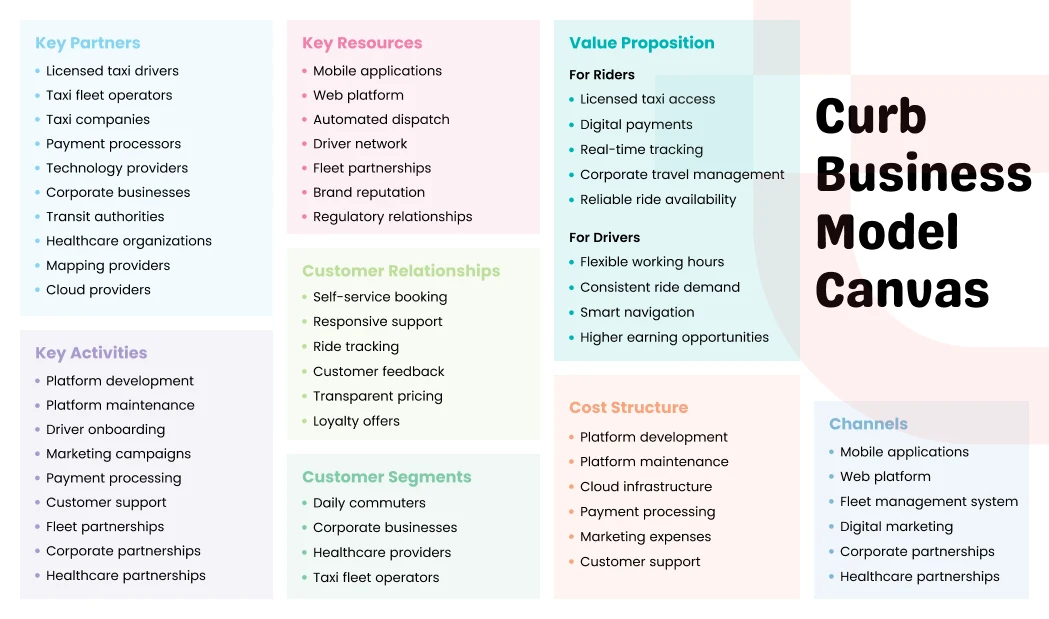
Curb business model is built on an aggregator approach that connects riders with licensed taxi drivers through a digital application. Let’s have a look at each important aspect of the model.
Key Partners
The platform collaborates with several partners to conduct taxi-hailing operations.
- Licensed taxi drivers who are looking for additional income opportunities.
- Fleet operators and taxi companies that manage different vehicles
- Reliable payment processors to enable in-app transactions
- Technology providers to build and maintain the taxi booking platform
- Corporate companies that provide ground transportation services to employees and clients.
- City transit authorities, like the New York City Taxicab and Limousine Commission (TLC), need to understand the legal requirements for operating licensed taxis.
- Healthcare organizations that book non-emergency medical transportation trips through the platform.
- Mapping services like Google Maps help drivers navigate routes efficiently.
- Cloud architecture providers ensure platform scalability.
Key Activities
The taxi-hailing platform performs several activities to ensure smooth operations daily.
- Building and maintaining mobile and web applications.
- Onboarding reliable, licensed taxi drivers
- Launching marketing campaigns to extend reach
- Processing digital transactions on the platform
- Providing 24/7 support to both riders and drivers
- Partnering with additional taxi fleets to expand to other regions
- Partnering with local corporate companies and healthcare providers for long-term contracts
Key Resources
The company depends on different resources to operate effectively.
- Mobile and web applications to let riders book taxi trips
- Automated dispatch system to find and assign the nearest drivers quickly
- A strong network of licensed taxi drivers and fleet operators to ensure service availability at all times.
- A strong brand presence in different cities of the US, UK, and Canada
- Relations with city regulators and transit authorities to operate compliantly.
Value Proposition
The company creates value for both riders and drivers.
For Riders:
- They can book licensed taxi rides without waiting on stands.
- Digital payment options help increase convenience.
- They can track assigned drivers in real time.
For Drivers:
- They can operate flexibly at their preferred schedule
- Curb’s larger rider base creates consistent earning opportunities for drivers.
- The platform’s navigation system helps them complete trips efficiently.
Customer Relationships
Curb builds strong relations with riders by making the taxi booking process smooth and convenient.
- They can book trips, make payments, and track rides through a single app.
- The customer support team promptly resolves rider queries for payment or ride issues.
- Riders can rate their experience and provide feedback to help the platform maintain service standards.
- Upfront fare calculation helps maintain transparency with riders.
- Special offers and no surge pricing encourage riders to use the platform repeatedly.
Customer Segments
The taxi platform serves several customer groups, which include:
- Riders who need reliable on-demand transportation solutions for daily commuting.
- Corporate companies are looking for a solution to manage the everyday travel needs of their employees and clients.
- Healthcare providers who want to provide non-emergency transportation services to their patients.
- Taxi fleet operators who want to provide online ride-booking services without investing in building the technology platform.
Channels
The on-demand solution uses multiple channels to reach its diverse customer segment.
- Web and mobile applications to provide online taxi-hailing services.
- A fleet management system to help taxi operators manage daily operations.
- Digital marketing campaigns like SEO, paid ads, and social media platforms.
- Partnership with local corporate offices and healthcare clinics to extend reach.
Cost Structure
The platform has to invest in several things to ensure smooth operations.
- Building and maintaining a technology platform.
- Cloud infrastructure to ensure scalability.
- Payment processing fees for secure digital transactions.
- Marketing through different channels.
- Hiring a dedicated customer support team for instant resolution of user queries.
How Curb Makes Money – Understanding Its Monetization Model
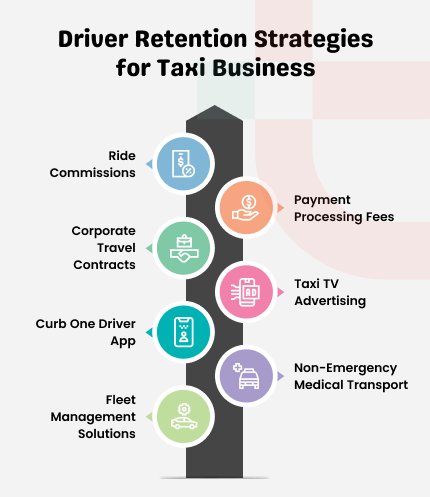
The company generates revenue through multiple streams. Here is the detailed breakdown of the Curb revenue model.
Ride Commissions
The platform charges drivers a commission for every ride request received through the platform.
It applies to both types of ride bookings, whether they originate directly from the Curb app or through Curb Flow, Curb’s booking integration that routes ride requests from partner platforms like Uber into its driver network. This revenue stream grows as the booking volume increases.
Payment Processing Fees
The platform equips taxis with the necessary hardware and software required to accept payments through credit cards, digital wallets, and tap-to-pay. To cover this, it charges a small amount to riders for processing online transactions. This allows the company to cover operational costs related to in-app payments.
Corporate Travel Contracts
Curb partners with platforms like Gett to offer ground transportation services to corporate companies for their employees. These contracts create recurring revenue opportunities that work independently of daily ride bookings.
Taxi TV Advertising
The platform operates Taxi TV, which allows local brands to promote their services or products via TV screens installed inside cabs. This benefits both the advertiser and Curb.
Businesses can extend their reach through Curb’s large rider base, while Curb earns an additional income stream, which is independent of ride volume.
Curb One
It is an all-in-one driver app that includes a taxi meter, payment processors, navigation systems, and real-time trip tracking. This cuts down the hardware distribution costs for Curb as it does not have to distribute hardware devices to drivers.
It also lets the platform earn through settlement and processing fees charged to drivers for every transaction. Driver churn is one of the reasons taxi businesses fail. Curb One helps address it by giving drivers a single application to manage trips.
Non-Emergency Medical Transportation Solutions
The taxi company collaborates with local healthcare providers to offer non-emergency transportation services to patients traveling to treatment centers. This provides the platform with a stable and predictable income source.
Fleet Management Technology Solutions
The company offers a dispatch system and fleet management software to taxi companies in exchange for licensing fees. This lets the platform create a steady revenue stream independent of individual ride fares.
Want to Start an On-Demand Taxi Business? Elluminati’s White-Label Curb Clone Reduces Launch Time and Helps You Enter the Market Quickly
How Elluminati Helps You Build an On-Demand Taxi Platform Like Curb?
The understanding of the Curb business model highlights how traditional taxi services can be modernized without disrupting existing workflows. Its diversified revenue model shows how businesses can monetize their taxi operations in different ways.
If you are planning to launch a similar app, Elluminati becomes your reliable technology partner with its ready-made Curb clone app. Our white-label solution comes with an automated dispatch system, a region-specific taxation system, and multi-currency and multi-city support. It will allow you to launch and scale taxi operations quickly and effectively under your own brand.
FAQs
The Curb business model works as a two-sided marketplace that connects riders with licensed taxis through a mobile application.
The Curb revenue model includes multiple revenue streams:
- Ride commissions
- Payment processing fees
- Corporate travel contracts
- Taxi TV advertising
- Curb One driver app
- Non-emergency medical transport solutions
- Fleet management technology solutions
Yes, Curb mainly allows riders to book licensed taxi services, while Uber works with independent rideshare drivers.
No, it partners with fleet operators and licensed taxi drivers.