Key Takeaways (or TL;DR)
- Yandex Go is a leading super app that allows customers to book rides, order groceries, meals, and more from a single digital platform.
- It works in a simple way where customers request a service, and the platform matches them with the nearby available service providers.
- The Yandex Go business model acts as a multi-service digital platform that connects customers, service providers, and delivery partners through a mobile application.
- The Yandex Go revenue model generates income from multiple sources, such as driver and restaurant commissions, delivery charges, subscriptions, in-app advertising, and corporate services.
- The company aims to strengthen its super app ecosystem by investing in AI and AVs, expanding into markets beyond CIS, and adopting EVs in its ride-hailing operations.
Multi-service on-demand applications are gaining more traction as they provide access to multiple services like ride-hailing, food delivery, and more on a single platform. Yandex Go is one such super app, operating in Russia and several other countries with millions of customers.
The Yandex Go business model is a multi-service digital platform that connects customers, local businesses (restaurants and stores), and delivery partners through a single application.
Understanding this model helps aspiring entrepreneurs learn how, by integrating multiple services, they can manage daily operations easily and also enhance earning opportunities through different verticals.
This article will give you a detailed glimpse of how Yandex Go works, its business model, revenue strategies, and future outlook, so you can start a similar business easily and confidently.
What is Yandex Go?
Yandex Go is Russia’s leading super app that combines multiple on-demand services like ride- hailing, food delivery, courier delivery, and cargo services in a single platform. It was introduced by Yandex, which is one of Russia’s largest internet companies, founded by Arkady Volozh and Ilya Segalovich.
Company Overview
Founded in: 2020
Founders: Arkady Volozh, Ilya Segalovich
Services Offered: Ride-hailing, Food delivery, Grocery delivery, Courier delivery, and more.
Headquarters: Moscow, Russia
Key People: Artyom Savinovsky (CEO), Alexander Anikin (head of urban operations)
Operating Locations: Middle East, Africa, Europe, South Asia, CIS, and Russia
Yandex Total Revenue (2025): 436 billion roubles (Approximately USD 5.68 billion) in the 4th quarter
Major Milestones of Yandex Go From a Ride-Hailing Platform to a Successful Super App
2011
- It was launched as Yandex Taxi, an on-demand ride-hailing platform, founded by Arkady Volozh and Ilya Segalovich in Moscow.
2017
- The company acquired Moscow’s Foodfox to step into the food delivery market.
2018
- Launched Yandex.Eats food delivery services in Russia’s dozens of cities.
- Completed the merger with Uber for ride-sharing operations in Russia and other neighboring countries like Azerbaijan, Belarus, and Kazakhstan.
2019
- Launched Yandex.Lavka grocery delivery services in Moscow.
2020
- Introduced Yandex Go by combining its multiple services, ride-hailing, food delivery, grocery delivery, and more in one application.
2023
- Purchased Uber’s stakes in the taxi joint venture for $703 million.
2024
- The ex-Yandex self-driving group, Avride, partnered with Uber to start robotaxis and robot delivery.
2025
- Hyundai partnered with Yandex Avride for robotaxi development.
A Glimpse of Yandex Go’s Market Presence
Today, Yandex Go is operating successfully in more than 15 countries in Central Asia, the Caucasus, and Eastern Europe. Moreover, it is processing around millions of orders daily. This is possible because of its strong partnerships with local businesses like supermarkets, fleet operators, and more.
Different Services Offered by Yandex Go
Now, let’s explore the multiple services that Yandex Go offers.
1. Transportation
The company offers diverse transport solutions for urban commuters.
- Ride-Hailing: Users can book taxis through a mobile application.
- Yandex Drive: Allows passengers to book rental cars for short distances or intercity travel.
- Yandex Scooters: Offers electric scooters for rent to make last-mile delivery and short urban travel easy and convenient.
- Yandex E-Bikes: Provides electric bicycles for rent to travel short distances.
- Yandex Self-Driving Cars: Offers autonomous taxis in selected regions to commute in cars without depending on drivers.
- Public Transport Updates: Itmakes it easy for passengers to know the schedules, book tickets, and plan routes for public transport solutions from within the app.
- AeroExpress: Passengers can book and purchase tickets for trains and flights from the app.
2. Delivery & Logistics
The platform makes it easy for both individuals and businesses to book different delivery services through the application.
- Courier Delivery: Offers delivery of parcels and documents within the cities.
- Cargo Transportation: Transports larger shipments in both urban and semi-urban areas.
- Intercity Delivery: Delivers packages between different cities.
- Food Delivery: Provides food delivery services from local restaurants to customers’ doorsteps.
- Grocery Delivery: Delivers groceries and other household essentials within cities in a few minutes.
Shopping
Yandex Go allows customers to purchase different products like electronics, clothing, and more from the digital app.
- Yandex Market: Customers can select and order different things from the platform.
- Express Delivery: It delivers ordered items on the same day or the next day.
Car Services
Besides allowing customers to order or book different products and services, Yandex Go also offers services to maintain various types of vehicles.
- Fuel and EV Charging: Helps customers find nearby fuel or charging stations through an in-app GPS system.
- Car Wash: Makes it easy for customers to schedule car cleaning services in different locations within a city.
- Power Bank Rental: Provides portable power banks for rent to customers during travel to charge their smartphones and other essential devices while commuting.
Corporate Services
The firm provides services to corporations and their employees in different ways.
- Yandex Go for Businesses: Provides ride-hailing, delivery, and rental services for companies to manage their employees’ daily commuting needs with ease.
- Pay-Upon-Receipt Delivery: Allows a cash-on-delivery payment method for companies and their employees for different services.
Explore the Yandex Go Business Model
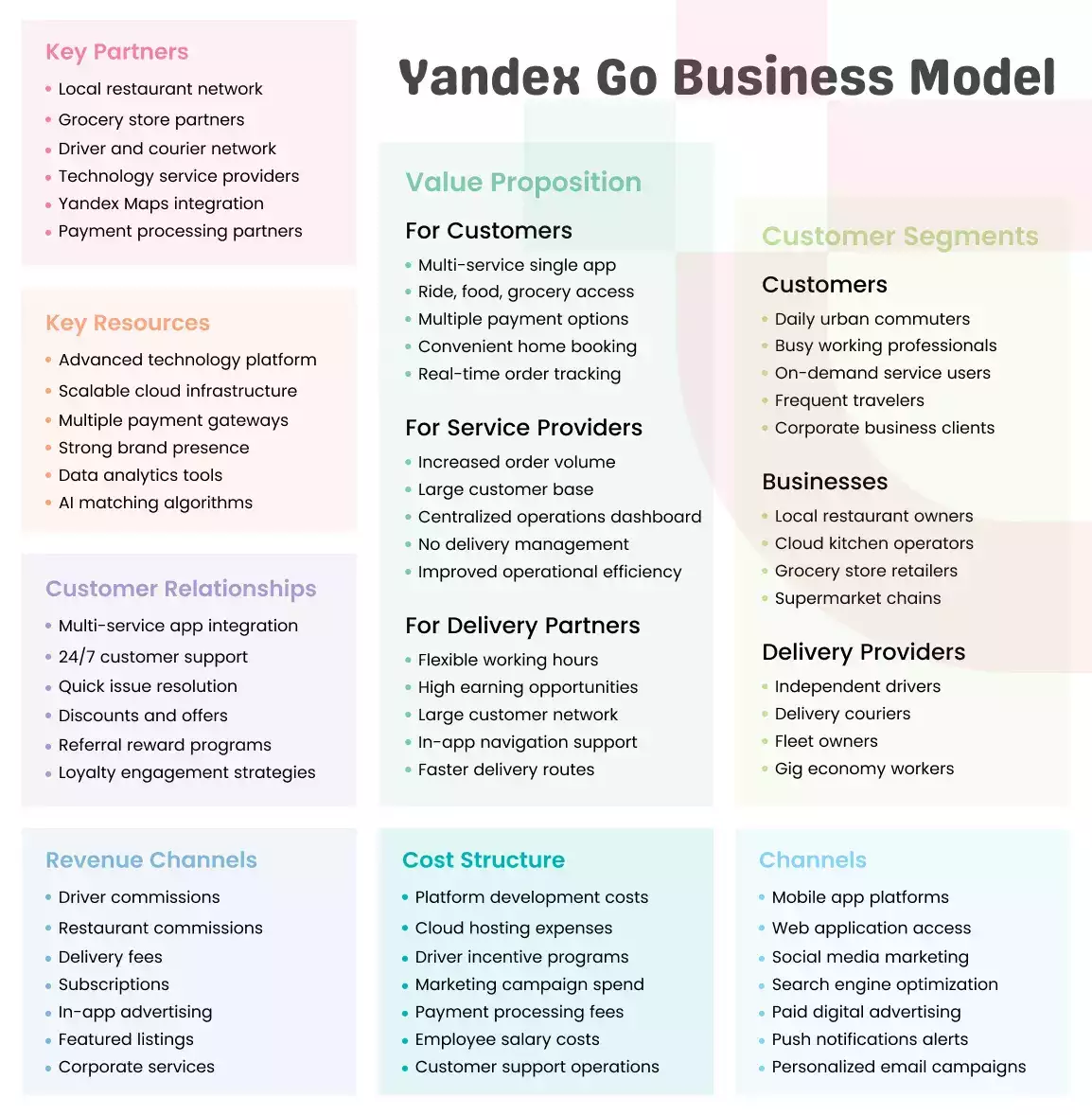
The Yandex Go business model operates as a multi-service marketplace that combines different services like ride-hailing, food and grocery delivery, and logistics in a single application. Here is a detailed breakdown of each important component of the model.
Value Proposition
The platform creates value for all its user segments: customers, service providers, and delivery partners.
For Customers:
- Get access to multiple services from a single app.
- Multiple payment methods make it easy to pay according to one’s convenience.
- Customers can book services from the comfort of their space.
- They can track their orders in real time from within the app.
For Service Providers:
- Local restaurants and stores can increase their order volumes through Yandex Go’s larger user base.
- They get a centralized dashboard to manage daily operations, helping enhance overall operational efficiency.
- Do not have to worry about delivery operations as Yandex Go itself manages it.
For Delivery Partners:
- Flexible working hours allow delivery providers and couriers to work as per their preferences.
- In-app navigation systems allow them to deliver orders faster and more efficiently.
- Yandex Go’s larger customer network creates high-earning opportunities for delivery partners.
Key Partners
Yandex Go collaborates with several external entities to run daily operations.
- Strong network of local restaurants, supermarkets, and grocery stores to deliver different items.
- Collaboration with local drivers and couriers to provide faster delivery.
- Technology providers to build and maintain web and mobile applications.
- Yandex Maps to optimize routes for quick deliveries.
- Trusted payment processors to enable online transactions securely.
Key Resources
The super app requires different elements to perform various operations.
- A technology platform to allow customers to book services.
- Cloud infrastructure to ensure scalability when needed.
- Multiple payment gateways to process online transactions.
- Powerful brand presence to attract customers and build trust.
- Data analytics tools to provide personalized product suggestions to customers.
- AI-powered smart matching tools to find and assign nearby delivery partners quickly.
Customer Segments
Yandex Go serves three customer segments, which include,
Customers:
- Individuals who need reliable ride-hailing solutions for daily commuting.
- Busy professionals who find it difficult to visit restaurants or retail stores physically.
- Travelers looking for on-demand ride services.
- Corporate companies that want to manage employees’ daily travel to offices.
Businesses:
- Local restaurants and cloud kitchens that want to provide online food delivery services.
- Supermarkets and grocery stores are looking to extend their customer reach through online platforms.
Delivery Providers:
- Independent drivers looking for flexible working opportunities.
- Couriers who want to enhance their earnings through online deliveries.
- Fleet owners looking for platforms to create higher income opportunities.
Customer Relationships
Since its launch, Yandex Go has been making efforts to build long-term relations with its customers.
- Integration of multiple services under one platform eliminates the need to switch between apps for booking different services.
- 24/7 in-app support helps in resolving customer queries and disputes quickly.
- Special discounts and referral programs help in enhancing customer loyalty.
Channels
The app uses diverse media to reach its customers.
- Web and mobile applications to provide online services.
- Digital marketing campaigns to promote their services online through social media platforms, SEO (Search Engine Optimization), and targeted ads.
- Real-time push notifications and personalized emails to make customers aware of ongoing offers and discounts.
Cost Structure
Yandex Go has to incur several operational expenses to conduct on-demand delivery and ride-hailing operations.
- Technology platform development and maintenance
- Incentives and payouts for delivery partners.
- Marketing and promotional expenses
- Online payment processing fees are charged for each transaction done through the application.
- Salaries for operational and customer support teams.
- Cloud infrastructure hosting costs
Want to Build a Multi-Service Platform Similar to Yandex Go? Connect with Elluminati for Reliable and Scalable Technology Solutions
How Yandex Go Works?
Yandex Go follows a simple workflow supported by an interactive multi-service UI, that lets users access multiple services with ease. Let’s have a closer look at how Yandex Go works.
For Customers
- They log in to the app, enter their location, and select the desired service.
- After selecting the service, the customer confirms booking by choosing their preferred payment mode.
- The app then uses AI-powered smart matching algorithms to find and assign the nearby delivery partners.
- During the delivery process, customers can track the delivery partner through the in-app tracking system.
- After service execution, customers are asked to rate their overall experience and share feedback to help the platform improve its service quality.
For Merchants / Restaurants
- Firstly, restaurants and merchants register themselves and then list their products.
- After successful verification by the application, businesses can go online.
- They start receiving order requests, which they can accept or reject depending on their availability.
- Once the request is accepted, service providers confirm the expected preparation time in the app and start preparing the order.
- After an order is prepared, providers notify the system, and the platform assigns the nearest available delivery partner.
- The providers get paid by the app after the customer receives the delivery.
For Drivers
- First, drivers register themselves on the platform by completing the required verification process.
- After successful registration, drivers go online and start receiving requests for taxis and deliveries.
- Drivers can accept or reject the requests based on their availability.
- Once the driver accepts the request, they reach the pickup location with the help of the navigation system provided in the app.
- They receive payments after the platform deducts their percentage of commission.
Yandex Go Revenue Model: A Detailed Look into Its Monetization Streams
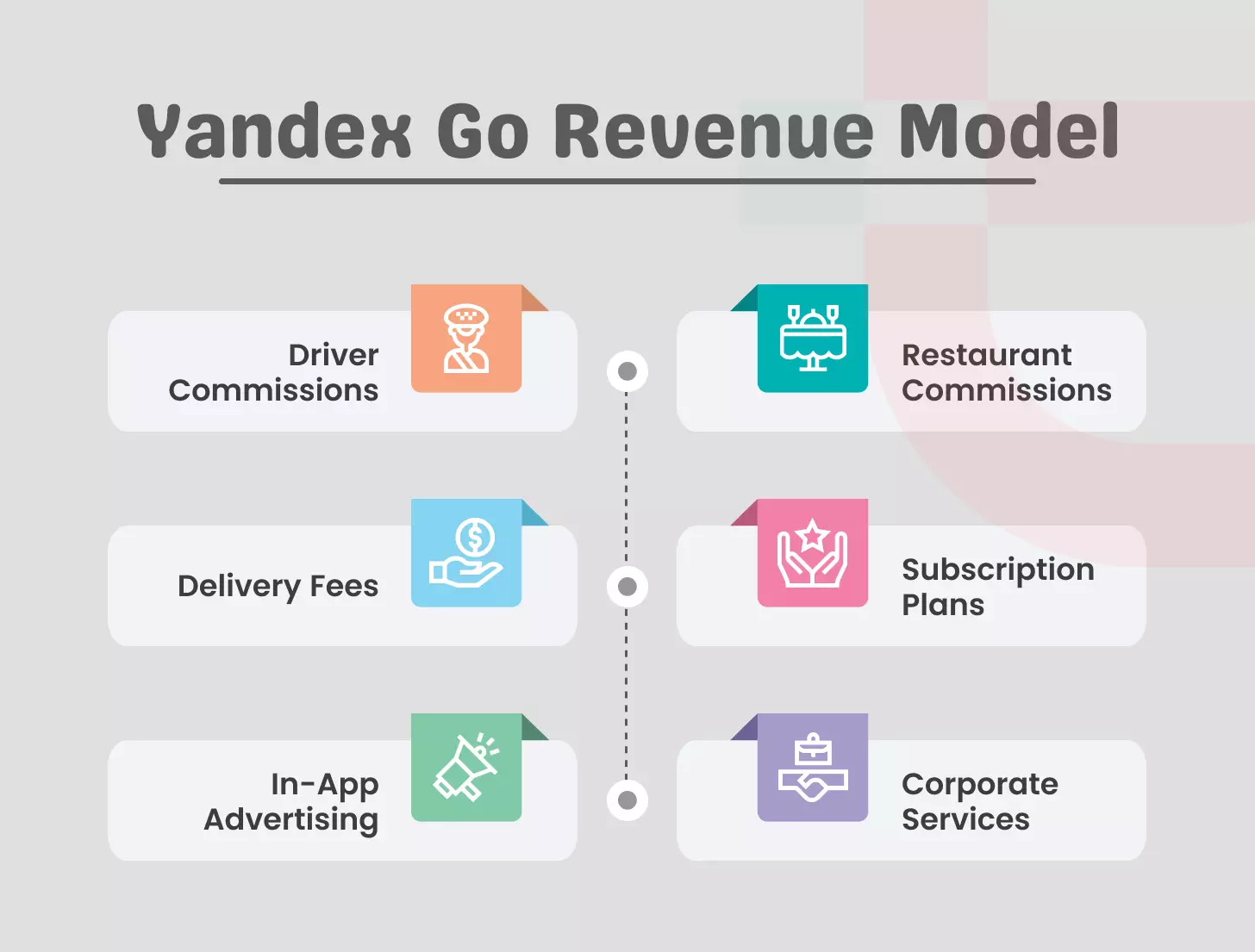
Yandex Go generates revenue from multiple sources, such as commissions, subscriptions, delivery charges, and more. Let’s have a detailed understanding of the Yandex Go revenue model.
Commissions from Drivers
This is considered to be the primary revenue source of Yandex Go, where the platform charges a percentage of commission to drivers for each ride-hailing order received through the application.
The commissions usually vary between 16% to 28% based on the region and service type. However, with millions of rides completed daily in 15+ countries, the driver commissions help Yandex Go generate higher income.
Restaurant Commissions
Similar to driver commissions, Yandex Go charges a percentage of commission to restaurants for each food delivery order booked on the platform. Usually, it charges around 20% to 30% of commission on the total order value.
Though the percentage can vary depending on different factors like order type, distance, and more. This revenue source allows the platform to earn from every single food delivery order.
Delivery Charges from Customers
The app charges delivery fees from customers for each food, grocery, and courier delivery order. These charges are not fixed. They depend on factors like distance, order size, total order value, and more. Delivery fees help the company to cover the expenses of delivery and logistics.
Subscription Plans (Yandex Go Plus)
This is a premium subscription model where users pay a set recurring amount on a monthly or annual basis to access a multitude of benefits like free delivery, priority bookings, and more. This source creates predictable income opportunities for the platform while also enhancing customer loyalty in the long term.
In-App Advertising and Featured Listings
In this revenue source, service providers (restaurants and stores) pay a certain amount to appear at the top of search results and promote their services through the app’s banner ads.
This creates a win-win situation for both providers and the platform. Service providers can easily attract more customers, while Yandex Go can earn beyond its on-demand services.
Corporate Services
This revenue model allows the application to generate income through business accounts to manage corporate travel and deliveries. Billing is done every month or annually, based on the plan chosen by the company. This helps Yandex Go to generate a stable revenue opportunity.
Ready to Build Your Own Super App Like Yandex Go? Partner with Elluminati for Expert Technology Guidance and Solutions
What Does the Future Hold for Yandex Go?
Yandex Go has been planning to strengthen its position in the market in the coming years. Here is a detailed glimpse of how Yandex Go is planning its future.
Expand its Super App Ecosystem
The platform aims to broaden its super app ecosystem by integrating several other services like eCommerce, fintech, cloud services, and entertainment into its app.
This deeper integration will help Yandex Go to cross-sell its other services because of its large customer base already using the app. This is one of many multi-service app trends followed by businesses globally.
Investments in AI and Autonomous Vehicles
Yandex Go is continuously making huge investments in artificial intelligence and AVs. They are actively using smart technology for demand prediction, fraud detection, and dynamic pricing in their application.
Moreover, the company already has advanced self-driving programs (Yandex Self-Driving Group) outside the US to encourage users to opt for driverless technology. This will strategically help the company reduce driver commission and incentive expenses and increase its profit margins.
To Operate Beyond CIS Markets
After acquiring Uber’s stake from the CIS joint venture, Yandex Go has opened several ways for itself to expand its operations in Central Asia, Africa, and the Middle East.
And the biggest advantage for the platform is that it is running in high-density urban markets, which have higher smartphone penetration. This makes it easy for it to build a larger user base.
Introducing EVs for Environmental Sustainability
With environmental sustainability being a global concern, more governments are introducing regulations for reducing carbon emissions. That’s why Yandex Go is also taking measures to integrate EVs into its ride-hailing and delivery operations.
They are already offering electric bikes and bicycles for rent for short-distance travel. And they are planning to integrate EVs into their car-sharing services. For this, it is conducting collaborations with EV providers and also providing incentives to drivers to encourage them to use the electric vehicles.
How Elluminati Can Help You Build a Multi-Service App Like Yandex Go?
The Yandex Go business model acts as a multi-service ecosystem that connects customers, local businesses, and delivery partners through a mobile application. Understanding this model helps you learn how offering multiple on-demand services through a single digital platform can help reduce customer acquisition costs while enhancing user lifetime value.
If you are considering building a similar app, then Elluminati becomes your reliable technology partner through its Yandex Go clone. With 14+ years of experience in building on-demand solutions, we have helped several entrepreneurs to launch their mobility and delivery platforms across the globe.
With pre-tested features and dedicated modules for customers, merchants, and delivery partners, our solution helps businesses enter the market quickly while ensuring higher operational efficiency.
FAQs
Yandex Go works as a multi-service super app in which:
- Customers log into the app, enter their location, and select their desired service.
- The service providers (restaurants or stores) receive the order request.
- After preparing the order, the provider notifies the platform, and the system assigns the nearest available delivery partner for delivery.
- At last, the delivery partner delivers the order, and the customer can rate their experience and provide feedback.
The Yandex Go revenue model generates income from multiple streams, including:
- Driver commissions
- Restaurant commissions and delivery fees from customers
- Subscription plans
- In-app advertising and featured listings
- Corporate services
The Yandex Go business model operates as a multi-service super app that connects customers with nearby local restaurants or stores and drivers through a mobile application.
Yandex Go offers mainly 4 types of services, which are:
- Ride-hailing (Yandex Taxi)
- Car sharing (Yandex Drive)
- Food delivery (Yandex Eats)
- Courier and logistics (Yandex Delivery)
Yandex Go mainly operates in 15+ countries, which include Russia, Armenia, Kazakhstan, Belarus, Georgia, and more in the CIS and Eastern Europe region.
Yandex Go’s major competitors include Uber, Delivery Club, Bolt, Cabify, Gett Taxi, and Careem.
Yes, you can build a super app like Yandex Go easily, either through custom development or opting for a white label, ready-to-launch solution. Custom development helps you build the app from scratch, while a white label solution helps in entering the market quickly. Partnering with an experienced technology company can help you make the right choice based on your business needs and goals.