Key Takeaways (or TL;DR)
- Identifying AI’s power, an increasing number of entrepreneurs are trying to implement it into their SaaS products, but there’s a lack of knowledge about a standardized cost.
- Building an AI SaaS product can cost anywhere between $35,000 and $400,000, but the actual cost may differ based on various factors.
- While AI-based software costs more than traditional ones, you can significantly reduce the expense with various cost-cutting measures.
- The AI SaaS platform development timeline typically ranges between 6 months and over a year, depending on your specific product requirements.
AI has truly transformed every aspect of modern business, and SaaS is no exception. It has significantly increased the potential of SaaS products, driving the rise of intelligent platforms. However, since AI and SaaS are booming markets, it’s common for entrepreneurs to wonder what their AI SaaS product development cost will be.
To eliminate confusion and gauge the true cost, we have prepared this guide, which provides a complete development cost breakdown for AI-powered SaaS products. You will also explore cost-effective factors and tips for reducing them through effective measures. Let’s dive right into understanding SaaS and how AI can transform it.
What is a SaaS Product, and How Can AI Supplement It?
A SaaS (Software as a Service) product is a cloud-based application delivered over the internet on a subscription basis. Instead of installing and maintaining software on their own servers, users simply access it through a web browser or mobile app.
This software delivery model has changed how businesses access and use technology because it offers incredible benefits:
- Scalability: It grows easily with a business
- Cost-effectiveness: Eliminates the high upfront costs of AI development.
- Rapid deployment: Requires practically no installation and minimal configuration.
- Security: Data security and compliance are handled by providers.
These benefits led to the SaaS market’s massive boom, with its 2032 value predicted at USD 1,131.52, making it a huge business opportunity.
Furthermore, cutting-edge technologies like AI have also stepped in to supercharge the traditional SaaS model. By integrating machine learning (ML), natural language processing (NLP), and predictive analytics, AI enhances SaaS products in four main ways:
- It drives advanced analytics, converting complex data into actionable insights
- It enables higher-level automation, handling repetitive and time-consuming tasks like data entry and reporting.
- It allows for deep personalization, delivering unique user experiences and recommendations.
- It creates advanced workflows that can predict outcomes, identify fraud, or optimize the supply chain, transforming a simple software into an intelligent business partner.
This is why an increasing number of entrepreneurs aspire to build AI SaaS products, but they often stumble when deciding on the budget due to a lack of understanding about the cost of building such products.
AI SaaS Product Development Cost: Breaking Down By Complexity
The cost to build an AI SaaS product can range from USD 35,000 to 400,000. However, this is quite a broad and rough estimate. The actual expense depends on various factors, such as the complexity of your product, team size, and features.
A small, basic AI tool using a pre-trained model requires a vastly different budget than an enterprise platform with custom-built deep learning algorithms.
While there can’t be a one-size-fits-all approach for AI SaaS products, we can provide a clear expectation for initial development costs based on industry standards for the complexity of an app.
The table below lists the cost breakdown based on AI SaaS product complexity.
|
AI SaaS Product Complexity |
Typical Features & Scope |
Development Cost Range |
|---|---|---|
|
Simple/MVP |
Basic core features use pre-trained AI APIs |
$25,000-$80,000 |
|
Medium/Advanced |
Model feature set, custom ML model, integration with multiple third-party services |
$80,000-$200,000 |
|
Highly Complex/Enterprise |
Expensive features, custom deep learning models, high compliance needs, full DevOps setup |
$200,000-$400,000 |
Note: This is the cost for initial development up to launch. It doesn’t include ongoing costs for infrastructure (cloud services) and maintenance.
Want to Learn How Much Your AI SaaS Platform Development Will Cost? Reach Us With Your Needs to Evaluate Cost
Factors Affecting the Cost of AI SaaS Platform Development
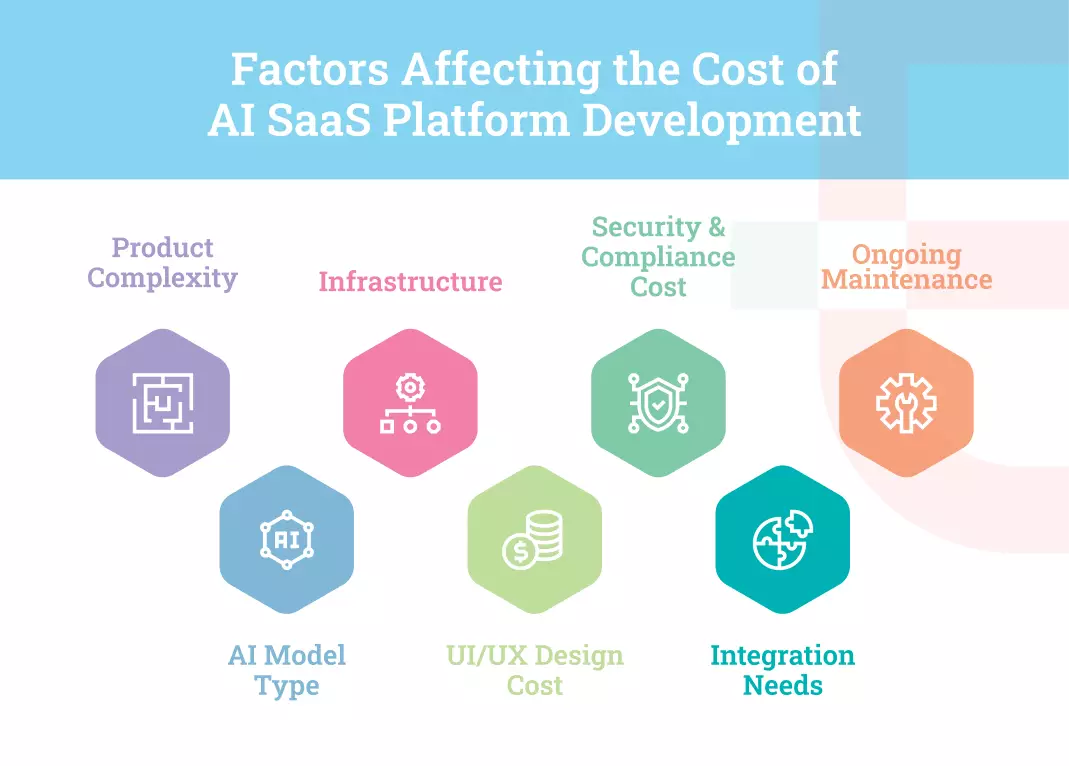
The final cost of your AI SaaS product is determined by several key factors. Understanding these elements allows you to adjust your scope and manage your budget effectively.
Product Complexity
One of the major drivers of AI SaaS product development cost is the number of features and the depth of functionality. A simple product might require a few external API calls, while a complex enterprise solution needs multiple user roles, advanced reporting dashboards, and sophisticated internal logic.
The higher the complexity, the more resources it might require to design, code, and test, which, in turn, increases the cost.
AI Model Type
The type of model is often the single biggest cost driver. Relying on simple, pre-trained AI models is cost-effective, but building a proprietary model using sophisticated methods like deep learning or NLP is complex, which can be significantly expensive.
Infrastructure
All SaaS products require cloud infrastructure (AWS, Azure, GCP, etc.) AI workloads are more resource-intensive than traditional SaaS, requiring specialized GPU computing power for model training and deployment. Moreover, third-party APIs also add to both development cost and ongoing maintenance.
UI/UX Design Cost
A great product requires an intuitive and seamless user experience (UI/UX). For AI SaaS platforms, this is even more crucial, as complex AI outputs need to be presented in a simple way. The more custom and iterative the design is, the higher the cost.
Security & Compliance Cost
Handling customer data, especially sensitive customer information, requires strict adherence to regulations like GDPR or HIPAA. Ensuring robust security protocols, performing penetration testing, and implementing compliance features significantly increase the initial development workload and the required expertise.
Integration Needs
The need to integrate your system with external systems like Salesforce (CRM), HubSpot (Marketing), or QuickBooks (Accounting) requires dedicated development time. Each integration involves complexity, potential security risks, and ongoing maintenance challenges, directly impacting the final cost.
Ongoing Maintenance
SaaS products require continuous maintenance, updates, and feature additions. For an AI-based SaaS product, this includes model monitoring, retraining to prevent performance degradation, managing cloud infrastructure, and addressing security patches. Ongoing maintenance typically costs around 10-20% of the initial development cost.
Cost-Saving Strategies for AI SaaS Development
While AI SaaS product development requires significant investment, businesses can still employ smart strategies to reduce overall costs without compromising quality or scalability. Here are some strategies that can help you reduce your development cost.
Using Pre-trained Models
One of the quickest ways to save money is to leverage existing, powerful AI models from providers like OpenAI, Google, or Microsoft. Instead of spending months and hundreds of thousands of dollars on custom models, you can use pre-trained model APIs to reduce costs and speed up time to market.
Starting with MVP
The minimum viable product (MVP) approach can be effective for cost optimization. Focus your initial build on the single most critical AI feature that solves a core user problem. This allows you to validate your product, collect real user data, gather user feedback, and minimize the risk of building features that nobody wants.
Outsourcing vs In-house Team
Building a complete in-house team of specialized AI engineers, cloud architects, and data scientists can be expensive. Outsourcing AI development services from experienced firms can help you access a global talent pool at competitive rates. For more cost-effective development services, find experts from South Asian countries like India.
Cloud Cost Optimization
Cloud infrastructure can quickly become a cost aggregator if not managed properly. To keep your cloud expenses in control, employ a cloud architect to optimize your setup, use reserved instances, and implement auto-scaling features. This ensures you’re only paying for the computing power you are using, especially for expensive AI model serving.
Automating Retraining Pipelines
AI models degrade over time. If you manually manage the process of gathering new data and retraining your models, it becomes a continuous, expensive task for your data science team. Investing upfront in an automated MLOps pipeline reduces the manual effort, making model maintenance and deployment cheaper and faster in the long run.
A Comprehensive Guide on AI SaaS Platform Development Stages & Timeline
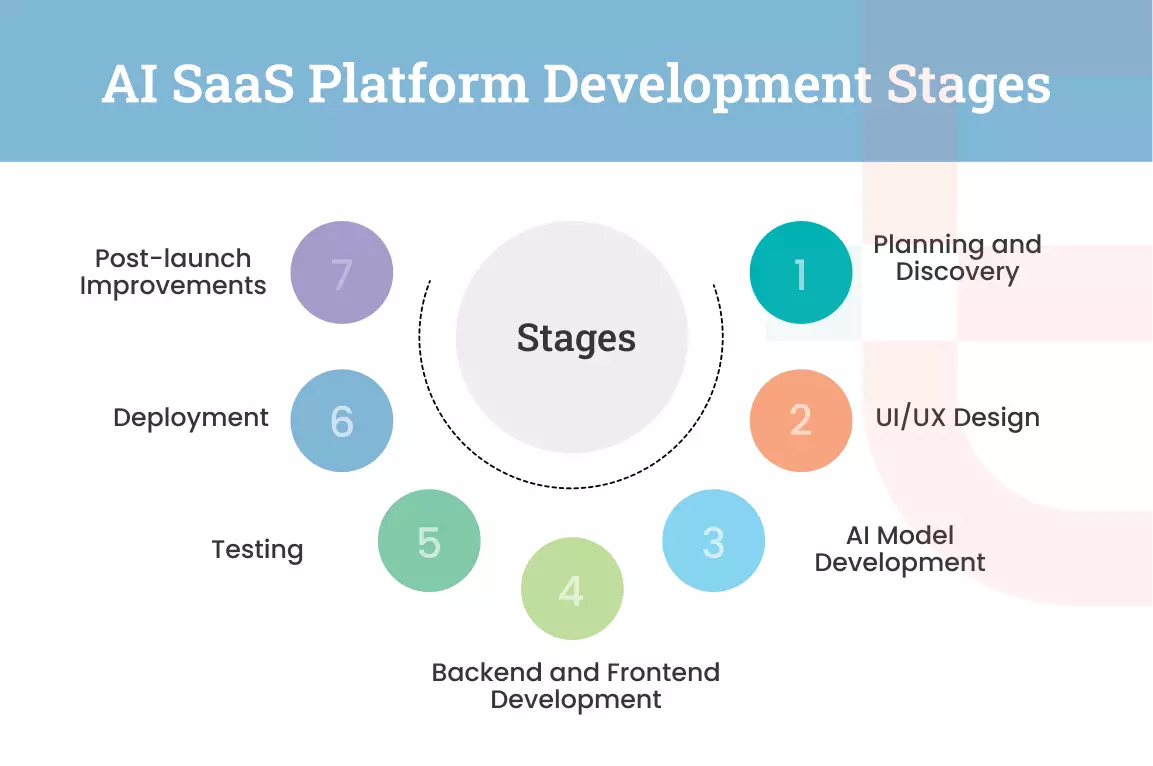
To successfully execute AI SaaS platform development, you need to follow a structured timeline, which also informs your budget. While a total time can span 6 months to over a year, here is a general breakdown of the phases and estimated cost involved in each of them.
Stage 1: Planning and Discovery
This initial phase involves market research, defining the target users, establishing core features, and creating detailed technical specifications. For intelligent products, this also includes defining the data strategy and success metrics for the AI model.
- Estimated Time: 4-6 Weeks
- Estimated Cost: $5,000-$20,000
Stage 2: UI/UX Design
Designers create wireframes, prototypes, and final user interfaces (UI) to ensure the platform is intuitive and easy to use. A crucial step here is designing how complex AI outputs are clearly communicated to the end user.
- Estimated Time: 4-8 Weeks
- Estimated Cost: $5,000-$50,000
Stage 3: AI Model Development
This is the core technical work, including data gathering, cleaning, labeling, and actual training, testing, and validation of the machine learning or deep learning models. This phase is often iterative and takes the longest time.
- Estimated Time: 8-24+ Weeks
- Estimated Cost: $10,000-$150,000
Stage 4: Backend and Frontend Development
The development team builds the core SaaS infrastructure, including the database, user authentication, APIs, and the cloud-based delivery systems. This stage also involves building a user-facing application.
- Estimated Time: 10-20 Weeks
- Estimated Cost: $30,000-$150,000
Stage 5: Testing
Next, the QA testers conduct comprehensive QA testing across the platform, including functional testing, stress testing, security audits, and rigorous testing for the AI model’s accuracy, performance, and bias levels.
- Estimated Time: 4-6 Weeks
- Estimated Cost: $5,000-$80,000
Stage 6: Deployment
Once the platform is approved, it is launched onto the selected cloud infrastructure. Developers perform final checks, including setting up continuous integration/continuous deployment pipelines for efficient updates.
- Estimated Time: 1-2 Weeks
- Estimated Cost: $5,000-$80,000
Stage 7: Post-launch Improvements
The work doesn’t end here. After launch, development continues based on real-world user feedback and model monitoring. New features are added, the AI models are retrained, and scalability is continuously optimized.
- Estimated Time: Ongoing
- Estimated Cost: $10,000-$50,000 (Annually)
Benefits of Implementing Artificial Intelligence in SaaS Products
Integrating artificial intelligence doesn’t just modernize your SaaS product; it fundamentally transforms the value proposition. Here are some core benefits you can deliver to your customers with an AI-powered SaaS product.
Smarter Automation
AI takes over repetitive tasks like data entry, reporting, ticket routing, and monitoring, which reduces manual workload and speeds up workflows.
Better Personalization
AI analyzes user behavior to deliver personalized dashboards, recommendations, onboarding flows, and content that fits each user’s needs.
Faster and Accurate Decision-Making
Artificial intelligence derives insights from data, which helps entrepreneurs make faster and more accurate business decisions.
Enhanced Customer Support
AI-powered chatbots and virtual agents handle common queries instantly, reducing wait times and improving support quality.
Stronger Data Security
It detects unusual activity, potential threats, and security vulnerabilities in real-time, protecting SaaS platforms from data breaches.
Lower Operational Costs
Automation and predictive capabilities reduce resource usage, cut support costs, and streamline operations for both the SaaS providers and their customers.
Higher Product Scalability
AI models adapt as user workloads grow, making it easier for SaaS platforms to scale without performance issues.
Improved User Retention
AI can identify churn signals easily, recommend proactive actions, and deliver personalized product experiences that keep users engaged.
Predictive Analytics for Planning
SaaS companies can predict usage patterns, customer needs, and potential risks, improving resource allocation.
More Intelligent Workflows
AI enhances core SaaS functions such as search, recommendations, anomaly detection, workflow automation, and fraud prevention.
Build a High-Impact AI-Powered SaaS Platform Efficiently with Elluminati & Maximize Your Cost Savings
Common Challenges Faced During AI SaaS Platform Development
While the benefits are clear, implementing intelligence into a SaaS platform comes with its own set of technical and logistical hurdles. Being prepared for these challenges in AI SaaS product development is key to a smooth launch.
Data Quality and Availability Issues
AI performance depends on clean, structured, and high-volume data. Poor data slows development and reduces model accuracy, leading to a flawed product.
Solution
Start your AI SaaS platform development with a dedicated data audit phase. Implement robust data pipelines and data governance policies from day one to ensure data is consistently cleaned, labeled, and prepared for the AI models.
High Development Cost and Resource Allocation
AI requires specialized talent (AI/ML engineers), costly GPU compute power for training, and complex data pipelines, significantly increasing initial expenses compared to traditional software.
Solution
Focus on cost-saving strategies like using pre-trained models and starting with an MVP. Also, consider partnering with an experienced AI development services provider who offers specialized resources without the need for hiring full-time, in-house employees.
Model Training Complexity and Performance Optimization
Training AI models is highly iterative. Achieving desirable accuracy, reducing unwanted biases, and improving model performance take dedicated time and specific technical expertise.
Solution
Adopt an MLOps (Machine Learning Operations) framework early on. This system automates experimentation, testing, and deployment, making the iterative refinement of the model faster and more reliable.
Choosing the Right Tech Stack and Architecture
Selecting the best AI framework (TensorFlow, PyTorch), cloud environments, and a scalable microservices architecture is difficult due to rapidly evolving technologies, posing a significant challenge in AI SaaS product development.
Solution
Consult with a dedicated cloud architect early in the planning phase. Prioritize a modular architecture that allows you to swap out or upgrade components without rebuilding the entire system.
Scalability Limitations for AI Workloads
AI workloads require demanding resources, specifically auto-scaling, distributed computing, and optimized cloud setups, which can be complex to manage as your user base grows.
Solution
Design your architecture to separate core SaaS logic from the AI inference service. Use serverless functions or containerization managed by your cloud provider to handle scaling automatically.
Integration Challenges with Third-Party Tools and Legacy Systems
Connecting the AI engine to existing customer systems, APIs, CRMs, or legacy databases can lead to data mapping issues and incompatibilities.
Solution
Standardize on modern API protocols (like REST or GraphQL) and use a dedicated integration platform layer (iPaaS) to manage all external connections, isolating the core AI logic from external changes.
Security, Compliance, and Data Privacy Concerns
Data privacy and security are one of the significant challenges in AI SaaS product development. AI systems handle sensitive data, requiring compliance with strict regional regulations (GDPR, HIPAA). A security breach can be catastrophic for a SaaS business.
Solution
Implement privacy-by-design principles. Use techniques like data anonymization and encryption for all sensitive data, and conduct mandatory third-party security audits before launch.
Diving Into the Future of AI SaaS Products
The evolution of AI SaaS platforms is accelerating. Businesses starting now should position themselves to embrace these future trends to remain competitive.
Hyper-Personalized AI Experiences
The future involves AI not just making recommendations, but dynamically reshaping the entire user interface and workflow based on real-time individual user intent and behavior. The AI’s role in SaaS products will make them less like software and more like an intelligent, adaptive partner.
Autonomous AI Systems & Self-Optimizing Platforms
Next-gen AI SaaS products will use agentic AI to not only suggest actions but also execute them autonomously. Platforms will self-monitor, self-diagnose, and self-optimize workflows without human intervention.
Low-Code/No-Code AI SaaS Development
New development tools allow business users, not just engineers, to build, customize, and deploy AI features using simple visual interfaces. This allows everyone to innovate and reduces the reliance on specialized talent.
AI Native Enterprise Solutions
Instead of integrating artificial intelligence into existing software, future solutions will be built from the ground up to be AI-native. These will be highly specialized niche industries, like AI for precision agriculture or complex legal e-discovery.
Advanced AI Governance, Ethics, and Regulations
As AI becomes more powerful, the focus on transparency, fairness, and accountability will intensify. Future SaaS platforms will need built-in tools for auditing decisions and ensuring compliance with evolving global ethical standards.
Get Cost-Effective AI SaaS Platform Development With Elluminati
AI SaaS product development cost varies significantly depending on specific business requirements. The good news is that you can reduce the cost with some strategic measures, and outsourcing development services is one of the most effective measures.
When it comes to AI development services, Elluminati stands at the top among the most revered technical partners. We have delivered hundreds of successful projects, helping local startups and global organizations harness AI’s power in their SaaS business.
We take cost-cutting strategies from the start, allowing you to save on significant financial resources so that you can invest them in other areas of your business. Let’s partner up and build a cost-effective AI SaaS product that drives innovation and success for your business. Reach out to us today for a quick, personalized quote.
FAQs
The cost to build an AI SaaS product ranges anywhere between $30,000 to $400,000. However, its final cost may vary based on factors such as development complexity, data requirements, team expertise & other customized needs. To get a personalized quotation, we suggest you connect with our sales executives at sales@elluminatiinc.com.
The development timeline varies based on complexity. A simple MVP can take 2 to 3 months. A medium-complexity platform with custom ML Models generally requires 4 to 9 months, while an advanced enterprise system often takes 9 to 12 months or more to fully develop and deploy.
Ongoing maintenance, which includes infrastructure fees, security updates, bug fixes, and continuous AI model monitoring/retraining, typically costs 15% to 20% of the initial development cost per year.
The most effective way to reduce the cost of AI SaaS product development is to start with an MVP, use pre-trained models, and optimize your cloud infrastructure to minimize expensive compute time.
Yes. They do need continuous updates as they experience model drift, meaning their performance degrades as the real-world data they encounter changes. Continuous monitoring and automated retraining pipelines are essential to maintain the accuracy and value of the AI features.