Key Takeaways (or TL;DR)
- By leveraging artificial intelligence for enterprises, businesses can streamline operations, enhance decision-making, and fuel large-scale automation.
- AI for enterprise refers to scalable, secure AI systems built to support complex, multi-department operations in large organizations.
- The core enterprise AI technologies include ML, NLP, RPA, computer vision, and generative AI, enabling businesses to automate tasks, analyze large datasets, and generate insights and content at scale.
- From customer service, finance, operations, healthcare, and HR, AI enhances accuracy, speed, and consistency in everyday business processes.
- Effective implementation of enterprise AI starts with a clear business problem, small pilots & controlled scaling with proper governance.
- While it offers compelling benefits, businesses also face challenges related to data security and integration complexity when adopting it.
- The future of enterprise AI is rapidly moving towards autonomous and multimodal systems that embed intelligence into every business decision.
Artificial intelligence is becoming a core driver of modern enterprise growth. By effectively implementing AI for enterprise growth, businesses can not only streamline operations but also unlock new levels of efficiency. Moreover, to leverage its power at the enterprise level, there should be a proper plan and a strong technical foundation from the beginning. Also, there should be clarity about how to use artificial intelligence in the enterprise, beyond the challenges that arise over time.
In this article, we will break down everything you need to know about AI in enterprise environments. This includes the key technologies involved, real-world benefits, practical use cases, implementation steps, challenges, and future trends shaping the next era of business transformation.
What Is AI for Enterprise?
AI for enterprise refers to artificial intelligence systems that are built for large organizations. Unlike consumer AI, the model is not designed for individual tasks or personal use. Instead, it supports complex operations across departments, teams, and large datasets.
An ideal enterprise AI model should
- Meet higher standards
- Be dependable during heavy workloads
- Scale as the business grows
- Follow strict data security and compliance rules
Why Does Enterprise AI Matter for Modern Businesses?
Enterprise AI enables intelligent automation and improves efficiency across all departments simultaneously. It connects data, systems, and workflows so teams work with a single source of truth, preventing the misunderstandings and errors that often hamper productivity.
With real-time data processing, the team can respond to market changes quickly and improve how they serve customers.
Key Technologies in Enterprise AI
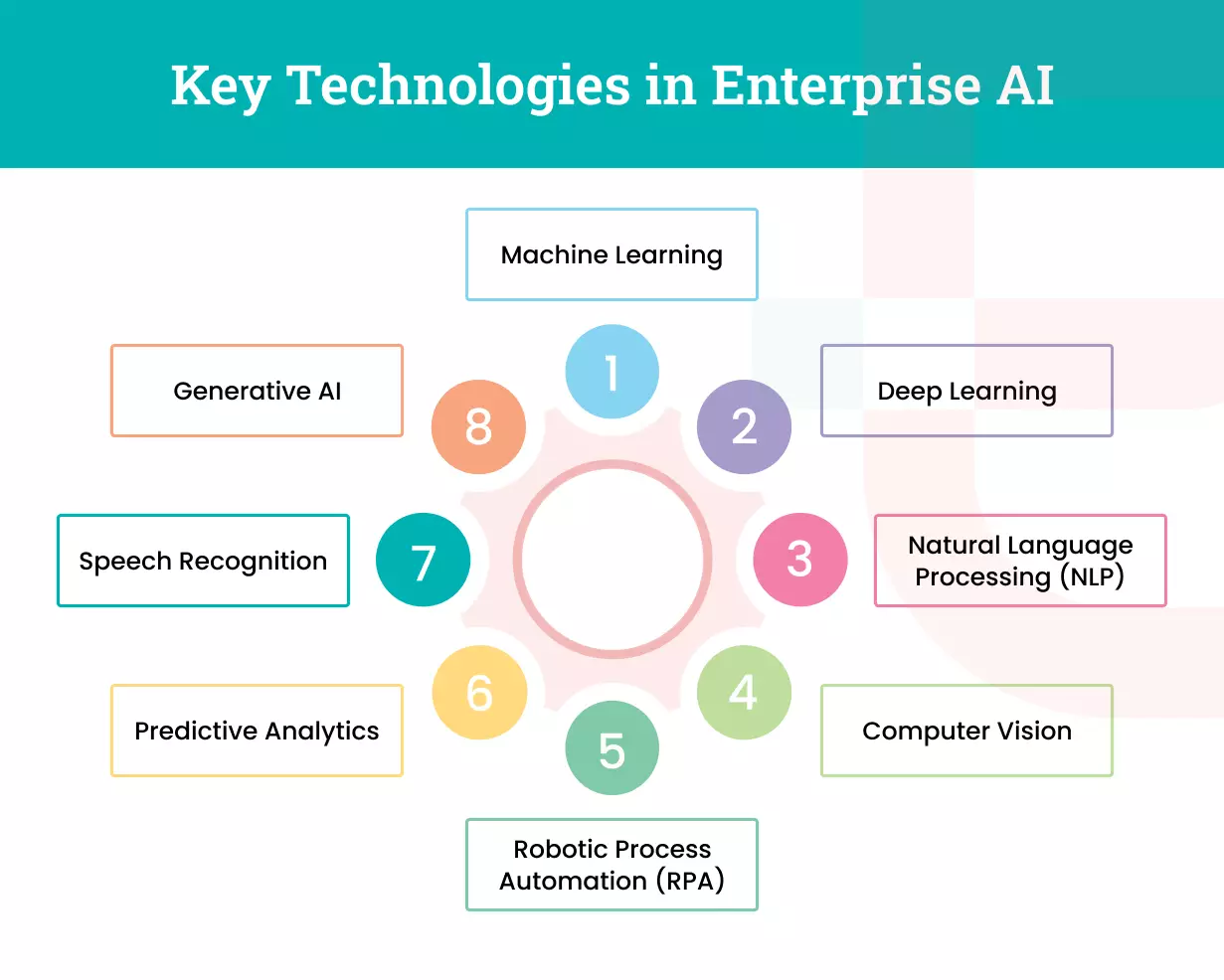
Let’s take a look at eight core technologies of an ideal enterprise AI model.
Machine Learning
Machine learning helps AI systems learn patterns from large datasets without manual programming. It can turn raw data into accurate predictions with data-backed decisions.
Enterprise Applications:
- Predict customer behavior
- Classify large volumes of data
- Automate decisions across departments
- Improve fraud detection and risk analysis
Deep Learning
Deep learning is an advanced form of ML with multi-layered neural networks. It empowers AI to perform high-complexity tasks that require deeper pattern recognition.
Enterprise Applications:
- Image and video analysis
- Speech processing
- Advanced anomaly detection
- High-accuracy forecasting and analytics
Natural Language Processing (NLP)
NLP allows machines to read, understand, and respond to human language. Enterprises want AI to automate communication-heavy tasks and interpret large text datasets; NLP integration is important.
Enterprise Applications:
- Chatbots and virtual assistants
- Document processing and automation
- Customer support workflows
- Sentiment analysis at scale
Computer Vision
Computer vision technology is used for interpreting images and video in real time. It becomes an essential part of AI when a majority of operations rely on visual monitoring, inspection, or compliance.
Enterprise Applications:
- Security and surveillance systems
- Quality inspection in manufacturing
- Compliance monitoring
- Visual data extraction and processing
Robotic Process Automation (RPA)
Robotic Process Automation (RPA) automates repetitive, complex, and rule-based business tasks across departments such as finance, customer service, HR, and more using bots.
Enterprise Applications:
- Invoice and billing automation
- Data entry and database updates
- Compliance and audit workflows
- High-volume administrative tasks
Predictive Analytics
Predictive analytics takes the help of ML and statistical modeling to forecast future outcomes. This feature is very useful for making proactive decisions rather than reacting to problems in an enterprise.
Enterprise Applications:
- Sales and revenue forecasting
- Inventory and supply chain planning
- Customer churn prediction
- Risk scoring and financial analytics
Speech Recognition
Speech recognition converts spoken words into text or system commands. It supports hands-free operations and automates workflows that depend on voice input.
Enterprise Applications:
- Voice-enabled enterprise apps
- Automated meeting transcription
- Hands-free operations in warehouses or factories
- Speech-driven customer service
Generative AI
Generative AI creates new content such as text, images, audio, and even code. It helps enterprises scale creativity, personalization, and automation.
Enterprise Applications:
- Automated content generation
- Personalized customer experiences
- Workflow and document automation
- Rapid idea generation and prototyping
Modernize Your AI Initiatives with Our Enterprise-Grade Technologies for Sustainable Business Growth
Explore the Transformative Benefits of Using AI for Enterprise
Enterprise-level challenges are far bigger than everyday business problems. Let’s see how using AI for enterprise benefits organizations in enhancing their operational efficiency and achieving scalable growth.
Operational Efficiency
Most enterprises deal with slow, repetitive workflows. Tasks such as data entry, ticket triage, or invoice processing leave little or no room for strategic work and often cause delays.
AI automates them for faster execution and fewer errors. For example, an RPA bot can process thousands of invoices in minutes or auto-update records across multiple systems without human intervention.
Enhanced Decision-Making
When data is scattered across sales, finance, and operations, it takes time to bring them all together. This leads to slow reporting and reactive planning.
AI, with predictive analytics and forecasting, can do this in just a few minutes. For example, your finance team can detect early signs of revenue risk with ML models for prompt resolution before it escalates further.
Customer Experience and Personalization
Enterprises often struggle to deliver fast, personalized customer support during peak hours.
AI chatbots, powered by sentiment analysis, can process thousands of interactions and offer personalized recommendations. As a result, customers enjoy smoother, more tailored interactions.
Scalability and Cost Optimization
For a growing enterprise, handling large datasets and rising workloads becomes expensive and resource-heavy. Traditional scaling involves more human resources and smooth manual coordination.
AI can handle big data processing and automate routine work so that existing teams can focus on more critical tasks. This reduces operational costs and helps businesses scale without hiring large numbers of extra staff.
Competitive Advantage
To stay competitive, businesses should know how to perform better in dynamic market conditions. It gets challenging with outdated processes.
AI accelerates innovation if you know how to use it to your advantage. For example, generative AI can help the product team brainstorm features in a few days. Similarly, manufacturing units can use a computer vision solution to detect defects in real time.
As you innovate and improve your processes faster, your business keeps becoming competitive in the market.
Enterprise AI Application Across Key Business Functions
Let’s take a look at some of the most prominent enterprise AI applications across major business functions.
Customer Service & Support
- Chatbots handle high-volume queries and share instant replies to improve the overall customer satisfaction score.
- Virtual agents guide users on how to troubleshoot technical problems to reduce ticket workloads for human agents.
- Also, AI chatbots automatically route tickets to the concerned department for faster resolution and service accuracy.
Operations & Manufacturing
- AI-powered predictive maintenance detects equipment failures early to reduce downtime and improve asset reliability.
- AI helps in optimizing process flow by automatically detecting bottlenecks and anomalies.
- Computer vision inspects products on assembly lines to promptly spot cracks, misalignment, or missing components.
Finance & Risk
- Fraud detection systems scan millions of transactions per minute to flag anomalies such as unusual logins or rapid high-value transfers.
- AI-based risk evaluation models analyze loan applicants based on credit history, user behavior, and alternative data such as utility payments.
- AI-powered compliance tools automatically scan financial reports to highlight missing disclosures or mismatched figures that lead to policy violations.
Sales & Marketing
- AI chatbots are showing hyper-personalized product combinations based on the browsing and purchase history of visitors.
- Lead-scoring AI models shortlist ideal prospects based on CRM data, email engagement, website visits, and recent purchase behavior.
- AI-powered behavioral analysis tools predict the likelihood of customer churn by tracking inactivity and negative sentiment of users.
Healthcare
- AI diagnostic tools analyze X-rays and MRI scans to detect abnormalities, such as tumors or fractures, with high precision.
- Patient analytics models predict hospital re-admission risk by evaluating vitals, lab results, and historical data patterns.
- AI automatically handles insurance claims by validating codes and applicants’ eligibility to reduce manual paperwork.
HR & Talent Management
- AI-powered screening tools sort ideal candidates for an interview based on matching skills and required experience or certifications.
- It also analyzes performance metrics from the automated feedback loop to identify root causes of low productivity or high absenteeism.
- Automated onboarding systems save development costs by helping with creating IT accounts, assigning training modules, and scheduling orientation sessions without manual input.
How to Implement AI in Enterprise – Step-by-Step Guide
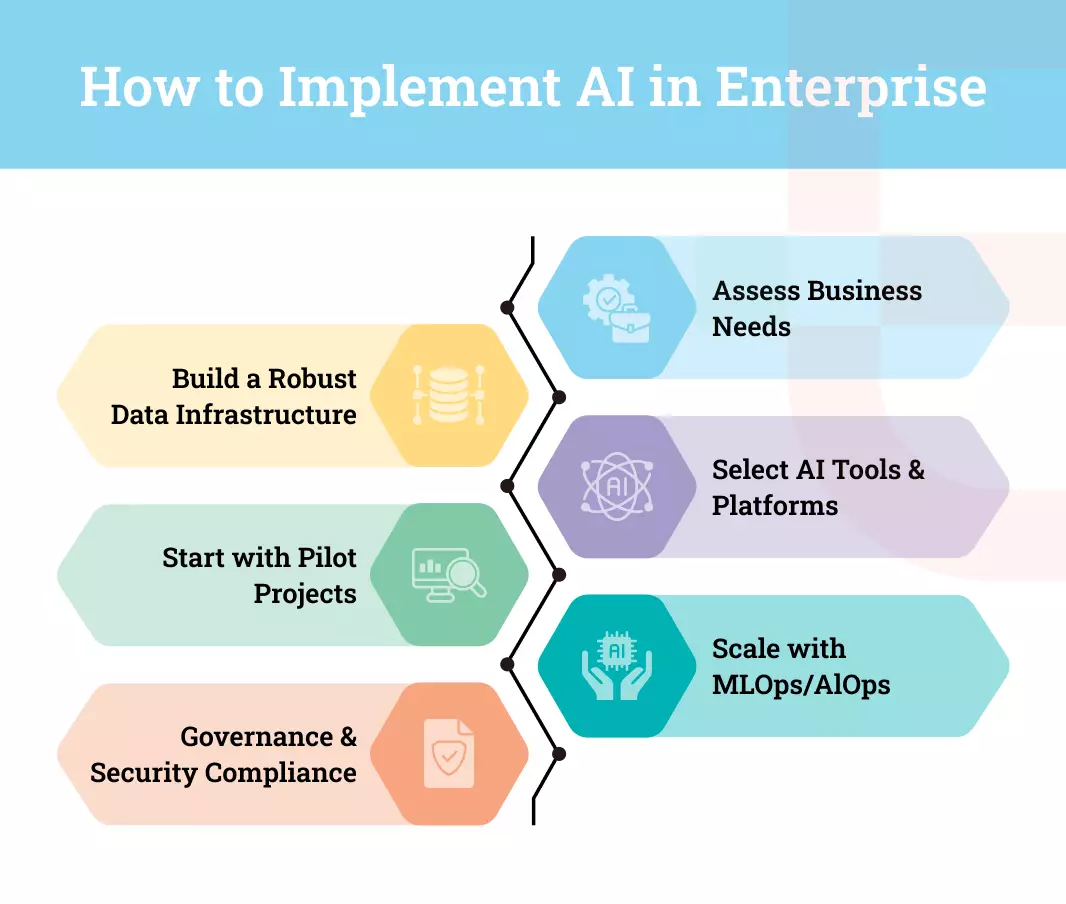
To successfully implement AI on an enterprise level, organizations need structured planning and mature data systems. Here is a simple process to follow through.
Assess Business Needs & AI Readiness
First, determine the problems to identify the scope of AI in the organization. For instance, route-planning errors at a logistics company could lead to delivery delays. So, here, the scope of AI is clear: predictive routing.
Build or Modernize Data Infrastructure
AI thrives on clean and structured data. Create data pipelines to pull information from reliable sources. If it is about using machine learning and AI for sales forecasting, create a unified data lake that combines sales records, inventory logs, and customer profiles.
However, clean and standardize data before processing it through AI. Data anomalies can significantly alter insights and lead to wrong decisions.
Select AI Tools, Platforms & Models
Choosing the right AI stack is challenging. There are ready-made solutions with less scope for customization. You can also build a customized enterprise AI platform. Depending on their needs, talent, and timeline.
For instance, a GenAI platform will suffice for generating campaign content. Advanced automations like churn prediction and forecasting will require ML platforms like AWS SageMaker or Azure ML.
Pilot Projects & Proof of Concepts
Before scaling across the enterprise, consider automating a few workflows to gauge accuracy. It offers the scope for modifying the AI model for better outcomes.
For instance, consider applying an AI-based ticket classification system on 10 percent of incoming support emails at the beginning. If the percent reduction in routing time matches the desired figure, consider applying it to the rest of the emails.
Scale with MLOps / AIOps
Once AI pilots show results, enterprises must operationalize them. Machine learning operations (MLOps) and AI operations (AIOps) are dedicated programs used to automate the deployment, monitoring, updating, and maintenance of ML/AI models.
For instance, MLOps can automatically retrain demand forecasting models weekly as new sales data arrives, with minimal human intervention.
Governance, Security & Compliance
AI at an enterprise scale requires strict access controls for datasets, models, and AI outputs. This is imperative to comply with data privacy laws such as GDPR, HIPAA, and PCI-DSS.
For instance, customer transaction data should be protected with role-based controls to allow only authorized analysts to train risk models.
AI for Enterprise: Buy vs Build
When adopting AI for the enterprise, it’s a constant challenge deciding whether to buy ready-made solutions or build from scratch. The table below compares the two options across key factors to help you make a quick decision.
|
Buy (Off-the-Shelf AI Solutions) |
Build (Custom AI Development) |
|
| Implementation Speed |
Very fast to deploy, often within weeks. |
Slow, requiring months of development, testing, and integration. |
|---|---|---|
| Customization |
Limited customization, mostly configuration-based. |
Fully customizable to unique processes, data, and business logic. |
| Integration with Existing Systems |
Pre-built connectors, but they may not support all legacy systems. |
Designed to integrate natively with internal tools and workflows. |
| Scalability |
Scales as per the vendor’s platform capabilities. |
Scales based on internal infrastructure and architectural decisions. |
| Competitive Advantage |
Offers baseline industry features used by many competitors. |
Enables proprietary capabilities and differentiation. |
| Cost Structure |
Lower upfront cost, subscription-based pricing. |
High upfront investment, ongoing engineering and maintenance costs. |
| Control & Ownership |
Limited control over model behavior and updates. |
Full ownership of data, models, logic, and deployment cycles. |
| Addressing Specific Use Cases |
Best for standardized use cases like chatbots or ticket routing. |
Ideal for complex, niche, or mission-critical workflows. |
|
Long-Term ROI |
Good short-term ROI, moderate long-term returns if needs grow. |
Higher long-term ROI for enterprises with evolving or complex demands. |
| Risk of Vendor Lock-In |
High risk due to proprietary platforms and data dependency. |
Low risk since the enterprise owns the full stack and can migrate freely. |
Deciding Between Buying or Building an Enterprise AI Solution? Consult Our AI Experts Today & We Will Help You Make the Right Choice for Your Business
Potential Challenges of Incorporating AI in Enterprise for Businesses
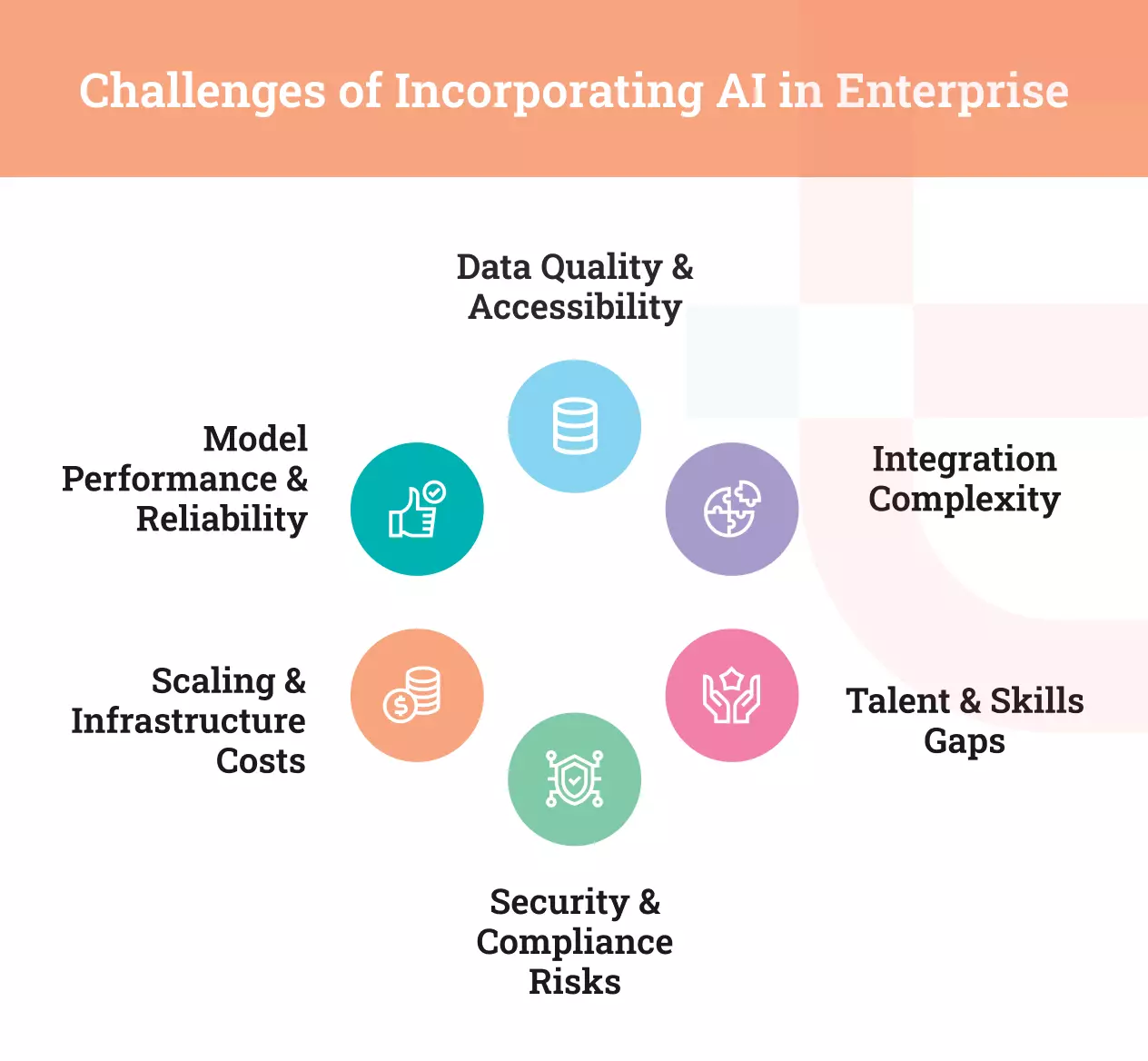
Using AI at an enterprise level comes with challenges. Let’s discuss the biggest challenges and learn practical solutions you can apply right away.
Data Quality & Accessibility
Missing, inconsistent, or siloed data makes AI training unreliable. For instance, storing data across multiple platforms can lead to data mismatches.
Solutions
- Create a unified data architecture to pull data from all departments.
- Clean data and maintain standardized formats to remove duplicates and minimize errors.
- Define ownership and access rules to ensure data is protected from mishandling.
Integration Complexity
Integrating AI with legacy systems is one of the toughest challenges enterprises face. If the integration is not proper, it may degrade output quality and thus affect decision-making.
Solutions
- API gateways can help with smooth integration.
- Adopt a microservice architecture to break monolithic systems into modular components.
- Modernize gradually with hybrid integration
Talent & Skills Gaps
Managing AI on the enterprise level requires a team of experts from ML, data science, MLOps, data security, and more. Otherwise, HR will constantly struggle to recruit experts who understand both AI and compliance.
Solutions
- Upskill internal teams to handle AI training programs.
- Partner with agencies offering AI services to fill immediate skill gaps.
- Stress on cross-functional teamwork between domain experts, data teams, and IT.
Security, Privacy & Compliance Risks
As AI handles sensitive data, the model is prone to data breaches, resulting in paying the regulatory penalties. If customer transaction data is used without anonymization, it can directly violate compliance rules.
Solutions
- Apply encryption, anonymization, and role-based access controls for all datasets.
- Conduct regular security audits and model risk assessments.
- Ensure training data complies with GDPR, HIPAA, PCI-DSS, or local data laws.
Scaling & Infrastructure Costs
AI models require heavy data storage and scalable engineering support. Enterprise may struggle to fund GPU clusters needed for deep learning workflows.
Solutions
- Use auto-scaling cloud infrastructure to pay only for the required compute.
- Optimize models using quantization, pruning, or smaller architectures.
- Adopt a hybrid cloud approach to balance cost, performance, and compliance.
Model Performance & Reliability
AI models require frequent training over time. Model training is important to maintain performance as data, behavior patterns, or market conditions shift. Otherwise, the model will generate biased insights with poor accuracy.
Solutions
- Analyze model drift with automated A/B testing.
- Retrain models regularly using updated data.
- Implement MLOps workflows to automate continuous deployment, version control, and rollback.
What Future Does the Enterprise AI Hold?
AI-powered automation is just getting started. Gradually, it is heading towards new upgrades to help enterprises stay competitive, if leveraged properly.
Generative AI Everywhere
- Generative AI will become a breathing element of almost every enterprise workflow to cut down operational costs and improve efficiency.
- AI agents will handle most repetitive tasks, allowing teams to focus on strategy and innovation.
- Enterprises will prioritize automation-powered processes to improve delivery speed and accuracy across departments.
AI-native Enterprises
- Every business decision will include AI at its center, not as an option.
- Future AI models will be better at suggesting the best course of action with continuous data analysis.
- Teams will be expected to work with AI-powered tools from day one for operations, customer service, sales, and planning.
Autonomous operations (AIOps)
- Rather than just fixing issues, AIOps will have the power to scale infrastructure, prioritize workloads, and optimize processes.
- The entire AI workflow can upgrade and maintain itself autonomously without human intervention.
- AI will be able to create its real-time “digital nervous system” to sense disruptions early. Any unusual customer patterns or supply chain delays will be promptly addressed before they escalate further.
Multimodal AI
- Instead of integrating with other tools to scan text, images, and data individually, AI will be able to analyze everything together. It will help enterprises gain instant 360-degree insight into their rough ideas.
- AI will have advanced computational powers to answer questions with charts, insights, transcripts, and images, almost instantly.
- Multimodal AI will enable AI-driven inspections, real-time conversation analysis, and auto-generated training videos that update as you speak.
How Elluminati Empowers Your Enterprise AI Journey
If AI adoption feels overwhelming, partner with Elluminati to empower your enterprise AI journey. We have over 13 years of experience building scalable digital products. We help enterprises integrate AI with confidence, speed, and measurable impact.
Our team works across the full AI lifecycle. We identify your highest-value use cases, design intelligent workflows, train custom models, and deploy enterprise-grade automation. Whether your workflow requires AI co-pilots, intelligent chatbots, predictive systems, or fully automated operations, we build solutions that meet industry standards. Leverage Elluminati’s AI development services and move your enterprise forward.
FAQs
AI for enterprise refers to the use of artificial intelligence technologies to improve business operations, decision-making, and customer experiences at scale. It helps companies automate tasks, analyze large datasets, and create smarter workflows across departments.
Applying AI in enterprise workflows can automate many tedious tasks that consume valuable time. When leveraged properly, it also helps businesses improve customer service, tighten security, and unlock new opportunities for innovation and revenue growth.
First, identify burning business problems that AI can solve. Then assess the data sources for AI to analyze. Choose the right tools and build a cross-functional AI team. Once the AI workflow is ready, apply it to a small section of your workflow. Once successful, scale it for the entire workflow.
Building enterprise AI applications gives you full control over their customization. However, they require more time, expertise, and investment. Off-the-shelf enterprise AI models are comparatively cheaper and faster to integrate, but offer less scope for customization.
The biggest challenge of adopting AI for enterprise is poor data quality. Also, high initial implementation costs and a lack of skilled talent are major reasons for its poor adoption in many enterprises. Some old enterprises also face difficulties integrating AI with legacy systems.