
Key Takeaways (or TL;DR)
- The AI development process involves multiple stages, including problem identification, data collection and preparation, selecting appropriate AI frameworks, model training, integration, and continuous testing.
- High-quality data is the backbone of any successful AI app, requiring proper collection, labeling, cleaning, and secure storage.
- Choosing the right AI tools and frameworks, such as TensorFlow, PyTorch, Google AutoML, and cloud platforms like AWS, Azure, and Google Cloud, significantly impacts scalability and performance.
- AI apps deliver transformative business benefits, including personalization, real-time decision-making, workflow automation, scalability, and competitive advantage.
- AI is already revolutionizing multiple industries, including transportation, logistics, eCommerce, healthcare, education, and delivery services.
- AI app development costs vary widely depending on complexity, features, custom models, UI/UX, cloud services, and long-term maintenance—ranging from $10,000 for basic apps to $300,000+ for advanced platforms.
- Common AI development challenges include data quality issues, algorithm selection, ethical risks, scalability, and ongoing maintenance—but each can be addressed with the right strategy and compliance standards.
In this digital era, AI-driven app development is fueling innovation across industries and around the world. It is reshaping how users interact with technology by enabling experiences that feel smarter, faster, and more human-centric.
Businesses of all sizes and sectors are turning to advanced AI capabilities to stay ahead of the competition. Whether it’s streamlining operations or gaining insights into user behavior, there’s a growing interest in developing AI-powered apps that can truly make a difference.
But have you ever wondered where the AI development process begins? What technologies does it require? How much does it cost? If you are on this transformation journey, you have got us. We have prepared a guide on how to develop an AI app, walking you through each required stage, its key benefits, challenges, and more.
What is AI App Development? Understanding Its Key Role in Business
AI app development is the process of building mobile applications using advanced AI technologies such as machine learning, natural language processing, computer vision, and predictive analytics. These technologies enable businesses to create smarter, more intelligent solutions that deliver personalized, adaptive user experiences.
Unlike traditional apps that adhere to fixed rules and established pathways, AI-powered apps continuously learn from user interactions, allowing businesses to improve efficiency, accuracy, and relevance over time.
The global AI market is forecast to grow at a CAGR of 31.5% between 2025 and 2033. This rapid growth is encouraging more businesses to invest in AI app development to automate processes, improve operational efficiency, strengthen customer engagement, and gain a competitive edge in this digitization era.
How to Develop an AI App? Breaking Down Each Step
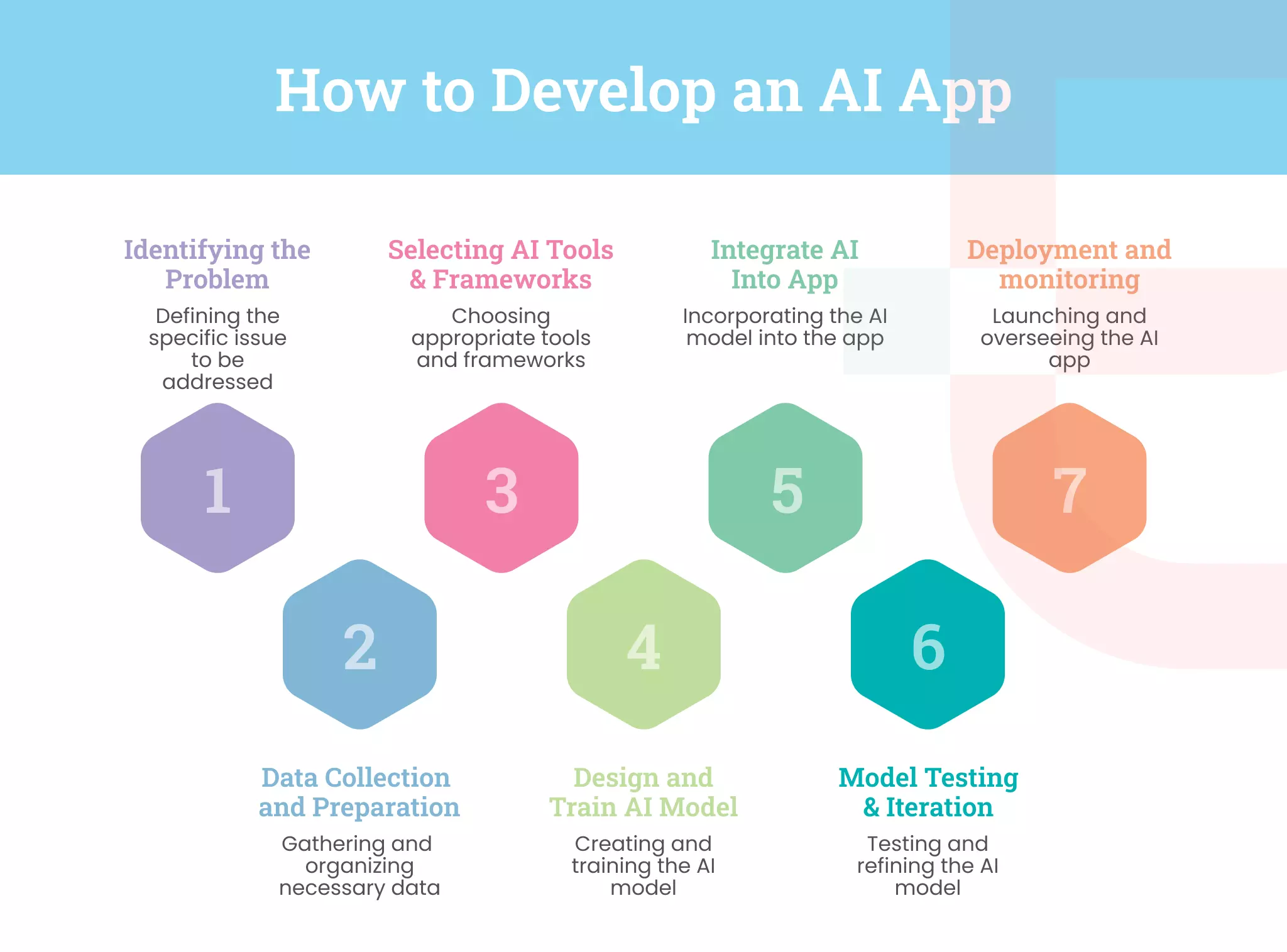
Developing an AI app is not just about using intelligent technologies and algorithms; it also requires a strategic approach that blends data science, user experience, and business logic.
Here is a step-by-step guide to help you build an AI-powered application for your business.
Identifying the Problem
The first and foremost step is to pinpoint a specific problem that your AI app will address. Before diving into the technical aspects, you must define why you need an AI app and what problem it solves.
Whether you aim to automate complex tasks, improve decision-making processes, or provide personalized experiences, this phase of the AI development process helps you prepare a crystal-clear purpose for building an AI app.
If this is your first time building an app with AI, take a moment to define your MVP (Minimum Viable Product) and the features your app requires, and give you the structure you need to build an AI-powered application.
Data Collection & Preparation
The success of any AI applications relies heavily on the quality of the data they are trained with. There is nothing wrong with saying that data is the backbone of the entire AI development process. However, this stage involves collecting, cleaning, and preparing relevant datasets to train your AI algorithms effectively.
- Data collection: Data is gathered from various sources, including user interactions, IoT devices, and online repositories, to create raw materials from which insights and functionalities are derived.
- Now, if you are focusing on supervised learning models, accurate data labeling is essential. For this, a dedicated AI labeling team is required that uses advanced tools to design AI & ML apps.
- After the data is labeled, it must be cleansed to remove errors, missing values, and inconsistencies, thereby ensuring its reliability.
Once the data is cleansed, it is essential to store it securely to enable easy access during model training and operational use, ensuring your AI app delivers intelligent insights that align with your business goals.
Selecting the Right AI Tools & Frameworks
Identifying the purpose doesn’t mean you have successfully stepped into the world of AI. Choosing the right AI tools & frameworks is critical to building a robust, scalable, and efficient AI app. The right selection depends on your business objectives, technical capabilities, and the complexity of your use cases.
So, let’s dive deep into some of the leading AI frameworks that are dominating today’s digital landscape:
- TensorFlow: If you are willing to build or deploy a machine learning model, then TensorFlow is ideal for you. It excels in large-scale commercial projects, particularly for image recognition, predictive analytics, and speech processing.
- PyTorch: Considered as one of the best frameworks for researchers and developers, as it helps them make their experimental setup easier. This flexible & modular architecture is primarily meant for businesses that prioritize AI model customization & innovation.
- Google AutoML: Businesses that want to develop an AI model with minimal coding expertise can go with this framework. It trains customized models quickly and integrates them seamlessly into your app.
Apart from these frameworks, several cloud-based AI platforms provide comprehensive environments for developing, training & deploying AI models, including.
- Google Cloud AI
- Amazon SageMaker
- Azure Machine Learning
Selecting the right combination of these tools ensures your AI app integrates seamlessly with existing systems while remaining adaptable to future technological advancements.
Design & Train Your AI Model
Even the most powerful AI application will struggle to succeed if users cannot interact with it effectively. This phase of the AI development process is where innovation meets structure. Here, you are required to define your model’s architecture—its layers, neural network nodes, inputs & outputs, and other core features—ensuring it aligns effectively with your app’s goal.
Once you have prepared a blueprint for your model’s architecture, the next thing you will need to do is opt for the most suitable learning approach based on your requirements:
- Supervised learning algorithms are ideal for predictive tasks such as demand forecasting, risk analysis, or customer behavior prediction.
- Unsupervised learning algorithms don’t require labeling the data, but they are mainly used to explore data structure, clustering, and finding associations within the data.
- Semi-supervised learning is useful when labeled data is limited, but you want to leverage large volumes of unlabeled data to enhance model accuracy.
Further, your AI model transforms raw data into actionable intelligence, helping your business make smarter, faster, and more informed decisions.
Integrate AI Into Your App
Developing an AI app is not just about integrating technologies; it also ensures that these technologies significantly enhance the overall user experience of your app, which is what makes this step a pivotal part of the entire AI development process.
Before integrating AI into your app, you must decide where to embed it. Generally, AI models are integrated into the frontend to interact directly with users. However, certain models, such as speech recognition and fraud detection, are best suited for the backend because they improve accuracy while reducing processing power requirements.
To ensure a smooth integration, collaborating with an experienced AI app development services provider is the best option. It helps you ensure your AI model is implemented effectively while also balancing performance, security, and scalability throughout the integration process.
Model Testing & Iteration
Your app needs continuous testing, evaluation, and iteration to maintain accuracy and performance over time. Regular AI model testing helps identify errors, optimize algorithms, and adapt your app to evolving business needs.
Moreover, AI development is an ongoing process. As your users interact with the app, new data streams in, providing opportunities to retrain and refine your AI models. By continually testing and improving the AI model, you can deliver long-term growth for your app while maintaining scalability and measurable ROI.
Deployment and Monitoring
Once your AI model is trained, tested, and integrated into your application, deploy it into a real-world environment. In this stage, your app will show its real performance under actual user load and how it adapts over time. Choosing the right deployment environment depends largely on your scalability, security, and infrastructure needs.
Further comes monitoring. Data patterns evolve, and user behaviors change over time. Continuous monitoring is necessary to ensure consistent performance. Model drift, accuracy degradation, or rising error rates must be quickly identified and addressed.
To maintain long-term accuracy and efficiency:
- Implement automated performance-tracking tools.
- Retrain your model regularly using new data samples.
- Integrate continuous learning pipelines to enable your AI to adapt to real-time insights.
- Ensure logs, metrics, and feedback loops are in place to support ongoing improvements.
Excited to Unlock New Business Opportunities with AI? Let’s Build an AI App And a Strong Partnership
Discover the Transformative Benefits of AI Apps in Business

Nowadays, AI apps are a strategic necessity for sustainable growth. Businesses across the globe are integrating AI-powered solutions in their operations and for their customers.
Whether you’re looking to streamline operations or enhance decision-making, AI provides a robust framework for achieving these goals. Let’s have a closer look at how AI apps in business are delivering transformative benefits.
Enhanced User Experience & Personalization
One of the core benefits of AI apps for businesses is their ability to deliver highly personalized, intuitive user experiences. By analyzing customer behavior, buying patterns, and preferences, AI enables businesses to deliver tailored services, boosting engagement and customer satisfaction.
In fact, according to one report, the global AI-based personalization market is projected to reach USD 788.7 Bn by 2033, reflecting the growing demand for intelligent, experience-driven solutions that fuel long-term business growth.
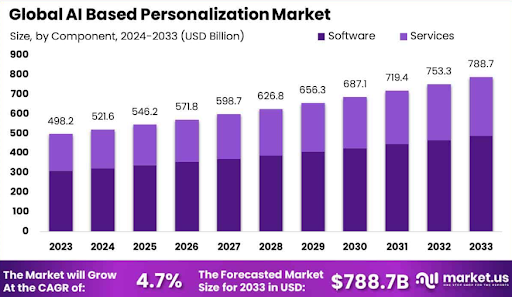
Source: market.us
Data-Driven Decision Making
By integrating advanced AI algorithms like ML and data analytics into an app, businesses can make faster, smarter, and more accurate decisions. These smart technologies easily process vast amounts of data in real time to identify emerging market trends and predict customer demand.
This data-backed approach allows businesses to move beyond intuition; it helps them in making strategic decisions that enhance efficiency, reduce risk, and improve overall business outcomes.
Enhanced Productivity & Efficiency
Integrating AI apps into business operations delivers drastic improvements in overall operational efficiency. It automates repetitive, time-consuming tasks, such as responding to customer queries instantly with AI-powered chatbots, sorting emails, organizing data, and more.
This reduces manual workload and allows businesses to focus more on innovation and strategic initiatives that drive greater value, ultimately boosting productivity and profitability.
Scalability & Flexibility
As your business grows, so should your technology. AI apps are inherently scalable, which enables businesses to handle expanding user bases and larger data volumes without compromising performance. You can easily upgrade AI models, integrate new features, and adapt to changing needs while maintaining smooth functionality.
This flexibility helps reduce remodeling or redevelopment costs and enables businesses to remain adaptable in a constantly changing digital environment.
Competitive Advantage
Developing an AI app in today’s tech-driven market gives businesses a clear competitive edge. By continuously analyzing market trends, anticipating customer behavior, and forecasting demand, AI equips decision-makers with real-time insights that help them act strategically.
Moreover, businesses that adopt AI in their operations can always stay a step ahead of competitors while also delivering superior value to their customers.
How AI is Driving Digital Transformation Across Industries—Let’s Evaluate Its Real-World Applications
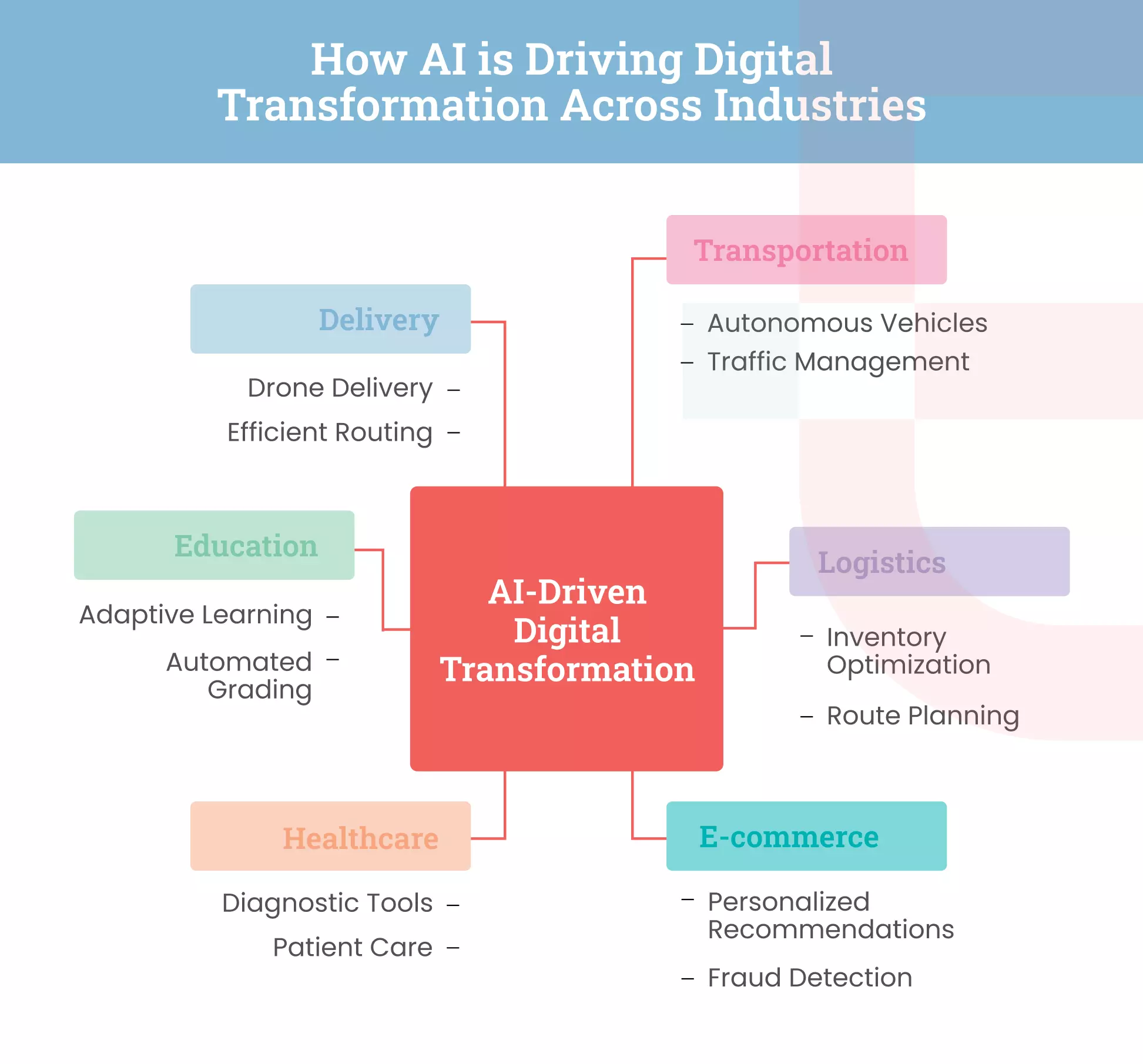
AI is a game-changer across diverse industries, enabling businesses to redefine how they operate, engage with customers, and achieve sustainable growth. From transportation to healthcare, AI apps in business are transforming conventional approaches into intelligent, data-driven solutions that boost efficiency and profitability.
Transportation
AI in transportation industry offers impressive capabilities such as fleet management, route optimization, behavior analysis, and demand forecasting. Tools such as predictive analytics help businesses minimize delays and reduce fuel costs, enabling them to deliver faster, more reliable services to their end users.
Logistics
Implementing AI in logistics helps businesses streamline complex supply chains through real-time tracking, demand forecasting, and warehouse automation. By using data analytics and computer vision, businesses can gain real-time insights into resource allocation and more, enabling them to make decisions promptly and improve delivery accuracy.
eCommerce
In the eCommerce industry, AI apps create highly personalized shopping experiences by analyzing customers’ behavior, their buying patterns, and more. From dynamic pricing to personalized product recommendations, AI helps businesses improve user engagement, strengthen loyalty, and increase sales conversions.
Healthcare
From virtual assistants that handle queries to predictive analytical tools that detect diseases early, AI is reshaping the healthcare industry in many ways. It fosters personalized care by simplifying medical record management and enhancing decision-making for healthcare providers, thereby improving patient outcomes.
Education
AI-driven education platforms enable adaptive learning by analyzing student performance and personalizing teaching methodologies. Intelligent tutoring systems and automated grading reduce manual workloads while also providing real-time feedback. This makes education more accessible, intelligent, and in tune with the modern era.
Delivery
From optimizing last-mile operations to route and real-time order tracking, AI apps play a vital role in transforming the overall delivery operations. Businesses can handle queries instantly and deliver continuous updates to customers by integrating AI chatbot solutions into their apps, making communication smoother and providing customers with a satisfying experience.
Want to Upscale Your Current Infrastructure with AI? Collaborate With Elluminati for Our Proficient Services
How Much Does it Cost to Develop an AI App? Dive Into Its Estimation
When planning how to build an AI app, one of the most crucial considerations for any business is understanding the total cost of development. However, the investment varies significantly depending on the scope and the complexity of your project.
AI App Development Cost Overview
| AI App Type | Estimated Cost Range | What It Includes |
|---|---|---|
| Basic AI App (chatbots, simple recommendations) | $20,000 to $80,000 | Basic AI features, limited datasets, standard integrations |
| Advanced AI App (predictive analytics, NLP, automation) | $300,000 to $1,000,000+ | Complex models, real-time processing, scalable architecture |
For businesses exploring AI apps, viewing this cost not as an expense but as an investment is crucial. A well-designed AI app can deliver exponential returns by enhancing overall efficiency and scalability, helping businesses turn their innovation into measurable growth.
How to Overcome the Key Challenges in Developing an AI App?
Building an AI app can be a transformative endeavor, offering innovative solutions and improving efficiency across sectors. But it also comes with its own set of complexities that require strategic planning to overcome. The following are common challenges every business faces when developing an app with AI.
Data Quality and Quantity
AI models rely heavily on data to learn and make accurate predictions. Collecting high-quality as well as relevant data in sufficient quantities is often a significant hurdle.
Solution:
Build robust data management practices by cleaning, validating, and preprocessing your data to ensure it effectively showcases real business issues and supports your AI model in delivering precise, reliable outcomes.
Choosing the Right Algorithms
There are numerous algorithms available, each suited to different types of problems and data sets. Selecting the right algorithm is essential to maintain the app’s accuracy & performance.
Solution:
The best way to overcome this challenge is to define your app requirements in advance. Conduct thorough market research to determine the most appropriate algorithm that delivers the best business-driven results.
Ethical and Legal Considerations
AI-powered apps are significantly raising the ethical and legal concerns, including data privacy, security, and the potential for biased outcomes.
Solution:
To encounter these challenges, you must comply with all the ethical AI standards and data privacy laws. This includes regularly auditing your AI models to eliminate bias and ensure transparency and security throughout the AI-driven operations.
Scalability and Maintenance
As user demands and data volumes grow, AI apps require greater scalability to handle more details efficiently without disrupting ongoing operations.
Solution:
Design your AI app with scalability in mind, using modular, cloud-based architectures. This will not only keep your model up to date and retrained but also help you stay ahead in this competitive market by scaling your app as your business evolves.
Common Mistakes to Avoid in AI Application Development
We need to do more than just build an app and integrate it into your systems. Unknowingly, we make critical mistakes that limit the model’s performance, scalability, or long-term reliability. Below are the most common pitfalls—and how to avoid them.
1. Poor Data Handling and Preparation
Data is the base for AI apps. One of the biggest mistakes in AI app development is relying on incomplete, inconsistent, or unstructured data. Without proper cleaning, labeling, and validation, even the most advanced AI models will give inaccurate or biased results.
How to avoid it:
Implement strong data governance practices from the start. Collect the data, clean it, validate the datasets, and establish clear labeling protocols to ensure your AI model learns correctly.
2. Ignoring MLOps (Machine Learning Operations)
Setting up AI systems needs operational ecosystems as well, which sometimes teams forget to set up. Without MLOps, deploying, monitoring, and scaling the model become difficult, resulting in slow updates and inconsistent performance.
How to avoid it:
Include a robust MLOps pipeline that streamlines data versioning, model monitoring, CI/CD for ML, and real-time performance tracking. This ensures your AI app remains stable, scalable, and easy to update.
3. Overlooking Model Drift
With the change in user behavior, market situations, and patterns in the data, the AI model starts to degrade. This phenomenon is known as model drift. It will lead to unreliable outcomes and poor predictions.
How to avoid it:
Continuously monitor model accuracy and performance. Retrain models regularly with fresh data and implement automated alert systems to detect sudden changes in data distribution.
4. Overfitting the Model
Overfitting happens when an AI model performs well on training data but fails to generalize to real-world scenarios. This mistake often occurs when the model is too complex or trained on a narrow dataset.
How to avoid it:
Use appropriate validation strategies, such as cross-validation and splitting the dataset into training, validation, and test sets. Simplify your model when needed and track performance on unseen data to ensure it generalizes effectively.
Elluminati Can Help You Build a Future-Ready AI App
In today’s fast-paced world, learning how to develop an AI app is both an exciting & strategic opportunity for businesses. However, turning an AI vision into a market-ready product requires the right expertise, strategy, and technological foundation—and that’s where Elluminati becomes your trusted partner for AI development services.
With over 13 years of experience in the field, Elluminati helps businesses seamlessly navigate every stage of AI app development. Our team ensures your product is built using the most advanced AI frameworks, robust data pipelines, and industry-best engineering practices.
Whether you need ML model development, NLP-driven features, predictive analytics, or fully customized AI integration, we deliver solutions tailored to your unique use cases. This empowers your operations with intelligent, scalable technology that drives lasting impacts.
FAQs
The key steps of AI application development process are:
- Identifying the Problem
- Data Collection & Preparation
- Selecting the Right AI Tools & Frameworks
- Design & Train Your AI Model
- Integrate AI Into Your App
- Deployment and Monitoring
The key components that power the AI development process include:
- Machine Learning
- Deep Learning
- Robotics
- Natural Language Processing
- Expert Systems
The cost to build an app ranges from $10,000 for basic apps to $300,000+ for advanced platforms. Nevertheless, it is affected by various characteristics during the development process, such as technologies, tools, integration requirements, customization requirements, team bandwidths, etc. To get personalized information, you can reach out to our sales executives at sales@elluminatiinc.com.
For AI app development, you will need tools and frameworks like PyTorch, TensorFlow, and cloud platforms like AWS, Azure, and Google Cloud. Also, it involves databases, APIs, front-end frameworks, and model training environments to build, test, and deploy a scalable AI solution.
As AI apps deliver measurable outcomes to businesses, they also come with a set of challenges that include:
- Data Privacy & Security Concerns,
- Lack of Transparency,
- Higher AI Implementation Costs
- Dependence on Quality Data, among others.
Below, we have provided key tips to accelerate AI app development.
- Use pre-trained AI models & APIs to minimize development time.
- Start with Minimum Viable Products (MVP) & iterate based on user feedback.
- Leverage cloud AI platforms like Google Cloud and AWS SageMaker for scalable and ready-to-use tools.