Key Takeaways (or TL;DR):
- Robotaxis are fully autonomous vehicles that use advanced technologies like artificial intelligence, GPS, and sensors like LiDAR to operate without human drivers.
- Starting an online Robotaxi business requires extensive research, regulatory approvals, business planning, acquiring funding, app development, pilot testing, and scaling.
- Businesses can generate revenue through multiple ways, like per-ride pricing, surge pricing, subscriptions, in-vehicle advertising, partnerships, and enterprise contracts.
- Robotaxi services usually operate through a mobile app that manages everything from booking and identity verification to payments and feedback.
- Launching Robotaxi services offers several benefits, like reduced operational costs, increased utilization, higher safety, and sustainable mobility.
Today, the demand for Robotaxis is rapidly increasing as cities are leaning towards smart mobility solutions, and customers are preferring safer and more convenient solutions. For businesses, this growing demand creates an opportunity to reduce operational costs, enhance service availability, and gain a competitive edge in the transportation market.
However, starting an online Robotaxi business requires extensive research and planning. This article will take you through the step-by-step process of how to start a Robotaxi business. Besides, you will also get to understand how the business operates, different revenue strategies, and challenges in starting the business.
What is a Robotaxi? And how did it start?
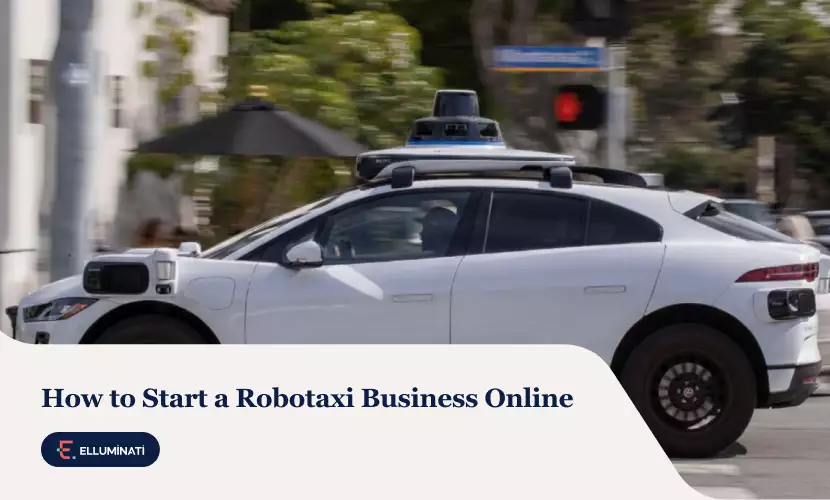
A Robotaxi is a fully autonomous vehicle that transports passengers from one location to another without a human driver. The vehicles use AI technology, specialized sensors, and cameras for route planning, predicting traffic conditions, and safely driving through the roads.
When it was initially introduced in the 1980s, it was a mere experiment. However, the idea was fully executed with the first commercial Robotaxi service by Waymo in December 2018. Today, you will find several companies operating across the world, including Tesla, Baidu, and Cruise.
How to start a Robotaxi business?

Here is a step-by-step guide on how to start a Robotaxi business online.
Step 1: Perform In-Depth Market Research
Before investing your time, money, or effort in vehicles and software, it is essential to have a clear understanding of the market you are considering entering. It basically includes:
- Identify who will be your target customers, like daily commuters, business travellers, or tourists, and also decide where to start a Robotaxi business.
- Studying existing autonomous ride-hailing services and traditional taxis and finding gaps in their service quality, pricing, or customer experience.
- Knowing the latest technology trends, such as using AI in autonomous vehicles.
- Checking for the availability of charging hubs and specific areas in the city where driverless vehicles can legally run.
A detailed market research eliminates guesswork and allows you to align your services perfectly with real user needs.
Step 2: Adhere to Regulatory Compliance
Robotaxis need extra precautions, government approvals, and regulatory checks before starting a business. Entrepreneurs must ensure safety standards, obtain a license, and test technology before starting the self-driving car business. Other than that, policies and compliance also depend on the country in which you wish to start a business.
However, regulations for Robotaxi businesses vary by city and country. For instance, in the US, the National Highway Traffic Safety Administration (NHTSA) oversees vehicle safety standards and grants exemptions for autonomous vehicles operating without human drivers.
Step 3: Choose the Appropriate Business Model
A business model is a strategic blueprint highlighting how your services will generate revenue. You can operate your own fleet, partner with third-party fleet owners, or even offer franchise opportunities.
Besides, you can offer on-demand rides, subscription packages, or even enter partnerships with local hotels and corporate offices.
To make your choice easy, below we have provided a table providing a detailed overview of each model.
| Business Model | How It Works | Best For | Pros | Cons |
| Fleet Ownership Model | You own and operate the entire autonomous vehicle fleet. | Well-funded startups and enterprises | Full control over operations and service quality; higher profit margins | High upfront investment in vehicles, infrastructure, and maintenance |
| Partnership Model | You partner with third-party fleet owners or businesses like hotels, airports, or corporate offices | Startups with limited capital or businesses willing to offer mobility services through partnerships | Lower investment; faster market entry | Less control over vehicle standards and customer experience |
| Franchise Model | Local partners run services under your brand and technology. | Businesses aiming for multi-city expansion | Faster scaling; local market knowledge | Revenue sharing; dependency on partner performance |
| On-Demand Ride Model | Users book rides instantly through a mobile app. | Urban mobility platforms | High demand; flexible pricing | Requires strong fleet availability and real-time operations |
| Subscription Model | Users pay a monthly or yearly fee for discounted or fixed rides. | Daily commuters and corporate users | Predictable revenue; customer retention | Needs a large and consistent user base |
Step 4: Create a Strong Business Plan
After getting clarity about the business model, the next step involves building a strategic business plan. Having a strong plan is essential as it acts as a roadmap for your company by defining how your services will operate, grow, and generate revenue over time. A strong plan usually includes:
- Complete details about your target market and customer segments
- How do your services stand out from those of different competitors
- Pricing and revenue strategies
- Cost of vehicle fleet and business setup
- Cost estimations for the booking platform
- Charging infrastructure expenses
Step 5: Secure Funding
A Robotaxi business requires substantial funding. Although it does not rely on human drivers, businesses will need significant upfront spending on self-driving vehicles, advanced sensors like LiDAR, AI systems, software development, and charging infrastructure.
Besides, you will also need intensive capital for regulatory compliance, insurance, and timely technology upgrades.
You can acquire funds from different sources, like venture capital firms, government support programs, and partnerships with established transportation or technology companies, like autonomous vehicle manufacturers and charging infrastructure companies.
Step 6: Develop a User-Friendly Booking Platform
When it comes to the Robotaxi business, a user-friendly and reliable platform becomes crucial to enable easy bookings.
With so many options available in the market, identifying a trustworthy app provider becomes important. A booking platform with a user-friendly design and the latest AI features , like demand prediction and smart route optimization, ensures efficient operations and effective user experiences.
Elluminati, a leading white label taxi app development company , develops robust platforms and dedicated apps for on-demand ride-hailing businesses. It has a proven experience of 14+ years in serving 450+ mobility businesses worldwide through its solutions.
Step 7: Build Operational Infrastructure and Assemble a Skilled Team
Launching a Robotaxi business is not just about having autonomous vehicles. You need a powerful operational setup to keep your fleet running safely and efficiently always. This includes setting up charging stations, regular maintenance hubs, and a control room to have an eye on all the operating vehicles.
Besides, you also need a team of skilled human professionals to operate your business. This will include data and AI technicians to manage self-driving systems, vehicle technicians for maintenance and repairs, a customer support team to assist users, and operations managers to oversee fleet performance.
Step 8: Pilot Test Your Services
Before fully launching your business, it would be better to conduct pilot tests in a limited service area. Operate a small number of autonomous vehicles on selected routes to monitor their performance in real traffic conditions, like navigating intersections and maneuvering parked vehicles.
This also allows you to evaluate your booking app performance and see how smoothly users can book rides. Getting feedback from real users will help you find and fix technical and operational glitches early.
Step 9: Launch Your Service and Optimize Performance
After successful pilot tests, you can now launch your services publicly. However, this doesn’t mean your work is done. Unlike human-driven cars, autonomous fleets depend on software updates, sensor calibration, regular hardware checks, and AI model upgrades.
After launch, keep a continuous eye on fleet performance, ride completion rates, and customer feedback. These insights will help you improve your service quality and also have long-term sustainability.
Step 10: Work on Customer Acquisition and Market Expansion
Customer acquisition is a crucial aspect that businesses must focus on after launching their business. Promote your business through digital marketing, referral programs, and special discounts.
Once your services become popular, you can plan to gradually expand them into new areas. You can increase your fleet size and hire additional operational staff to meet growing demands efficiently.
Connect With Us to Launch a Successful On-Demand Self-Drive Mobility Business Backed By Innovative Technology
Why Robotaxis Are the Next Big Thing in the Mobility Business?
With the changing ride-hailing standards , innovative ideas are shaping the future of mobility, and Robotaxi stands out as the most revolutionary approach. As we discussed earlier in this blog, Robotaxis are embraced in the world’s major cities, including the USA and the UAE.
But why are Robotaxis considered the future, and how will they reshape transportation? The answer lies in its true potential to change how people move with a smarter, better, and safer approach.
Beyond being beneficial for customers, it also offers advantages to businesses by lowering workforce-related costs and reducing human errors. Some of the prominent reasons why it is the future of transportation are as follows:
Growth Opportunity for Ride-Hailing Companies
Since Robotaxis do not require drivers, many operational aspects and overhead costs can be cut down for ride-hailing companies. No driver salaries, no management efforts, and no dispatchers, just smooth AI and technology-driven rides, which are always available for customers.
Customers Embrace Future-Driven Innovation
Customers are increasingly drawn to the popularity and convenience of self-driving cars. While some customers are curious to explore emerging technology, others prefer it due to its benefits, such as privacy and quick service.
Why Start a Robotaxi Business?
Starting a Robotaxi business involves a multitude of benefits. Here’s a closer look at the key advantages.
Cost Reduction
Robotaxis eliminates the need for human drivers, cutting down the salary, incentive, and management costs. Besides, self-driving cars also reduce idle time, which ultimately reduces operational costs and increases profit margins for businesses.
Enhanced Safety
Self-driving cars are empowered with advanced AI, specialized sensors, and cameras, which allow them to follow every rule, react in milliseconds , and operate without distraction, ensuring safe rides for customers.
Increased Utilization
Autonomous vehicles do not require shifts, breaks, or sleep like human drivers. This allows them to operate for a longer time on the road every day. This means less idle time and higher revenue potential per vehicle.
Market Disruption
By reducing operating costs, improving safety, and enabling 24/7 support, the Robotaxi companies have the potential to disrupt the traditional ride-hailing market with a global market projected to reach $147.25 billion from 2026 to 2033. This highlights a good opportunity for early adopters to capture the market share and establish a leading position in the competitive landscape.
Sustainable Mobility
Robotaxis are electric, which helps reduce air pollution and carbon emissions caused by conventional vehicles. Also, when people use autonomous ride-hailing services instead of personal cars, it helps reduce fuel consumption, significantly contributing to environmental sustainability.
Accessibility & Convenience
Driverless cars can operate 24/7, which ensures anytime ride services for people, even during peak times when finding reliable transportation is a real challenge. Moreover, with voice-activated controls, Robotaxis makes it easy for non-drivers and even differently-abled individuals to travel in the city.
How an Online Robotaxi Business Works?
Now, let’s see the detailed workflow of an online Robotaxi business.
Ride Booking and Confirmation
Customers book the ride through the booking app by entering their pickup and drop-off locations. The app finds and assigns the nearest Robotaxi and confirms the booking.
Robotaxi Arrival and Vehicle Identification
After confirmation, Robotaxi reaches the specified pickup point with the help of GPS and maps. Passengers can identify the vehicle by the basic details provided in the app, like vehicle number and model name.
Trip Initiation and Safety Checks
Before starting the ride, the passenger’s identity is verified through the app using facial recognition, QR code scanning, or OTP. Once verified, doors unlock and the trip starts.
Destination Arrival and Passenger Exit
When it arrives at the destination point, the car stops automatically. The ride fare is automatically deducted from the passenger’s saved payment method.
Post-Ride Feedback and Payment
After the trip, passengers have the opportunity to share their ride experience through the app’s reviews and ratings system.
Key Technologies to Integrate to Start a Robotaxi Business

Advanced Autonomous Vehicle Technology is the key technology behind Robotaxis. It uses AI, sensors, and cameras that eliminate the need for human input in driving a car. Let’s understand this technology by breaking down its minute aspects and functions:
Artificial Intelligence
Using artificial intelligence in self-driving cars helps a lot with decision-making and many other predictive aspects. It gives real-time directions to the system based on the surroundings and road conditions. For instance, a pedestrian walking on the road, a car coming from the side, and more.
Sensors
The types of sensors used in the Robotaxis are Radar (Radio Detection and Ranging), LiDAR (Light Detection and Ranging), Ultrasonic, and advanced navigation systems. For example, Radar helps to get aware of the surroundings of a car to measure distance and other aspects.
By measuring the distance of nearby objects, the car adjusts its speed accordingly.
On the other hand, LiDAR is basically an eye for a self-driving car since it is a 3D picture model based on the environment. The interesting part is that LiDAR also helps to see in conditions of low lighting, fog, or snow. However, in cases of extreme temperature and harsh weather, their performance can be adversely affected.
With ultrasonic sensors, the system predicts the distance of surrounding objects. With this, it measures time to react to obstacles, adjust speed in tight spaces, and identify when to apply brakes.
Machine Learning & Predictive Analysis
Machine learning collects the data from the surroundings and background, identifies the objects that are in the way of cars, and helps to get a clear direction to move forward. It also makes decisions based on past patterns, such as identifying road signs or obstacles. Additionally, it decides when to increase or decrease speed, turn, reverse, or brake.
Cameras
The cameras provide a 360-degree overview of the surroundings to find objects and pedestrians and effectively carve through the routes. Going beyond the basics, cameras provide the utmost accuracy by detecting colors and shapes along the way. So, it detects road signs and other objects by their size, distance, and color.
Vehicle-to-Everything (V2X) Communication
Vehicle-to-everything communication enables a network between other cars driving on the road, signs, or any other object. In simple language, the car can send signals to other vehicles and receive messages in return. For instance, it can tell other vehicles about an obstacle ahead with its wireless system.
Launch Your Robotaxi Business Faster with Elluminati’s Taxi App Solutions Designed for Autonomous Mobility.
Top Examples of Robotaxi Companies to Get Inspired By
Now, let’s go through the top examples of Robotaxi companies to retrieve valuable information.
Waymo
Waymo is the pioneer of the Robotaxi business execution. They started Google’s self-driving car projects in 2009. They started serving fully automated cars in 2015. As per a recent article in the Los Angeles Times , Waymo cars operate in Phoenix, San Francisco, and Los Angeles. It is soon going to start its operations in Austin, Atlanta, and Miami.
Cruise
Cruise was founded in 2013 in San Francisco, California, United States. Cruise has received funding from other leading companies such as Honda, Microsoft, and Walmart. As per their website claim, they are testing their driverless car technology in Houston, Dallas, Texas, and the Bay Area. They are also set to test vehicles in the UAE.
Tesla
Tesla piloted its first autonomous ride-hailing service in Austin, Texas, in June 2025 and is planning for a national and international rollout in the following year. The service allows users to book driverless rides using Tesla vehicles through the company’s Full Self-Driving (FSD) software.
Zoox (Amazon)
The company first started in 2014 with a vision of providing purpose-built and zero-emission vehicles for autonomous ride-hailing. Recognizing Zoox’s potential to disrupt ride-hailing markets, Amazon acquired it in 2020 for $1.2 billion. It is currently operating in Las Vegas and will soon expand to San Francisco, Austin, and Miami.
Baidu (Apollo Go)
Baidu’s Apollo Go was launched with the goal of making every ride safer, efficient, and easier with autonomous driving technology in China’s Changsha in 2019. Today, it operates in 20 major cities in China, like Wuhan, and is also planning to expand its operations in Hong Kong, the UAE, and Switzerland.
Pony.ai
It was founded in December 2016 in China by Baidu’s former software developers James Peng and Tiancheng Lou. It is one of the industry leaders in the commercialization of autonomous driving and plans to expand its services in the UAE, Qatar, and Singapore.
How Your Robotaxi Business Will Make Money?

Online Robotaxi businesses generate revenue in multiple ways. Below are mentioned the most common revenue models opted by businesses.
Pay-Per-Ride Pricing Model
This is the most common type of model in which customers pay for each ride based on distance, time, and route. Since driver costs are not involved, businesses save heavily on operational costs, which eventually contribute to overall profits.
Dynamic and Surge Pricing
Prices automatically increase based on high demand, traffic conditions, and vehicle availability. This allows businesses to make better use of their vehicles during peak hours and generate more revenue.
Subscription-Based Plans
In this model, customers pay a fixed monthly or yearly fee for discounted or unlimited rides. This ensures a predictable, recurring revenue for businesses.
In-Vehicle Advertising and Partnerships
Robotaxi businesses can partner with local restaurants, hotels, malls, and even entertainment platforms to display their digital ads within the mobile app. In return, these businesses pay a considerable amount, allowing taxi operators to generate extra revenue.
Government and Enterprise Contracts
Businesses can offer driverless taxi services to corporate offices, government officials, and airports through long-term agreements. These contracts ensure a stable income.
Challenges Associated With Robotaxi Business
While the Robotaxi business holds strong growth opportunities, it also involves several challenges that entrepreneurs must be prepared to navigate.
Regulatory and Legal Complexity
The legal rules and regulations for launching an autonomous taxi business vary by country and city. Acquiring permits, approvals, and safety clearances makes it a lengthy process, which can delay the launch process.
Safety Public Trust
AVs heavily rely on sensors, AI systems, and real-time data to operate safely. Even a single technical glitch can easily impact passenger safety and reduce public trust.
High Capital Investment and Operating Costs
Starting a Robotaxi business requires a huge upfront investment for vehicles, AI-powered systems, booking app development, and charging infrastructure. Moreover, ongoing costs for maintenance, legal compliance, and technology upgrades are also high.
Intense Competition
With leading players like Waymo, Cruise, and Tesla, the Robotaxi market becomes intensely competitive. Having a strong business strategy and partnerships becomes crucial to thrive in the competitive landscape.
Urban Mobility Integration
Robotaxis have to work smoothly in the city’s existing transport system, including traffic systems, public transit, and road infrastructure. This integration becomes challenging and time-consuming for AVs as they have to follow traffic rules, adapt to road conditions, and also coordinate with public transport. Updating the systems can take time.
How Elluminati Can Help You Start Your Robotaxi Business
Starting a Robotaxi business is not just about having autonomous vehicles. The real challenge lies in ensuring a smooth digital experience where rides are booked easily, vehicles are tracked in real time, and operations are handled efficiently. This becomes possible with an effective booking software. However, most businesses still struggle with how to start a Robotaxi business with the right technology and platform.
For this, Elluminati becomes an effective partner. With 14+ years of expertise, our taxi app development company builds Robotaxi platforms that perfectly align with the real mobility needs. Moreover, with expert guidance and consultation, we help businesses plan their entire roadmap with the right technology choice, ensuring scalable growth in the competitive market.
FAQs
Starting a Robotaxi business requires thorough market evaluation, choosing the right business model, creating a strong business plan, ensuring legal compliance, building a booking software, and securing funding.
The robotaxi business operates using autonomous vehicles.
- Customers initially book rides through a mobile app,
- The booking software confirms the ride, and the vehicle arrives at the pickup point using maps and GPS.
- The app confirms passenger identity through QR code and face recognition,
- The vehicle navigates the destination point by optimizing the routes with advanced sensors and maps, and completes the ride safely.
Launching a Robotaxi business becomes highly profitable as it eliminates driver operating costs, ensures higher utilization, and offers multiple revenue channels like per-ride commission, subscription model, and in-vehicle advertising.
Driverless vehicles rely heavily on autonomous driving technology that includes advanced AI systems, sensors like LiDAR, radar, cameras, and GPS. Besides, a user-friendly booking software and fleet management system are also essential for smooth operations.
Revenue is usually generated from multiple ways, such as:
- Pay-per-ride price
- Dynamic and surge pricing
- Subscription plans
- In-vehicle advertising and partnerships
- Government and enterprise contracts