
Key Takeaways (or TL;DR)
- The taxi market is growing more competitive, making it necessary for businesses to implement powerful growth strategies.
- Some of the taxi business growth strategies include using modern technology, such as automated dispatch systems.
- Strong driver loyalty programs help businesses maintain service quality.
- Expanding into Tier II and Tier III cities allows businesses to scale their taxi operations more easily, with less competition.
- Businesses can increase revenue opportunities by diversifying their service offerings.
- Digital marketing strategies such as SEO, social media, and digital ads can help businesses boost online visibility.
The taxi industry is evolving rapidly with changing customer demands, technology advancements, and intense competition. In such scenarios, one effective way to remain competitive and profitable is to adopt strategies that drive long-term, sustainable growth for their taxi business.
With that, businesses will get multiple opportunities to easily attract more customers, increase operational efficiency, and scale effectively. This article will give you a detailed look at how to grow a taxi business, highlight the outcomes of each, and explain what common mistakes to avoid.
Why Ride-Hailing Business Growth Strategies Are Critical in Today’s Competitive Market?
The taxi industry has changed a lot in the last few years. With rising competition, evolving customer needs, and technological enhancements, having just a driver network and vehicle fleet is no longer enough to run a taxi business.
According to Mordor Intelligence, the global taxi market is projected to reach US$366.91 billion from 2026 to 2031, with a CAGR of 7.62%.
This highlights the necessity for businesses to implement powerful growth strategies to have sustainable growth in the rapidly advancing market.
Intense Competition
Today, on-demand taxi services have become an integral part of people’s daily lives because of the convenience they offer. Customers can easily book cabs with just a few taps on their mobile phones.
Also, with the presence of multiple service providers, including traditional taxis, ride-hailing apps, and local cab operators, customers have several options to choose from. This makes the market intensely competitive for new businesses.
Price Wars and Commission Models
Many businesses try to attract customers by offering low fares and special discounts.
Although these strategies help attract customers, they also reduce businesses’ profit margins. Also, many companies charge higher commissions to drivers, which affects driver earnings and overall profitability.
Low Customer Loyalty
Today, customers have numerous taxi apps and local operators to choose from. In case of inconsistent pricing and poor service quality, they can easily switch to another provider.
Rapidly Advancing Technologies
Technology is advancing rapidly, ultimately transforming how customers book and access on-demand taxi services. Customers prefer using apps that offer the latest features, such as real-time ride tracking, digital payment options, and fare transparency.
Adopting modern taxi app technologies can help businesses keep up with changing customer preferences and remain competitive.
Operational Inefficiencies
Inefficient ride-hailing operations can easily impact the overall profits. Poor route planning, manual dispatch systems, and a lack of performance tracking lead to higher fuel costs and idle vehicles.
Inefficient operations increase expenses while degrading service quality, ultimately making it difficult for businesses to operate and scale.
Effective Taxi Business Growth Strategies You Should Implement in 2026
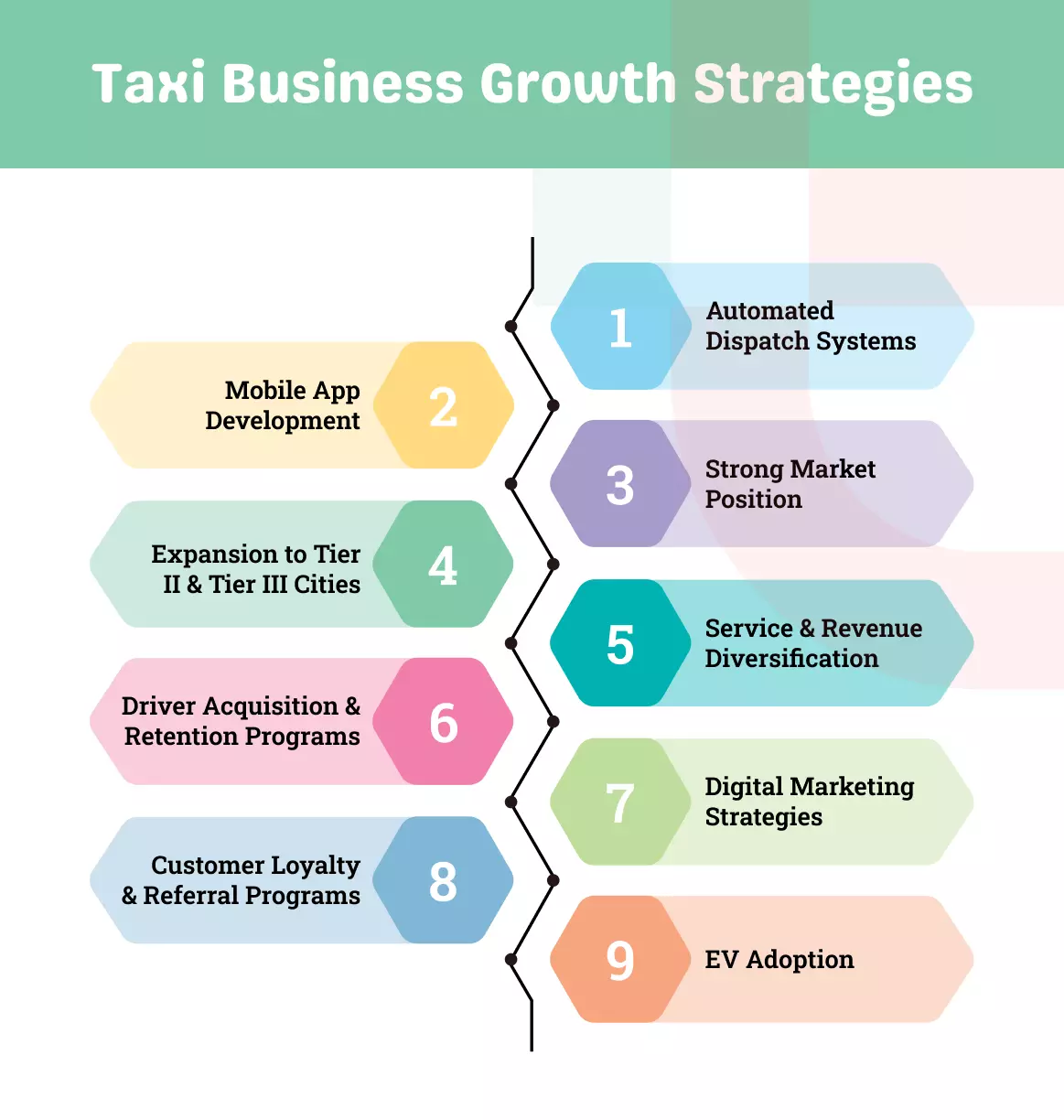
Now, here’s a breakdown of powerful ride-hailing business growth strategies you can implement to lead the competitive curve.
Opt for Advanced Dispatch and Automation Systems
Implementation:
Automated dispatch systems help match riders with the nearest available drivers. Besides, they help manage bookings and monitor fleet activity. Businesses can easily handle multiple ride requests with speed and accuracy by opting for an automated dispatch system.
Outcome:
By adopting automated taxi dispatch systems, businesses can improve ride allocation efficiency by 30% to 40%, resulting in a 2X increase in ride completion rates.
Grow Your Taxi Business Using Mobile App Technology
Implementation:
Taxi businesses can ensure smooth operations by having separate apps for drivers, riders, and businesses. Rider apps allow passengers to book rides, while driver apps allow drivers to accept or reject ride requests, optimize routes using GPS, and track earnings.
Moreover, the admin panel makes it easy for businesses to manage bookings and drivers, and to track overall fleet activity.
Outcome:
Dedicated apps enable businesses to improve rider booking convenience, simplify driver ride management, and streamline overall operations with ease. This ultimately leads to 2x higher operational efficiency and 50% higher repeat bookings.
Create a Strong Position in the Taxi Market
Implementation:
You can strengthen your market position by offering transparent pricing and better customer support. Maintaining service quality helps you create a strong brand presence. Also, by analyzing the current taxi market statistics, you can create a strategic plan for business scalability.
Outcome:
A strong competitive position helps your business achieve 20% to 30% higher customer retention while maintaining booking demand, even in a highly competitive market.
Expand Services to Tier II and Tier III Cities
Implementation:
The best way to scale your taxi business is to expand in Tier II and Tier III cities, where services are still developing, and competition is less. You can initially start small with a few vehicles and gradually expand as demand increases. This will prevent major risks.
Outcome:
By targeting emerging markets, market penetration increases by 50% to 60%. Furthermore, it ensures faster growth with less competition.
Diversify Your Offerings and Revenue Streams
Implementation:
Instead of relying on a single revenue source, such as ride fares, you should diversify your offerings to include corporate travel, intercity rides, airport transfers, and hourly rentals.
Multiple service offerings will help you generate revenue from different sources.
Besides, there are several other taxi app revenue models, such as in-app advertisements and dynamic pricing, which create several earning opportunities.
Outcome:
Service diversification helps businesses create up to 3.5x higher earning opportunities.
Get Long-Term Scaling Opportunities with Elluminati’s Impressive Growth Strategies and a Scalable Taxi App
Apply Driver Acquisition and Retention Programs
Implementation:
Retaining drivers is more challenging than attracting new ones. By charging low commissions and offering performance-based incentives, you can improve driver retention and maintain service quality.
Outcome:
Driver retention strategies help businesses reduce driver turnover by 45% and increase ride availability by 50%.
Opt for Digital Marketing Strategies
Implementation:
In today’s digital era, one of the most effective ways to enhance your brand visibility and extend your reach is to use digital marketing strategies, including SEO (Search Engine Optimization), SMM (Social Media Marketing), targeted digital ads, and Google Business Listings.
Outcome:
A strong online presence can increase online booking opportunities by 7x, driving higher revenue growth.
Introduce Customer Loyalty and Referral Programs
Implementation
Loyalty programs are among the most effective strategies for ride-hailing businesses to attract new customers and retain existing ones.
By offering special discounts, ride credits, or points for every completed ride, you can encourage customers to remain loyal to your brand. Moreover, referral programs allow existing customers to promote your services, indirectly expanding your user base.
Outcome:
Loyalty and referral programs allow businesses to achieve 30% to 35% more repeat ride bookings and increase customer base by 25%.
Adopt Electric Vehicles (EVs) to Reduce Operational Costs
Implementation
Adding EVs to your fleet helps you reduce fuel costs and support sustainable mobility. You can initially start with a small number of electric vehicles and gradually expand them as you realize operational savings. This makes the transition easy without incurring major financial risk.
Outcome:
EV adoption enables businesses to cut fuel expenses by 40% to 50%, significantly reducing operational costs and improving long-term profitability.
Common Mistakes Taxi Businesses Make While Growing
Growing a taxi business involves transitioning from a small setup to a larger system that requires better technology to handle a growing user base and bookings more efficiently.
However, many businesses struggle to scale because they make certain mistakes during this phase. Let’s have a look at the most common mistakes and key measures to prevent them.
Relying on Word-of-Mouth and Lacking Digital Presence
Word of mouth helps build trust among new customers, but relying solely on this approach cannot help you scale in today’s digital era. Customers now mostly search for ride-hailing services online.
In such scenarios, if your business lacks a digital presence on search engines or social media, many potential riders may never discover it, resulting in missed opportunities.
How to Avoid
Invest at least 15-20% of your budget in implementing digital marketing strategies like SEO (Search Engine Optimization) and SMM (Social Media Marketing). This will make your business discoverable on online channels.
Focusing More on Driver Acquisition Than Driver Retention
Drivers play a critical role in ride-hailing operations, yet many taxi businesses pay little attention to driver retention. This will result in your driver switching to a competitor’s platform where they find more incentives and earning potentials.
How to Avoid
Along with acquiring new drivers, implement certain measures to retain your existing ones. Introduce performance-based incentives and reduce commission rates for high-performing drivers. Also, provide dedicated driver apps to help them track their earnings. Driver loyalty will help you maintain your service quality and availability.
Running Operations Without Data Analytics
One of the common mistakes businesses make is making pricing, fleet, and hiring decisions based on mere assumptions rather than data.
Without properly analyzing data, you cannot identify peak-demand hours, driver performance, ride completion rates, or high-demand zones. This ultimately results in poor pricing strategies and inefficient operations.
How to Avoid
Include data analytics tools in your admin dashboard to get detailed insights about driver activity, ride cancellation rates, heat maps for high-demand zones, and average trip value. These insights will help you make the right decisions and operate efficiently.
Sticking with Manual Dispatch
Many businesses dispatch rides manually via phone calls or basic spreadsheet tracking. This results in delays and inefficiencies. Manual dispatching might work for small taxi fleets, but it becomes inefficient as the number of bookings increases.
How to Avoid
Use smart dispatch systems that assign rides automatically to drivers based on their availability. Also, route optimization helps with faster navigation, reduces customer wait times, and thereby makes dispatching more efficient.
Having No Dedicated Mobile App for Riders
In today’s digital age, customers prefer booking rides via mobile apps, which offer them the convenience of digital payments, instant confirmation, and real-time location tracking. Businesses that still operate on a traditional booking approach are making it difficult for themselves to compete in the market.
How to Avoid
Invest in a white label app for riders that lets them book rides, track trips using geolocation in real time, check ride history anytime, and more. Spending in rider app development will help you increase repeat bookings by 50% or more.
Expanding Too Fast Without Validating Local Demand
Scaling too quickly without validating market demand can pose serious challenges, such as low ride demand and higher operational costs. Every country, state, or city has different customer demands, regulatory needs, and pricing expectations.
How to Avoid
Instead of expanding your services in multiple cities at once, use a phased expansion model. Launch in one market at a time, validate demand with a smaller fleet, achieve profitability, and then expand to other regions. With tools like Google Trends, ride demand heat maps, and local search volume data, you can easily identify high-opportunity areas for scalability.
How Elluminati Can Help You Build a User-Friendly Taxi App?
Implementing effective taxi business growth strategies requires robust technological support. A user-intuitive app can simplify ride bookings and fleet management, ensuring a smooth experience for both riders and drivers. The appropriate digital tools allow taxi businesses to streamline daily operations and scale effectively.
Elluminati is an experienced taxi app development company with experience of serving 450+ mobility businesses worldwide. We offer scalable on-demand taxi apps with dedicated apps for passengers and drivers, which help businesses scale effectively while ensuring efficient operations and a smooth user experience.
FAQs
The best ride-hailing business growth strategies include:
- Having a user-intuitive mobile app
- Implementing digital marketing strategies
- Opting for automated dispatch systems
- Introducing strong customer and driver loyalty programs
These strategies help businesses attract and retain customers and stay ahead of the competition with ease.
The cost of expanding a taxi fleet ranges from approximately $18,000 to $50,000 or more. It can vary depending on numerous factors, such as the number of vehicles, vehicle type, insurance, licensing, and more.
Usually, it takes 2-3 weeks to launch a taxi business with a ready-made solution, while custom development can take 6 months to a year. Also, several other factors, like legal licensing and driver and fleet acquisition processes, influence the time.