Key Takeaways (or TL;DR)
- Semantic AI is a subtype of AI that allows machines to make more context-aware interpretations of human language.
- Businesses need this technology to understand user intent to offer more relevant content, leading to customer satisfaction and improved sales.
- Semantic AI can be applied to a wide range of industries and business verticals, including e-commerce, healthcare, marketing, and customer service.
- Its implementation spans several stages, and implementers are expected to follow best practices for seamless business adoption.
- Like every AI technology, this one also has its own challenges. But if addressed effectively, it proposes a bright future for businesses
In a world where customers expect rapid outcomes, Semantic AI has transformed how products and data are accessed. This new technology offers instant, contextually informed search results, encouraging entrepreneurs to leverage Semantic AI for business, whether on customer-facing sites or in internal data repositories.
In this article, we are going to discuss this technology in detail, from what it is to how it benefits and how it can be applied across different business verticals. So, without delay, let’s get started.
What is Semantic AI and How It Works?
Semantic AI is a branch of artificial intelligence (AI) that enables machines to understand the meaning and context of human input data.
Unlike rule-based AI, which processes data by matching it against explicit instructions, Semantic AI truly understands it by inferring meaning, finding patterns, and measuring conceptual closeness.
To decipher intent, it uses techniques such as Natural Language Processing (NLP) and knowledge graphs rather than just keyword matching. This allows machines to understand the full context of users’ queries.
By implementing semantic AI in businesses, entrepreneurs can make decisions based on accurate, data-driven insights rather than guesswork, gaining contextual insights from data.
Key Components of Semantic AI
Semantic AI is powered by components that work together to achieve a human-like understanding of data.
- Natural Language Processing (NLP): It is a subfield of AI that enables computers to understand, interpret, and generate human language effectively.
- Ontologies and Knowledge Graphs: Ontologies are formal sets of terms, concepts, and categories, and knowledge graphs define relationships among ontologies.
- Machine learning (ML): ML models learn, adapt, and convert abstract language into numerical vectors that provide contextual data for interpretation.
How Semantic AI Works
Semantic AI processes involve multiple steps that enable machines to process and understand language through text. Here’s a complete process that the Semantic AI system uses to decipher raw text.
Data Ingestion
The process begins by ingesting vast amounts of unstructured data (text from documents, emails, social media, and other sources). This data is then cleaned, normalized, and tokenized, preparing it for further analysis.
Contextual Understanding
Next, the system, powered by NLP, analyzes the context of words and phrases to grasp their true meaning. This step involves deep analysis to identify synonyms, polysemy, and the text’s overall intent.
Knowledge Integration
In this stage, NLP insights are integrated into the knowledge graph to represent information that machines can understand. This allows the system to connect related ideas, even if they are not explicitly linked in the text.
Semantic Analysis
The system then leverages its understanding of language and relationships within the knowledge graph to apply semantic reasoning to drive insights. This process enables the system to interpret the text’s meaning and deliver accurate, contextually relevant responses.
Continuous Learning
Lastly, the ML algorithms continually analyze the system’s performance with new data and feedback. This ongoing learning process becomes more effective with time, enhancing its capability to understand the language.
Why Businesses Need Semantic AI in Their Search Strategy
Implementing semantic AI for business is essential for a competitive search strategy. It moves beyond simply answering what customers ask to deciphering what customers need.
Understanding User Intent at Scale
The major advantage of semantic technology is its ability to understand human thought at scale. This is especially beneficial at decoding longer customer queries into their core components, such as:
- Intent
- Context
- Entity
- Qualifiers
Since it analyzes the customers’ entire historical interaction, from past purchases to search patterns, it can deliver better, tailored results.
Enhanced Content Relevance and Ranking
Semantic AI has been revolutionary in Search Engine Optimization (SEO), focusing on topical depth rather than keyword-based optimization. It helps businesses structure content into logical topic clusters, grouping articles that cover every related subtopic.
This signals to search engines that a site is an authority, improving its ranking.
Voice and Conversational Search Optimization
Voice assistants and search bars are increasingly accepting natural language queries (complete sentences). Voice search features are fully semantic, which compels AI to understand sentence structure and intent to offer a single, direct answer.
Moreover, this technology serves as a bridge between how humans speak and how machines index information. This is essential for:
- Google’s featured snippets: The AI helps structure your content so it offers a precise, direct answer that Google can display in the featured snippet.
- Chatbots and customer support: By embedding knowledge graphs, chatbots powered by semantic AI for business can accurately answer complex customer queries.
Industry-Wise Applications of Semantic AI for Business
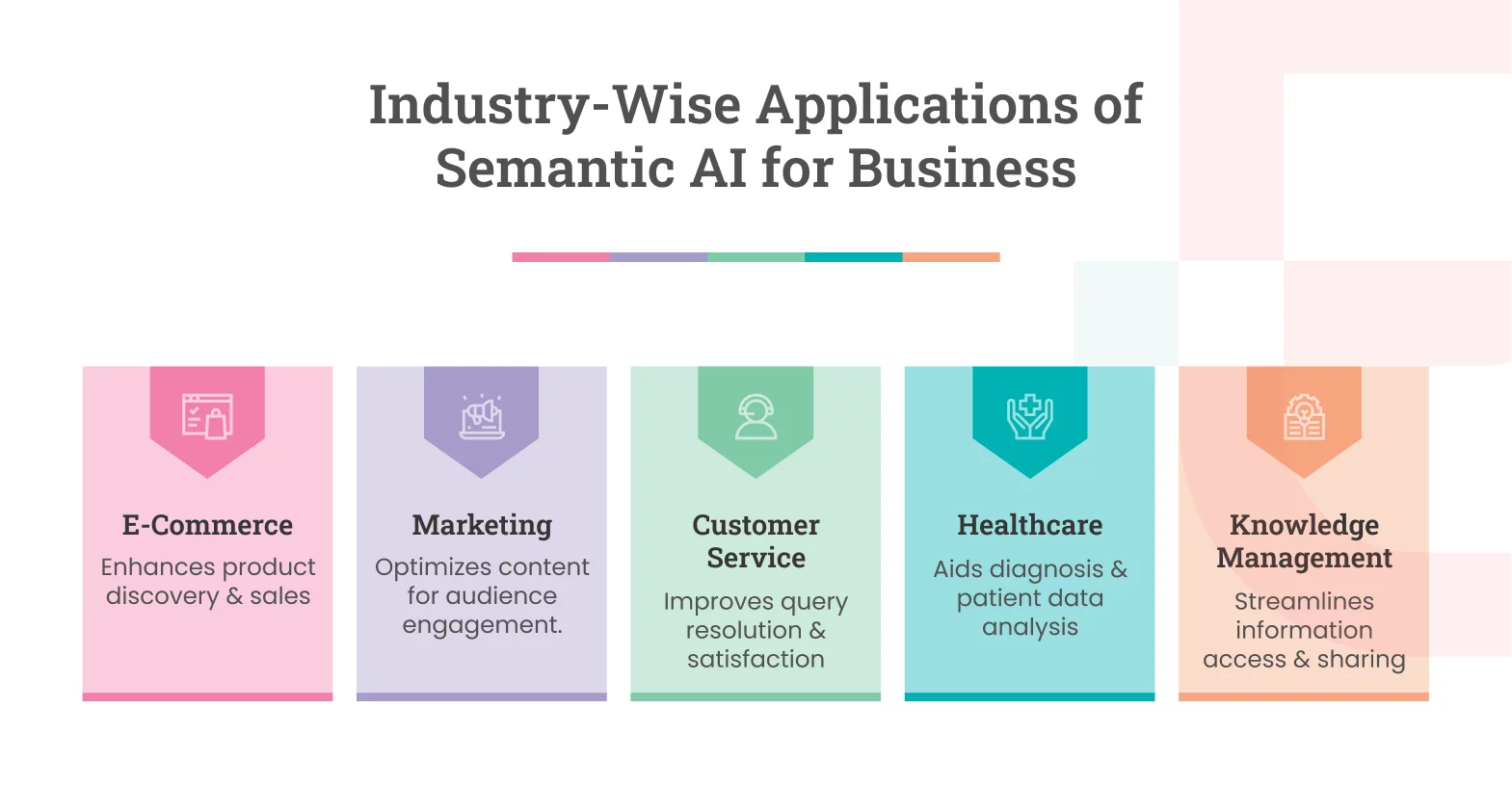
AI’s use is widespread, with 88% of organizations reporting it in at least one of their functions. Likewise, semantic AI is becoming increasingly prevalent across industries. Here are some key areas where this technology is already delivering significant returns on investment.
Semantic AI in E-commerce
In an increasingly competitive e-commerce landscape, finding the right product quickly has become crucial for customer satisfaction and instant conversion. Instead of offering product recommendations based only on exact tags, Semantic AI understands the context behind a search query.
For example, if a customer searches for a boho shirt, it won’t just return products with descriptions that include “boho.” Rather, it analyzes the visual and descriptive meaning of products associated with the boho style. This leads to far more accurate personalization and a substantial increase in order value.
Semantic AI in Marketing and Content Strategy
When semantic AI powers marketing, it allows marketers to truly understand the customer’s mindset, shifting from broad targeting to a laser-focused approach. It analyzes the language, tone, and interests expressed across customer data to build highly targeted audience segments.
The context-aware targeting enabled by semantic AI ensures your marketing campaigns are relevant, enhancing click-through rate and increasing return on investment.
Semantic AI in Customer Service
Semantic AI’s ability to understand intent is most helpful in customer interactions. When combined with AI chatbot development, this technology enables businesses to better understand customers’ concerns and desires.
NLP-empowered systems can quickly resolve queries with instructions or assistance, thereby enhancing customer satisfaction and retention.
Semantic AI in Healthcare
AI has been transforming the healthcare industry since its implementation. And semantic AI is proposed just to elevate it. Medical documents are complex and often messy. In healthcare, Semantic AI helps make sense of complex reports and deliver prompt results that save lives.
Semantic AI reads through jargon-filled medical records and research papers and interprets the meaning of clinical notes and symptoms, even if they are written by various doctors with different terminologies. This helps hospitals’ administrative AI agents grasp complex conditions and improve diagnostic accuracy.
Semantic AI for Enterprise Knowledge Management
For scaling your businesses with vast data, finding the right information at the right time across multiple departments, geographies, and systems can be a challenge. It connects information across separate groups, systems, or data repositories within an organization by creating a semantic layer.
Moreover, semantic systems can automatically classify and tag new documents based on their conceptual content rather than just keywords. This helps employees find information more intuitively, reduces hallucinations in generative AI, and makes AI-driven insights most trustworthy and actionable.
Transform Your Business Search Strategy. Let’s Connect and Create a Plan for Integrating Semantic AI for Business.
Semantic AI Implementation Strategies for Businesses
Implementing semantic AI for business requires a structured, phase-by-phase approach. It’s not a single software installation. It is a comprehensive process that focuses on transforming how your business manages and understands information.
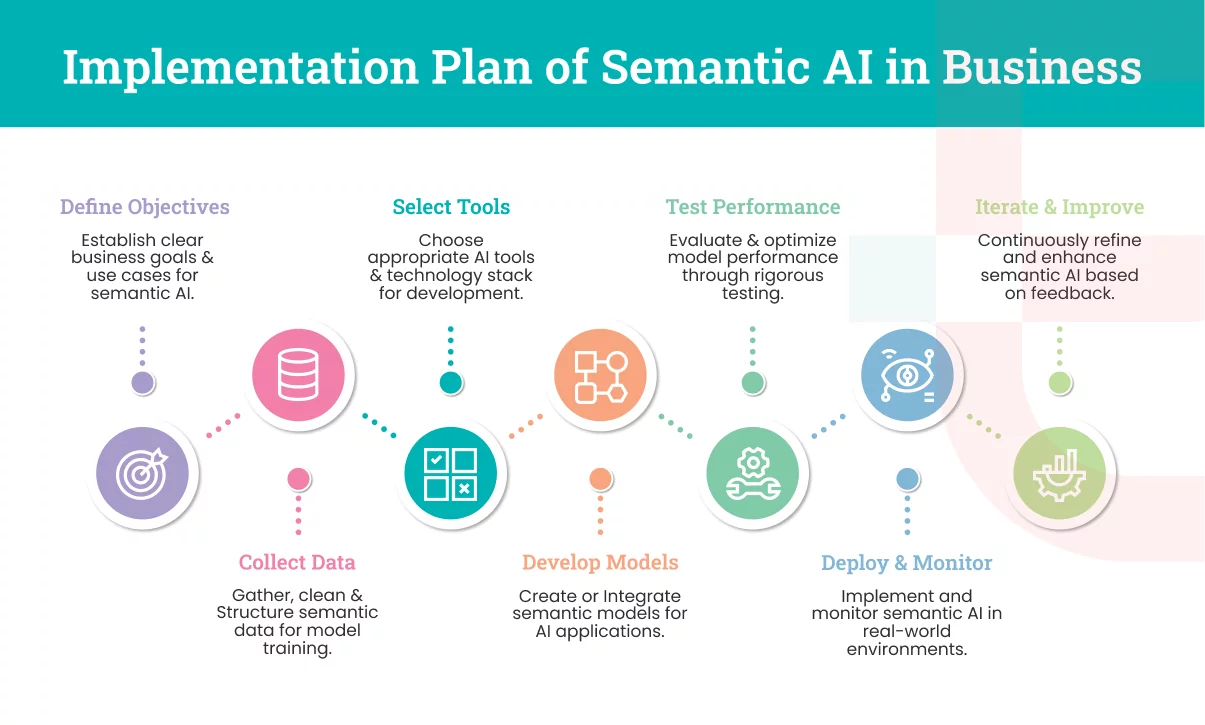
Here’s a complete installation roadmap that ensures a seamless implementation for continuous, long-term business benefits.
Step 1: Define Objectives and Key Use Cases
Before you start building the semantic model, identify high-impact areas where this technology can be leveraged to achieve maximum benefit. Your goal determines the necessary data and the type of semantic model you need to build.
Step 2: Collect, Clean, and Structure Semantic Data
Quality contextual data is paramount for achieving accurate results with semantic AI. Your technology partners will gather all relevant unstructured data (from email, customer reviews, documents) and structured data (from inventory databases). This data needs to be cleaned and organized to ensure AI learns correctly.
Step 3: Select the Right AI Tools & Technology Stack
This stage involves choosing the infrastructure. To implement semantic AI for a business search strategy, you need tools capable of generating and storing vector embeddings and supporting a robust knowledge graph. Depending on your budget and requirements, your partner offering AI software development services will select either open-source or specialized vendor tools.
Step 4: Develop or Integrate Semantic Models
This is the core building phase, where the AI development services provider uses machine learning models to train your cleaned data and generate a vector map. If pre-trained models are available, they will be integrated and fine-tuned with your proprietary business data to provide a customized solution.
Step 5: Test, Validate, and Optimize Model Performance
Before final deployment, the model’s accuracy is tested against the defined objectives to evaluate whether the semantic system accurately interprets complex queries. This phase is iterative, meaning the parameters are continuously adjusted until the model yields the desired result.
Step 6: Deploy and Monitor in Real-World Environments
Once validated, your developers begin deploying the semantic AI for your business. They not only integrate the system into an existing or newly developed solution but also establish clear metrics to continuously track performance.
Step 7: Continuously Iterate Based on Insights and Feedback
Semantic AI needs continuous updates based on real-world performance data to identify areas where the model is weak. Developers feed this new data back into the system to retrain and improve the model’s understanding, ensuring its long-term effectiveness.
Best Practices to Implement Semantic AI for Business Search Strategy
To ensure your semantic artificial intelligence system delivers maximum ROI, keep these strategic best practices in mind.
1. Keep Human Expertise in the Loop
Human subject-matter experts are needed to validate AI’s outputs and label initial training data. This ensures the model learns the complex nuances of your industry correctly.
2. Ensure Data Transparency & Ethical AI Usage
In an increasingly data security-conscious environment, businesses must be transparent about how they use their data. Implement audit trails and explainable AI tools to ensure your semantic system is fair and unbiased.
3. Continuously Train & Update Models
As languages evolve, products change, and customer behavior shifts, your semantic model must be updated regularly with new, relevant data. Model maintenance is an ongoing operational task, not just a one-time project.
4. Implement Robust Data Security & Compliance Measures
Since semantic artificial intelligence processes vast amounts of sensitive, unstructured data, implementing strong security measures is essential. Ensure all data storage, processing, and transfer methods comply with relevant data protection laws.
Looking to Implement Semantic AI in Your Business? Tell us Your Needs & we’ll Help You Design a Strategy that Delivers Measurable Impacts
Challenges and Solutions in Implementing Semantic AI Technology
Entrepreneurs may face some challenges while implementing semantic AI for business. Here’s a list of those challenges and solutions that can help you overcome them.
Challenge 1 - Data Quality and Model Training
Semantic AI models require vast amounts of high-quality, relevant data. Inadequate, unstructured, or biased data may lead to poor performance.
Solution:
To tackle this challenge, you must implement a data governance system with quality checks and enrichment tasks before using data for model training.
Challenge 2 - High Initial Implementation Costs
The initial investment in hardware, software, and specialized talent can be drastically high.
Solution:
Using scalable cloud infrastructure, open-source AI frameworks, and existing platforms can be an effective way to reduce costs and development time.
Challenge 3 - Technical Integration with Legacy Systems
Integrating Semantic AI in existing technological ecosystems is complex, especially when integrating AI into legacy systems or a varied technological stack.
Solution
This challenge can be effectively addressed by adopting API-first and modular integration strategies, and by carefully assessing and planning integration.
Challenge 4 - Lack of Skilled Talent and Domain Expertise
A shortage of skilled AI professionals, such as data scientists and machine learning engineers, is a major hurdle. This makes hiring in-house employees costly and time-consuming.
Solution:
Address his challenge by collaborating with a leading AI development company to hire an AI engineer who fills the skill gap.
Challenge 5 - Difficulty in Maintaining Transparency and Explainability
It can be difficult to understand how semantic AI models arrive at their decisions, raising concerns about transparency, bias, and responsible AI practices.
Solution:
You can tackle this challenge by incorporating ethical AI practices, using tools for bias detection, and developing more transparent models.
The Future of Semantic AI in Business Search
The future of semantic AI in business involves widespread adoption across industries, combining with more cutting-edge technologies to fuel business growth. Here are some future trends in the semantic AI sector you need to be aware of.
Rise of Multimodal AI (Text, Image, and Video Integration)
Multimodal AI is the foundational technology moving the future of semantic AI by enabling systems to integrate and interpret diverse data types (text, images, audio, and sensor data) to achieve a more context-aware understanding of the world.
Integration of Semantic AI with Generative AI Systems
The integration of semantic AI with generative AI creates contextually aware systems by combining generative capabilities with semantic understanding. This relationship significantly transforms the future of semantic AI, supporting more intuitive search.
Emergence of Hyper-Personalized and Context-Aware Search Experiences
As hyper-personalized, context-aware search experiences are emerging, companies are rapidly implementing semantic AI to inform their business search strategies. Enhancing accurate product access improves customer satisfaction, leading to higher sales.
Greater Focus on Ethical and Transparent AI Search Frameworks
Ethical and transparent AI search frameworks are key to a secure, sustainable future for semantic search systems. The companies that lead tomorrow will be the ones that use the power of semantic AI to find answers responsibly, ensuring ethical growth.
Expansion of Real-Time, Voice, and Conversational Search Capabilities
The widespread consumer adoption of smart speakers, voice assistants, and AI-powered customer service agents is not just a trend. It is a massive, real-world testing ground that forces continuous improvement in semantic AI.
How Elluminati Helps You Leverage the Power of Semantic AI
Semantic AI is a transformative technology that can elevate the customer experience with personalized, more context-aware outputs. By implementing semantic AI in your business, you can achieve higher customer satisfaction and more sales through rapid, accurate search results. Now that you understand everything about semantic AI, it’s time to put it into practice.
Elluminati, a leading provider of premier AI development services, can deliver well-trained, accurate, and high-performing semantic AI models for your new or existing systems. We house a team of experienced data scientists and ML engineers who provide their expertise and cutting-edge technology to transform your business’s search strategy.
FAQs
Semantic AI is a branch of artificial intelligence that allows machines to understand the meaning and context of human language. The major difference between semantic AI and traditional AI lies in their working, as the former focuses on the meaning and context of data, while the latter focuses on keywords.
Semantic AI uses technologies like NLP and ML to understand the meaning, context, and relationships in data, rather than just matching keywords.
Absolutely. Semantic AI can significantly improve SEO and content marketing performance by helping search engines better understand content’s context and user intent. This leads to higher rankings, more relevant traffic, and better user engagement.
Semantic AI is well-suited for both small businesses and large enterprises. Advancements in technology and the availability of affordable, cloud-based tools have made semantic AI accessible to companies of all sizes, enabling them to compete more effectively with larger organizations.