Key Takeaways (or TL;DR)
- Starting a limousine business online requires careful planning and consideration, such as market research, competitor analysis, business planning, and a strong marketing strategy.
- Different types of limo services, like corporate travel, airport transfers, events, and tourism, allow you to attract multiple customer segments.
- The total cost to start an online limousine business ranges from $30,000 to $350,000+, depending on factors like fleet size, app development, marketing, and legal licenses and permits.
- Running an online limousine business offers several key benefits, such as high market demand, steady revenue, and higher profitability.
- Partnering with Elluminati allows you to launch and scale your online luxury transport business efficiently and successfully.
Are you considering starting an online limousine business and tapping into the growing market of luxury transportation? The limousine taxi market is continuously gaining traction worldwide as a larger number of tourists, corporate clients, and event planners are opting for premium travel services.
While it sounds like a profitable venture, starting a chauffeur-based taxi business requires more than luxury vehicles. It requires strategic planning, understanding your target audience, ensuring legal compliance, and having an app that streamlines operations easily.
In this article, we will walk you through every step of how to start a limo business online, from market understanding and choosing service types to estimating the overall costs involved in the process. Besides, you will also get a key understanding of legal regulations and revenue models in this guide.
How to Start a Limo Business: Step-by-Step Process
Starting an online limo business requires an intense research and planning process. Here is a detailed guide on how to start a limousine business.
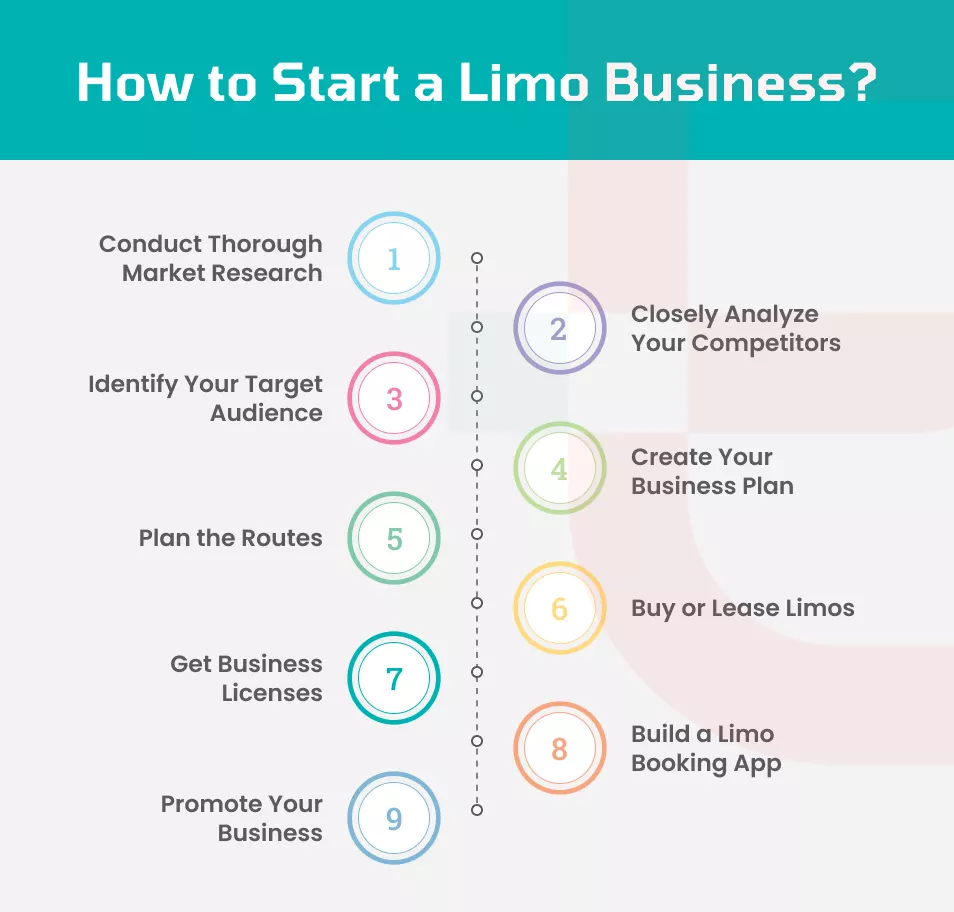
Step 1: Conduct Thorough Market Research
Before you start planning for capital investment, it is essential to have a complete understanding of how the industry works and where the real demand exists.
According to a recent survey by 360iResearch, the limo services market is anticipated to reach from $26.87 billion in 2026 to $41.33 billion by 2032 at a CAGR of 7.36%. This highlights the opportunities lying for businesses in the coming years.
Moreover, the success of any luxury transportation business also partly depends on the location in which it operates. For instance, urban and suburban areas have high demand as they have a larger number of airports, tourist spots, business hubs, and events. On the contrary, rural areas have limited or no demand due to low population density and lower income levels.
Performing thorough market research will help you identify the key opportunities lying for your business in the market.
Step 2: Closely Analyze Your Competitors
After understanding the market landscape, the next step involves analyzing your competitors. Ride-hailing giants like Uber (Uber Black), Lyft (Lyft Lux), Didi Chuxing, and Grab are the major players in the market right now. Moreover, there will also be local limo companies offering online services.
Have a close look at their fleet size, vehicle type, service quality, business models, app experience, and customer feedback. Competitor analysis will allow you to identify the gaps in their services and prepare a winning strategy to ace them.
Step 3: Identify Your Target Audience
Not everyone prefers using luxury taxis. And so it becomes essential to identify your targeted audience. Your audience will mainly include daily commuters, corporate clients, government officials, business professionals, celebrities, event planners, and tourists.
Corporate clients will use limos mainly for business travel, while event planners will require them for VIP guests. And tourists will opt for the service for a luxurious travel experience, and hotels will require reliable transport for their guests.
Defining the target audience early allows you to design pricing and marketing strategies effectively.
Step 4: Create Your Business Plan
A business plan will typically be a digital roadmap that defines how your limousine business will operate, generate revenue, and scale later. Most businesses often overlook the importance of creating a business plan, which later leads to poor financial decisions.
Your plan to start an online limo business should mainly include:
- The type of services you would offer through your digital platform, such as corporate rides, airport transfers, events, and hourly rentals.
- Driver onboarding and management
- Pricing strategy that you would follow (fixed rates, hourly, or distance-based)
- Revenue model (Direct bookings, subscriptions, or commissions)
- Overall cost to start the business, including expenses related to fleet, app development, insurance, operating costs, and marketing
- Digital marketing strategies (SEO, ads, social media marketing, partnerships, or referrals)
This will allow you to plan your financial expenses strategically and avoid unnecessary costs while ensuring sustainable growth for your business.
Step 5: Plan the Routes
Route planning is about strategically deciding the areas where your limos would operate and how drivers would reach customers without wasting time. Start by listing all the popular areas of your city, like airports, corporate offices, luxury hotels, event venues, and tourist spots, where people are more likely to need premium transportation.
This allows you to position your taxi fleet near high-demand locations from day one. As a result, drivers reach customers faster, ensuring smooth and efficient operations.
Step 6: Buy or Lease Limos
To start an online limo business, you will need a fleet on hand. For this, you can either buy your own limousines or lease them based on your budget. Purchasing your own vehicle fleet will require significant investment, which proves to be costly when you are a startup.
That’s why it would be better to lease the vehicles initially. Then you can have your own fleet once your business starts scaling.
Step 7: Acquire Business Licenses and Permits
Before you start operating, it is essential for the business to be legally compliant. This involves business registration, acquiring commercial vehicle permits, driver’s licenses, and having proper insurance coverage.
Legal compliance saves you from fines or shutdowns, and it makes your business trustworthy for customers.
Step 8: Build an On-Demand Limousine Service Booking App
Since you want to launch your online business, having a booking app is one of the key necessities. An on-demand limo software will allow customers to book rides, track vehicles, and make secure payments. For businesses, it will streamline operations by assigning drivers, monitoring the fleet, and providing insights about customer preferences.
However, developing a mobile app is not easy. It is a time-consuming process that requires proper planning and execution. Partnering with an experienced taxi app development company will help you build high-performing apps and attract loyal customers with ease.
Step 9: Make Effective Promotional Strategies
Do you know that 14% of startups fail because of poor marketing strategies? So you can imagine how important it is for your business to follow the right tactic. In today’s digital-first landscape, focus strongly on digital marketing through SEO, social media marketing, and online listings.
Further, partnering with local luxurious hotels, wedding venues, and event planners helps enhance your brand visibility. Also, referral programs allow satisfied customers to bring new clients in exchange for discounts and rewards. A strong marketing strategy will allow your on-demand business to grow effectively.
Expert Tips:
- Dynamic pricing helps you boost revenue by 20-30% during peak hours.
- Having just 5-10 corporate clients for your limousine business can generate around 40-60% of monthly revenue.
- Leasing luxury vehicles in the first year reduces capital risk by 30-40%.
- Smart route optimization minimizes the chances of empty trips, improving Revenue Per Mile (RPM) by 10-20%
Launch your Online Limousine Business with Elluminati’s Booking Software Built for Smooth Operations and a Faster Launch.
Why Start a Limo Business Online?
While considering starting a luxury transport ride-hailing business, you might at first wonder, “Why start a limo business online?” Here are the numerous benefits that an online limousine business holds for you.
Growing Market Demand
With the rise in corporate travel, tourism, and special events across the world, the demand for premium transportation continues to grow. This creates a strong growth opportunity for businesses considering starting limousine services.
Steady Revenue
Luxury transport business serves diverse customer segments like corporate clients, airport travellers, event planners, and tourists. This diversity allows you to generate steady revenue throughout the year.
High-Value Service
Unlike standard ride-sharing or taxi services, limousine services are focused on providing luxurious comfort and reliability. Customers are ready to pay more for professional chauffeurs and luxury vehicles. This gives you the advantage to charge premium rates and also build a strong brand reputation with quality service.
Higher Profit Gains
Since limousine services are meant for premium customer segments (who are willing to pay extra for luxurious travel), each booking can generate more revenue for you compared to standard taxi booking rides. This ultimately leads to higher profit margins when combined with multiple revenue models.
Types of Limousine Services You Can Offer
Before starting your chauffeur-based taxi business, it’s important to decide which type of services you want to offer. This will allow you to determine the type of fleet you will need and also the regions to operate in. Here is the breakdown of types of limousine services.
Corporate and Executive Travel
This kind of service is mainly opted for by business professionals for corporate events, client meetings, and office travel. These customers usually prefer having luxury sedans or premium SUVs for luxury travel.
Airport Transfers
These are the most in-demand services for luxury transport businesses. Customers book this service when they want grand and comfortable airport pickups and drop-offs. Moreover, most customers also prefer limos to navigate the traffic congestion in airports peacefully. Luxury sedans and SUVs are widely used for airport transfers.
Special Events
This service type includes weddings, award shows, and any private function. Customers prefer travelling in stylish and luxurious vehicles for special events, due to which they choose luxury sedans, stretch limousines, and SUVs.
Group & Party Transportation
In cities with nightlife, group and party transportation becomes a suitable solution for people travelling in groups for parties, concerts, or celebrations. Stretch limousines, luxury buses, and executive vans allow people to travel together and also generate higher revenue per trip.
Point-to-Point Transfers
These are usually one-way trips between two locations, for instance, from home to office or from hotel to event venue. Sedans and compact SUVs are most commonly booked limos for this service.
Tourism
This service fits tourist destinations where travellers book limousines for sightseeing or city tours. SUVs and executive vans are largely preferred as they provide more space and comfort for longer journeys.
Here is a visual representation in the form of a table to tell you which type of service suits which kind of regions.
|
Type of Limousine Service |
Customers |
Common Vehicle Types |
Regions You Can Target |
|
Corporate and Executive Travel |
Business professionals, executives, and corporate clients |
Luxury sedans, premium SUVs |
Business hubs, financial districts, metro cities |
|
Airport Transfers |
Frequent travelers, tourists, and corporate clients |
Luxury sedans, SUVs |
Cities with international or domestic airports |
|
Special Events |
Wedding clients, VIP guests, celebrities |
Stretch limos, luxury sedans, SUVs |
Urban areas, wedding destinations, event cities |
|
Group & Party Transportation |
Party groups, concert-goers, and nightlife crowd |
Stretch limos, executive vans, luxury buses |
Nightlife cities and entertainment zones |
|
Point-to-Point Transfers |
Local commuters and hotel guests |
Sedans, compact SUVs |
Urban and suburban areas |
|
Tourism |
Tourists and travel groups |
SUVs, executive vans |
Tourist destinations and holiday sites |
Revenue Channels for Your Online Limousine Business
Running a profitable limo business requires more than just ride bookings. It needs smart revenue strategies that help you earn from multiple sources. Below are the most widely used revenue channels.
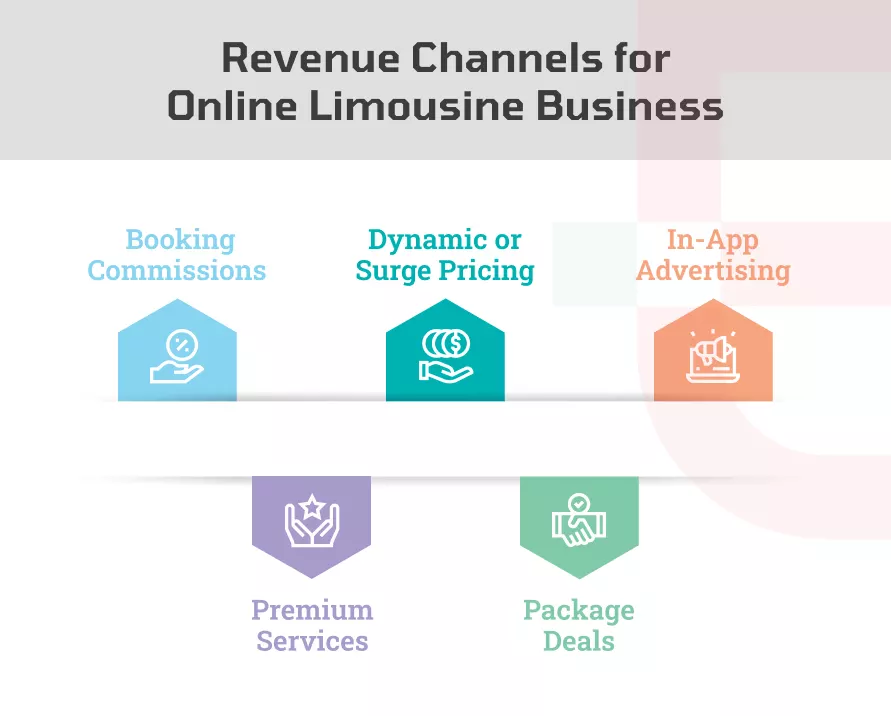
Booking Commissions
This is one of the most common revenue models. Every time a rider books a limo ride from your app, you earn a commission from that booking. Commission can be either a fixed amount or a percentage of the total ride fare.
Premium Services
Many customers want to have a more comfortable, personalized, and premium travel experience than simply having a basic limo service. And for this, they are ready to pay an extra amount.
You can take advantage of this and increase the average value of such bookings by offering luxury vehicles, professional chauffeur services, and value-added amenities like dedicated wifi, bottled water, snacks, or special decorations for events.
Dynamic or Surge Pricing
Demand for chauffeur-based rides is not always the same. In such scenarios, it is always profitable to price your services according to the demand rather than operating with fixed pricing.
For instance, during peak hours, you can slightly increase the fares. And when the demand is low, you can offer your services at competitive prices to keep bookings consistent.
Package Deals
Some customers, like corporate clients and frequent travellers, need limousines on a regular basis instead of one-time rides. By offering package deals, you can easily secure such repeat bookings and generate a predictable and steady income for your business.
In-App Advertising
As your apps start having more users, it becomes a valuable space for luxury brands, hotels, and event organizers to promote their services. This becomes a win-win situation for your business and such third-party brands. By providing them with an ad space in your app, you can generate an additional source of income.
How Much Does it Cost to Start an Online Limousine Business?
The overall cost to start an online limousine business ranges from $50,000 to $350,000+, depending on different factors like vehicles, insurance, permits, app development, marketing, and office setup. Here is the complete cost breakdown.
|
Factor |
What It Includes |
Estimated Cost |
Cost Depends On |
|
Vehicles |
Buying or leasing luxury cars such as sedans, SUVs, or stretch limos for customer rides. |
Used vehicles: $30,000 – $100,000 per vehicle New vehicles: $150,000+ per vehicle Leasing: $1,000 – $3,000/month per vehicle |
Type of vehicle, new or used condition, number of vehicles, buying vs leasing |
|
Commercial Insurance |
Insurance to cover passengers and vehicles in case of accidents or damage during trips. |
Passenger liability: $2,000 – $4,000+/year Vehicle insurance: $5,000 – $10,000+/year per vehicle |
Number of vehicles, coverage level, driving history, and local rules |
|
Licensing & Permits |
Business registration, chauffeur licenses, and transport permits are required to operate the business legally. |
$500 – $3,000+ |
Local laws, number of drivers, business structure |
|
Marketing & Branding |
Creating websites and apps, Google business profile, social media pages, online ads, SEO, and local promotions. |
$1,000 – $5,000 (initial) |
Marketing channels used, competition, and target audience |
|
Booking App Development |
Features like ride scheduling, vehicle selection, fare estimate, airport pickup details, chauffeur contact, and online payments, AI-based demand prediction, multilingual support, and an advanced taxation system |
Basic app: $15,000 – $80,000 Advanced app: $150,000 – $300,000+ |
Number of features, platform type (Android or iOS), design complexity, and development timeline |
|
Office Setup & Operations |
Office space, computers, internet, phone systems, staff salaries, utilities, and daily business tools. |
Office rent: $2,000 – $5,000 Total setup & operations: $15,000+ |
Office location, team size, and utilities |
Simplify Operations and Enhance Customer Experience with Elluminati’s Limo App Development Services.
Legal Regulations to Start an On-Demand Limo Business
Legal compliance is mandatory to prevent financial penalties and operate as a trustworthy brand. While legal requirements vary by country and city, we have listed here the most common ones.
Federal Compliance for Interstate Operations
If you desire to operate your luxury transport business across different states or regions, you will need to acquire certain national-level approvals, such as:
- USDOT (United States Department of Transportation) Number: To link your business with the national transport system of the desired country. It is essential for vehicles running across multiple states and exceeding a specific weight limit.
- MC (Motor Carrier) Number: To get approved by the government to charge passengers for interstate travel. Without it, your limousine services would be limited to local boundaries.
State Licenses and Permits to Operate Locally
You will need to acquire basic approvals to run your business within the desired state or city.
- General Business License: A standard permit to register your business with local authorities
- State For-Hire Permit: Issued by your state’s Department of Transportation or Public Utilities Commission to confirm that your limo fleet is approved for commercial use.
- Airport Permits: To allow your limos to pick up and drop off passengers at commercial airports.
Vehicle Registration and Insurance
These approvals are meant to ensure that your limo fleet is legally registered for commercial purposes and also that it is properly insured.
- Livery Registration & Plates: Specialized commercial plates to differentiate your vehicles from private vehicles.
- Commercial Livery Insurance: To protect your business, drivers, and passengers from damages incurred in accidents during rides.
Driver Approvals and Licenses
Your drivers must comply with professional standards to run a limousine.
- Chauffeur’s Licenses: Legally authorize your drivers to operate paid passenger vehicles.
- Commercial Driver’s License (CDL): Mandatory for drivers operating heavy vehicles or carrying many passengers in limousines.
- Municipal Chauffeur Permit: To ensure that all your drivers have undergone background checks and safety verifications legally.
Challenges You Face While Running a Limo Business
While a chauffeur-based ride-hailing business involves a large number of benefits, it also involves numerous challenges. Here are the common set of challenges you would encounter while starting and running the business.
Higher Operational Costs
The limousine business involves several continuous expenses. Premium vehicle acquisition, timely maintenance, insurance renewals, app maintenance, and compliance with safety standards significantly increase the costs compared to any standard ride-hailing solutions.
Growing Competition
With the growing demand for luxury travel, the limousine market is getting crowded with traditional limo services, luxury taxi providers, and ride-hailing platforms. As per the recent survey by Congruence Market Insights, North America alone has around 14,500 registered limo operators, highlighting intense competition in the market.
Complex Regulatory Landscape
Legal rules and regulations related to business licensing, permits, and insurance vary by state and city, which can become complex to manage for businesses considering operating in multiple states or cities.
Chauffeur Retention and Management
Retaining professional chauffeurs is more challenging than finding and hiring them. High turnover rate often impacts the service quality, ultimately affecting the overall business.
Fulfilling Customer Expectations
Today’s customers expect more than just luxury travel. They expect premium services and instant support from businesses. Failing to fulfill customer expectations can easily make them move towards your competitors.
How Elluminati Can Help to Start Your Limo Business Online?
While planning to start a limo business online, most businesses focus more on visible parts like having luxury vehicles, professional chauffeurs, and pricing. However, long-term success depends on how well your business operates in the background, that is, how bookings are handled, how easily customers can book your services, and how chauffeurs are managed.
This is where Elluminati comes in. With 14+ years of expertise, Elluminati has helped numerous businesses to launch and grow their limo services online. Our limousine booking software allows you to run your business in an organized and efficient way with features like advanced analytics, support for multiple countries and languages, AI-based demand prediction, and an advanced taxation system.
Contact us now to make your journey in the online limousine market easy, profitable, and scalable.
FAQS
Limousine services usually target the premium customer segment who are ready to pay a large amount for luxury travel. This significantly increases the profit margin per ride compared to standard taxi rides.
The overall cost to start an online limousine business ranges between $30,000 and $350,000, depending on different factors like vehicle fleet, app development, legal licenses, marketing, and office setup costs.
Usually, licenses and permits for chauffeur-based service businesses vary by country. But the most common types of licenses needed are Federal permits for interstate operations, State business licenses for local operations, vehicle registration and insurance, and chauffeur licenses for drivers.
The most common types of limousine services include corporate travel, airport transfers, events, parties, and sightseeing.
Yes, a limousine booking app allows you to streamline daily work operations like booking handling, driver management, and payments, ensuring efficient operations.