Key Takeaways (or TL;DR)
- Understand the role of AI in self-driving cars to detect objects, map roads, add conversational interaction, and more.
- Learn how AI powers self-driving cars through sensors, data fusion, and computer vision.
- Dive into the business opportunities AI holds for entrepreneurs in the autonomous vehicle industry.
- Understand the challenges involved and the benefits of overcoming them with the right solutions.
- Know the future of AI in automotive and how to act early to benefit from the opportunities involved in using AI for self-driving cars.
The role of AI in self-driving cars has transformed lately. It is no longer limited to small automations. AI is enabling vehicles to sense, think, and respond on the road, just like humans. There is a goldmine of opportunities for entrepreneurs looking to leverage autonomous vehicles. However, it also requires overcoming development hurdles, cost overruns, and deployment delays.
Understanding the Role of AI in Self-Driving Cars
AI is the brain of every autonomous vehicle. Let’s understand how AI allows self-driving cars to run smoothly without human assistance.
Object Detection and Pedestrian Recognition
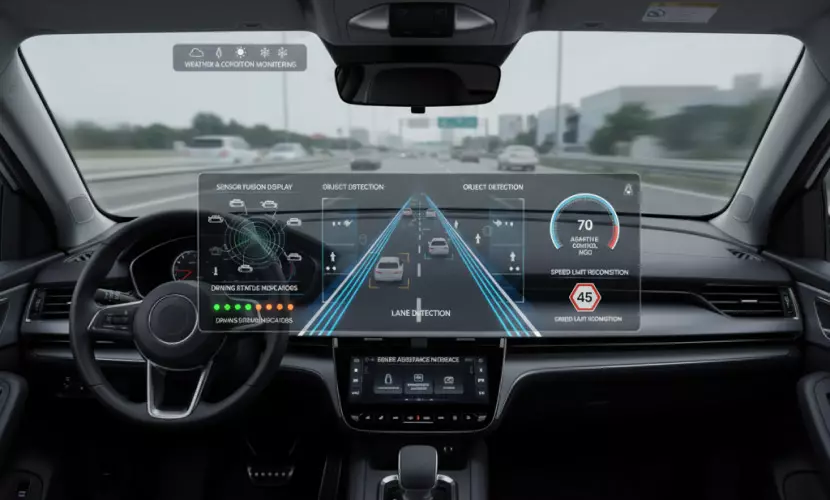
One of the biggest challenges for self-driving cars is accurately identifying everything around an unpredictable roadway. AI tries to understand objects around the road by combining data from camera feeds, LiDAR data, and radar signals. Even in crowded or low-visibility environments, it can detect pedestrians, animals, or other objects with high accuracy.
Road Mapping and Navigation
Static maps cannot capture dynamic road conditions, like overnight road repairs or temporary diversions. AI-powered self-driving cars overcome this by using simultaneous
localization and mapping (SLAM) algorithms. These technologies constantly update a car’s internal map by real-time analysis of the environment to help with correct reorientation.
Predictive Analytics for Accident Prevention
Predictive analytics anticipate risky situations on the road before they happen. This feature is highly useful in preventing accidents. For instance, if a nearby car suddenly changes lanes, AI can pivot or apply brakes faster than humans. This ensures passenger safety in high-traffic environments.
Voice Recognition and Driver Interaction
For many years, engineers have struggled to make autonomous vehicles interpret and respond to human instructions in real time. With AI in self-driving cars, conversational interaction has become a reality.
AI-powered voice recognition systems are smartly using natural language processing (NLP) to instantly understand speech patterns. As a result, users can enjoy a hands-free driving experience.
Decision-making Under Uncertain Environments
Sometimes, a self-driving car must make safe decisions when information is incomplete. It usually happens when sensors receive noisy data or human drivers act unpredictably. AI addresses this using probabilistic models, reinforcement learning, and real-time sensor fusion.
These systems weigh multiple uncertain inputs and choose the safest possible action. For instance, the car continues to offer smooth manoeuvring even if there is a partially blocked road sign.
As you can see, AI does not work alone. It works along with other technologies to add true autonomous power to self-driving cars. Let’s briefly understand them in the next section.
Core Technologies: How AI Powers Self-Driving Cars
AI takes help from the following technologies to collect and process raw data into safe driving insights.
Sensors
A self-driving car depends on a lot of sensors, such as:
- LiDAR: to create a 3D map of the surroundings
- Radar to measure speed and distance
- Cameras capture color, objects, and lane markings
- Ultrasonic sensors to detect nearby obstacles
Sometimes, these sensors may read the wrong data. For example, cameras may struggle in the dark, or radars may misinterpret small objects.
AI solves this by processing continuous streams of sensor data in real time. This reduces dependency on any single sensor’s limitations.
Data Fusion & Computer Vision
Self-driving cars are powered by a lot of sensors. However, the real challenge is bringing all those fragmented data points together into one coherent view.
AI handles this through sensor fusion. It is a process where algorithms merge data from all sensors to produce a unified dataset.
Once the data fusion is complete, computer vision interprets visual cues, such as:
- Road signs
- Nearby vehicles
- Traffic light states
The combination of fusion and vision produces a more accurate and stable perception of the environment.
Decision Making & Path Planning
There are countless micro-decisions involved when driving on a busy road. Humans rely on instinct and experience. However, autonomous vehicles must calculate every move with precision.
AI handles this by using advanced path planning algorithms. These models are best at evaluating thousands of possible trajectories in milliseconds to suggest the most efficient and secure path.
Layered on top is decision-making logic. It is powered by AI reasoning systems that assess risks and priorities. For example, these systems minimize sudden braking or uncomfortable maneuvers.
Learning & Adaptation
A self-driving car cannot rely solely on pre-programmed rules. It must continue learning long after it rolls out of the factory.
Autonomous vehicles can self-improve over time with:
- Supervised learning: improves the ability to recognize new objects or unfamiliar road patterns over time
- Unsupervised learning: makes the system better at spotting unusual scenarios, like new terrains or driving cultures
- Reinforcement learning: simulates millions of driving situations to improve decision-making by trial and reward
This improves the long-term accuracy and reliability of AI in self-driving cars.
Business Opportunities From Autonomous Vehicles
Gradually, AI is becoming a necessary element of autonomous driving. Entrepreneurs can use this opportunity to tap into the following business domains for sustainable growth:
Driver Assistance
AI-powered driver assistance features are becoming standard in modern cars. Businesses can tap into this market by offering
- Basic safety add-ons that help vehicles avoid collisions, stay within lanes, and detect nearby obstacles.
- Setup and installation services for dealerships and fleet operators who want to upgrade older vehicles.
- Ongoing calibration and updates to keep these systems accurate and reliable over time.
Autonomous Vehicles
Entrepreneurs in the autonomous vehicle industry can focus on:
- Developing systems that allow vehicles to clearly understand their surroundings in real time
- Virtual simulations that help test self-driving capabilities under different traffic situations.
- Software layers that support autonomous movement in delivery vans, shuttles, or commercial fleets
Driver Monitoring
There is also a huge scope in monitoring driver behavior, with business opportunities for
- Creating AI-based cabin monitoring solutions to alert drivers when they are under stress or fatigue.
- Offering emotional analysis and eye-tracking models that improve in-car safety and comfort
- Providing compliance dashboards to meet compliance requirements and changing regulations.
Personal Assistant
Voice-enabled driving support is now a common expectation in modern cars. Current innovations include:
- Intelligent voice features for navigation, calling, and entertainment.
- AI assistant systems that allow brands to offer unique in-car experiences.
- Personalized cabin adjustments based on individual preferences and usage habits.
Passenger Experience
Passenger comfort is becoming a major factor. There is a bright scope for businesses to:
- Offer immersive infotainment and gaming services for robotaxi passengers.
- Run personalized ads, content, or in-car services for additional revenue
Automotive Insurance
AI is reshaping how insurers assess risk and process claims. Businesses in the same industry can:
- Build systems that track driving style to help insurers offer fair pricing.
- Offer tools that instantly assess vehicle damage after an accident using photos.
- Provide fraud detection and risk analysis services for insurers.
Quality Control
Manufacturers are using AI to improve overall production quality. It shows that there is going to be a huge demand for:
- AI tools that check for defects on factory lines automatically.
- Inspection services for carmakers who want reliable quality checks.
- Reporting dashboards that show where defects happen most often.
Connected Cars
Vehicles are increasingly becoming connected devices. Emerging applications include:
- Building platforms that help cars share useful information with roads, traffic lights, and other vehicles.
- Offering security services that protect cars from digital threats, such as vehicle hacking, remote hijacking, data breaches, GPS spoofing, etc.
- Providing tools that send car health alerts to owners or service centers.
Collaborate with Elluminati to become a Mobility Leader and Automate Up To 50% Of Your Tasks and Boost Your Business Efficiency.
Benefits of AI in Self-Driving Cars
Let’s take a look at some major benefits of using AI in self-driving cars that go beyond convenience.
Safety Improvements
Humans are prone to distraction, fatigue, and delayed reactions. AI is consistent and reacts within milliseconds. This is a great opportunity to reduce road accidents.
Efficiency
Inconsistent human behavior can lead to sudden braking or aggressive acceleration. However, AI accelerates smoothly and maintains optimal speed. This reduces fuel/battery usage and operational costs.
Accessibility
People with mobility challenges face barriers to independent travel. AI gives them a newfound freedom. They are no longer required to depend on caregivers or public transport for travelling.
New Revenue Streams
Since the vehicle can operate without a human driver, there is potential for new business opportunities, like:
- Autonomous fleets for ride-sharing
- Last-mile delivery and logistics
- On-demand mobility services
- Autonomous taxi services
Businesses can also monetize vehicle data to support city planners, insurance companies, and transport networks.
Environmental Gains
By avoiding harsh braking, AI reduces fuel consumption. It results in lower carbon emissions and cleaner urban air.
AI also holds the power to optimize driving patterns to conserve power in electric vehicles. It can
- Choose the most energy-efficient routes
- Maintain steady speeds
- Monitor battery health to reduce charging costs
On a larger scale, fleets of autonomous EVs can coordinate charging schedules to reduce grid stress. That’s how AI can support sustainable transportation ecosystems.
Challenges of Implementing AI in Self-Driving Cars

While AI helps self-driving cars move to new levels of sophistication, it also comes with some technical, legal, and ethical challenges.
Challenge 1: Technical Challenges
Ideally, AI is expected to manage data from multiple sensors in real time. Any delay or misinterpretation can compromise the vehicle’s reaction time. Additionally, hardware has to be reliable, and sensors should be well-calibrated to maintain consistent performance under any environment.
Solution:
- Build sensor redundancy so multiple sensors validate each other’s data
- Use advanced simulation environments to test rare and extreme scenarios
- Improve hardware computation for faster data processing with lower latency
- Continuously update AI models with fresh, diverse, real-world driving data
Challenge 2: Regulatory & Legal Issues
When an autonomous vehicle makes a decision that leads to an accident, it’s a challenge to determine the entity responsible for that event. Should it be the manufacturer, the software provider, or the passenger?
This necessitates the need for consistent standards for testing, data privacy, cybersecurity, and ethical deployment. Otherwise, customers will lose trust in AI-powered vehicles.
Solution:
- Governments should create standard safety standards for testing and certification
- There should be clear frameworks for liability and accident responsibility
- Implement strong cybersecurity and data-protection regulations
Challenge 3: Data & Ethics
As per research by KPMG, 84% say cybersecurity risk is their top concern with AI. Autonomous vehicles generate different types of user data. It can be video footage of the passenger, location tracks, and behavioral patterns of the driver. In the absence of an ethical boundary, there is a chance of misuse of personal data.
Solution:
- Create ethical decision-making frameworks aligned with global standards
- Define transparent guidelines on what data can be stored or shared
- Implement strict data anonymization and encryption practices
Challenge 4: Infrastructure & Ecosystem Readiness
AI needs the right supporting infrastructure to aid smart cars. Underdeveloped cities lack well-marked lanes, updated traffic signs, and smart traffic lights. Even poor network coverage can reduce the accuracy of autonomous navigation.
Solution:
- Upgrade road infrastructure with clear markings and digital-friendly signage
- Develop V2I (Vehicle-to-Infrastructure) and V2V (vehicle-to-vehicle) communication systems
- Expand charging networks to support autonomous electric fleets
Challenge 5: Costs
Autonomous vehicles are dependent on high-end sensors, powerful onboard computers, and large-scale virtual simulations. These factors increase the development as well as maintenance costs. For the same reason, its adoption is still limited to elite users.
Solution:
- Cost-efficient sensors and mass-production techniques can lower the production cost
- Shared autonomous fleet models can reduce individual ownership costs
- Cloud infrastructure can lower operational expenses
- The government should provide incentives and R&D grants for innovation
Future of AI in Self-Driving Cars
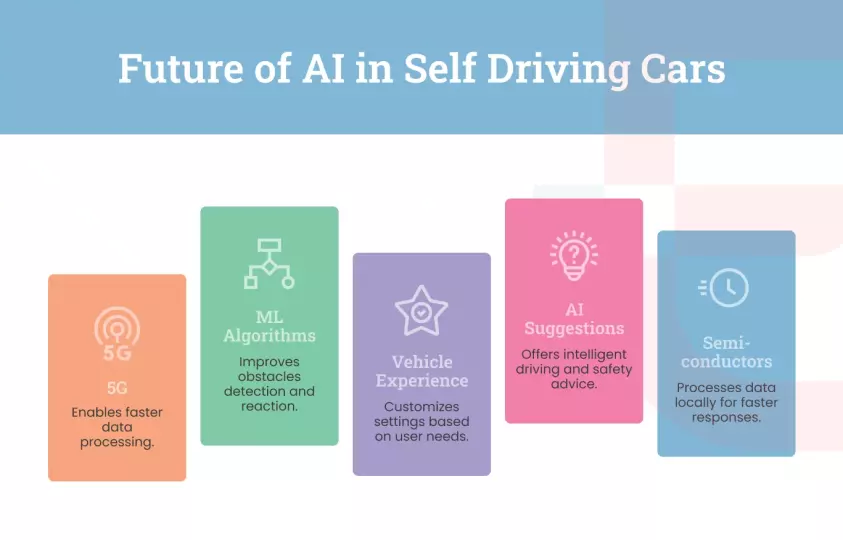
Let’s see how the next generation of cars will be smarter with the active use of AI in the automotive industry.
Enhancing Connectivity with 5G
- Ultra-fast data exchange with 5G will help AI process sensor data, map updates, and traffic information much faster.
- Vehicle-to-everything (V2X) communication will be faster for better traffic flow and to avoid hazards.
- Faster data exchange will also aid in fleet management, remote monitoring, and cloud-based AI services.
Improving Safety with ML Algorithms
- Advanced ML algorithms will enable smart cars to identify and react to obstacles faster.
- High detection accuracy will reduce false-negative/positive signals that lead to inappropriate braking or evasive maneuvers.
- Vehicles will learn from past data to make logical decisions over time for passenger safety.
Increasing Personalization in the Vehicle Experience
In the future, AI will be able to
- Adjust cabin temperature based on custom requirements
- Switch driving modes depending on the user’s stress or fatigue levels
- Customize infotainment, navigation suggestions, and even lighting preferences
- Learn daily routes and proactively suggest better alternatives
Transcending Limitations with AI Suggestions
- AI will act as a co-pilot to offer intelligent suggestions on how to conserve battery or adjust speed on a busy street.
- Through context-aware alerts, AI will be able to highlight blind spots and slippery patches even before sensors flag them.
- Based on the driver’s fatigue level, AI will be able to recommend rest stops until the biometric data returns to normal.
Elevating Support with Semiconductors and OEM-based AI Chips
- Advanced AI chips will process sensor data directly in the car to reduce dependency on the cloud for faster responses.
- Specialized chips reduce the power required for heavy computational work so that advanced features will be available in entry-level models.
- OEMs can customize chips for their own driving stacks for faster updates.
Why is Elluminati the Right Partner for an Autonomous Mobility Solution?
AI in self-driving cars is driving a future where transportation becomes safer, more connected, and incredibly efficient. With rapid advances in sensors, chips, algorithms, and connectivity, the space is wide open for innovation.
If you’re an entrepreneur exploring opportunities in AI for self-driving cars, now is the time to partner with Elluminati. We are a trusted agency offering AI development services to bring your ideas to life.
Our list of services includes but is not limited to AI consultation, AI app development, AI software development, natural language processing, and AI chatbot development. We can also help you create AI agents and add machine learning intelligence to them that minimizes human interventions in autonomous vehicles.
For more than a decade, we have been empowering industries across all verticals to scale up with AI. From AI-based education solutions to logistic app development, we have been helping businesses reduce their overall operational expenses.
FAQs
The cost of Integrating AI in self-driving can range from USD 5 million to USD 20 million. The cost varies depending on sensor quality, computing hardware, simulation requirements, and testing environments. It can further increase if custom datasets, proprietary AI models, or large-scale autonomous fleets are considered for the project.
It takes 18-36 months to fully develop and deploy AI in autonomous vehicles. The process includes model training, simulation, road testing, safety validation, regulatory approvals, hardware integration, and many more processes.
Startups prefer to go with low-key services like autonomous mobility-as-a-service, licensing AI driving stacks to automakers, or offering sensor or perception modules. Managing autonomous delivery fleets or providing simulation or data-intelligence platforms for OEMs are also considered high-profit, low-investment options.
AI can continuously monitor the vehicle’s surroundings through sensors and computer vision and react faster than human drivers. It can also predict potential risks, such as sudden lane changes or collisions, and take preventive action like braking or steering away, for passenger safety.