Key Takeaways (or TL;DR):
- AI transforms risk management from reactive to predictive, allowing enterprises to identify, analyze, and mitigate threats in real time—far faster and more accurately than traditional manual methods.
- AI strengthens fraud detection, cybersecurity, financial assessment, and supply chain resilience by spotting anomalies, patterns, and potential failures that humans often miss.
- AI improves decision-making and reduces financial losses by providing instant insights, automating monitoring, and alerting teams before a risk becomes a costly problem.
- Adopting AI comes with challenges—data quality, high costs, skill gaps, and ethical concerns—but each can be resolved with governance frameworks, scalable tools, training, and secure integration processes.
- The future of risk management will rely on technologies like Explainable AI and AI + Blockchain, enabling transparent, auditable, and tamper-proof risk models for safer, more trustworthy enterprise operations.
For modern enterprises, risks are becoming common. A critical financial fraud or nasty cyberattack can lead to complete operational failure. The scope of traditional risk management methods is limited. But AI in risk management is becoming the next wave of change.
As AI scans data and creates insights in real time, teams get sufficient time to battle the odds. However, achieving this speed and accuracy in decision-making with AI comes with its signature challenges. Let’s understand how to use AI in the most efficient way for risk mitigation.
What is AI in Risk Management?
AI in risk management is a process that uses artificial intelligence systems to identify, assess, monitor, and prevent risks in a responsible and ethical manner. Here, AI is utilized with other technologies like machine learning and predictive analytics to identify risks more accurately than traditional methods.
AI can skim through long, deep historical spreadsheets in real time. Most importantly, it can analyze data faster than humans. That’s why it’s been widely leveraged by different industries.
The adoption of AI in risk management across many industries around the world is huge. The global AI trust, risk, and security management market was valued at $1.7 billion in 2022 and is projected to reach $7.4 billion by 2032, growing at a CAGR of 16.2% from 2023 to 2032.
Let’s take a look at some more real-world use cases of AI in risk management.
Real-World Use Cases of AI for Risk Mitigation
If you’re doing business in an environment where new risks surface now and then, AI is your ideal risk investigator. Let’s see how AI can predict problems before they escalate for different enterprises.
Financial Risk Assessment
Manual financial risk assessment depends on static credit models. You have limited historical data for analysis, which leads to delays and inaccuracies. AI, along with machine learning, can analyze behavioral patterns, spending history, and market conditions in a few seconds instead of days.
Fraud Detection and Prevention
Fraudsters are targeting victims in different ways, like digital payment scams and fake online identities. It is almost impossible to detect such anomalies with millions of transactions happening every second.
However, with machine learning, it’s possible. It can compare every transaction against normal customer patterns. Deep learning is also useful to identify scam patterns unknown to traditional rule-based systems.
Cybersecurity Threat Detection
No digital enterprise is fully immune to ransomware, phishing, or internal data breaches. By the time you identify them, it is too late to neutralize the impact. However, AI can analyze logs, user behavior, access patterns, and network traffic, all at once, in real time. It can even predict breaches based on suspicious patterns to prevent attacks with ease.
Operational and Equipment Failure Risk Prediction
When equipment breaks down without warning, everything stops. Production halts. Costs pile up. Safety becomes a concern, and one unexpected failure can turn into a disaster. Traditional maintenance methods depend on fixed schedules and manual checks. Often, they miss the early signs that something is going wrong.
AI gives businesses a way out of that uncertainty. It watches machines in real time and picks up the warning signals that humans cannot see. Instead of waiting for a breakdown, teams get alerted before trouble starts. You fix the issue early. No panic. No costly shutdowns. No delays in delivery.
Supply Chain and Logistics Risk Monitoring
The supply chain industry faces challenges in terms of dynamic market demands, weather changes, and labor strikes. When even one link breaks, it negatively impacts revenue and customer happiness.
AI signals any anomaly in weather, shipping activity, or political news to help your teams prepare in advance.
For instance, it can predict demand surges before they occur. Congested routes are replaced by faster routes in seconds to avoid shipping delays. That’s how Amazon leverages AI-driven forecasting to keep its online store full and deliver on time amidst any disruption.
Market Risk Analysis
AI helps analyze market risk by monitoring real-time financial data, economic indicators, and geopolitical signals to detect potential fluctuation before it impacts the business. It allows any industry to make appropriate decisions on time to tackle any hurdles and protect its resources and money. Machine learning models evaluate trends, simulate market scenarios, and forecast price fluctuations with higher accuracy than traditional tools.
Customer Churn Prediction
Churn prediction systems analyze customer behavior patterns, trends in service preferences, history of transactions, and sentiment to identify users who are going to leave. These churn signals will allow proactive actions to retain high-value users. It leads to higher customer satisfaction, stronger loyalty, and reduced acquisition costs across industries like telecom, banking, SaaS, and e-commerce.
Benefits of AI in Risk Management for Modern Enterprises
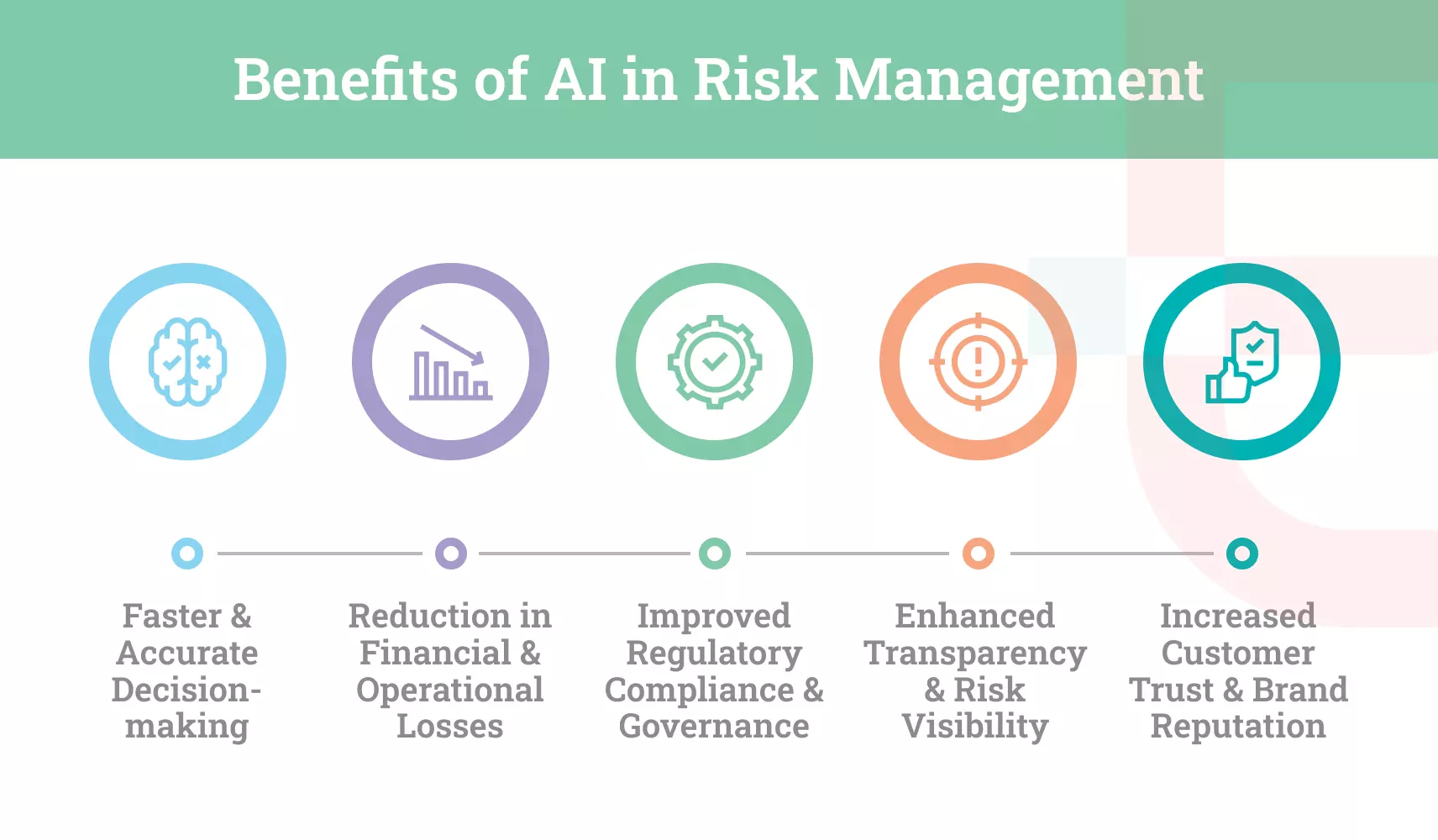
AI is preparing enterprises to switch from reactive to preventive and predictive modes of risk management. This proactive approach to risk management offers the following benefits:
Faster and Accurate Decision-making
When an enterprise faces a risk, it all boils down to how fast the management acts, and that too, in the right direction. AI offers the required speed and agility. A massive stream of data is processed to generate insights in just seconds. This allows the team to focus on making the right decision.
Reduction in Financial and Operational Losses
AI monitors your systems 24/7. Any system or equipment anomaly, or even the likelihood of a risk, is flagged promptly. It helps organizations avoid costly downtime. For example, bypassing a costly equipment breakdown saves thousands of dollars per hour for a big production unit.
Improved Regulatory Compliance and Governance
AI brings structure and automation to compliance management. It constantly looks for any updates on regulatory terms and policy changes. In case of any change, it flags areas where organizations may fall short. With all updates on a central dashboard, it becomes easy for all departments to follow the required protocols.
Enhanced Transparency and Risk Visibility
AI can process information from different departments into a single dataset. With an end-to-end process visibility, there are no blind spots or delayed responses in risk assessment. Also, transparency in the process builds individual accountability. Everyone works on their part without any assumption.
Increased Customer Trust and Brand Reputation
AI can highlight any indication of a data breach, almost instantly. It allows companies to respond to the threat proactively. When customers realize their personal data is safe with you, it increases their trust in your brand. That also translates to brand credibility.
Looking for Ways to Build Smarter, Faster, and More Accurate Risk-Management Systems? Let Our AI Experts Help You Build the Right Solution!
Common Challenges and Solutions When Adopting AI for Risk Mitigation
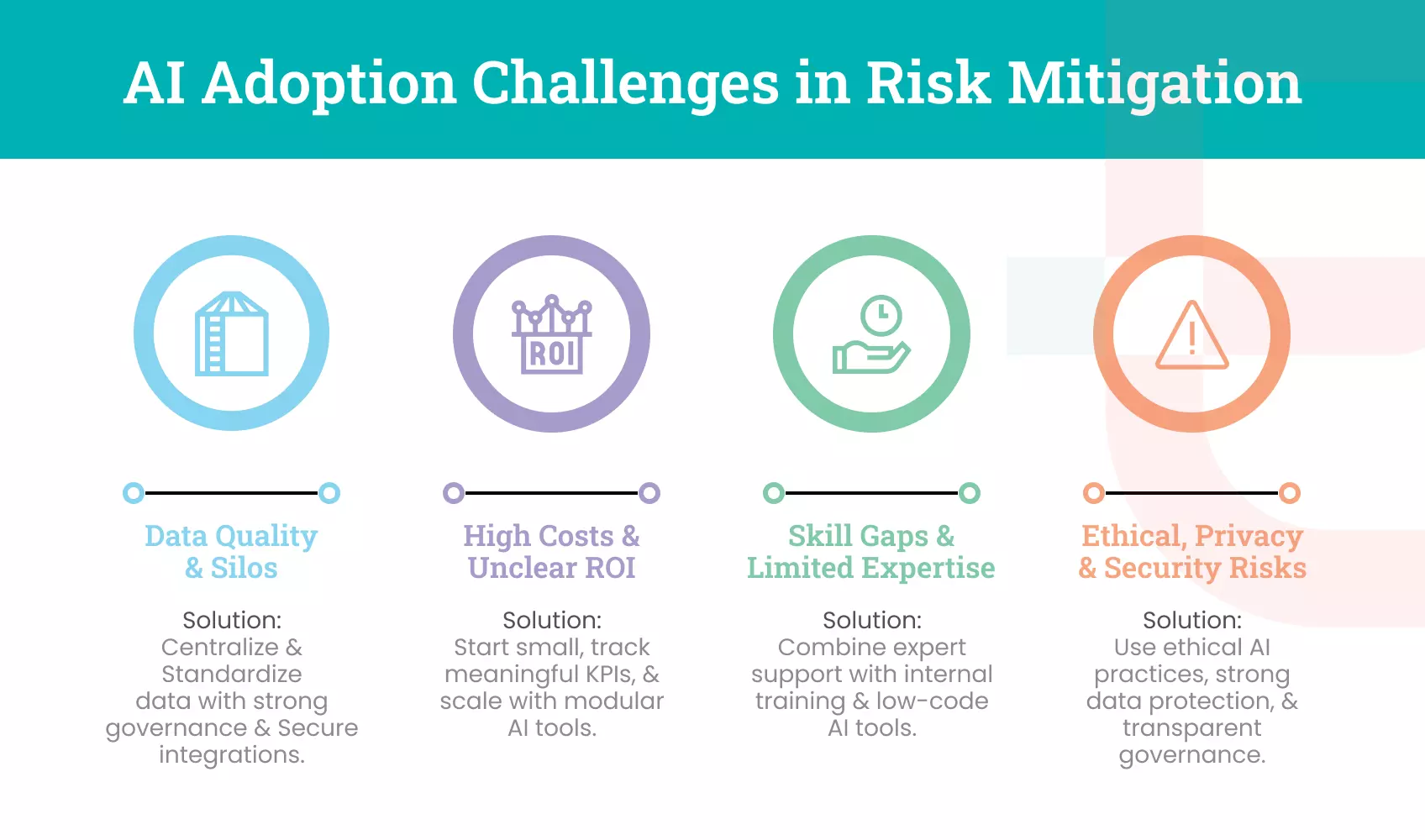
Following AI trends comes with its own set of challenges. However, there are easy ways to bypass them as well.
Lack of High-Quality Data and Data Silos
AI feeds on data. Sometimes, it is quite challenging to produce complete, accurate, up-to-date data without a proper system in place. Such data puts the risk model at the edge of failure.
Solution:
- Implement data governance policies
- Centralized information to remove data silos
- Clean data and follow one standardization process
- Use secure integration layers that sync with legacy systems
- Adopt cloud & unified data lakes for real-time visibility
High Implementation Costs and Unclear ROI
Using AI for risk management on a full scale requires a massive investment. You need to invest in technology, talent, and infrastructure. For small and mid-sized companies that expect ROI early, this can be a challenge.
Solution:
- Start using AI for a certain domain of risk management. Gradually expand as you grow.
- Choose the right KPIs to experience true ROI. Check for reduced downtime, fraud savings, or faster decision cycles.
- Use scalable, modular AI tools or managed services to reduce cost.
Skill Gaps and Limited AI Expertise
AI is booming. However, there is a huge shortage of skilled experts in the market. You need expert data scientists and machine learning engineers to handle complex models. Also, your internal team may perceive AI as a threat to their position. They may resist its smooth adoption.
Solution:
- Hire experts as freelancers until you have a dedicated in-house team.
- Invest in training interested staff and set them as role models for others.
- Use automated AI platforms with low-code interfaces to reduce technical dependency.
Ethical, Privacy, and Security Concerns
AI deals with sensitive company information and customer data for risk assessment. There always lies a fear of misuse. A single critical mistake can lead to regulatory violations. This slows down the adoption. Also, with compromised data, AI can make biased decisions. It will further increase compliance pressure.
Solution:
- Implement ethical AI frameworks and bias testing.
- Use data anonymization, encryption, and access controls.
- Adopt transparent AI governance and auditability.
Future Trends and Innovations in AI-driven Risk Management
The next wave of AI trends is already underway. Let’s see how it is going to redefine risk management for enterprises.
Explainable AI (XAI) for Transparent Risk Models
- There will be a significant use of XAI in financial risk management.
- It will help stakeholders understand the ethical implications of risk in a clear manner.
- AI will help organizations justify why it flagged a particular risk and how the decision aligns with policy.
AI + Blockchain for Secure Risk Validation
- The future of risk management will depend on verifiable data integrity.
- AI will integrate with blockchain to verify the accountability of data.
- AI-integrated blockchain will be used to tokenize large-value transactions.
- By 2030, every one in four large value transactions will be tokenized by using AI-powered blockchain networks.
- This will reduce transaction costs by 12.5% and save businesses more than $50 billion.
Elluminati Will Help You Take the Next Step With AI in Risk Management
The use of AI in risk management should not be considered just a technical upgrade. It’s a step forward toward a future where you project your organization as a responsible AI user. There will be a constant struggle to overcome challenges in terms of data quality, system integration, skills gaps, and model transparency.
Elluminati helps you bring intelligence into your systems with various AI development services that enhance your operations, tools, and systems. Our experienced team builds solutions for predictive analytics, real-time risk monitoring, and adaptive decision-making, ensuring a proactive approach to risk management and fostering operational agility.
Whether you are innovating existing risk workflows or launching a full AI-driven transformation, Elluminati provides the technology, customization, and industry expertise to elevate your risk management strategy.
FAQs
The cost of implementation may vary. It can range from $50,000 to several million, depending on data complexity, customization, and integration needs.
Some industries deal with complex risks and real-time decision-making needs. They benefit the most by using AI in risk management. Industries like finance, healthcare, manufacturing, cybersecurity, retail, logistics, and insurance are the best examples.
No, AI cannot fully replace human intelligence in risk assessment. AI enhances decision-making but still requires human judgment. AI also requires human support for regulatory oversight and ethical evaluation.
Startups with a limited budget should start with cloud-based AI tools. Any low-code platforms or modular analytics will cost less. Gradually, they can build their customized solution and integrate it with their existing legacy system.
Data privacy breaches, unauthorized access, and model manipulation are some of the major concerns with AI-powered risk assessment models.