Key Takeaways (or TL;DR):
- AI is more than a technological advancement; it is a strategic imperative for businesses aiming to thrive in the digital age.
- Artificial intelligence transforms business operations by streamlining processes, automating routine tasks, and unlocking unprecedented growth opportunities.
- Whether it’s the automotive industry or a financial institution, AI delivers substantial qualitative change to businesses of any size and creates new, growing opportunities for them.
- However, implementing AI in business is not without challenges. This includes data privacy, skill gaps, and integration issues.
- The future of AI in business is not about replacing humans but augmenting them, creating more efficient, innovative, and adaptive business processes.
Artificial intelligence is no longer just a futuristic concept; it’s a core pillar of business transformation today. Businesses across industries are integrating AI not just to automate repetitive tasks but to drive innovation, unlock new efficiencies, and deliver superior customer experiences. As intelligent automation accelerates, businesses that delay adoption risk falling behind in a digital-first world.
Whether you are a startup or an established business owner planning to refine your business using AI-powered technologies, this blog will help you navigate the journey. Throughout this blog, you will learn what AI in business actually means, the use cases that drive measurable ROI, the challenges of adopting intelligent systems, and more.
What is AI in Business? Understanding the Market Trend & Technologies Utilized
AI in business leverages technologies such as machine learning, deep learning, NLP, computer vision, robotic process automation, etc., to boost efficiency, uncover data-driven insights, and enhance customer experiences, while also driving innovation and measurable business values.
As the adoption of artificial intelligence in business accelerates, organizations are moving from testing intelligent concepts to deploying them at scale. The global artificial intelligence market is projected to reach USD 1.68tn by 2031, underscoring the essential role of AI technology in business for innovation, productivity, and long-term competitive advantage.
Now, before we explore the core benefits & real-world applications of artificial intelligence, it’s essential to dive into the essential technologies that play a vital role in delivering AI solutions in businesses effectively.
Machine Learning
Machine learning is one of the key technologies of AI, enabling systems to analyze and learn from historical data, identify patterns, and continuously improve accuracy, thereby supporting forecasting, fraud detection, and smarter business decisions.
Deep Learning
Deep learning is considered a subset of machine learning. It is an approach to building and training neural networks that enables businesses to learn & generate outputs without supervision.
Natural Language Processing (NLP)
Natural Language Processing (NLP) enables systems to understand and interpret human language through text & speech. It powers applications such as chatbots & virtual assistants.
Computer Vision
Considered one of the most effective AI technologies, computer vision enables machines to understand and interpret visual information from images and videos. Industries like healthcare are using this technology for diagnostics, ensuring a faster start to the treatment.
Robotic Process Automation
Robotic Process Automation (RPA) involves the use of software bots to automate repetitive, rule-based tasks, such as data entry and analysis, invoice processing, etc., reducing manual effort while enhancing overall operational accuracy.
Why Is Integrating Artificial Intelligence in Business Essential for Innovation-led Enterprises?
Incorporating AI into your everyday operations offers transformative benefits, redefining efficiency and strategic positioning. By leveraging AI, businesses can streamline processes and achieve significant operational improvements.
Below are some of the operational boosting benefits a business can gain through AI:
Increases Efficiency & Productivity
One of the most significant benefits of artificial Intelligence in business is its ability to enhance the efficiency & productivity in the workplace through;
- Automating repetitive tasks
- Streamlining processes
- Providing data-driven insights
This leads to significant gains in operational performance. According to a McKinsey survey, 40% of businesses are expected to adopt AI by 2035 to boost overall productivity.
For example, by integrating AI-powered virtual assistants that help you manage your schedule, set reminders, and prioritize, you can streamline your day-to-day activities, reducing manual tasks and freeing you up to focus on achieving highly effective business goals.
Improved Decision Making
To lead the market, it is vital to build a step-ahead strategy, and with AI, this is possible! By analyzing vast amounts of data, artificial intelligence delivers businesses with actionable insights in real time, which they need most to make informed decisions.
No matter what industry you are in, artificial intelligence can aid in highly complex decision-making in today’s fast-moving world. For instance, AI in transportation can optimize route planning, predict vehicle maintenance, & forecast market demand to help businesses effectively allocate resources while also serving customers with the best outcomes.
Cost-Effectiveness
The core focus of every entrepreneur is definitely on how to cut down the additional operational costs of their businesses, right? And this is where AI enables them by automating routine and time-consuming tasks, empowering your employees to engage in more strategic initiatives.
There are several AI tools, like predictive maintenance, that anticipate maintenance requirements in advance, saving businesses from last-minute maintenance costs; predictive analytics that streamline inventory management, reducing operational expenses and allowing businesses to invest their savings in other core strategies; and others.
Enhanced Customer Experience
Customers always expect businesses to be available for them 24/7 to respond to their queries instantly. Thus, considering this perspective, businesses are now focusing on delivering more personalized & satisfying services to their customers.
One of the best ways is through AI-powered chatbots that anticipate customer needs and respond to inquiries promptly in real time, and also use Natural Language Processing (NLP) to analyze customer feedback and improve service delivery. These technologies are transforming the way businesses interact & provide a personalized service experience to their customers.
Encourages Innovation
With AI, businesses can explore the wide range of opportunities that drive their operations towards innovation! By harnessing the power of artificial intelligence in business, it can help make your business innovative, by;
- Accelerating your product development
- Optimizing business operations
- Discovering effective ways to help you fulfill the changing customer demands.
A Generative AI solution is one of the best AI algorithms a business can rely on to drive innovation. It has an excellence in brainstorming & creating new ideas that help innovators spark off each other.
Scalability & Growth
Scalability is the key every entrepreneur is looking for in their business to achieve success, and this is where AI can be a better option. Artificial intelligence can help businesses scale their operations seamlessly.
Whether it’s adding a new tech stack to automate operational tasks or integrating new features, AI systems can seamlessly integrate into your workflow without disrupting ongoing operations, making it one of the core benefits of implementing artificial intelligence for business.
Minimizing Human Errors
Another significant benefit an entrepreneur gains by leveraging AI capabilities is that it eliminates human errors and reduces risk compared to human intelligence. We all know that whether it’s a machine or a human, everyone can make mistakes. Still, when it comes to delivering productive results for businesses, even minor mistakes can lead to major negative outcomes across overall operations.
Therefore, businesses can take advantage of AI-agents to perform repetitive tasks, ensuring high accuracy that improves data integrity as well as reduces errors. Besides that, automating the invoice & billing process, inventory management through AI robots, etc., ensures accurate records & compliance in the business.
Ready to Harness the Power of AI in Your Business? Share Your Requirements & Our Team Will Handle the Rest.
Top 8 Real-World Use Cases of Integrating Artificial Intelligence in Business
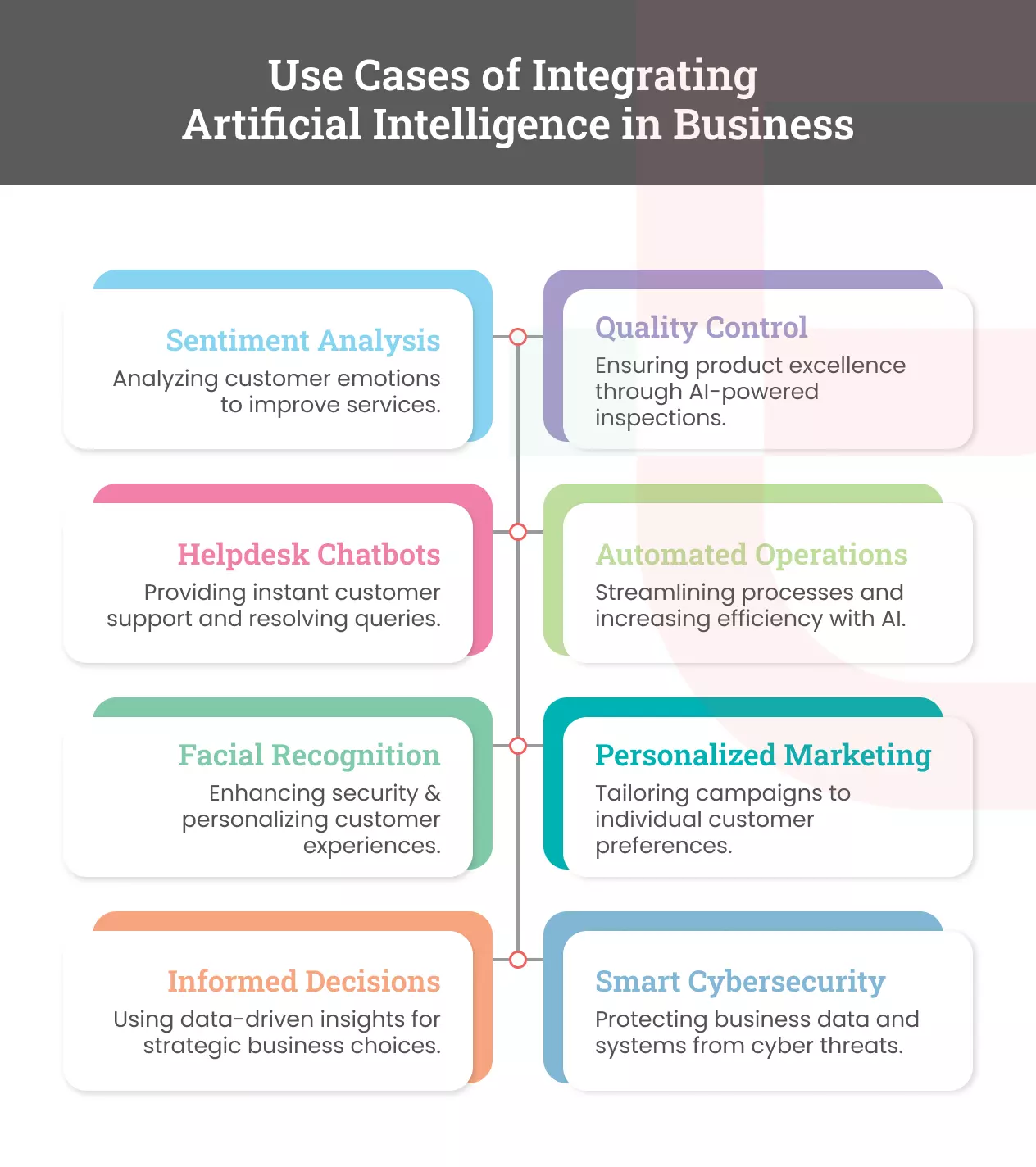
AI in business is no longer limited to experimentation — it is powering real, measurable transformation across industries. From optimized customer interactions to intelligent automation and enhanced decision-making, companies are using AI to streamline workflows, reduce costs, and accelerate growth.
The following use cases highlight how organizations are applying artificial intelligence in business to gain a competitive edge.
Sentiment Analysis
Understanding customer sentiment is the core focus for businesses aiming to deliver exceptional customer service, and this is where AI-powered sentiment analysis is applied. This tool processes reviews from various websites, analyzes social media posts, and more to gather customer feedback on a particular product or service.
These valuable insights help businesses to address common concerns that customers frequently face, also highlighting the core areas where they need to improve their services, as well as anticipating the potential issues, keeping the businesses ahead of their customers demands.
Helpdesk Chatbots
In this ever-evolving world, we have witnessed customers opting for an AI chatbot over human support to solve their queries or make their interactions smoother. There is nothing wrong with saying that AI-driven chatbots have become an essential tool for businesses looking to enhance customer service.
These digital tools are available around the clock for their customers, help them resolve issues, and guide them in making the best choice without human intervention. This results in reducing response times for the customers while also improving overall customer satisfaction.
Facial Recognition Technology
Nowadays, facial recognition technology is no longer used only on smartphones; it is becoming an essential part for businesses, too. Entrepreneurs are utilizing this technology to enhance security, streamline attendance systems, and provide personalized services.
For example, retailers are employing this facial recognition to tailor the shopping experience, while financial institutions rely on it for secure transactions. This not only improves operational efficiency but also enhances trust & customer engagement.
Informed Decision-Making
One of the prominent use cases for implementing AI solutions for business is that it helps entrepreneurs leverage an intelligent decision support system (DSS) to make data-driven decisions. This system analyzes vast amounts of data and, based on that, offers suggestions and guidance to help businesses make informed decisions.
Moreover, by integrating AI into planning and strategy, businesses can reduce uncertainty and improve overall efficiency. From financial forecasting to supply chain optimization, businesses gain a clearer understanding of risks & opportunities by keeping the AI at the top of their business processes.
AI-Enabled Quality Control & Quality Assurance
Over the decades, manufacturers have used computer vision and deep learning to improve inspection accuracy and streamline operations. These AI-powered solutions easily detect defects & inconsistencies, improving the speed and accuracy of their quality functions while keeping costs in check.
These systems deliver more precise, ever-improving quality assurance functions as deep learning models create their own rules to define quality.
Automated Operations
Businesses across sectors are adopting AI to automate tasks such as scheduling meetings, automated data entry, automated reporting, and compliance tracking. Automation reduces repetitive workloads and enables the team to focus on core & high-quality business tasks, resulting in increased ROI.
By improving process consistency and minimizing human error. These AI-driven systems accelerate operational efficiency, enabling faster execution, streamlined processes, and the development of scalable AI solutions for businesses.
Personalized Advertising & Marketing
In the digital era, we have seen customers increasingly prefer platforms that deliver a more personalized touch, and AI has played a vital role in this. With the rise of AI in marketing, the technology has transformed advertising and customer engagement by enabling businesses to deliver hyper-personalized campaigns. By analyzing vast amounts of user data, AI identifies preferences, predicts behavior, and generates content accordingly.
Whether it’s suggesting the perfect product or creating tailored ad experiences, this approach not only increases engagement but also drives business through higher conversion rates, enabling you to connect with your audience worldwide effectively.
Smart Cybersecurity
As AI rapidly becomes part of every business, robust cybersecurity is what businesses are seeking. Whether in the retail, automotive, or e-commerce industries, leveraging AI technologies is a must to safeguard overall operational security.
With AI in the cybersecurity sector projected to reach USD 93.75bn by 2030, businesses are increasingly adopting threat detection solutions to safeguard sensitive data and strengthen digital resilience across their operations.
How to Adopt AI In Business? – Let’s Break Down Its Adoption Process in Detail
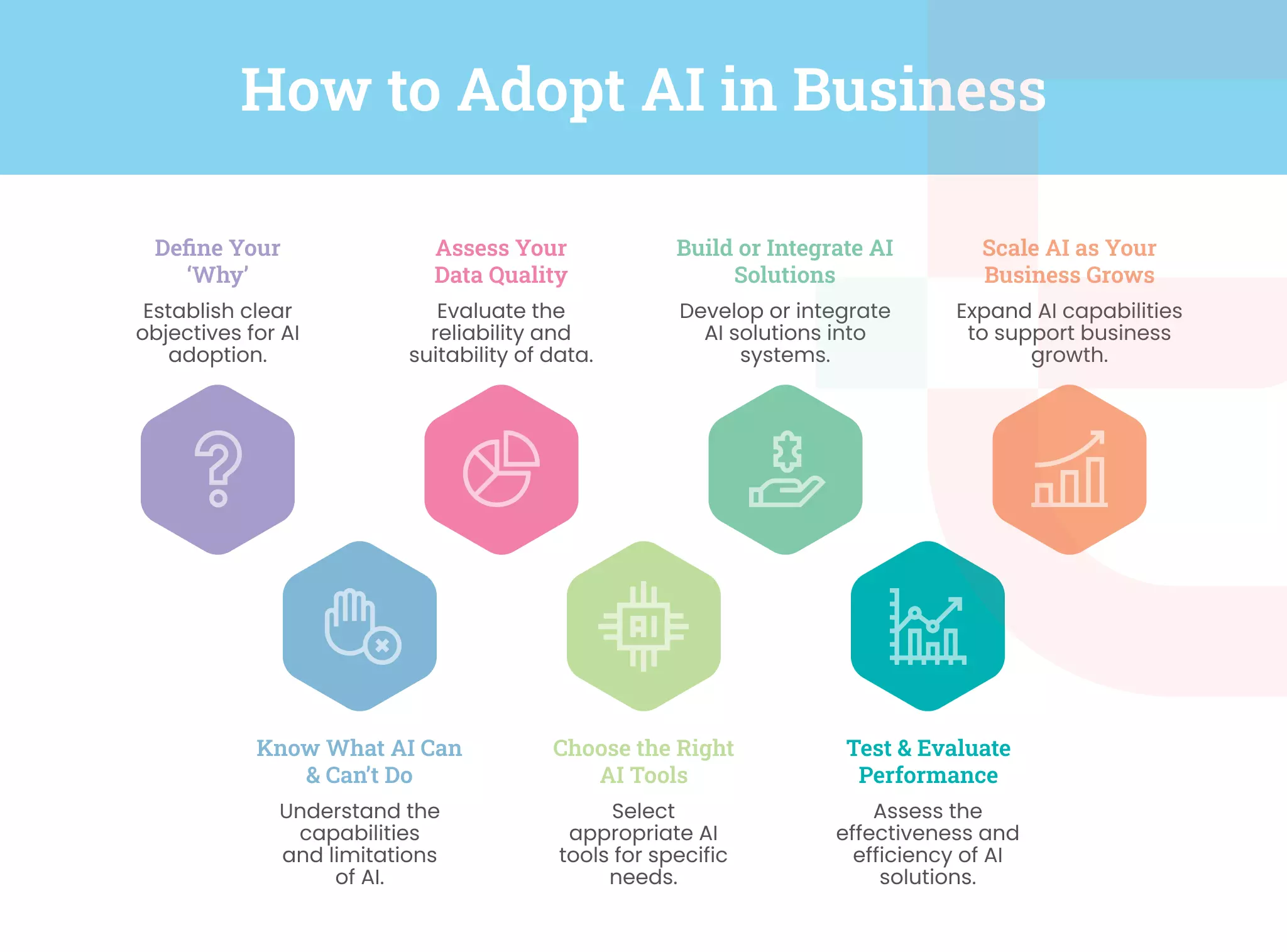
Businesses often have queries on “how to adopt AI in business”, right? But before implementing or leveraging AI’s benefits in business, a few things must be clear on the business side: a clear strategic plan, the right technology foundation, and a clear understanding of what your business needs.
Therefore, we have provided a brief overview of each stage that every business must consider when implementing AI solutions.
Start with the “WHY”
Before diving into how to adopt AI in business, the first and foremost thing you need to ask yourself is, Why do you want to integrate AI in your business?
There might be several strategic reasons for implementing AI in business, such as streamlining operations. Improving customer service? Or reducing the operational costs? Defining a clear, predefined goal is essential to achieving measurable outcomes in your business.
Determine What AI Can & Can’t Do
AI is a transformational catalyst, but it’s not a one-size-fits-all solution. The core of artificial intelligence is its ability to analyze large amounts of data, recognize patterns, and make predictions. Now, when talking about what AI can do, it includes:
- Automation
- Customer Insights
- Personalization
- Optimizing Efficiency.
However, on the other hand, AI has also come up with its set of challenges, and the core one is that it requires proper oversight to avoid errors or biases.
Evaluate Data Quality & Availability
Data is considered the backbone when designing & deploying an AI solution. Therefore, before implementing AI, it is essential to conduct a data audit across your systems to understand what information you currently collect, how it’s stored, and whether it’s accessible in real time.
To ensure your data is AI-ready, adopt the following data management practices.
- Data Consolidation eliminates silos by integrating data from multiple sources for unified access.
- Governance Structure, which defines roles, responsibilities, and policies for consistent data management.
- Data Cleansing, which applies validation techniques to remove inaccuracies and reduce data noise.
- Ongoing Maintenance to conduct regular audits, updates, and version control to keep current data accurate.
- Compliance Readiness, adherence to regulations such as GDPR and HIPAA.
- Data Enrichment to incorporate external datasets to complement & strengthen internal data.
Choose the Right AI Tools & Platforms
The key to successfully implementing an AI strategy is to choose the right AI tools and platforms that align exactly with your business requirements.
Start by identifying whether your AI use cases require predictive analytics, NLP, computer vision, or Gen AI, which powers innovations in content creation, code generation, knowledge management, and automated customer services.
Another thing to consider when evaluating tools & platforms is:
- Make sure the tools or platforms you are integrating will help you scale your operations and integrate with your current tech stack.
- Then, opt for tools that enable easy, tailored fine-tuning for your unique industry & compliance needs.
- Ensure that data usage aligns with regulatory standards and your business’s privacy frameworks.
- Opt for platforms with intuitive interfaces and seamless onboarding, critical for adoption across teams.
Develop or Integrate AI Solutions
Once you have successfully identified the objectives and tools, it is time to determine whether you need to build an AI technology system from scratch or integrate it into any third-party software. If you opt to build a custom AI solution, you gain a deeper understanding and better utilization of AI capabilities, facilitating easier maintenance and upgrades in the future.
On the other hand, a pre-built third-party platform can be easily integrated into the existing system, reducing development costs and time.
Test AI Model & Performance Evaluation
The success of your AI solution highly relies on its testing process. Depending on your business requirements, the testing process may take weeks or months. However, it is generally conducted to assess whether your clients are satisfied with the services or whether your employees can work efficiently with a new AI system.
This helps you determine whether the technologies you have integrated are worthwhile enough to increase your business productivity or require any further upgrades.
Scale Your Solution As Your Business Grows
AI adoption is an evolving journey, not a one-time implementation. As the business grows, the AI system should scale to support new workflows, industries & customer demands.
Continuous optimizations, performance tracking, and alignment with emerging AI trends ensure the solution remains relevant & delivers ongoing value to businesses.
Potential Challenges & Effective Solutions of AI Adoption in Business
Along with all the positive & long-term outcomes that AI delivers to businesses, it also comes with a set of complexities, including technical issues, costs, and integration challenges.
Thus, businesses planning to implement artificial intelligence must be aware of the core challenges they face in real time when applying AI to their operations.
High Implementation Costs
One of the obvious barriers to adopting AI in business is its high implementation costs. Whether you want to build an AI-powered app from scratch or upgrade the existing ones for scale, it will be more expensive, specifically for small & medium-sized businesses.
Solution:
The most effective tactic is to adopt a phased investment approach. Small or medium-sized businesses can start with a pilot AI project before scaling up. Leveraging cloud-based AI services also provides cost-effectively benefits. Conversely, its AI capabilities explore more ways for businesses to get better ROI.
Data Privacy & Security
We all know that AI systems often require vast amounts of data, but collecting, storing, and processing sensitive information is a major concern for their privacy & security.
Solution:
The best way to overcome this challenge is for businesses to prioritize data governance frameworks. This includes data encryption, anonymization, and adhering to privacy standards. By implementing privacy-preserving AI technologies such as federated learning, businesses can train AI models without sharing sensitive data, safeguarding both user privacy and model performance.
Lack of Skilled Talent
As demand for AI implementation in business is increasing rapidly, more businesses are seeking professionals with expertise in data science, AI specialization, and machine learning, rather than a person skilled in a single field. This results in a significant shortage of such talent, making it challenging for businesses to find and retain qualified candidates.
Solution:
A significant way to remove this roadblock is for businesses to start investing in upskilling and reskilling programs for their employees. Collaborating with universities, offering internships, and providing ongoing AI training to staff can help meet the demand for AI expertise.
Resistance to Change
Regardless of whether AI integration is technically feasible in your existing system, human resistance is one of the reasons that delay AI adoption. Employees often prefer familiar workflows and are hesitant to adopt AI-powered automation, which can negatively affect decision-makers and reduce ROI.
Solution:
The easiest way to overcome this challenge is for businesses to start focusing more on change management strategies that highlight AI’s role in augmenting human work rather than replacing it. You must let your employees know how AI will help them improve their performance, thereby eliminating the fear of job displacement.
Integration with Existing System
Even in this ever-evolving era, many businesses still rely on outdated legacy systems that are not compatible with modern AI technologies. These outdated systems often lack the flexibility and scalability needed to handle AI workloads, making it a core challenge when adopting artificial intelligence in business.
Solution:
To overcome this barrier, businesses must adopt hybrid models that blend legacy systems with new AI infrastructure. Modern APIs, cloud services, and middleware solutions can act as bridges between old and new technologies, enabling smoother AI integration into legacy systems without redesigning or major operational changes.
Ethical Concern
As AI becomes more powerful and widespread, ethical concerns around its usage have come to the forefront. There are many issues like data privacy, bias, and accountability that raise serious questions about the ethical implications of AI in decision-making.
Solution:
To resolve this challenge, businesses must develop AI ethics guidelines to govern the use of AI technologies. This includes creating ethical committees, ensuring transparency in AI decision-making, and adhering to international ethical standards for AI use. This helps businesses in mitigating ethical risks while also building trust among customers.
Emerging Artificial Intelligence Trends Powering the Future of Business
As artificial intelligence in business continues to evolve, it also plays a vital role in shifting from automation and optimization to strategic enablement and intelligent autonomy. The future of AI is marked by advances that go beyond basic automation.
Moreover, AI-as-a-Service offerings and autonomous decision-making engineers play a vital role in accelerating this transformation. It provides businesses with scalable, cloud-based solutions that streamline AI model deployment & management, allowing them to innovate faster and with more flexibility.
Also, with the help of AI-powered ecosystems, businesses can offer hyper-personalized products & services, and real-time predictive oversight for supply chain operations, giving them the strength to stand out in the future market with confidence.
How Can Elluminati Help with Deploying AI Solutions in Business?
In today’s digital era, we all know that implementing AI in business is no longer an option; businesses must stand out in this competitive market. Therefore, businesses seeking to drive sustainable growth and gain a competitive advantage in the modern business world must consider partnering with a trusted AI development company like Elluminati to harness AI’s full potential.
Whether you want to integrate an AI-powered recommendation system chatbot, voice assistant systems, or want to modernize a legacy system with AI, we have an experienced team of AI developers who can help you craft cutting-edge business solutions that help you turn your vision into reality.
FAQs
The following are some of the effective ways artificial intelligence is used in businesses:
- Enhancing customer services
- Providing product recommendations
- Detecting & preventing fraud
- Optimizing supply chain management effectively
Several common challenges that the entrepreneur faces when implementing AI into their businesses are:
- Data Privacy & Security
- Integration Complexity
- Skills Gaps & Talent Shortage
- Regulatory Compliance, etc
Addressing these challenges requires careful planning & a strategic approach that involves both technology and people with specialized expertise.
The initial costs to build an AI solution for business range from $10,000 to $100,000. Several factors that affect its final costing include the level of project complexity & scope, the use of AI technologies, the chosen type of AI model, data requirements, and other customization requirements. To obtain the custom quotation, we recommend you to connect with our sales executives at sales@elluminatiinc.com.
In this realm of AI, the majority of the leading business players across industries are adopting AI into their business processes to gain a competitive edge, including;
- Amazon
- Apple
- Alibaba
- Netflix
- Tesla, etc.
Adopting artificial intelligence in business offers numerous benefits, including task automation, increased efficiency, reduced human error, and enhanced customer satisfaction. This helps businesses streamline their operations while also providing better customer service worldwide.