Key Takeaways (or TL;DR)
- The cost of AI development ranges from $10,000 to $500,000, depending on factors such as complexity, integration requirements, and more.
- The major drivers behind increasing the business’s investment in AI include project scope, data quality, tech stack, and team expertise.
- An AI solution with customization is comparatively more expensive than other project types, such as pre-built or basic, but it delivers more business-oriented benefits.
- Choosing the suitable AI pricing model for your business, from fixed, time & material, dedicated team, or outcome-based pricing, will help you save your development budget.
- AI development can be expensive, but with careful planning and the right strategies, businesses can optimize costs while maximizing ROI.
Artificial intelligence has transitioned from being a futuristic concept to a central component of modern business strategy. From automating interactions to predicting market demand, it has completely changed how businesses operate and scale, leading the digital landscape.
This changed the approach of most entrepreneurs, inspiring them to invest in AI to leverage a range of benefits, including improved efficiency, driving growth, and staying competitive in this market.
But one of the key concerns businesses have at the core of their AI thinking is the cost of AI development. So, by putting their question at the top, we have brought this comprehensive guide for all such businesses. It includes all the information on the factors influencing expenses.
How Much Does AI Development Cost? Let’s Understand It With Its Complete Breakdown
AI solutions can provide considerable value, but their pricing can be challenging to understand. The starting costs for AI development typically range from $10,000 to $500,000. However, the total price varies based on factors such as project complexity, data quality, and the specific, customized needs of each business.
Let’s have a look at the detailed cost breakdown to help you get a clear picture of what’s included and how it impacts the overall AI development budget.
Cost Breakdown by Level of Complexity
Pre-Built AI Solutions
These AI solutions offer a rapid deployment with limited configuration access and standard functionality, which makes the cost of implementing AI manageable and suitable for MVPs. The aim of creating this solution is to focus on speedy development and simplicity rather than tailored functionality.
Examples:
- Plug-and-play analytics tools for SMEs.
- Subscription-based AI APIs to streamline marketing or HR tasks.
- Standardized AI solutions with a limited scope for customization.
Estimated Costs: $10,000 to $40,000
Time Period – A Few Weeks
Basic AI Solutions
It is recognized as a cost-effective solution, as it uses a pre-trained AI model with minimal fine-tuning or customization. It primarily streamlines tasks such as prototyping and automates processes using established ML techniques, providing an affordable entry-level AI solution with moderate flexibility.
Examples:
- A chatbot & Voice Assistants solution to deliver custom support.
- Simple ML models for spam filtering and text processing.
- Basic recommendations and predictive analytics systems.
Estimated Costs: $20,000 to $80,000
Time Period: 1 to 2 Months
Mid-Level AI Solutions
Mid-level AI solutions combine more complex logic with partial model customizations trained on specialized or industry-specific data. It requires substantial data preparation, tailored feature engineering, and a broader system integration to deliver high accuracy, better personalization, and more domain-specific outcomes.
Examples:
- Natural Language Processing (NLP) systems for tone analysis and automatic translation.
- Computer vision for image recognition and classification.
- Personalized recommendations on medium- to complex-level platforms.
Estimated Costs: $50,000 to $300,000
Time Period: 2 to 4 Months
Advanced AI Solutions
Advanced AI solutions involve custom model training, more extensive data processing, and integration with complex business systems. These projects often involve multiple AI technologies and require rigorous testing, optimization, and scalability considerations. It is mainly designed for high performance or for specific use cases.
Examples:
- A generative AI solution for generating images, code, or text.
- Real-time systems for video and audio processing.
- Complex predictive models and recommendation systems with high accuracy.
Estimated Costs: $300,000 to $1,000,000+
Time Period: 4 to 6 Months
Custom AI Solutions
These solutions are specifically created to fulfill a specific business requirement. It is comparatively more expensive to develop, but it delivers maximum flexibility, scalability, and other competitive advantages, specifically in industries with strict compliance or operational complexity.
Examples:
- Predictive maintenance systems for manufacturing.
- Security & compliance solutions for regulated sectors
- AI integration in complex industrial or telecom systems.
Estimated Costs: $100,000 to $5,000,000+
Time Period: More than 6 Months
| Cost Breakdown Based on Level of Complexity | |
|---|---|
| Level of Complexity | Estimated Cost (USD) |
| Pre-built AI Solution | $10,000 to $40,000 |
| Basic AI Solution | $20,000 to $80,000 |
| Mid-Level AI Solution | $50,000 to $300,000 |
| Advanced AI Solution | $300,000 to $1,000,000+ |
| Custom AI Solution | $100,000 to $5,000,000+ |
Cost Based on Project Type
The type of project you’re using an AI solution for is one of the significant factors driving the rise in cost. It determines exactly how much effort & time your developers require to deploy a solution. Also, factors like resources, data requirements, etc., will undoubtedly affect your final figure.
| Cost Breakdown Based on Project Type | |
|---|---|
| Type of Project | Average Cost (USD) |
| Minimum Viable Product (MVP) | $10,000 to $150,000 |
| Proof of Concept (POC) | $10,000 to $100,000 |
| Full-Scale Implementation | $25,000 to $300,000 |
| Fine-Tuning | $5,000 to $40,000 |
| Consulting | $20,000 to $80,000 |
Cost Breakdown by Stages:
Businesses intending to develop AI-based solutions have to keep in mind that it is not a one-time investment. But with careful planning and better cost evaluation across phases, you will make a unique contribution to the project’s quality and performance by the end.
| Cost Breakdown by Stages | |
|---|---|
| Stages | Average Cost (USD) |
| Planning | $15,000 to $30,000 |
| Design | $20,000 to $40,000 |
| Development | $100,000 to $250,000 |
| Deployment & Launch | $10,000 to $25,000 |
| Maintenance & Updates | $15,000 to $40,000 |
Planning
The core success of your AI app development depends highly on its effective planning. This phase will help the team understand your actual project requirements by identifying pain points and objectives, determining the types of AI models & technologies required, and more.
Additionally, this planning phase includes key activities like;
- Feasibility Analysis
- Technical Consultation &
- Early Prototype Planning
This phase costs you around $15,000 to $30,000, but it also saves your business from having to make huge, expensive changes in the future.
Design
This is the phase where the UI/UX designers turn your ideas into the shape & size you desire! The team develops user-friendly layouts for your solutions, wireframes, and data flow diagrams to showcase how the users and algorithms will interact.
Estimated costs: $20,000 to $40,000
Development
Recognized as one of the most resource-intensive as well as a cost-consuming stage, where AI models are designed, trained, and validated. We all know that developing robust, accurate models requires significant effort, from data preprocessing and learning pipelines to automating the processes.
Estimated cost: $100,000 to $250,000
Deployment & Launch
After successfully developing an AI model, this phase focuses on deployment. Whether it’s related to server configurations or to establishing all the necessary infrastructures, to ensure the model works perfectly with your system.
Estimated cost: $10,000 to $25,000
Maintenance & Updates
After successfully deploying and launching an AI model, it is essential to maintain the model, add new features, optimize its performance, and scale data and user volumes as they grow over time.
Estimated costs: $15,000 to $40,000
Ready to Plan Your AI App Budget? Tell us your Requirements & We’ll Help You Define a Smart Budgeting Strategy To Build Your AI App
Industry-Wise Cost Breakdown
AI is defined differently across industries, and it delivers varied results, which is why there is no universal price tag for developing a solution. Whether it’s automating patient diagnostics, detecting fraud, or optimizing supply chains, the AI development costs depend on data readiness, regulatory environments, and operational goals.
Here, we are sharing a quick overview of the average spending that businesses across sectors are making on AI solutions.
| Industry-Wise Cost Breakdown | |
|---|---|
| Industry | Estimated Cost (USD) |
| Healthcare | $50,000 to $500,000 |
| Finance | $35,000 to $400,000 |
| Manufacturing | $30,000 to $500,000 |
| Automotive (Transportation) | $80,000 to $800,000+ |
| Telecommunications | $100,000 to $500,000 |
| Retail & eCommerce | $40,000 to $200,000 |
| Education | $50,000 to $300,000 |
| Logistics & Supply Chain | $50,000 to $300,000 |
| Marketing & Advertising | $30,000 to $150,000 |
| Real Estate | $30,000 to $150,000 |
Disclaimer:
The costs mentioned in the above section reflect general market conditions and may differ. For an accurate estimation, we recommend that you connect with a reliable tech partner.
What Are the Significant Factors Influencing the Cost of AI Development?
AI pricing will never be one-size-fits-all for businesses. It is an intricate process that depends on what you build, how you build it, and who builds it for you. From choosing a platform to setting up infrastructure, there are hundreds of millions of factors that affect your overall project expense.
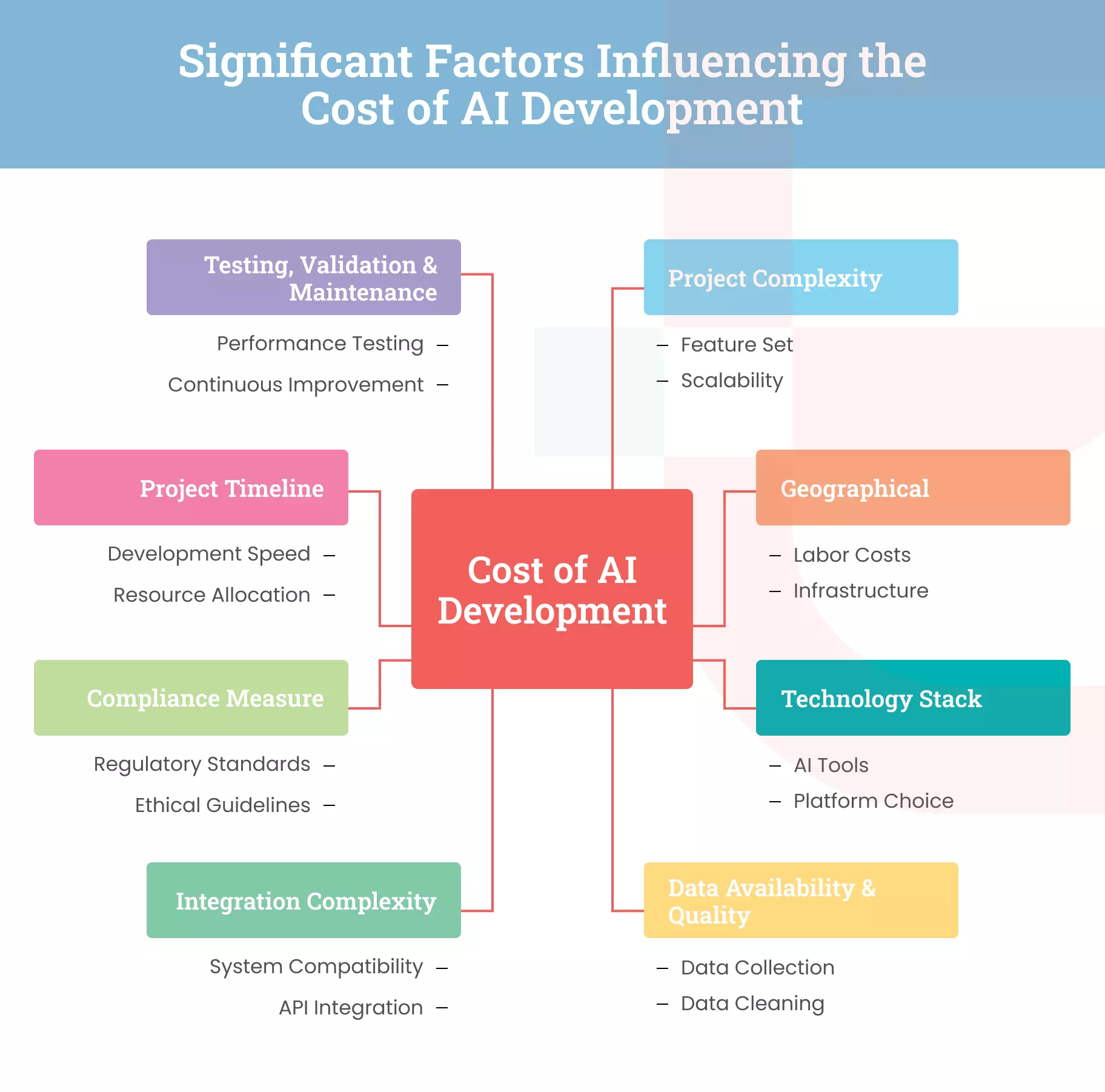
So, let’s break down each costing factor to understand how and to what extent it can influence your investment.
Project Complexity
Without a doubt, the higher the demand you set for your project, the more you are required to pay. The scope and complexity of your project are the primary factors driving the cost increase.
For instance, developing a basic AI chatbot solution to enhance customer experience is comparatively less expensive, as it already has predefined rules and can be built within a few weeks. On the other hand, designing large-scale project models becomes more expensive because it involves various requirements, such as
- Architectural design in an advanced or high-level AI project requires custom model development, whereas a basic project can use pre-trained APIs.
- Integration – Connecting AI to CRM, ERP, or other Internet of Things (IoT) devices requires more engineering time.
- Testing – a High-level AI system usually requires multiple validation loops before deployment.
These are a few complexity factors that directly lead to increases of 30-40% in the final project expense.
Geographical
Another significant factor driving AI development costs is the expertise and location of the team you hired. For instance, hiring an in-house team of machine learning engineers, data scientists, and MLOps specialists can be expensive, especially in North America or Western Europe.
Outsourcing development to a trusted technology partner in regions like Asia, Eastern Europe, and beyond can reduce overall AI implementation costs while maintaining high quality.
Technology Stack
Whether you opt for a new AI system with on-premises infrastructure or choose the cloud, both options will significantly impact your overall budget and timing. There are many free, open-source frameworks, such as TensorFlow and PyTorch, that work well for your business.
However, for more complex projects, businesses are often required to pay for a library or platform to gain additional features and better support. For example:
- Hardware: GPUs, TPUs, or other accelerators for training complex models.
- Cloud Computing: Cloud-based AI platforms charge per computer instance or per GPU-hour. Here, the cost scales rapidly with model size & training iterations.
- On Premises vs. Cloud: On-premises solutions usually require upfront capital investment and ongoing maintenance, whereas cloud solutions offer flexibility but incur recurring costs.
In short, businesses opting for a cloud configuration or reusable AI frameworks often cut costs by up to 20%.
Data Availability & Quality
Data is considered the backbone of any AI system. The global AI in the data quality market size is projected to grow at a CAGR of 22.10% between 2024 and 2033, as it helps enhance the accuracy and consistency of AI models.
There is nothing wrong with saying that accurate and reliable data fuels the success of your AI models. However, collecting, cleaning, and labeling the data may cost 30-50%, but it also provides accurate predictions, saving you money in the future.
Now, if you also want to process the data but are concerned about your budget, here are some effective ways to reduce costs while maintaining data quality.
- Reusing the internal operational data wherever it’s possible.
- Leverage public data or licensed repositories.
- Use synthetic data generation to efficiently fill gaps.
Also, if you are planning to build an AI app from scratch, then it’s worth consulting an AI engineer who can help you design a data pipeline strategy.
Integration Complexity
Businesses often wonder whether they can integrate AI into their existing systems without incurring additional costs. So, the answer is very simple: integrating AI into your existing software is possible, but you will face complexities in making them work together, due to complex APIs or microservice-based architectures required for successful integration.
Generally, below are some common systems where businesses can integrate AI with,
- CRMs, ERPs, custom dashboards
- APIs, legacy databases
- Security protocols & compliance layers
However, one of the key challenges businesses face is integrating AI into legacy systems. This is because the legacy system requires a complete overhaul using modernization techniques for data interoperability, which will drastically increase your overall AI development costs.
Compliance Measure
Compliance standards are something that businesses should never ignore! If you are planning to build industry-specific AI solutions, such as for healthcare or e-commerce, you must strictly adhere to laws like HIPAA, GDPR, and PCI DSS. This adherence will include audit-ready documentation, process modifications, and, in some cases, other technical measures.
Non-compliances with such requirements may result in penalties or legal actions, so adherence is a crucial component of planning, which may impact its development timeline as well as the costs by 5 to 10%, but in return delivers trustworthiness amongst its customers, and helps them build their business a valuable name in the market.
Project Timeline
One of the key factors that directly affects the cost of developing AI solutions for businesses is the project timeline. The longer the duration a team takes to build your solution, the higher the experience because of extending the use of resources like AI infrastructures, and potential changes in technology or requirements during the development processes.
Businesses intending to build a long-term solution for businesses must have sustained investment, contributing 5 to 10% of overall costs, whereas there are many cases in which the projects are required to redevelop or aren’t able to be fulfilled successfully, due to a lack of research work, resulting in both more time-consuming and money, as well.
Testing, Validation & Maintenance
AI is not a one-time investment, and we all agree on it to some extent. Testing, validation, and maintenance are essential parts of the loop businesses must work through after deployment, influencing overall development expenses by approximately 10-20%.
Let’s have a look at the typical ongoing prices, which include:
- Model Monitoring to track performance and accuracy in real time.
- Retraining helps you adjust your AI models to account for data drift or changing conditions.
- Infrastructure costs to compute resources to serve predictions
- Providing end-to-end support, troubleshooting errors, or upgrading any tech stack.
Custom AI vs. Pre-Built AI Solutions – A Cost Difference Businesses Must Know
Choosing between custom AI and a pre-built AI solution can significantly impact your budget and long-term results. Pre-built AI is typically more affordable and faster to deploy.
On the other hand, custom AI requires a higher initial investment but provides tailored features and long-term scalability. Now, let’s take a closer look at a comparison table to learn about each’s pros & cons and costs.
| Factors | Custom AI | Pre-Built AI |
|---|---|---|
| Definition | A custom AI is a tailor-made solution built from the ground up to meet businesses’ specific requirements. | Also known as an off-the-shelf, it is a ready-made AI solution designed to perform specific or general-purpose tasks with minimal setup required. |
| Initial Cost | The initial costs for a custom AI solution range from $50,000 to $500,000+. | The initial cost of a pre-built AI solution ranges from $5,000 to $50,000. |
| Description | It fully aligns with the exact business workflow, data, and goals. | As it is a pre-built solution, it has limited scope for functionality and customization. |
| Pros | High customization, better control, and a goal-specific solution. | Faster time to market, lower cost, and easy to implement with the existing system. |
| Cons | Time-consuming and required a larger investment | Limited scope of customization, & less flexibility. |
Collaborate with Elluminati to Transform Your AI Ambition into a Profitable Reality – Without Overspending
Discover the Common Pricing Models for AI Development Projects
Most AI development companies offer a range of pricing models for businesses, depending on the project type. This includes a fixed-price model for well-defined scopes and an outcome-based model that ties compensation to measurable results.
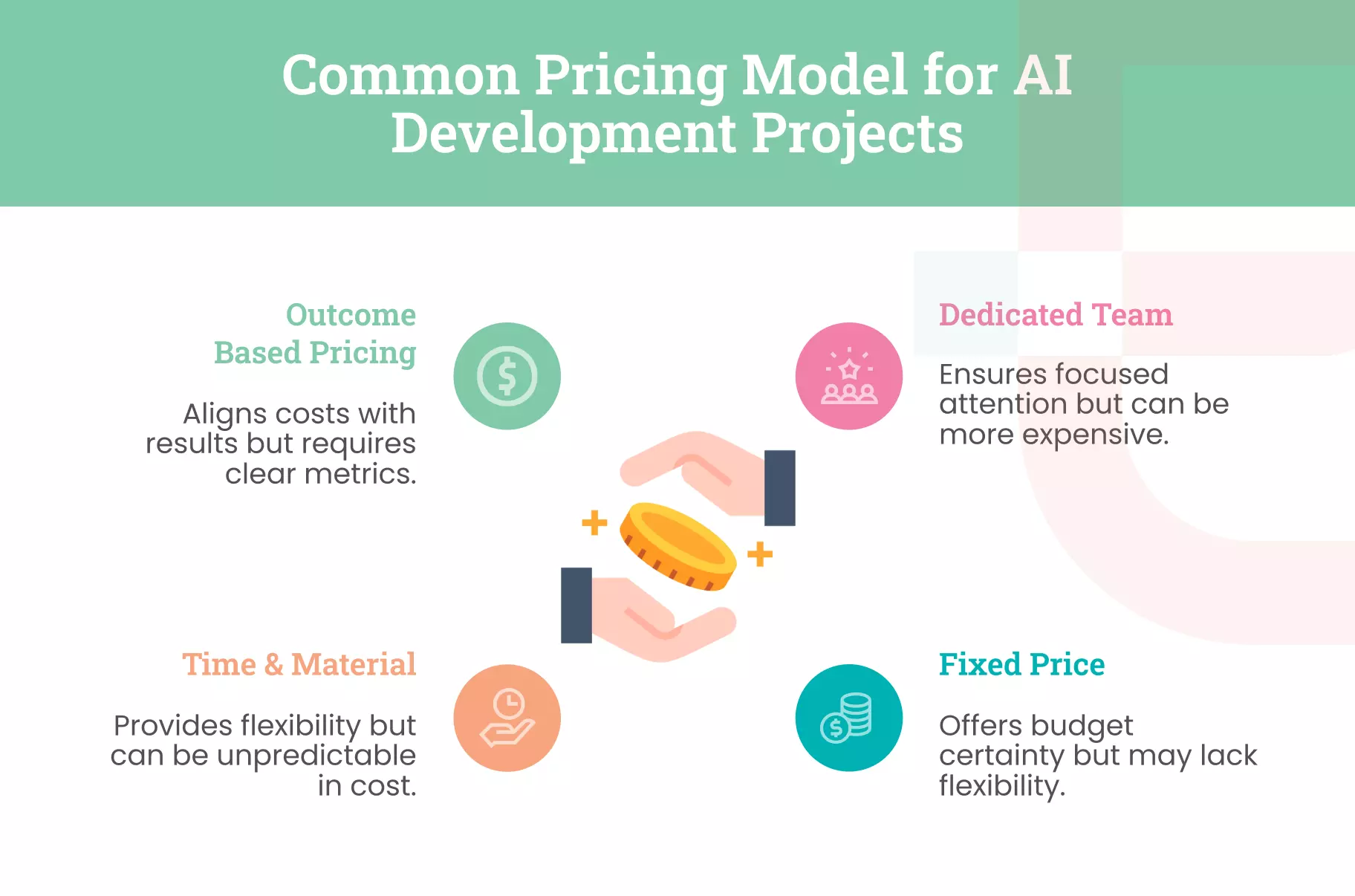
Opting for the right model significantly impacts risk allocations and the project’s success. Now, let’s determine each pricing model listed below to understand which suits which kinds of businesses best.
Fixed Price Model
Businesses with a defined scope and milestones can use this fixed-price model. It offers a straightforward approach to budgeting AI projects, with the scope of work, timeline, and expense agreed upon before the project begins.
Pros: Beneficial for businesses working within strict budget constraints.
Cons: Unable to make any changes as per the requirements while the development process is ongoing.
Best Suited For:
- To build a Proof of Concept (POC) or a pilot program that validates feasibility.
Time & Material Model
Ideal choice for businesses that need to implement changes frequently in their business as the market evolves. By leveraging this model, businesses are required to pay for the time spent by the development team on their project & resources utilized.
Pros: It offers businesses flexibility to make easy adjustments to the project scope and features while maintaining transparency around costing.
Cons: It is difficult for businesses to determine the final price upfront, leading to budget overruns.
Best Suited For:
- R&D-heavy AI, or when the end product will evolve through experimentation.
Dedicated Team Model
This dedicated team model provides clients with a fully committed group of professionals working exclusively on their projects, ensuring a high level of control and scalability.
Pros: One of the core advantages of this model is its cost-effectiveness for long-term projects, reducing overhead costs such as salaries and office space.
Cons: Not an ideal choice for short-term or small-scale projects.
Best Suited For:
- If your business is scaling across multiple AI systems, this pricing model is for you.
Outcome-Based Pricing Model
A relatively new model, outcome-based pricing is an innovative approach that directly links the cost of AI development to specific, predefined goals. This model focuses mainly on measurable outcomes rather than time spent or resources used.
Pros: Both teams are sharing the risk associated with project success, leading to better outcomes for the solution.
Cons: One of the biggest drawbacks of this model is that it may lead to disputes if the metrics are not clearly defined before the project starts.
Best Suited For:
- It directly aligns with the company’s success, as demonstrated by the client’s measurable business results, including revenue uplift, expense savings, and improved efficiency.
Effective Strategies to Minimize the Cost of Developing AI Solutions
Embarking on an AI project is a great opportunity for businesses, and ignoring it, because of the cost, is not the right decision. For those exploring pocket-friendly ways to adopt AI in their operations, here are some effective strategies to check out.
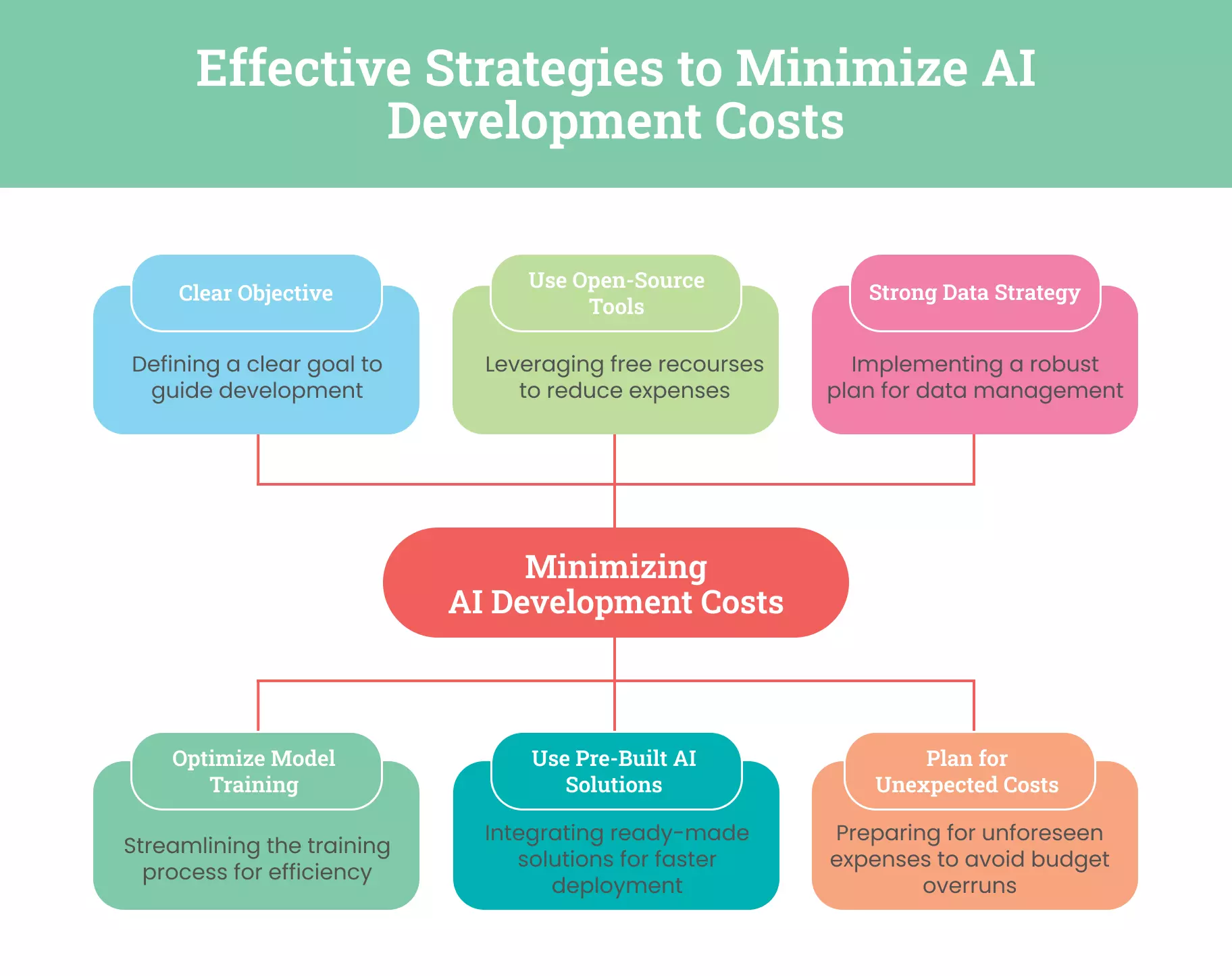
Start with a Clear Objective
One of the key reasons for overestimating development costs is the vagueness or the constantly shifting objective for building an AI solution. Therefore, the best place to start saving your extra money on development is by following the effective ways:
- Define a clear objective you want to resolve with AI.
- Start with an MVP (Minimum Viable Product) first, as it helps you validate ideas, test model performance, and gather real-time feedback.
- Focus on a roadmap that helps you minimize the manual tasks while also lowering your overall AI development budget.
Optimize Model Training & Evaluation
We all know that training an AI model, such as a deep learning model, is comparatively more expensive than training others. So, the best way for businesses to minimize training costs is to optimize their processes.
Techniques like transfer learning, where a pre-trained model is fine-tuned for a specific task, can reduce the need for extensive training from scratch. This results in minimizing resource requirements without compromising the quality of training.
Use Open-Source Tools & Frameworks
Despite investing in advanced AI technologies, start utilizing several open-source AI libraries and frameworks that offer robust capabilities without incurring any licensing fees.
The following are some of the popular and powerful tools you can go with your minimal investments:
- TensorFlow & PyTorch for deep learning
- Scikit-learn for machine learning
- LangChain & Haystack for Gen AI
- Hugging Face for pretrained model access
Leverage a Pre-Built AI Solution
Despite building a custom AI solution, businesses can opt for the pre-built AI solutions, which are comparatively less costly, as well as best suited for startups or small & medium-sized businesses. This will take less time to market and offer businesses a competitive advantage.
Effective Data Strategy & Quality
We all know that data is the lifeblood of overall AI development. Therefore, businesses should invest time upfront in developing a robust data strategy that includes quality data collection, storage, and cleansing practices. This results in data prepared with robust strategies that require less retraining with AI models, ultimately saving costs and resources.
Plan to Escape from Unexpected Costs
We never know what hurdles will clash with our business in the future, right? Whether it’s technical issues or AI systems, we need to keep separate funds to handle sudden changes.
For instance, if any business encounters an unexpected data privacy issue that must be resolved on time, then you can use your contingency fund to escape from the sudden rise in costs.
How Elluminati Helps You Build Your Cost-Effective AI Solution
In this world, where smart solutions are powered by and built on artificial intelligence, businesses are willing to be part of it. It comes with concerns about how much AI development costs. So, building an AI solution shouldn’t require overspending. It required an accurate and pre-planned investment strategy. And that is where Elluminati comes into play.
As a trusted AI development company, we help businesses create high-performance AI systems while keeping their investments optimized by offering a range of pricing models. Whether you opt for a full-cycle app development or want to integrate any AI solutions into your existing system, you only pay for the resources and services your business requires.
With 14+ years of experience, we empower businesses to adopt AI with full financial clarity. Our end-to-end transparency in planning, milestones, and cost breakdowns to avoid hidden expenses. This commitment to clarity and efficiency helps you move forward in this competitive market with confidence.
FAQs
The AI development costs typically range from $10,000 to $500,000. However, there are several factors that vary total costing, including the level of complexity, project scope, locations, data availability, needs for integrations, and other customization requirements. To obtain a personalized quotation, we would like to recommend you connect with our sales executives at sales@elluminatiinc.com.
Well, many factors influence the cost of AI development, but the primary ones include;
- Data Requirements
- Project Scope & Complexity
- Experienced Required to Build AI Solutions
- Advanced Technologies
- System Integration & Maintenance
The AI system requires continuous monitoring, retraining, and proper infrastructure management. Therefore, below are some of the factors that affect its after-deployment costs:
- Model monitoring for performance drops or data drift.
- Retraining based on new data or changing use cases.
- Cloud interference costs.
- Bug fixes & other maintenance required.
Mostly, startups or small businesses opt for pre-built AI tools or APIs, as they are a more affordable & faster option than building an app from scratch. On the other hand, businesses opt for custom AI development, as it grants them greater control over the system, leading to long-term success & business growth.
The following are some of the smartest ways to help you cut down the cost of developing an AI.
- Leverage on pre-trained models & frameworks
- Start by launching a small project or MVP
- Utilize the open-source tools
- Optimize your data strategy
- Collaborate with a reliable tech partner
- Measure ROI continuously